
Micro Bernedoodle: Full Grown Size, Cost, Shedding, Temperament & Care

Micro is not a formal-sized breed, it’s a very small Bernedoodle-type. It can vary further than many listings indicate, as breeders can use it differently, and even their expectations for an adult’s size, coat and even their expectations may differ.
The questions that are most important in the real world are addressed here: growth size, temperament, grooming, shedding, cost, apartment size and suitability of this dog for the home.
Quick Answer: What Is A Micro Bernedoodle?
They tend to be very small Bernedoodles, typically in the small dog size range (10-25 lbs) and 12-17 inches tall. The word micro is a term used by breeders not a breed type and size determination should be regarded as a guide to the probable size of a lot based on the parent size, generation, line history, and normal variation.
Not a breed size standard. It is still a dog that has Bernese Mountain Dog and Poodle in its blood, but the breed’s purpose is to create a smaller dog that is more convenient to carry, to fit a smaller house, and is more portable than a larger Bernedoodle.
A softer touch and friendliness is frequently added by the Bernese side. The Poodle side may provide the skills and attributes that make the dog easy to train, agile, and have the desired coat properties for many owners. One puppy in one litter may have more of those influences than another and that’s why one litter can look and feel different.
Characteristics At A Glance
This table provides a quick and handy reference of what most homes can look forward to.
| Trait | Practical expectation |
|---|---|
| Adult weight | Often around 10 to 25 pounds |
| Adult height | Often around 12 to 17 inches |
| Build | Small, compact, often lighter-framed than larger Bernedoodles |
| Coat | Straight, wavy, or curly |
| Shedding | Usually low to moderate, depending on coat |
| Grooming frequency | Several brush sessions each week, plus regular professional care |
| Grooming difficulty | Moderate to high |
| Barking tendency | Usually low to moderate, but can increase with boredom or alertness |
| Energy level | Moderate |
| Trainability | Often strong with calm, reward-based training |
| First-time owner fit | Often good for involved first-time owners who accept grooming work |
| Good with kids | Often, yes, with supervision and manners |
| Good with other pets | Often, yes, with proper introductions |
| Apartment fit | Often, good, routine exercise and quiet behavior are taught |
| Crate training difficulty | Usually manageable, but attachment can make it slower in some puppies |
| Alone time tolerance | Moderate at best |
| Family style | Best for homes that want a close companion |
| Maintenance level | Higher than the small size may suggest |
Quick Verdict: Is A Micro Bernedoodle a Good Fit Or A Poor Fit?
This chart should be presented as approximate, not exact.
| Good fit for | Poor fit for |
|---|---|
| Homes wanting a close companion | Homes wanting a very independent dog |
| Smaller space living with routine | Long daily alone time |
| Owners willing to brush, groom, and train | Low maintenance expectations |
| Families wanting a social indoor dog | Homes wanting guaranteed adult size |
| People are comfortable with the ongoing grooming cost | Homes wanting guaranteed non-shedding |
Why The Name Causes Confusion
Micro sounds exact, but it is not. One may use the term for a 15 lb. adult dog. Another might use the same word for a 24 lb. dog. There are some programs that are labeled based on the parents. Some rely upon the desired outcome. Some use the term just because it’s popular.
The best way to read the label is to understand it as a ‘direction of size’ and not a promise. The word micro means much more than it does alone, particularly when combined with parent-size, older related dogs, line consistency, and breeder honesty.
Bernedoodle Tiny, Micro, Petite, And Teacup Mini Bernedoodle

In the case of online labels, these often overlap, and many buyers fall into the trap of the overlap. The terms may seem to be distinct, but in practice, they are not.
| Label | What sellers usually mean | What readers should verify |
|---|---|---|
| Toy or Petite Bernedoodle | Very small Bernedoodle type | Actual parent size and adult relatives |
| Micro | Small dog range, smaller than mini | Whether the estimate is realistic or just marketing |
| Tiny Bernedoodle | Often used like micro or petite | How much overlap exists with other labels |
| Teacup | Extremely small marketing language | Whether health and structure are being discussed at all |
The right response is not panic. It is a careful verification. Buyers should ask what the dog is expected to weigh, how that estimate was reached, and how previous puppies from the line matured.
Bernedoodle Sizes Comparison

A broader size chart helps place micro in context.
| Size label | Usual weight range | Usual height range | Important note |
|---|---|---|---|
| Toy or Petite | Often under 15 pounds | Usually under about 14 inches | Terms vary widely |
| Micro | Often around 10 to 25 pounds | Often around 12 to 17 inches | Overlaps with petite and mini |
| Mini | Often around 25 to 49 pounds | Often around 18 to 22 inches | More room for sturdiness and size stability |
| Medium | Often around 50 to 69 pounds | Usually over 20 inches | Less common label consistency |
| Standard | Often 70 pounds and up | Tall, larger build | Strong Bernese size influence remains |
The ranges are overlapping because there is no uniformity in the labels of the breeders. If you are comparing different lines of Bernedoodles other than size labels, then you might need to know about another known Bernedoodle type, its coat, size and family fit. Australian Bernedoodle can fill in the blanks. That’s why some dogs will have similar names but different pages.
How Are Micro Bernedoodles Bred?

Breeding path is relevant because of more than just size. It has also been seen to affect the texture of the coat, the shedding of the coat and the predictability of the litter.
There are some that are made with a smaller Poodle line. Others are from a reduced stock of Bernedoodles. Others have been constructed over several generations with the selection of smaller adults. The upshot is that the same label could be applied to dogs with different backgrounds and slightly different results.
Micro F1B Bernedoodle
The F1b micro mini Bernedoodle breed is essentially an F1 Bernedoodle dog bred back to a Poodle, making the dog about 75 percent Poodle and 25 percent Bernese Mountain Dog. In actual flesh, this usually results in a more wavy or curly coat, less hair to see, and the requirement to groom more often than with an F1. It also can make size a little easier to estimate when compared to a first-generation cross, but it’s not exact.
Micro F1BB Bernedoodle
The best understanding of a micro F1BB Bernedoodle is that it is an F1B Bernedoodle that has been bred back to a Poodle again, resulting in coat characteristics that are even closer to those of the Poodle. In other words, that generally translates to the biggest potential for a tighter curly coat and the smallest amount of visible shedding from the common generations of Bernedoodles. It can also have the greatest coat maintenance requirements.
Why Generation Matters
Generation can affect:
- coat texture
- grooming demand
- shedding tendency
- size predictability
- allergy expectations
- The intensity of the parents’ side in the puppy
The age of the victim is not the only factor. The size of the parents, their line history, sex and plain variation remain important.
How Big Is A Micro Bernedoodle?

This is typically in the realm of a small dog, but the term is more of a direction than a commitment. Most adults will be expected to be between 10-25 lbs. and 12-17 in. tall, although sizes may vary from parent size, generation, and line consistency.
Method note: Parent size, line consistency and normal variation were used in this guide to estimate size. There is no standard on the breeders’ labels.
Typical Full Grown Size
If you’re seeking complete growth size for these dogs, you’re most likely looking for the dimensions you should expect as an adult. For the majority of them, that entails a dog that will remain clearly under a mini Bernedoodle, with adequate range for every dog that no breeder should guarantee a dog will be a specific final weight. Reliable estimates typically are made by combining two or more clues:
- Geographical size of parents
- yield of older siblings or of previous litters
- the generation
- the smoothness of the line’s curve.
Height And Weight Expectations
The dog’s height and weight do not necessarily correspond. The Bernedoodle may appear bigger in photos because he or she is thick, furnished, and compact, as compared to a leaner dog that can be quite heavier. That’s why, as a rule, shoulder height, scale weight, and body shape should be interpreted in combination and not individually.
Micro Bernedoodle Size Chart
This chart is a planning aid and should not be relied upon as a guarantee. It provides the range that most buyers should look for, then review it against parent size, related adults and breeder honesty.
| Size point | Approximate range |
|---|---|
| Height at the shoulder | 12 to 17 inches |
| Common adult weight | 10 to 25 pounds |
| Broader published adult range | 15 to 30 pounds |
| Full maturity | Around 12 to 18 months |
Most end up being smaller than mini Bernedoodles in reality, but there is some overlap due to inconsistent breeder labels.
Micro Bernedoodle Weight Chart
This growth chart is a typical growth curve, not a standard course all puppies will necessarily follow. Some puppies will gain quickly in early life but will reach a plateau earlier than others and then fill out later.
| Age | Approximate weight range | What owners usually notice |
|---|---|---|
| 8 weeks | 3 to 8 pounds | Small frame, soft puppy coat, adult size still hard to judge |
| 4 months | 10 to 15 pounds | Faster growth, longer legs, and a more obvious body shape |
| 6 months | 12 to 20 pounds | Many are nearing much of their adult height |
| 9 months | 14 to 24 pounds | Growth slows, and the body starts filling out |
| 12 months | 15 to 28 pounds | Many are close to adult size |
| 12 to 18 months | 15 to 30 pounds | Final adult size range, with some continued body development |
In general, the adult size of a dog is expected to be between 10 and 25 lbs; some dogs will be a little smaller or larger.
What Affects Final Size
The final size depends on many factors and not just the word micro. The most helpful hints are the size of the parents, the nature of the Poodle influence in the line, generation, sex and consistency of previous litters.
- parent weights
- The influence of toy vs miniature Poodle.
- generation
- line history
- sex
- Siblings, or other older siblings from the same litter.
- nutrition and body condition
- normal variation
Trend labels are good for people who aren’t looking for the most realistic estimate; for those who are, however, it is best to use actual family data.
Micro Bernedoodle Growth Stages
Typical growth occurs in stages. The majority of them grow quickly in the first 6 months, slow down from 6 to 9 months, and continue to fill in until 12 to 18 months. A dog can look almost grown at 1 year of age and then look more grown a few months later, as height tends to stabilize before the rest of the body.
| Age | What usually happens |
|---|---|
| 8 weeks | Very small frame, soft puppy coat, adult size still hard to judge |
| 3 to 4 months | Fastest growth period, longer legs, more puppy energy |
| 5 to 6 months | Height may be approaching much of the later range in some dogs |
| 7 to 9 months | Growth starts to slow, and body shape becomes clearer |
| 10 to 12 months | Many are close to adult height |
| 12 to 18 months | Final fill out, coat texture, and body condition settle |
A practical way to explain this in an article is simple: height often settles before the dog fully fills out. That is why a Bernedoodle may look nearly grown at one year and still appear more mature a few months later.
Micro Bernedoodle Temperament And Personality

Temperament is influenced by genetics, handling, daily routine and training. When bred with the right dog, a Bernedoodle may make a loving, fun and manageable pet. An unruly one may be vocal, clingy or unsettled.
Mini Bernedoodle Personality Traits
Many Bernedoodles tend to be:
- affectionate
- people focused
- social
- eager to learn
- sensitive to tone
- routine responsive
- Able to be clingy with no structure
Not all dogs are alike. When it comes to patterns, it means that these are the ones that owners usually have to plan around.
Micro Bernedoodle For Families And Household Fit
This breed of dog is suitable for many households, particularly those that desire a companion that is involved.
Micro Bernedoodle With Kids
It can accommodate family life well provided children are gentle and supervised. Being tiny doesn’t necessarily mean they’re safe to handle, and still, family etiquette counts on both sides.
For First-Time Owners
This may be a great first dog for a groomer who is ready to learn about routine and calm reward training. Concerning friendliness, the problems are typically related to the harder parts of coat care and attachment.
For Older Adults
A smaller size might be nice, but a better fit may be a better alternative if grooming, exercising and regular appointments are not feasible.
In Busy Households
Some puppies may be more excitable, clingy or difficult to calm down if they feel that their home is loud or inconsistent. Routine is very important.
Cats And Other Dogs
If introduced slowly and given positive reinforcement for a non-agitated nature, many dogs get along well with cats. A slow approach and a calm demeanor of the cat help.
They generally do very well with resident dogs, but it is important that introductions are not rushed and are neutral. Manners don’t go with a small size. Any dog that barks, jumps or bothers the other pets still requires training no matter how small.
Micro Bernedoodle Behavior Issues
Most of the issues are typically behavior management issues and not a lack of love.
These may include:
- Barks for no apparent reason or out of curiosity.
- over arousal
- difficulty settling
- separation sensitivity
- Velcro dog behavior, excitable greetings
- Grooming resistance if handling is not introduced early
Most of these issues improve when the dog has clear routines, calm training, and enough mental activity.
Are Micro Bernedoodles Good For Small Apartments And Small Homes?

Fit is more about routine than square footage in the apartment. It can be good in a smaller home if it’s exercised, let it know to be quiet, and provide a realistic potty plan during puppyhood. A small body is a good thing when it comes to management. It does not obviate the need for structure.
Apartment Fit
These are the common traits that lead to successful apartments:
- barking management
- Polite behaviour in the elevator and hallways
- regular bathroom opportunities
- indoor enrichment
- calm greetings
- scheduled rest periods
If a dog understands how to settle, he’ll be much better suited for apartment living than a dog that has a small body.
Small Home Reality Check
Small homes increase the visibility of behaviour. When you’re all in close proximity, it’s more difficult not to hear when everyone is barking, pacing, jumping and watching the owner. Starting these from an early age is important because they are important to the place.
How Long Can A Micro Bernedoodle Stay Alone?
There is no correct universal number. A shorter time alone is required for young puppies. Dogs also must have an adjustment period before they are given extended periods of alone time after they are rehomed. If done gradually, a moderate regular schedule is suitable for many adults, but if the schedule is excessive, long periods of isolation may not be a good fit for a companion dog.
It is important to provide progressive alone time training. The idea is to teach calm separation in small steps so that the dog doesn’t become panicked or rely on constant contact.
Coat Types, Colors, Shedding, And Hypoallergenic Expectations

The coat type determines the appearance and shedding, as well as grooming requirements and maintenance. Not all puppy photos give clear indications of puppy maintenance.
Coat Types
It’s more about the differences in the level of service provided than about the name of the coat.
| Coat type | What it looks like | Shedding tendency | Matting risk | Grooming load |
|---|---|---|---|---|
| Straight | Softer, looser, less doodle styled | Often, the highest of the three | Moderate | Moderate |
| Wavy | Classic doodle look | Often low to moderate | Moderate to high | Moderate to high |
| Curly | Tighter ringlets or dense curls | Often, the lowest visible shedding | High if not brushed well | High |
Crucially, a coat that doesn’t shed as much is more likely to hold more free hair within the coat. This can result in reduced visibility of the hair on the floor and increased brushing for the owner.
Common Colors And Markings
It may be found in a number of colour patterns, such as tri colour, black and white, and in some lines merle. It’s great to have colour but it must not be at the top of the list of priorities. Colour should never be a factor in health, structure or temperament.
Rare colour marketing should be at least 25 years behind health, structure and temperament in terms of buyer
Do Micro Bernedoodles Shed?
Some do shed, some do not shed. Some homes are not seeing much hair on the floor as the loose hair is retained within the coat. This is not to say that the dog is not actually non-shedding. It can also mean that the coat will have to be brushed more thoroughly to prevent matting before it gets dirty.
Are Micro Bernedoodles Hypoallergenic?
There are no 100% hypoallergenic dogs. Depending on the home, some may be easier to handle for some allergy-sensitive homes, particularly if the coat is curly and low shedding. However, even with that, it is not a guarantee to ensure comfort for everyone. One of the best things an allergy prone house can do is to avoid direct exposure prior to the committed point.
Micro Bernedoodle Grooming And Haircut Needs
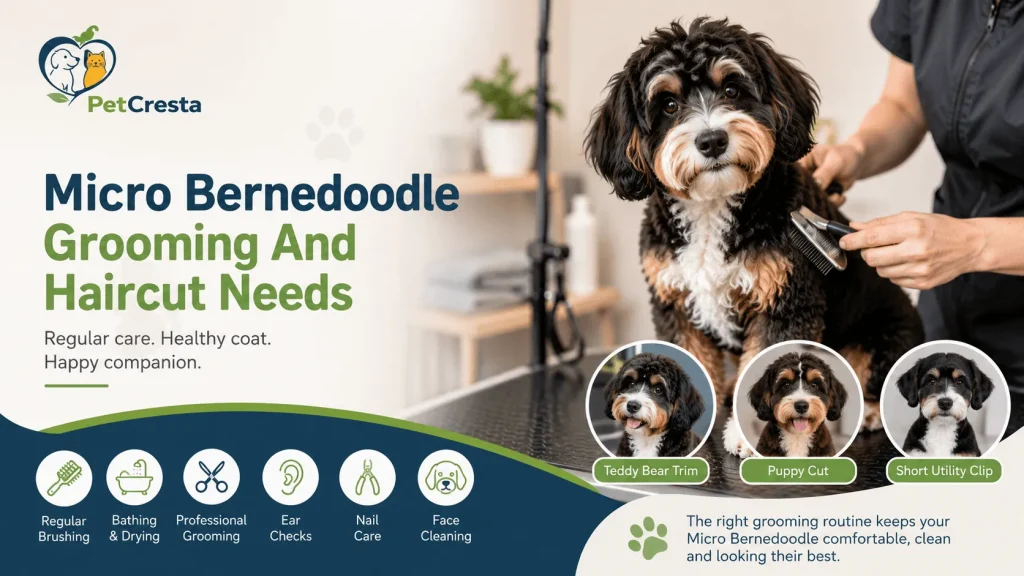
May require frequent at-home brushing and frequent professional grooming. This will vary with coat texture, coat length and the effectiveness of the home routine.
Home Grooming Routine
A practical home routine often includes:
- Line brushing, some areas are brushed in layers.
- Use combs to work out hair and skin, not brushes.
- ear checks
- nail care
- face cleaning
- Bathing or hygiene when necessary and drying off properly
Surface brushing is usually not enough. Mats tend to develop behind the ears, under the collar, in the armpits and around areas of friction.
Professional Grooming Schedule
A good ‘grooming’ pace is something like:
| Coat length and type | Common professional schedule |
|---|---|
| Shorter clip, lower maintenance style | About every 6 to 8 weeks |
| Medium coat with wavy texture | About every 4 to 6 weeks |
| Longer, fuller, curlier style | Often every 4 to 5 weeks |
The longer and more curled the coat, the more support it requires. Homes with a lot of activity tend to fare best with shorter, utilitarian trims that decrease the chances of matting.
Micro Bernedoodle Haircut Styles
Common choices include:
- teddy bear trim
- puppy cut
- short utility clip
- The scrubbers for the face and sanitary sections.
The simplest style is a shorter, more practical clip that keeps the dog soft and clean, but doesn’t make brushing a chore for the busy household.
Micro Bernedoodle Exercise Needs, Sleep, Daily Routine, And Enrichment

Many Bernedoodles will be in the middle of the energy category. The dog will usually want to be active and involved, but not have too much hard exercise. It’s more about frequency than intensity.
Daily Exercise Needs
A practical range by life stage often looks like this:
| Life stage | Common exercise needs |
|---|---|
| Puppy | Short play, short walks, training, rest breaks |
| Adult | Daily walks, play, sniffing, and mental work |
| Senior | Shorter, steadier movement with comfort in mind |
The dog typically requires both physical and mental work. Mental inactivity may make a bright companion dog noisy, clingy or restless.
Mental Stimulation
Enrichment can involve any of the following:
- food puzzles
- training games
- scent work
- toy rotation
- basic obedience sessions
- The laying and bedding down exercise
It is important for these dogs to have a job, even a simple one.
Bernedoodle Sleeping
Puppies require a lot of rest and may act fussy and boisterous when they are sleep-deprived. Adults should also get plenty of sleep. An overactive dog may not be an under-exercised dog. Sometimes the dog is disconcerted.
Daily Routine
| Time of day | Example rhythm |
|---|---|
| Morning | Potty break, short walk, breakfast, brief training |
| Late morning | Rest time, chew or enrichment toy |
| Midday | Potty break, short play, or sniffing session |
| Afternoon | Nap, light grooming check, calm indoor time |
| Evening | Dinner, walk, family time, short training, settle period |
| Night | Final potty break, quiet sleep routine |
Training And Socialization

Earlier training and a relaxed approach, make it easier. Do not use the size of the dog as an excuse not to use structure!
Are Micro Bernedoodles Easy to Train?
Bright and sociable, many are able to learn quickly. That’s usually accompanied by sensitivity. Dogs can become worried, stubborn or clingy as a result of harsh correction. The most common method of reward based training is the calm one.
Micro Bernedoodle Training Tips
The first year goals that are most useful include:
- house training
- crate comfort
- leash manners
- calm greetings
- impulse control
- handling for the veterinarian and groomer
- chewing management
- grooming tolerance
- alone time practice
These are useful life skills that are more important than advanced tricks.
Crate Training, Potty Training, And Alone Time Plan
The initial week plan should be straightforward and easy.
Crate Training
Feed close to the crate, leave the puppy to sleep close to the crate in short calm periods and do not use the crate just when the puppy is upset or excluded.
Night Routine
Have a consistent routine at night with one last potty opportunity, a quiet place to sleep and a quiet way to return from overnight bathroom breaks.
Potty Rhythm
Frequent opportunities are necessary especially after eating, drinking, playing and resting for young puppies.
Alone Time
Start with very short absences and return before the puppy becomes frantic. The goal is to build calm tolerance, not test the puppy too early. The same early routine matters for many small companion crosses, and this cavapoo puppy guide can help readers compare puppy training and first week care across similar small doodle mixes.
| First week focus | Practical goal |
|---|---|
| First week focus | Practical goal |
| Potty breaks | Frequent and predictable |
| Alone time | Brief, easy repetitions |
| Sleep | Quiet rhythm and low drama at night |
| Handling | Gentle touch, brushing, paws, ears, mouth |
Socialization Goals
Whether socialization is good or not, it is the difference between experiencing things calmly and overstimulation.
Useful targets include:
- friendly people
- household sounds
- travel
- different surfaces
- grooming tools
- being handled gently
- Tolerant approach to stable dogs
The objective is to feel confident and composed not constantly on the edge of excitement.
Feeding, Portion Control, And Weight Management

Feeding recommendations are most effective if based on body condition, food density, life stage, and activity. A cup quote that is not placed in context is usually not a true one.
Puppy Feeding Basics
Puppies typically require more feedings per day than adults. This will vary according to the food, body condition, rate of growth and activity of the puppy.
A good rule of thumb is to observe the dog, rather than the scoop. It’s not a number that has to be the same as some other dog’s, but lean body condition and steady growth.
Adult Feeding Basics
Many adults can get by on two meals a day. Run the budget issues as in small dogs can pick up weight quite fast. Weighs are taken regularly and a rapid body condition check is performed monthly to detect slow gain in time to prevent it from developing into a joint problem.
Sample Feeding Schedule and Portion Guide
This table is broad on purpose. It is not a substitute for the food label or veterinary advice.
| Age | Meals per day | Main note |
|---|---|---|
| 8 to 12 weeks | 3 to 4 meals | Frequent meals help support growth |
| 3 to 6 months | 3 meals | Watch body condition closely |
| 6 to 12 months | 2 to 3 meals | Transition depends on growth and the dog’s appetite |
| Adult | 2 meals | Adjust intake to weight, activity, and food density |
Remember, if your dog is active and taking a lower calorie food, he may require more volume. A less barky dog that eats dense food will require much less. The choice should be made based on the dog’s body condition.
Micro Bernedoodle Feeding Portion Reality Check
Many owners are looking for the exact cup amount, but this can be a trap. If one Bernedoodle is fed a calorie dense formula while the other is given a lighter formula, then they will require different amounts of food for the same amount of weight. All these are important: age, activity level, body condition, stool quality and appetite.
The better solution is to begin by examining the food label, then break down foods by life stage and then look at the dog in front of you. A puppy that is growing at a normal rate, maintaining a normal stool and continues to remain lean is typically eating more properly than a puppy that is copying another dog’s puppy feeding amount.
When Weight Becomes A Problem
Additional weight will increase the pressure on smaller joints and may affect the level of comfort over time. It can also exacerbate mobility, stamina and skin fold problems. Don’t simply start adding more exercise to an overweight dog. The entire feeding pattern should be looked at!
Micro Bernedoodle Lifespan And Health Concerns

There is no risk reduction for the mixed breed. By providing good care and good breeding, the chances are made better, but not eliminated.
Typical Lifespan
Don’t be surprised if some Bernedoodles (micro mini) reach the age of 10-15 years. Certainly, the genetic makeup, dental care, general body condition, preventive care, and general luck play huge roles in lifespan. Better to be cautious than overpromise.
Micro Bernedoodle Health Problems
Focus on the following areas:
- patellar issues
- joint comfort
- Crowded teeth and tooth decay.
- ear infections
- skin irritation
- eye concerns
- stomach sensitivity
- Excess weight and comfort over the long haul.
It can be challenging to see the dog’s condition from afar, especially when it’s a Bernedoodle small, as they require extensive care for their bodies and teeth.
Do Micro Bernedoodles Have Breathing Problems?
They are not a flat faced doodle type, and this is not their main concern when it comes to airway issues as is the case in flat faced breeds. But even healthy dogs may have trouble breathing for other reasons, which need prompt veterinary intervention.
What Health Questions to Ask a Breeder
A brief list of questions is helpful here.
- Which tests of the parents were performed to check their health?
- Did they talk about the bones?
- Does anyone in the line have an eye condition?
- Which of the above temperament patterns are the most common?
- What is the introduction to grooming and handling like for puppies?
- What is the method of size estimation and how well have the past estimates been done?
A responsible breeder should be able to explain in a straightforward, informative manner the line history.
Cost Of Owning A Bernedoodle

Daily care and ongoing maintenance often cost more than new owners expect.
Puppy Purchase Cost
Prices may fluctuate significantly depending on where the coat comes from, the generation, the reputation of the line, the coat’s demand, training extras, etc. and transport. It is also a good question to pose oneself what is included. Some may also be given with early vet services, or supplies and/or support. Others do not.
What The Purchase Price Should Include
The number is not the most important part, it’s the accompanying stuff. Breeder may offer early veterinary care, starter supplies, microchipping, early handling or post placement support. The other one might tout a lower cost point but pass the remaining costs on to the buyer.
That is why buyers should ask questions about what is included before looking into the various puppies. It’s not always the case that the lower starting number is the better value.
First Year Costs
A first-year budget often includes the following:
| First-year item | What to budget for |
|---|---|
| Veterinary setup | Exams, vaccines, preventives |
| Supplies | Crate, bed, leash, harness, bowls |
| Grooming tools | Brush, comb, shampoo, nail tools |
| Professional grooming | Recurring appointments |
| Training | Classes, guides, support |
| Food | Puppy food and treats |
| Insurance option | Monthly premium if chosen |
Ongoing Annual Costs
After the first year, many homes continue budgeting for:
| Recurring item | Typical need |
|---|---|
| Food | Monthly |
| Professional grooming | Every few weeks |
| Preventive care | Ongoing |
| Routine veterinary care | Annual or as needed |
| Dental care | Daily home care plus veterinary support |
| Pet sitting or boarding | Travel or busy periods |
| Replacements | Toys, bedding, gear |
Monthly Ownership Budget Snapshot
This type of snapshot helps readers think beyond the purchase price.
| Budget area | Practical monthly reserve |
|---|---|
| Food | Regular base expense |
| Grooming reserve | Ongoing and important |
| Preventive care reserve | Easy to overlook if not planned |
| Insurance or emergency reserve | Helpful for surprise costs |
| Training or care support | Useful during puppyhood or behavior work |
The monthly number varies by region and by home standards, but grooming and care support are common blind spots.
Micro Bernedoodle Pros, Cons, And Best Home Fit
It is well suited for homes that are willing to groom, train and interact with a small dog on a regular basis and have a desire for an affectionate companion. Though it is handy, it is not a low work dog.
The good news is that they are people-oriented, trainable, and easily ported and physically easier to work with than larger Bernedoodles. The other end of the scale, it may cost a lot to groom and without rules, they can bark or cling, and adult size remains a range rather than a guarantee.
Typical strong match:
- The residence is capable of dealing with daily brushing and grooming expenses.
- The schedule provides for daily interaction.
- The owner takes an estimate of size instead of a guarantee of a number
- The family is ready to teach calm behavior at a young age
- Coat care is more important than trendy labels or uncommon-colour marketing.
In this weaker match, it appears like this:
- The house owner would prefer a very independent dog.
- Long daily alone time is unavoidable
- Grooming is seen as a chore
- The buyer is looking for no shedding.
- This is primarily based on size words or puppy photos.
Micro Bernedoodle Vs Other Small Doodle Options

The comparison is also pretty common since many people have to choose between two different types of dogs as opposed to two sets of dog labels. Readers still comparing small doodle breeds may also want to review the miniature sheepadoodle, especially if they are weighing coat care, adult size, and family temperament side by side.
Micro Bernedoodle vs Mini Bernedoodle
| Trait | Micro | Mini |
|---|---|---|
| Size | Smaller overall | Larger and often sturdier |
| Portability | Easier to carry and travel with | Less portable |
| Grooming | Still high | Still high |
| Predictability | Can be less consistent | Often, it’s a bit easier to estimate |
| Household feel | Small companion style | Slightly more robust family dog feel |
A mini Bernedoodle might be a better fit for households that desire more size and strength. A micro might be best for a home with a compact design.
Micro Bernedoodle Vs Cavapoo
Some people choose to get a Cavapoo because they are looking for a toy dog that has a gentler feel. A Bernedoodle might be more suited to households that are attracted to the Bernese heritage, a slightly more robust silhouette, and a different kind of lap dog personality. Grooming may be an important factor in both.
Another small Poodle mix worth comparing is the miniature cockapoo, especially for homes that want a compact companion but are still unsure about grooming and energy level.
Micro Bernedoodle vs Goldendoodle
The comparison will frequently end up being based on owner expectations. There are some houses that like the look and the gentle family dog image of the Bernese. Others like the Goldendoodle’s retriever influence. Care and house fit are more important than trend photos. Homes that prefer a larger retriever-influenced doodle may want to compare this small Bernedoodle type with a standard goldendoodle before making a final breed choice.
Micro vs Toy Bernedoodle
These labels are frequently overlapping. One breeder’s toy can be similar to another breeders micro. Hence, the importance of parent size, adult relatives and line consistency, more than the label itself.
How To Choose A Healthy Micro Bernedoodle Puppy

It protects the buyer better than any trend label can.
What to Look For
A healthier buying process typically involves:
- realistic size counseling
- grooming honesty
- clear temperament discussion
- health testing conversation
- early socialization details
- after placement support
- eagerness to talk about potential first-year difficulties
Red Flags
Be wary of sellers who use:
- The exact adult size is guaranteed.
- Labels without details on trends
- The hype surrounding health content is uncommon.
- the force to make a hasty decision
- Lack of discussions or non-discussions of grooming.
- There is no clear after-care support.
- Drawing on photos without line information.
Questions Worth Asking
These are questions that are both practical and revealing.
- What are the true lengths of the two parents?
- What was the outcome of past letters by this line?
- Which type of coats are most common?
- What is most problematic for previous owners in their first year?
- On average, how often do owners groom this line?
- What kind of support is provided after placement?
It might be better to have clear and clear answers than polished marketing.
What A Responsible Breeder Should Already Be Doing
A better breeder isn’t just about puppies that are small. Prior to pickup, they should be familiar with parent health testing, how size estimates are made, the introduction of puppies to handling, and what socialization has begun.
Gentle grooming exposure, calm handling of ears and paws, realistic size counseling, coat care discussion and honest answers from previous owners about what they found easy or difficult is beneficial. Preparation does not always assure success but it will most often ensure a better start for the puppy.
Conclusion
A Bernedoodle may be a good fit for the right family, but it’s the right family that is the most important factor. Trend words and photos aren’t the best way to assess this dog. It is by fit.
A Bernedoodle can be an extremely delightful small family dog if it has the ability to be groomed, trained, routine and close friends. Fixed size certainty, low maintenance care or long days of independence at home make the match less convincing.
FAQ’s
Many full-grown dogs weigh around 10 to 25 pounds and are about 12 to 17 inches tall. Some finish outside that range, which is why parent size and adult relatives are more useful than the label alone.
Most need brushing several times each week and regular professional grooming. The exact amount depends on coat type, coat length, and how tidy the home routine is.
They can be. The main reasons are grooming, coat upkeep, training, and companionship needs. Small size does not make them a low effort dog.
A Bernedoodle micro is generally expected to be smaller than a mini Bernedoodle. The labels still overlap, so exact adult size depends on the specific line, parents, and breeder practices.
They can be a better fit for some allergy-prone homes, especially if the coat is curlier and lower shedding, but no dog is fully hypoallergenic. The safest advice is to avoid guarantees and spend time around the individual dog before committing.
Prices vary widely by breeder, location, generation, and color pattern, but current mini and micro listings commonly fall in the mid-$3,000s to upper-$4,000s. It is also worth asking what is included, because some prices cover early veterinary care or starter support, and others do not
Bernedoodles are generally viewed as intelligent and trainable, largely because of their Poodle influence and the eager-to-please side many inherit from the Bernese Mountain Dog. In real life, that intelligence cuts both ways: they can learn routines quickly, but they can also pick up bad habits fast if training is inconsistent.
Most Bernedoodles are better described as moderate barkers than constant barkers. Many stay fairly quiet, but barking often rises with alertness, boredom, overattachment, hallway noise, or under-stimulating routines.
The energy level is usually moderate. Many do best with daily walks, play, and mental stimulation, but they are often not extreme endurance dogs; smaller Bernedoodles may feel a bit livelier than larger ones, especially in puppyhood.
A petite Bernedoodle full-grown is often described in the small-dog range, commonly around 18 to 30 pounds and about 14 to 17 inches tall. The labels petite, tiny, and micro can overlap, so parent size and line history are usually more useful than the label alone.
A merle mini Bernedoodle is a mini Bernedoodle with a marbled merle coat pattern, usually inherited through the Poodle side. The color can be striking, but the better focus is still health, temperament, and careful breeding, because merle genetics need to be handled responsibly.
References
- American Kennel Club, Bernese Mountain Dog Dog Breed Information
- American Kennel Club, Poodle (Miniature) Dog Breed Information
- American Animal Hospital Association, 2019 Canine Life Stage Guidelines
- Merck Veterinary Manual, Dental Disorders of Dogs
- Merck Veterinary Manual, Disorders of the Mouth in Dogs
- World Small Animal Veterinary Association, Global Nutrition Guidelines
- World Small Animal Veterinary Association, Dog Body Condition Score Chart
- Veterinary Partner, Coat Clipping: Other Options to Keep Your Dog Cool