Miniature Sheepadoodle Guide: F1 vs F1B, Size, Generations, Coat Types, Colors, and Price
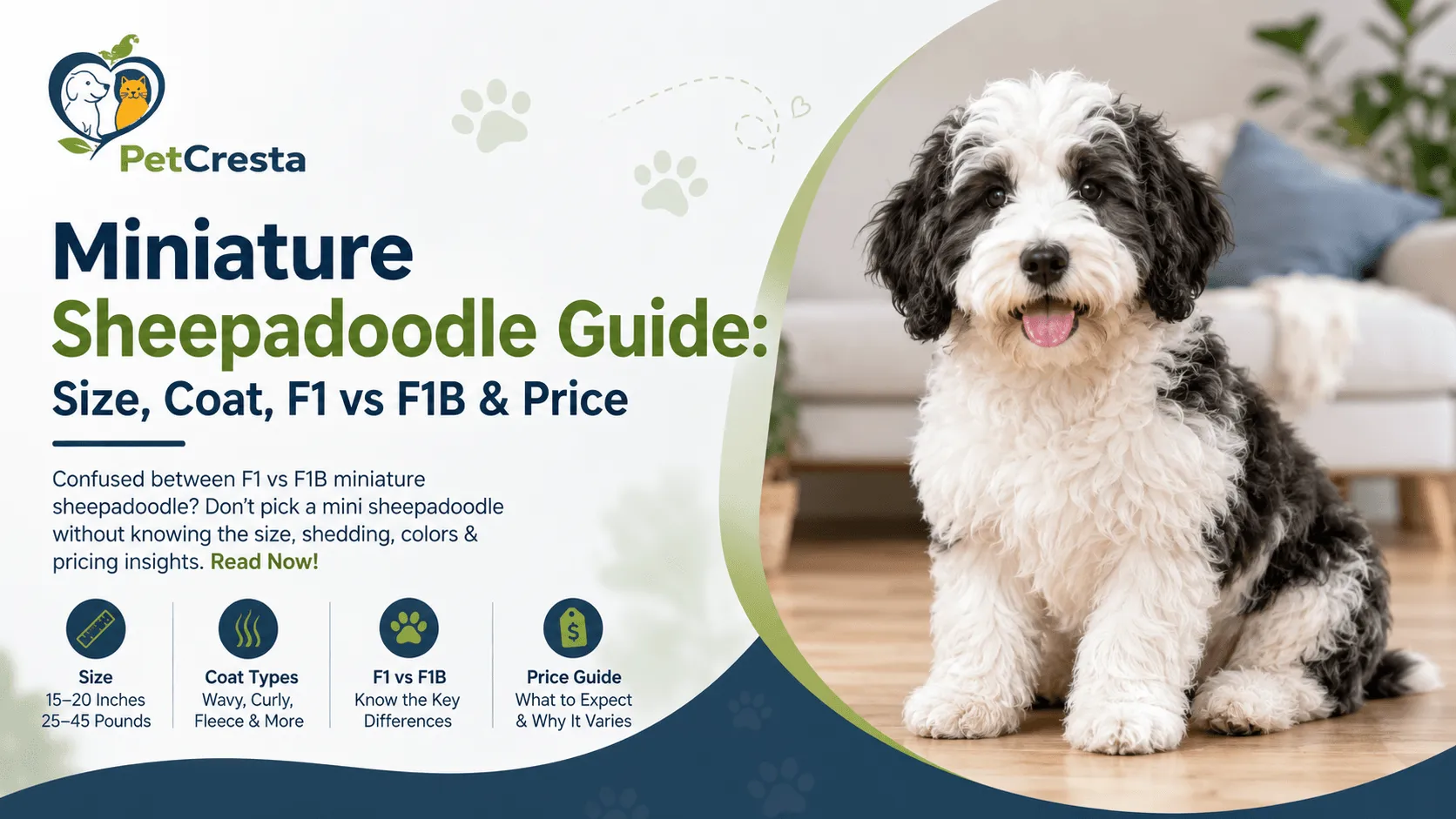
A miniature Sheepadoodle is a smaller version of a Sheepadoodle, bred by crossing an Old English Sheepdog with a Miniature Poodle. It is not a breed on its own, and does not have a single size or coat type. There may still be variations in adult size, weight, coat texture, and shedding within each line.
This guide addresses many questions readers have before they make their decision: how large does a Sheepadoodle mini grow, what does the difference between an F1 vs. F1B mean, what type of coats are typical, what does grooming entail, and what type of home is best suited for a Sheepadoodle mini.
TLDR
They are smaller versions of the Sheepadoodle breed, typically being a cross of an Old English Sheepdog and a Miniature Poodle. Most adults will grow to be around 15 to 20 inches in height and 25 to 45 pounds, but some will be smaller or larger. F1 dogs tend to have a lot more variation in coat and shedding, and F1B dogs are a bit more curly and low-shedding but require more grooming. This blend is suitable for active homes seeking a social, trainable companion and ready to provide daily care, grooming, and mental stimulation.
Quick Decision Guide
This dog may be a good fit for households that desire a trainable, smaller, social, soft-coated doodle with an active personality. Typically, the ideal family can provide brushing, professional grooming, daily exercise, and companionship.
This combination might not work for homes that prefer a low-grooming dog, a dog that’s guaranteed allergy safe, or a puppy that will thrive on long periods of daily isolation without training and support.
Best fit:
☑ Active families
☑ Committed first-time owners
☑ Homes ready for grooming
☑ People wanting a social companion
☑ Owners who can provide routine and training
Less ideal:
☑ Homes wanting very low maintenance
☑ Buyers choose mainly by color
☑ Long workday homes without support
☑ Anyone expecting a guaranteed tiny adult size
☑ Allergy-sensitive homes that cannot meet the dog first
Mini Sheepadoodle At A Glance
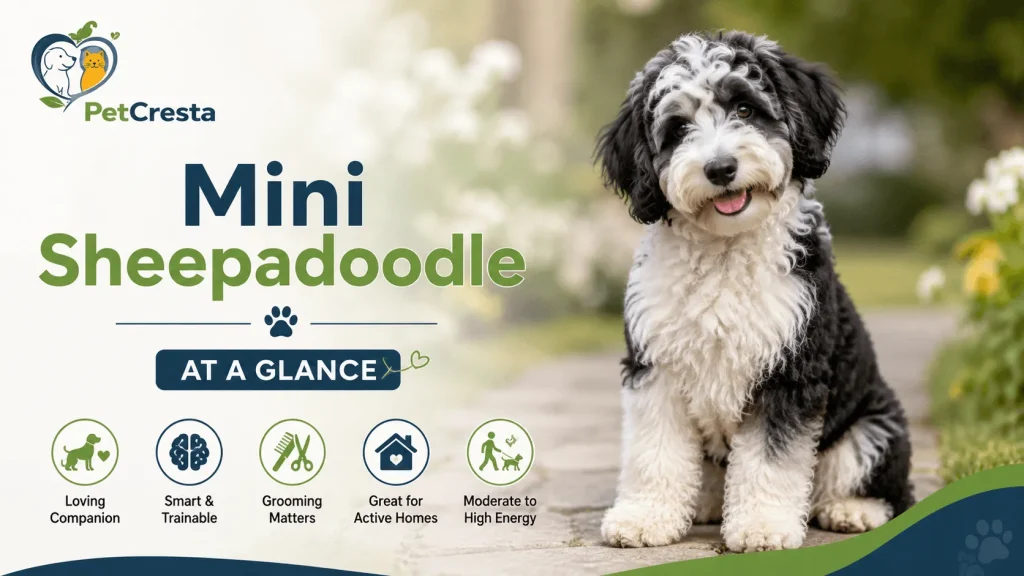
Mini or small Sheepadoodles are usually chosen by readers who want the Sheepadoodle look and personality in a smaller format than the standard version. Most adults stay in a small-to-medium range, not a toy range. The biggest tradeoff is usually coat work, not size.
| Trait | What to Expect |
|---|---|
| Parent breeds | Old English Sheepdog and Miniature Poodle |
| Breed type | Mixed-breed companion dog |
| Usual adult height | About 15 to 20 inches |
| Usual adult weight | About 25 to 45 pounds |
| Lifespan | Often 12 to 15 years |
| Energy level | Moderate to moderately high |
| Trainability | Usually strong with consistent training |
| Shedding tendency | Low to moderate, depending on coat |
| Grooming load | Moderate to high |
| Apartment fit | Often possible with exercise and structure |
| Child friendliness | Often good with supervision and early training |
| Common coat types | Wavy, curly, fleece-like, shaggy |
| Common color families | Black and white, black, brown, cream, red, merle, tri color |
| Best fit | Active homes that want a social, trainable companion and can manage coat care |
| Main watch-outs | Grooming workload, size variation, barking from boredom, and separation frustration |
What Is A Miniature Sheepadoodle?
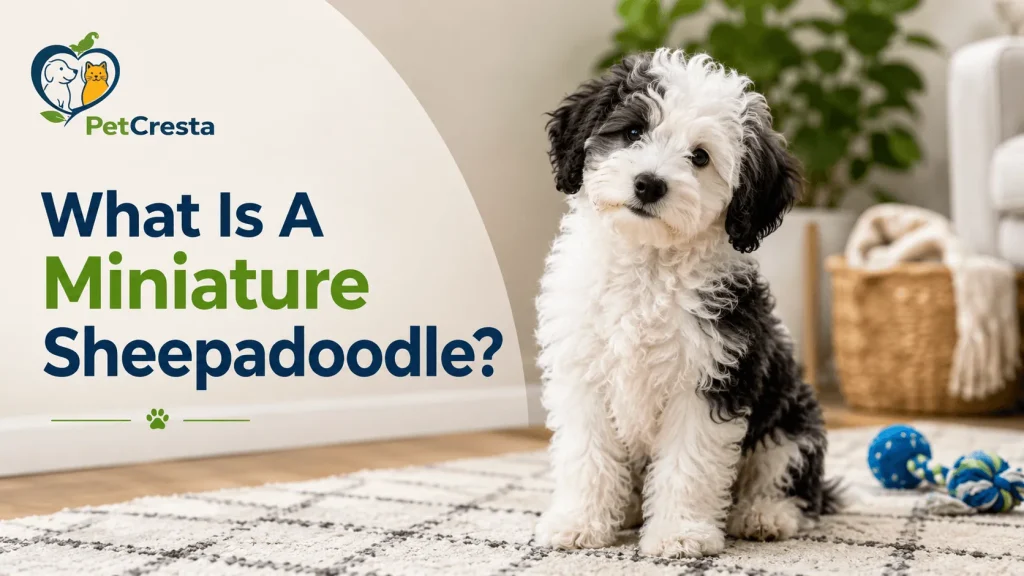
The small Sheepadoodle is not a breed, but one of the size variations of the Sheepadoodle. It is a smaller version of the Old English Sheepdog and Miniature Poodle, and is designed to maintain the social, playful, and “people dog” traits that many people want in this cross. The mini prefix may also be used to refer to the size that you are aiming for, but this is not a complete predictor of adult height, weight, coat, and shedding.
What mini does and does not mean
- The word mini definitely indicates that the dog is smaller than the traditional Sheepadoodle.
- Mini is not small and free of maintenance, or a sure bet to be under one number.
- Mini does not imply that all puppies in all lines will grow to be mini.
- The size of the parent plant and line consistency are largely determined by the label.
Naming Clarification
The smaller-sized dogs are referred to by readers as mini Sheepadoodle, mini micro Sheepadoodle, miniature Sheepadoodle, micro Sheepadoodle, and teacup mini Sheepadoodle: all of which are essentially the same, but are searched for separately. They do not.
- Mini, mini, and mini often indicate a similar search motive.
- Most of the time, the sizes for micro and teacup are marketing terms and not official sizes.
- One does not get one size fits all with just the label!
This is why size in itself isn’t the indicator you think it is, and why adult dogs from the same line and a realistic breeder’s perception say more.
Miniature Sheepadoodle Vs Sheepadoodle
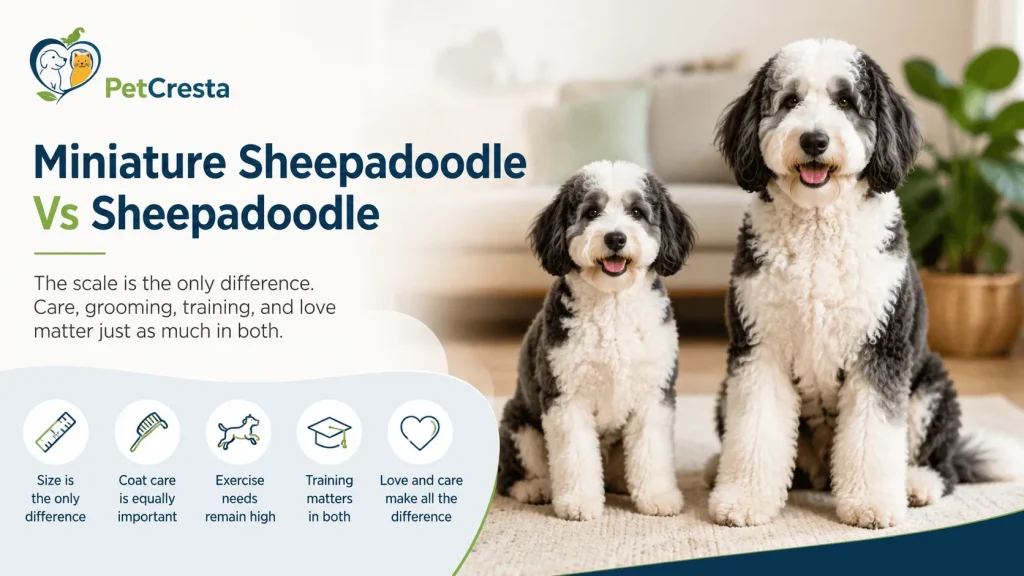
The scale is the only difference. A mini is more manageable in smaller homes, easier to carry around, and easier to lift compared to a standard Sheepadoodle.
It can’t be the same for the fact that it is smaller in size. Coat care, exercise, training, and grooming are still important in both.
| Point of Comparison | Mini or small Sheepadoodle | Standard Sheepadoodle |
|---|---|---|
| Size | Smaller and easier to handle | Larger and heavier |
| Handling | Easier for travel and routine care | More physical dog to manage |
| Home feel | Takes up less space | Feels more substantial indoors |
| Grooming | Still high maintenance in many coats | Still high maintenance |
| Daily management | Often easier physically | More strength and size to manage |
If you want another compact doodle comparison with a different parent mix and similar grooming tradeoffs, the miniature Bernedoodle is a useful side-by-side option.
Miniature Sheepadoodle Vs Old English Sheepdog
In most cases, a Sheepadoodle will have a larger range of coat and size than an Old English Sheepdog. Overall, the type of the Old English Sheepdog is easier to predict than the doodle cross due to the latter’s variety of coat colors and shedding.
The micro or small Sheepadoodle is also compact and will shed less. The shedding coat has one downside that is overlooked when comparing it to a heavier shedding coat, and that is that it requires more grooming.
Micro And Teacup Mini Sheepadoodle Explained
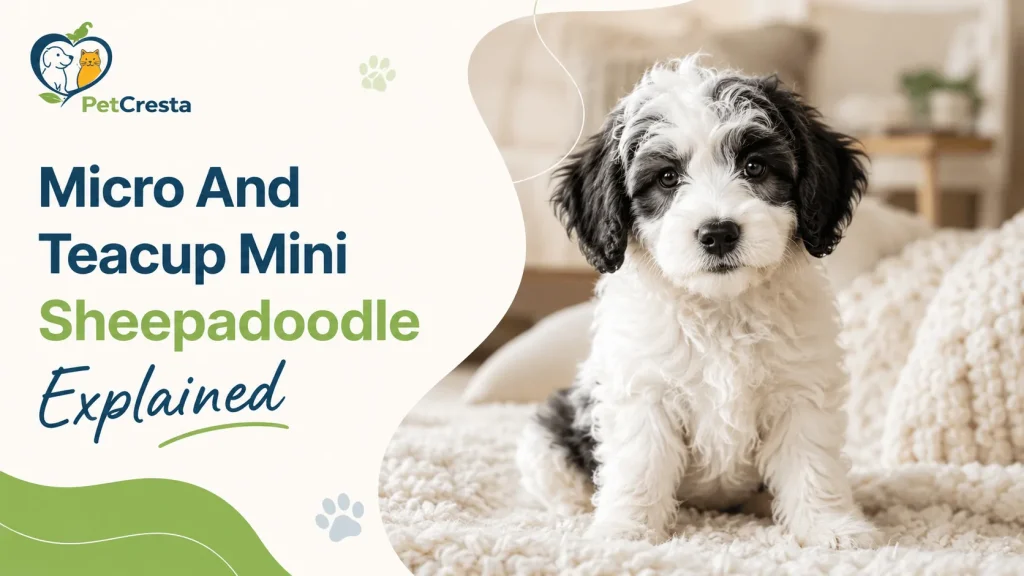
Usually, the marketing terms micro sheepadoodle, micro mini sheepadoodle, and teacup mini sheepadoodle refer to different sizes that are not standardized. They might offer a smaller-sized adult dog, but they can’t promise a set outcome.
The best way to determine a very small size claim is to request the parent sizes, photos, and weights of dogs in the same line and reasonable (adult) expectations from the breeder or rescue. This is not quite sufficient, just a label. Whereas your search is heading towards extra small doodle labels, you’ve got another option to help gauge the realism of those size claims: micro bernedoodle. This is especially important if size is the primary consideration in selecting a puppy.
Mini Or Small Sheepadoodle Generations Explained
The cross is explained in the generation labels. Useful for coat direction, shedding tendency, grooming needs, predictability, but not used to rank the quality.
An F1 mini Sheepadoodle is a breed that is a first-generation cross between the Old English Sheepdog and Miniature Poodle. This type may be more variable in coat texture and shedding, as it is between the two parent breeds.
Typically, an F1B mini Sheepadoodle will be a Sheepadoodle bred back to a Poodle. This can lead to a greater risk of a curlier, lower-shedding coat, but can also result in increased brushing, mat prevention, and regular grooming.
The F2 mini Sheepadoodle is a second-generation cross. This is related heavily to the consistency of the breeding line. For certain lines, the breed’s coat and size may be reasonably consistent. In others, the results may be less than anticipated.
| Generation | Common Coat Direction | Best Fit |
|---|---|---|
| F1 | Wavy, shaggy, or mixed | Homes open to more variation |
| F1B | Curlier and more Poodle leaning | Homes prioritizing lower shedding |
| F2 | Depends strongly on line quality | Homes chosen by the individual puppy fit |
The better question is not which generation sounds best. The better question is which dog fits the home’s grooming tolerance, activity level, allergy concerns, and daily routine.
For most readers, the practical question is not which generation is best. If generation labels are a major part of the decision, F1b Bernedoodle is another useful comparison for seeing how backcross coat goals can change grooming and shedding tradeoffs.
Mini Sheepadoodle Full Grown Size And Growth
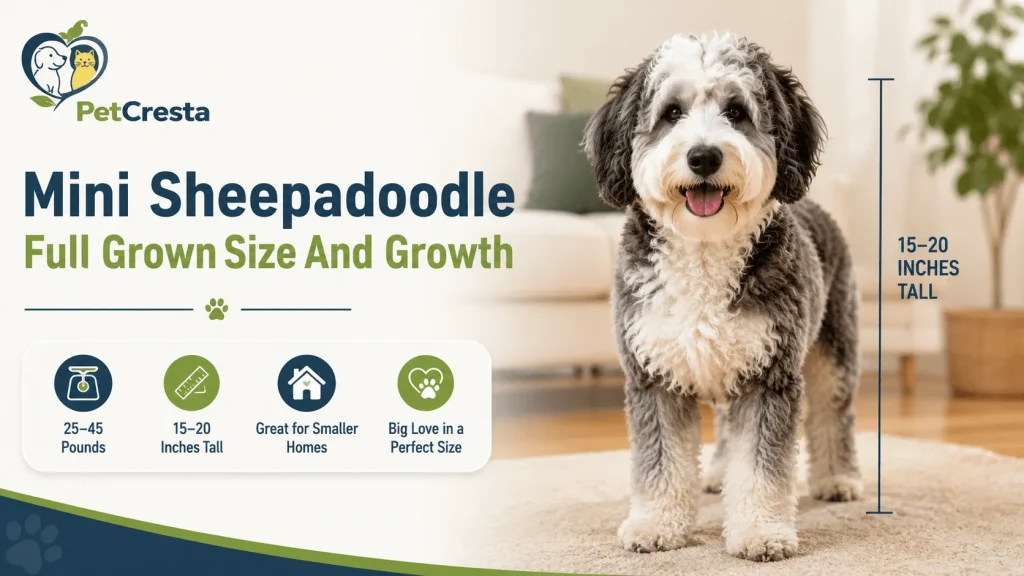
Typically, this dog will maintain a small to medium size, rather than a toy size. Most adults weigh between 25 and 45 pounds and are 15 to 20 inches tall, although some grow smaller or larger based on parent size, sex, and breeding line.
Mini is useful, but not the promise of 1 adult size. Estimates of size are likely to be better than a label alone from parent dogs, older siblings of the same line, body frame, and growth pattern.
This dog is generally easier to lift, travel with, and operate in smaller homes as compared to the standard Sheepadoodle. It is not a dog of low maintenance due to its smaller size. Grooming, exercise, training, and routine remain important.
| Size Clue | What It Tells You |
|---|---|
| Parent size | Best clue for adult height and weight |
| Older siblings | Helpful if they come from the same line |
| Puppy frame | Shows whether the dog is finer or sturdier built |
| Growth pattern | More useful than a single weigh-in |
| Generation label | Helpful for coat, weaker for exact size |
Most of these dogs reach much of their height during the first year. Some continue filling out through the chest, muscles, and body condition after that. A vet check is sensible if growth stalls, weight changes sharply, appetite drops, or the puppy looks out of proportion to its frame.
Mini Sheepadoodle Size and Weight Chart by Age
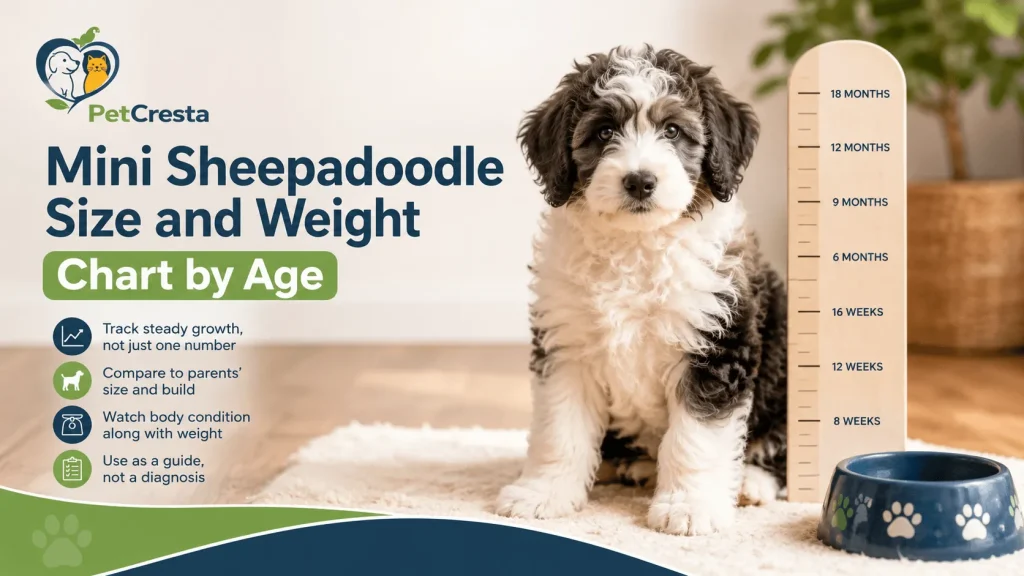
This chart works best as a growth guide, not a guarantee. One number on one date matters less than the overall growth pattern, body condition, and what the parents look like as adults.
| Age | Typical Weight Range | What It Usually Means |
|---|---|---|
| 8 weeks | 5 to 9 pounds | Early puppy size depends on litter, parent build, and growth rate |
| 12 weeks | 8 to 14 pounds | The frame starts to show more clearly |
| 16 weeks | 12 to 20 pounds | Growth remains steady in most pups |
| 6 months | 18 to 30 pounds | Many pups are gaining height quickly |
| 9 months | 22 to 38 pounds | Many are near adult height |
| 12 months | 24 to 42 pounds | Some are close to adult size, others are still filling out |
| 18 months | 25 to 45 pounds | Many have reached mature body condition |
How to use this chart
- Look for steady overall growth, not one exact number
- Compare the puppy to the parents’ size and body frame
- Watch body condition along with weight
- Use the chart as a guide, not as a diagnosis
Coat Types, Shedding, And Hypoallergenic Claims
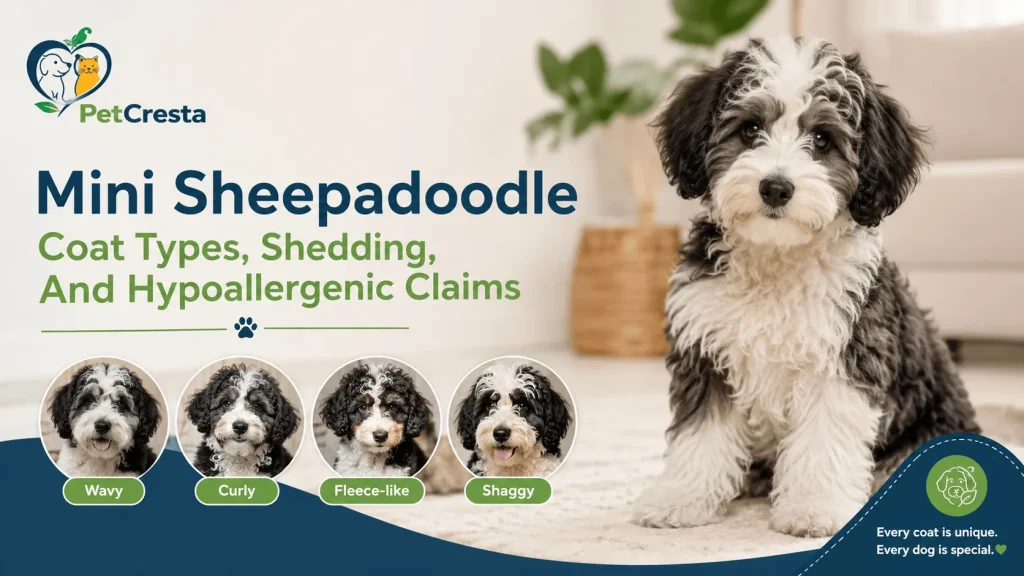
There are many different types of coats that influence the appearance, shedding, and maintenance of this dog. Coat patterns vary: wavy, curly, fleece-like, looser shaggy coats.
Coats are often cared for in the midway position, where they are wavy. Some curly coats will shed less, but require more brushing and grooming. The advantage of a looser coat is that it looks easier to keep up, but it can still mat if not brushed properly.
There is more variation in the F1 coat. F1B coats tend to be a bit more wavy and less shedding. The breeding line plays a greater part in the quality and regularity of the F2 coats.
These dogs shed. Many are less shedding than heavier shedding breeds, but it’s “no shedding”. While no dog is 100% hypoallergenic, there is still the possibility of an allergic reaction caused by dander, saliva, and skin particles.
Miniature Sheepadoodle Colors And Patterns
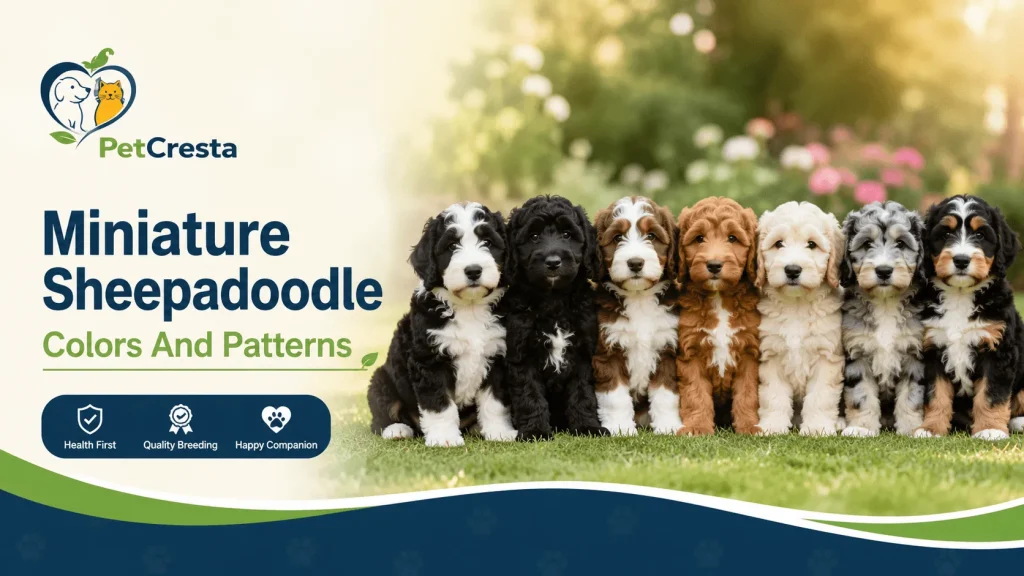
Color matters to many readers, but it should stay behind health, structure, and temperament in the decision process.
Common Color Families
Common color families include:
- black and white Sheepadoodle
- black Sheepadoodle
- brown Sheepadoodle
- red Sheepadoodle
- cream Sheepadoodle
- merle Sheepadoodle
- tri-color patterns
Some lines produce more traditional black and white looks, while others focus more on patterns or rare coat colors.
Which Colors Are Common and Which Are Rarer?
Black and white is still one of the most iconic ensembles. Dark solid coats are also popular. Combinations like Merle are sometimes more marketable than others.
A rarity is not a quality. Much can be gained from a quiet, nonaggressive dog, but not much from a showy one.
Do Black and White Sheepadoodles Turn Gray?
Pupfishes of the dark-coated varieties may become lighter as they get older. A dog that begins with a deep black color can fade over time to charcoal, gray, or a mixed color.
Hence, the photos of puppies don’t always reveal the adult’s coat color.
Can Color Affect Price?
Yes, in cases where a pattern gets a rare or particularly desirable marketing, color can have an effect on price. However, the color should not be a deciding factor in purchase, when health testing, good records, and honest expectations of size should take precedence.
Temperament and Daily Life Fit
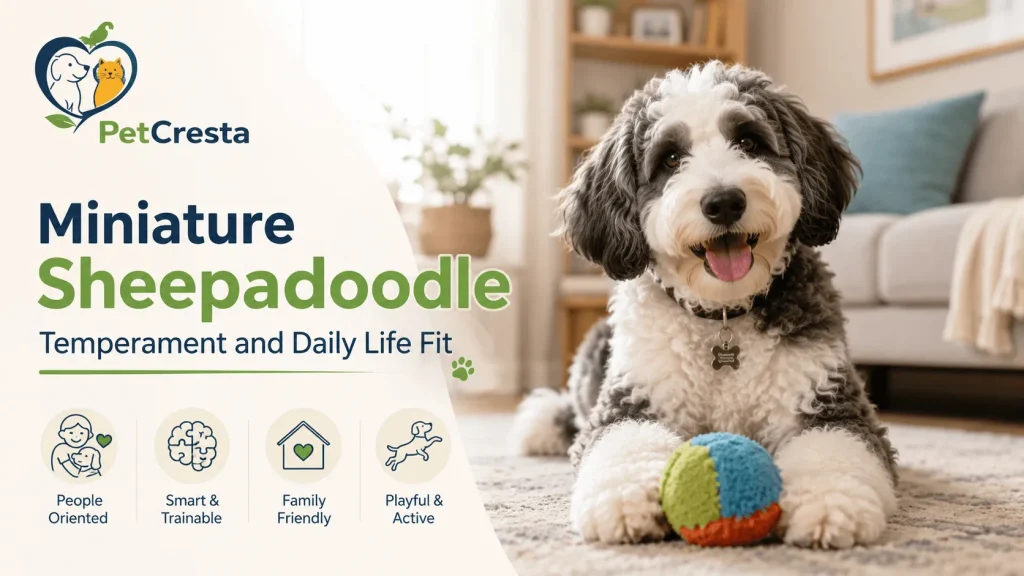
Many of them are bright, playful, social, and very people-oriented. They tend to thrive in an environment where they are interacted with, trained, and established in a daily routine. When household members want a pet that can be isolated for long periods of time or have a low engagement level, they are typically a weaker fit.
What Is The Temperament Of A Mini Sheepadoodle?
The Sheepadoodle is a sometimes cuddly, playful, sociable little dog. They are often quick learners and like to be part of the family and not just by themselves.
Others may exhibit Old English Sheepdog herding style behavior. This may manifest itself as nipping, circling, and attempts to direct movement during excited times.
Are Mini Sheepadoodles Easy To Train?
Many are bright and responsive, and easy to train. Routine, repetition, and clear reinforcement are still required for that strength.
Being smart without structure can become a bad habit in a dog. Begin training early and continue to be consistent.
Do Mini Sheepadoodles Bark A Lot?
Many will bark more on cue than if they were to bark continuously. The frequency of barking typically increases when boredom, poor behavior habits, lack of mental stimulation, and inadequate exercise become a way of life.
Are Mini Sheepadoodles Good With Children and Other Pets?
Many are very child and pet-friendly with proper introductions, boundaries, and supervision. They tend to be social and are well-suited to family homes.
There is still some puppy nipping and excitement that requires direction, particularly for younger children, as well as some mild herding behaviour.
Can Mini Sheepadoodles Live in Apartments?
Yes, many can live well in an apartment when exercise, grooming, potty, and noise control habits are managed correctly. It’s not the size of the square footage. It is a structure that is repeated every day.
Can Mini Sheepadoodles Be Left Alone?
Some small Sheepadoodles are social dogs and can become distressed if given too much space for too long an amount of time throughout the day. It is possible to achieve independence, but it should be developed step by step.
Are Mini Sheepadoodles Good for First-Time Owners?
They can be great for first-time owners who are dedicated. The challenge is typically not intelligence. It involves the overall package of grooming, routine, exercise, and social management. This may not be the best option for readers who are looking for an easy wash-and-wear dog.
How Much Exercise Does A Mini Sheepadoodle Need?
Most require daily walks, active play, and mental work. Short games, food puzzles, fetch, and recall can be as important as actual running time during training sessions.
Good fit: Active homes, structured family homes, owners who are ready for routine and grooming. Be careful of boredom barking, herding tendencies, separation issues, and failure to appreciate coat work.
Pros And Tradeoffs Of Owning A Sheepadoodle Mini
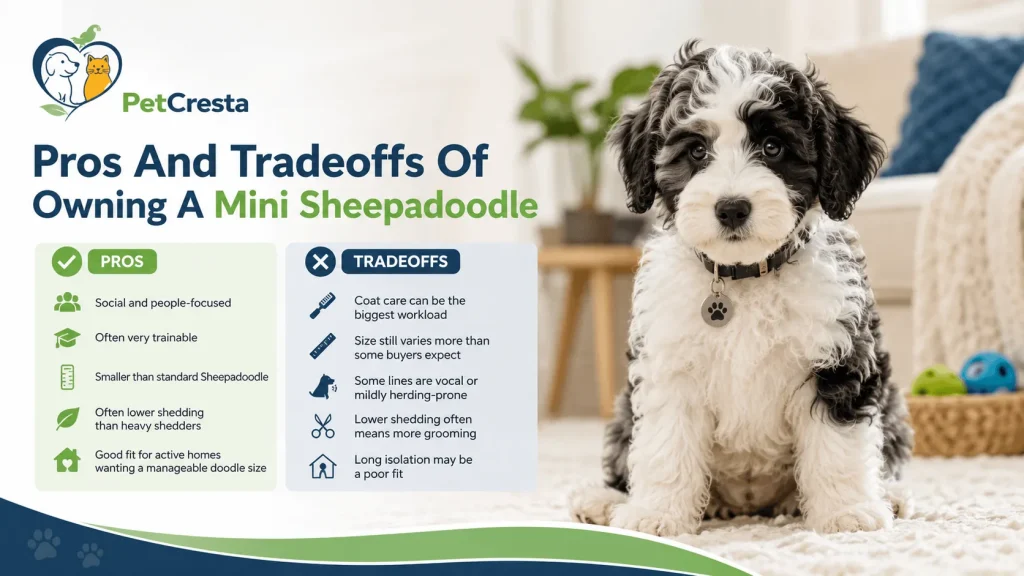
| Pros | Tradeoffs |
|---|---|
| Social and people-focused | Coat care can be the biggest workload |
| Often very trainable | Size still varies more than some buyers expect |
| Smaller than standard Sheepadoodle | Some lines are vocal or mildly herding-prone |
| Often lower shedding than heavy shedders | Lower shedding often means more grooming |
| Good fit for active homes wanting a manageable doodle size | Long isolation may be a poor fit |
A micro or small Sheepadoodle can be a strong everyday companion, but the best readers for this breed are usually the ones who take the trade-offs as seriously as the benefits. If you want a more familiar doodle comparison with a different parent mix but similar grooming and family-fit questions, the standard goldendoodle is worth reviewing, too.
Grooming And Maintenance
Grooming is one of the most important ownership questions for this breed.
How Often Should You Groom A Mini Sheepadoodle?
Most require multiple weekly brushings as well as professional grooming every 6 to 8 weeks. If you are thinking about loose wavy coats, you might be thinking about curlier coats as well. This is why a normal coat becomes troublesome when the owner neglects to brush it regularly.
Basic Home Care Routine
A solid home care routine usually includes:
- brushing several times each week
- checking behind the ears and under the collar
- trimming nails regularly
- cleaning ears as needed
- brushing teeth
- checking paws and friction zones for mats
- keeping the eye area neat if coat growth blocks vision
Common Grooming Mistakes
The most common mistake is waiting too long between brush outs. One is selecting a low-shedding coat without considering the increased care that can be required. The coat might seem floppy and easy-looking on the first day, but only with regular care will it remain so.
Feeding and Body Condition Basics
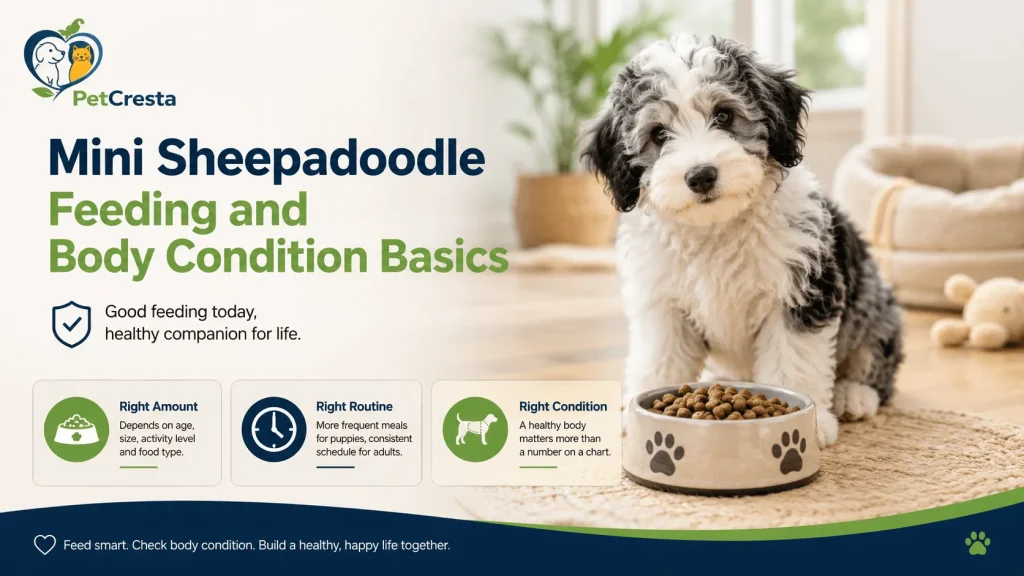
The section ought to remain practical. Using a feeding chart is not a substitute for proper body condition and routine.
How Much Should A Mini Sheepadoodle Eat?
The calorie density of the food, the body size, age, and activity level all affect the amount of food required. That’s why there’s no universal number that works for all dogs. It’s not about reaching one particular weight; it’s about maintaining a healthy body condition.
Mini Sheepadoodle Puppy Feeding Routine vs Adult Routine
Treats should be used sparingly for dogs under a year old. Dogs younger than 1 year of age should only have a few treats. It is best to feed puppies more often. They are doing well for adults to have fewer meals and a more regular schedule.
Healthy Body Condition Matters More Than a Single Chart Number
The health of the body is more important than just one chart number. A dog should have a nice, flat ribcage and a noticeable waist. There’s a difference between lean and thin, and a fluffy coat may make body condition more difficult to assess at a distance.
Mini Sheepadoodle Lifespan and Health Overview
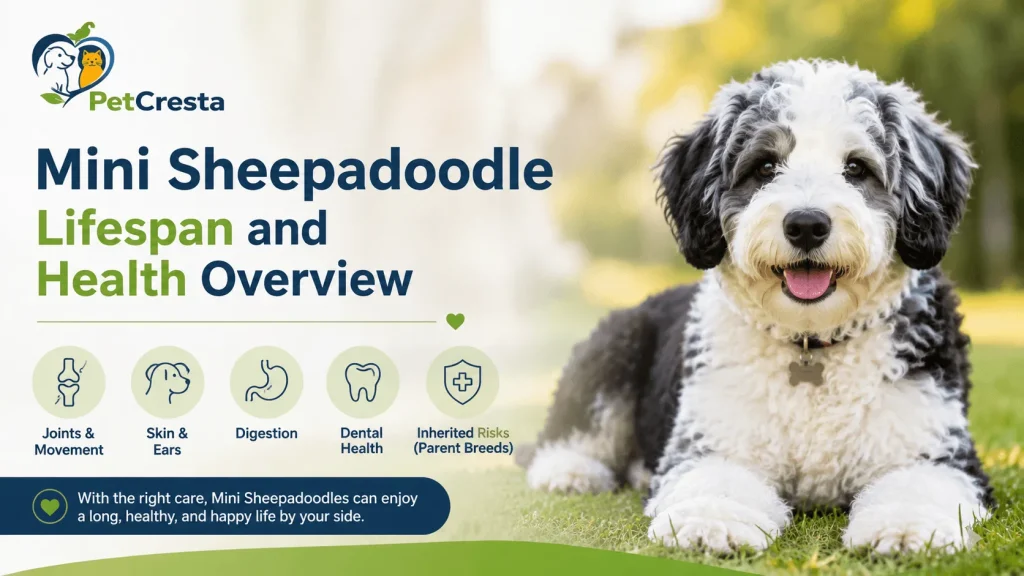
This is not an emergency section relating to the health of this breed. It is an area of decision support that is based on realistic care and smart questions.
How Long Do Mini Sheepadoodles Live?
Sheepadoodles are known to live for 12 to 15 years. While genetics are important, so are body condition, preventive care, exercise, dental care, and overall management.
Common Health Areas To Watch
Broad areas to watch include:
- joints and movement
- skin and ears
- digestion
- dental health
- inherited risks from the parent breeds
This is one reason records and health history matter so much.
Miniature Sheepadoodle Price And Ongoing Cost

Sheepadoodle prices vary widely by region, breeder standards, health testing, generation, and demand.
How Much Does A Mini Sheepadoodle Cost?
The small Sheepadoodle is usually sold in a wide range of approximately $1200 to $3200 or even higher, depending on region, practice, health testing, generation, and demand. This is a range for a moving market and should not be considered a hard rule.
Why One Mini Sheepadoodle Costs More Than Another
Price often changes because of:
- health testing and documentation
- breeding line consistency
- early socialization and puppy raising standards
- region
- generation
- rare color demand
A higher price does not always equal better value, but a low price should always be examined carefully.
First Year And Annual Ownership Costs
| Cost Area | First Year | Ongoing Pattern |
|---|---|---|
| Purchase or adoption | Highest upfront expense | Usually one time |
| Veterinary care | Set up care, exams, and vaccines | Preventive care continues |
| Grooming | Starts early and becomes routine | Recurring expense |
| Food | The puppy growth stage can cost more | Steady recurring cost |
| Training | Often higher in the first year | Refreshers as needed |
| Supplies | Crate, leash, bed, grooming tools | Replacement and upkeep |
Price vs Value
A low-cost puppy might have bad records, weak socialization, or may have had their coat and health problems never adequately explained – all of which can cost more in the long run. All good value is a result of good care, honest information, and transparency.
How to Choose the Right Type
This is where the article becomes a decision guide instead of a breed summary.
Best Fit by Household
A micro or small Sheepadoodle may be the most suitable breed for a home that desires a social and trainable dog, grooms regularly, and may not anticipate a dog to be around them for extended periods without being prepared.
That may encompass lively single people, couples, as well as families with routine. It’s not about the label. It is the match-up of the care requirements of the house and the dog. A reader with small, social doodles who prefers an alternate mix may also have to read through the mini Aussie Labradoodle to determine which temperament is best suited.
Puppy Buyer And Adopter Checklist
When selecting a Sheepadoodle mini, you shouldn’t just pick the first one you see and are looking for because of size, colour, or generation. The safer choice is to have clear records, clear expectations, and a good match between the puppy and the home.
It doesn’t matter if the dog is from a breeder or a rescue organization; transparency is important. A well-crafted photo or a popular label should never be a substitute for health documentation, temperament observations, and realistic sizing advice.
| What To Ask | Why It Matters |
|---|---|
| What are the parent sizes? | Helps estimate adult size more realistically |
| What generation is the litter? | Helps explain the likely coat and shedding pattern |
| What health records are available? | Shows whether basic screening has been handled |
| What coat types appear in this line? | Helps prepare for grooming needs |
| How are puppies socialized? | Affects confidence, handling, and home adjustment |
| What adult size range is realistic? | Prevents relying on vague mini or micro labels |
| What behavior notes are available? | Helps match the puppy to children, pets, or apartments |
Avoid exact size promises, guaranteed hypoallergenic claims, pressure to place a deposit quickly, and answers that focus only on color or cuteness. A good match should feel practical, not rushed.
Common Myths And Mistakes
- Myth: All micro and small Sheepadoodles are hypoallergenic.
- Reality: There are no 100% hypoallergenic dogs.
- Myth: All minis stay mini.
- Reality: Mini is not so tiny.
- Myth: Rare colors are of better quality.
- Truth: Color does not equal health, temperament, or structure.
- The myth of F1B always being easier.
- Reality: It may be reduced shedding, but may involve more grooming.
- Myth: Mini is low maintenance!
- Truth: Smaller size doesn’t mean less training, exercising, or coat care.
Conclusion
If the Sheepadoodle format is too large, but the size of a toy is too small, then a mini Sheepadoodle can be a very attractive reader. The decision is not as much a label as a complete picture of the dog.
The five most important are realistic expectations for size, coat care tolerance, activity level, cost, and record quality and transparency behind the dog. The Sheepadoodle micro is frequently a smart idea when these five pieces align. Even a beautiful puppy picture or a popular generation tag will not help if these don’t fit properly.
FAQ’s
Yes. The label mini narrows the target range, but it does not lock the dog into one exact adult size. Parent size, sex, older sibling size, growth pattern, and line consistency all matter more than a marketing label alone.
An F1 Sheepadoodle is a first-generation cross between an Old English Sheepdog and a Miniature Poodle. An F1B Sheepadoodle is usually crossed back to a Poodle. F1B lines often lean curlier and lower-shedding, but they also often need more grooming.
Most full-grown Sheepadoodles are about 15 to 20 inches tall and around 25 to 45 pounds. Some dogs may finish outside that range depending on the parents, sex, and breeding line. The word mini should be treated as a size direction, not an exact promise. Parent size and older siblings from the same line are usually better clues.
Yes, Sheepadoodles can shed. Many are lower-shedding than heavy-shedding breeds, but no coat should be described as zero shedding. Curlier coats may hold more loose hair inside the coat, which can reduce visible shedding but increase matting risk. Regular brushing is still needed.
No dog is fully hypoallergenic. Some Sheepadoodles may be easier for allergy-sensitive homes to tolerate, especially when the coat sheds less. Allergies can still be triggered by dander, saliva, and skin debris. The safest step is spending time around the individual dog before making a decision.
References / Source Notes
- Double U Doodles, The Mini Sheepadoodle Breed Characteristics
Page link: https://doubleudoodles.com/the-mini-sheepadoodle-breed-characteristics/ - PuppyPorch, Miniature Sheepadoodle
Page link: https://www.puppyporch.com/miniature-sheepadoodle/ - Jenna Lee Doodles, Mini Sheepadoodle Size and Weight With a Helpful Chart
Page link: https://www.jennaleedoodles.com/post/mini-sheepadoodle-size-and-weight-with-a-helpful-chart - Charm Lane, Miniature Sheepadoodle
Page link: https://charmlane.com/miniature-sheepadoodle/ - Premier Pups, Mini Sheepadoodle
Page link: https://premierpups.com/dog-breeds/mini-sheepadoodle - Petland Frisco, Miniature Sheepadoodle
Page link: https://www.petlandfrisco.com/breed/miniature-sheepadoodle/ - Australian Sheepadoodles Australia, Sheepadoodles
Page link: https://www.australiansheepadoodlesaustralia.com.au/sheepadoodles/ - AKC, Hypoallergenic Dog Breeds
Page link: https://www.akc.org/expert-advice/dog-breeds/hypoallergenic-dog-breeds/ - WSAVA, Body Condition Score
Page link: https://wsava.org/wp-content/uploads/2020/01/Body-Condition-Score-Dog.pdf