Aussie Mountain Doodle Breed: Temperament, Size, Grooming, Health, and Cost Guide
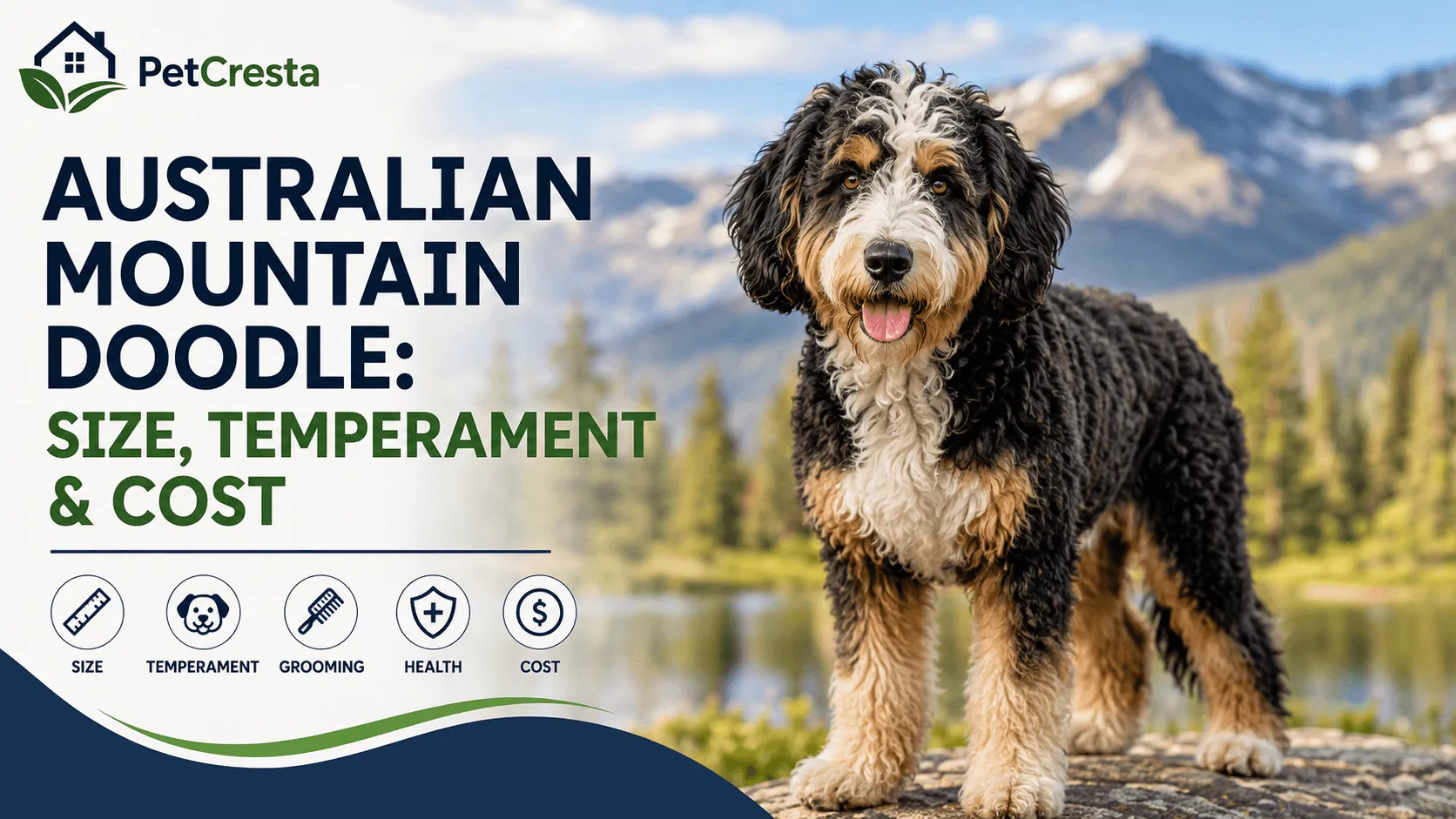
The Australian Mountain Doodle is typically a mix of the Bernese Mountain Dog, Australian Shepherd and Poodle breeds. The name is neat. The genes are not. Even puppies that are labeled the same may vary in adult size, coat, shedding, energy, and temperament because different combinations of parents are bred and different traits are selected for.
That variation doesn’t necessarily mean it’s bad. It just means that the name can’t make all the decisions for you. The identity of the parent, health records, size history, coat genetics, early socialization and individual dog are far more important than a well-done puppy photo.
This is a guide to the questions that tend to come after the initial puppy excitement fades: What size will the dog be? Will the coat shed? What’s a reasonable amount of grooming? What health records should a breeder give? How much will it cost to own after the deposit is made?
Quick Answer
It is a non-standardized cross between a Bernese Mountain Dog, Australian Shepherd, and Poodle. There is no one breed standard or universal “formula” for breeding, so many are social, bright, trainable companions, while others are not.
Most homes need to expect to brush often, get grooming professionally, use the house for daily activities, train and have lots of human interaction. The ideal match is an engaged family that is willing to deal with some uncertainty and carefully selects the specific dog.
Australian Mountain Doodle Characteristics At A Glance
The following table is a guide to planning, not a commitment. A breeder should be able to explain how the parents, grandparents, generation and coat testing support a prediction made about a puppy.
| Attribute | General expectation | What can change it |
|---|---|---|
| Classification | Three-breed designer cross | Breeder terminology |
| Common ancestry | Bernese Mountain Dog, Australian Shepherd and Poodle | Actual parents and generation |
| Recognition | No Australian Mountain Doodle standard on the AKC recognized-breed list | Private registries may use their own labels |
| Adult size | Wide breeder-reported range | Parent size, Poodle variety, grandparents and generation |
| Coat | Straight, wavy or curly; furnished or unfurnished | Coat variants inherited from both parents |
| Shedding | Low to noticeable | Furnishings, curl, coat length, shedding genetics |
| Allergy safety | Never guaranteed | Individual dog and individual person |
| Energy | Often moderate to high | Line, age, health, training and individual temperament |
| Grooming | Usually moderate to high | Coat length and texture |
| Lifespan | No established AMD population average | Size, inherited health and lifelong care |
| Price | Varies by breeder, location and services | Testing, training, demand and sales model |
| Best suited to | Engaged households prepared for coat care and training | Individual dog and household routine |
Planning note: These are general expectations and do not guarantee an individual puppy. The AKC has a recognized-breed list that includes the Bernese Mountain Dog, Australian Shepherd, and Poodle, but not the AMD as a recognized breed.
What Is An Australian Mountain Doodle?

The easiest answer is a dog that is a mix of Bernese Mountain Dog, Australian Shepherd and Poodle. The more useful answer is one additional sentence: No universal formula exists that governs the combination of these three ancestries. The broader Mountain Doodle guide explains how Australian, Golden and Bernese-focused Mountain Doodle labels differ and why buyers must confirm the actual parent breeds.
That distinction is the reason for almost all the confusing claims you will encounter. Some breeders will use an Aussiedoodle and a Bernedoodle, and others will use an Australian Mountain Doodle parent and a Poodle. They can be the same name, although the ancestry percentages and coat results are different.
Standard Definition And Parent Mix
This dog is not a breed in its own right, but rather a designer cross. It is basically a Bernese Australian Shepherd mix/ A puppy can be a combination of all three breeds from the parent generation or one breed can be seen in a grandparent or a long-established multigenerational line.
Please do not presume that every puppy is 1/3 Bernese Mountain Dog, 1/3 Australian Shepherd and 1/3 Poodle. Behavioral traits are particularly complex and genetic inheritance isn’t packaged in tidy slices. A large genomics study showed that breed ancestry accounted for approximately 9% of the variation in behavior among individual dogs, a cautionary note about using a family tree as a personality predictor.
Other Names And Naming Confusion
Many buyers get confused about the name before they meet the puppy. There are close variants and there may be other different cross types described.
| Term | Common usage | Safe interpretation |
|---|---|---|
| Australian Mountain Doodle | Usually Bernese, Australian Shepherd and Poodle ancestry | Confirm both parents |
| Aussie Mountain Doodle | Common shortened version of the same name | Confirm actual composition |
| AMD | Abbreviation | Define on first use |
| Aussie Bernedoodle | Used by some programs for a similar cross | Not universally standardized |
| Australian Bernedoodle | May mean a different cross involving Australian Labradoodle ancestry | Ask for full ancestry |
| Swiss Doodle | Used inconsistently for several mountain-dog-based crosses | Never assume composition |
| Aussiedoodle | Australian Shepherd and Poodle | Treat as a different cross |
| Aussie Bernese mix | Informal description without a fixed Poodle percentage | Ask whether Poodle ancestry is present |
The best question is a plainspoken one: What is the registered name, breed, size and health history of both parents? Any trendy label is less useful than a clear answer. An Aussie Mountain Doodle should also not be confused with a Golden Mountain Doodle, which generally includes Golden Retriever rather than Australian Shepherd ancestry.
Is The Aussie Mountain Doodle A Recognized Breed?
No. There is no single AMD standard for size, coat, temperament or accepted breeding structure for this cross, although a recognized breed usually has a written standard and a national parent club linked to the registry.
If a breeder is not recognized, it does not mean that the breeder is careless. It does not mean that the buyer should not look at the program, but instead look at it individually, rather than using a rulebook for the breed. Registration is not a substitute for health screening, parent information, or responsible placement, and may be recorded by private hybrid registries.
Origin And Development
No single founding event has been widely documented and accepted in all AMD programs. Breeder websites tell their own story: Blue Skye states that they started using “Aussie Bernedoodle” for their program in 2015 and Stokeshire says the cross is a newer development that has come about through multiple programs and not one specific origin. These are breeders’ reported histories and not a formal breed record.
It can be fairly said that the cross has been a result of the increased popularity of intentional Poodle mixes. While the same goals were sought by different breeders, they did not work to one standard for variation, temperament, or size.
Parent Breeds And Inherited Variability
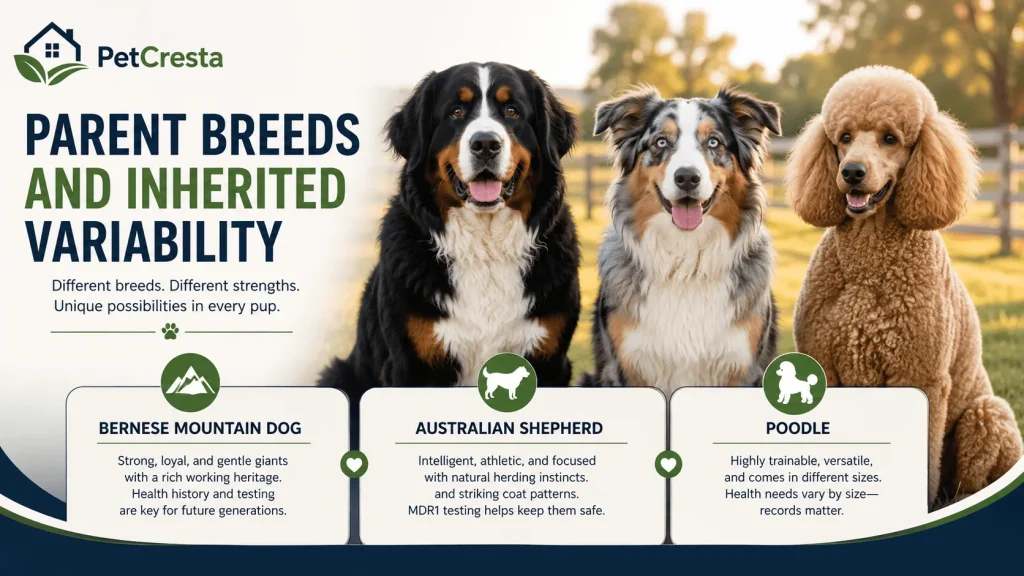
If you know the parent breeds, you can get an idea of what you may find in the litter. It is not going to guarantee you a quiet, athletic, bark-free, soft-coated, easy-to-live-with puppy.
Consider ancestry as a spectrum. All of these factors, including the puppy’s responses, health, early development, related dogs, and parent temperament, should be considered.
Bernese Mountain Dog
The Bernese Mountain Dog has a big, strong build, a black, white, and rust-colored coat, and a large working-dog heritage. The breed is known for being a loving family pet, but a Bernese grandparent doesn’t mean a quiet and easygoing puppy.
Health history is a serious matter. The Bernese Mountain Dog Club of America suggests that breeding dogs be screened for hips, elbows, eyes, heart, and degenerative myelopathy, plus one additional test from their list of available tests. The club also emphasizes the importance of health and longevity data from siblings and other relatives, in addition to the two parents.
Australian Shepherd
Australian Shepherd ancestry can include fast learning, awareness of surroundings, athleticism, herding instincts, motion sensitivity and merle coloring. That might manifest in everyday life as a dog that sees every delivery van, masters the house routine in no time and creates a couple of routines that no one asked for.
Australian Shepherds and mixed-breed dogs can have the MDR1 (ABCB1) drug-sensitivity variant. According to WSU, some medications may cause a severe reaction in affected dogs and testing is the only way to determine if a specific dog is affected. A result should be presented to the dog’s veterinarian, who will be able to make safe decisions about medication and dosage.
Poodle
Trainability, retrieving, length of coat, curl, furnishings and size may be affected by poodle ancestry. It’s important to note that it’s the real Poodle that counts. A Standard Poodle in the pedigree will raise other size and health-testing issues than a Miniature or Toy Poodle.
There are variety-specific health recommendations. Poodle Club of America recommends PRA-prcd testing, eye exams, and patellar exams for Toy Poodles, as well as hip exams for Miniatures; Standards have additional orthopedic, eye, thyroid, cardiac, sebaceous adenitis, and DNA considerations. Inquire about the type of Poodle, and check the records pertaining to that type.
Australian Mountain Doodle Size And Growth
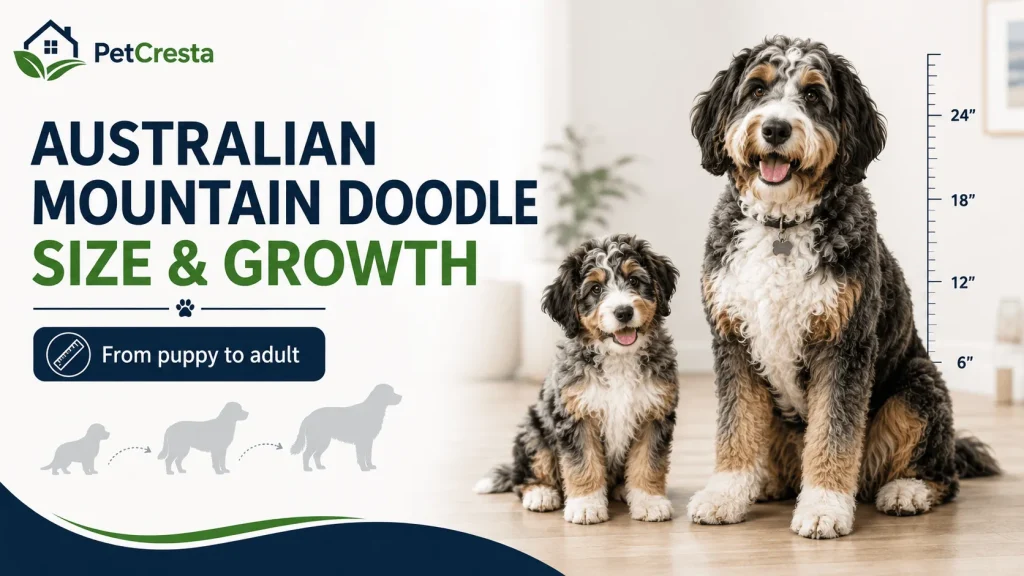
Breeder pages are reassuring when they have size labels. Unfortunately, “mini” doesn’t measure.
Not all programs have the same cutoff and a label that signifies 20 to 30 pounds in one program may be considered “medium” in another. A sturdier foundation for planning is provided by parent sizes and mature dogs from earlier litters.
How Big Do Aussie Mountain Doodles Get?
There is no official AMD size chart. Today’s breeders offer everything from a small dog in the teens to one that is close to a Bernese-influenced large dog.
WestPenn currently offers mini and medium litters ranging from 20–30 lbs and 35–50 lbs, respectively, and Stokeshire offers a broader range of litters from toy/micro through standard.
A comparison table is more honest if it reveals the instability of the labels rather than assuming that they are fixed.
| Label used by breeders | Range | Typical height information | What buyers should verify |
|---|---|---|---|
| Toy/micro | Roughly 10–25 lb in some programs | Often inconsistent | Adult parent weights and smallest dogs in prior litters |
| Mini Aussidoodle | Roughly 20–35 lb in several programs | Often inconsistent | Both parent sizes and previous mature offspring |
| Medium | Roughly 35–50 lb in several programs | Often inconsistent | Expected range rather than one guaranteed number |
| Standard | Roughly 50–100 lb in some programs | Often inconsistent | Upper range and handling/grooming implications |
These wide ranges are in metric and are not a chart, but rather the approximate ranges provided by the breeders.
What Most Affects Adult Size?
The puppy’s label is less practical than parent weight and height. Grandparents count as well, particularly when one parent is a mixed-breed dog and has a wide variety of dogs behind it.
The final result may vary based on the Poodle variety, generation structure, sex, litter variation, and growth pattern. While nutrition is important for healthy development, excess feeding will not make a small dog into a well-built large dog; it will more likely result in excess body condition.
A thoughtful breeder provides a range and an explanation for the range. If someone guarantees an exact weight (like, “your puppy will be 27 pounds”), you should stop and think for a moment because living animals aren’t particularly interested in marketing precision.
Puppy-To-Adult Growth And Maturity
Growth and maturity are not the same thing. A young AMD can grow to a significant size while exhibiting many of the characteristics of a teenager who has just discovered his/her selective hearing.
Puppy learning sessions should be short; puppies should move safely, and they need rest and a slow introduction to normal life. Even if training was successful, the adolescent might be more excitable, distractible, pushy, or sensitive. Steadiness is not something that you’re born with; it’s something you have to practice.
Often, bigger dogs will take longer to eat up than smaller dogs. As the puppy grows, your veterinarian will be able to monitor body condition, musculoskeletal development, diet and exercise.
Aussie Mountain Doodle Temperament And Daily Life
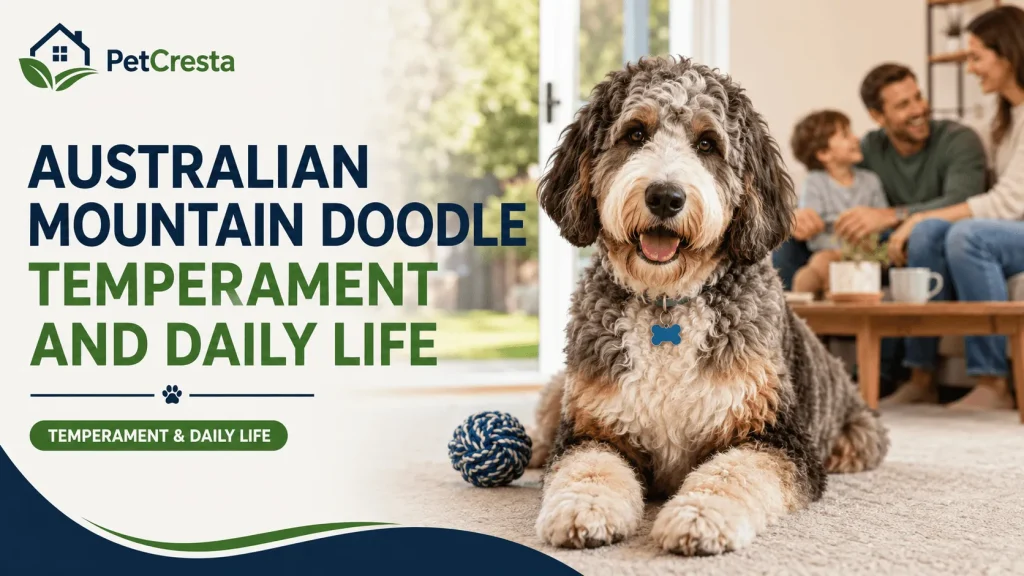
This dog is known to be affectionate, observant, playful and eager to work with people. Those are helpful only when combined with the other half of the story: an involved dog can also be demanding, vocal, sensitive or slow to relax.
Temperament is a product of nature and nurture. The personality of the individual puppy is more important than a guarantee that all three breeds are contributing their best.
Common Temperament Tendencies
A good match for an AMD could be family life, training games, outdoor activities and close contact. Many learn fast and see patterns quickly, and when the rules are consistent, everyday training is satisfying.
Social interest can be a great asset. These dogs are usually more wanting to be part of the group than to sit in the background. However, the attitude of people varies from being warmly affectionate to being shadow-like, and the difference is important when the family requires a dog that can lie down alone.
The quietest puppy on one visit is not always the calmest puppy! A good match takes into account recovery from surprise, willingness to engage, response to handling, frustration tolerance, and the home’s actual pace.
Behaviors Owners May Underestimate
A bright dog that is people oriented can pick up habits fast. There are some habits that are quite attractive. Others include the recycling bin.
| Possible challenge | What helps |
|---|---|
| Clinginess or weak independence | Build short, calm periods apart before distress develops |
| Alert barking | Reward quiet observation and manage window or doorway triggers |
| Herding or motion chasing | Teach recall, disengagement and calm behavior around movement |
| Jumping and mouthing | Reinforce four paws down and provide appropriate play outlets |
| Poor indoor settling | Schedule rest and reward calm behavior, not constant activity |
| Destructive boredom | Combine movement, chewing, scent work and predictable downtime |
| Sound or environmental sensitivity | Use gradual positive exposure and allow distance when needed |
Barking doesn’t necessarily mean separation anxiety and being clingy doesn’t mean it’s a temperament flaw. If your dog is showing extreme stress, behavior changes, aggression, or fear, seek help from a veterinarian or trained behaviorist.
Children, Other Dogs And Cats
Children can live in harmony with many AMDs. It takes supervision, the size and level of arousal of the dog, the behavior of the child, and the training of both the dog and the child.
A 50-pound boy or girl can be knocked over by a little kid, and the little kid will be no different. Other herding behaviors that can be seen in the ancestry include chasing, body blocking, and nipping at moving feet. The words “family friendly” are not as important as calm greetings, safe resting places and adult supervision.
When introduced properly, other dogs can be good companions. Cats are more individualistic. A puppy that has grown up around cats can adapt well, and a dog that has a more dominant chase instinct may need lifelong management.
First-Time Owners, Apartments And Time Alone
This dog is a good choice for a first-time owner. Preparation involves taking on puppy grooming, training for adolescence, daily activity and the fact that the puppy might not be the dog that was envisioned in an eight-week picture.
Some minis, mediums, and even larger adults can live in an apartment. There is only one piece of floor space. It is sometimes more important to settle after exercise, have elevator manners, care for his/her coat, and have a toilet routine, to mention a few.
A yard is not a magic place. Dogs aren’t always self-sufficient and a clever dog that’s left outside can develop a landscaping plan you didn’t approve of. Slowly releasing the dog from dependence, safe rest and a realistic home timetable are required in all environments.
| Household situation | Possible? | Main requirement | Main caution |
|---|---|---|---|
| First-time owner | Yes | Coaching, consistency and realistic expectations | Underestimating grooming or adolescence |
| Apartment | Sometimes | Daily activity, quiet skills and toilet planning | Barking and shared-space manners |
| Busy household | Sometimes | Predictable care and protected rest | Overstimulation or long absences |
| Multi-pet home | Often | Slow introductions and resource management | Chase behavior or mismatched play styles |
Aussie Mountain Doodle Coat Types, Shedding, Allergies And Colors
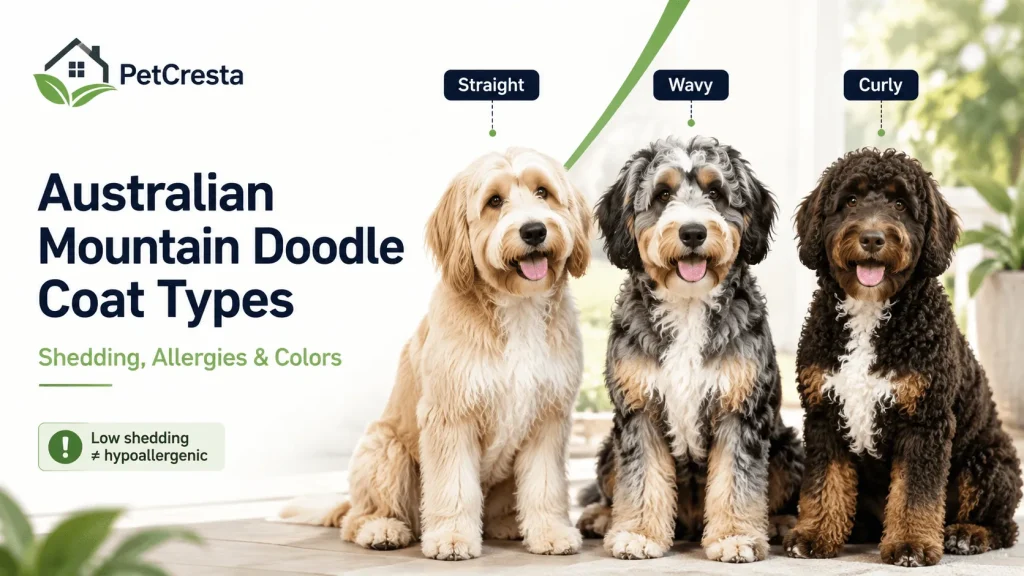
The coat is usually the first thing that people notice and the last thing they really consider when buying a coat. Puppy coats can be straight, wavy or curly and may change as the adult coat grows in.
One appearance is not enough to say anything about shedding, matting or allergy tolerance. Coat traits are interdependent, and that’s why a breeder who knows about tested genetics should not talk in absolutes.
Straight, Wavy And Curly Coats
A straight or loose coat may not be as traditionally “doodle” and could shed more in the house. Wavy coats provide the luxurious feel that many buyers are seeking, although they may become mat. Loose hair may not be as visible on a curly coat, but it can be harder to remove tangles.
| Coat description | Typical appearance | Visible shedding tendency | Matting tendency | Care implication |
|---|---|---|---|---|
| Straight | Loose, natural outline | Often more noticeable | Low to moderate | Regular brushing and seasonal coat checks |
| Wavy | Soft waves and teddy-bear outline | Low to moderate | Moderate to high | Thorough brushing several times weekly |
| Curly | Dense curls or tight waves | Often less visible | High | Frequent brushing, comb checks and regular clipping |
Texture is just one of the clues. The type of furnishings, length of coat, and shedding cycle of the dog also have an impact on what the owner will experience.
Furnishings, Curl, Length And Shedding Genetics
Furnishings” is the longer hair around the muzzle and brows that forms the classic doodle face. Variants of RSPO2 have been associated with furnishings, variants of FGF5 with coat length and variants of KRT71 with curl. Other variants such as markers for MC5R, may play a role in shedding, but none of these markers can predict the overall shedding experience in a household.
| Genetic factor | Commonly associated feature | What it cannot guarantee |
|---|---|---|
| RSPO2 | Furnishings around muzzle and brows | Allergy tolerance |
| KRT71 | Degree of curl | Mat-free coat |
| FGF5 | Coat length | Shedding level by itself |
| MC5R-associated marker | Contribution to shedding tendency | Complete prediction of household shedding |
Generation labels are not a substitute for coat testing. Some F1B puppies might not look exactly like their littermates and some furnished puppies might shed more than is normal.
Do Australian Mountain Doodles Shed?
Some shed very little in the home. Others shed noticeably. The truth is, it’s not the name on the contract that matters; it’s the individual coat.
Low shedding is a good sign but if loose hair is left in a fur coat, it can be a bad sign. If not properly brushed, that hair will mat with the developing coat and create mats. If there is less hair on the sofa, there is more hair in the comb.
Request to visit mature family members with the same coat characteristics that have been tested. Fluff can’t be used as a good indicator of adult coat.
Are Australian Mountain Doodles Hypoallergenic?
There are no guarantees that all Aussie Mountain Doodles will be hypoallergenic. According to the American College of Allergy, Asthma and Immunology, all dogs have allergens and they can be found in dander, saliva, hair, and urine. Although some people can tolerate low shedding, fur length and curl do not mean a dog is not allergenic.
If a person has significant medical allergies, he or she should consult an allergist and spend time with the dog in question, if possible. Even then, a few visits can’t guarantee how the dog will respond to the house.
Warning: Low shedding does not equal allergy safe.
Colors And Markings
Australian Mountain Doodles come in a variety of different patterns including black tri, brown or chocolate tri, blue merle, red merle, phantom, parti, tuxedo, bi-color, and white marked varieties. Eye color can range from brown to blue or be a mix, particularly in merle or Australian Shepherd lines.
There is no standard language for color among breeders. The amount or placement of white may vary from program to program, and may be described as “parti,” “tuxedo,” or “mismark.”
The puppy that looks different is not necessarily healthier, better-tempered, or better as a pet. Though color should be on the preference list, it should be lower than health, structure, temperament and breeder transparency.
Merle Breeding Safety
Merle is associated with the PMEL/SILV area and has an impact on pigmentation. Studies have also correlated merle-related genetic contexts with hearing impairment, smaller eye size and other developmental issues, particularly when merle is passed down from both parents.
A good breeder should be aware of the merle status of all breeding dogs before breeding. Appearance is not the only factor to consider when interpreting a dog’s genes; two visibly non-merle dogs may still need careful genetic interpretation if there is a possibility of cryptic or atypical merle variants.
Do not choose merle puppies because they have blue eyes or odd markings. Inquire about the lab that tested the parents, obtain the reports and ask a veterinarian or canine genetics expert to review any complex claims.
Aussie Mountain Doodle Grooming Tips And Requirements
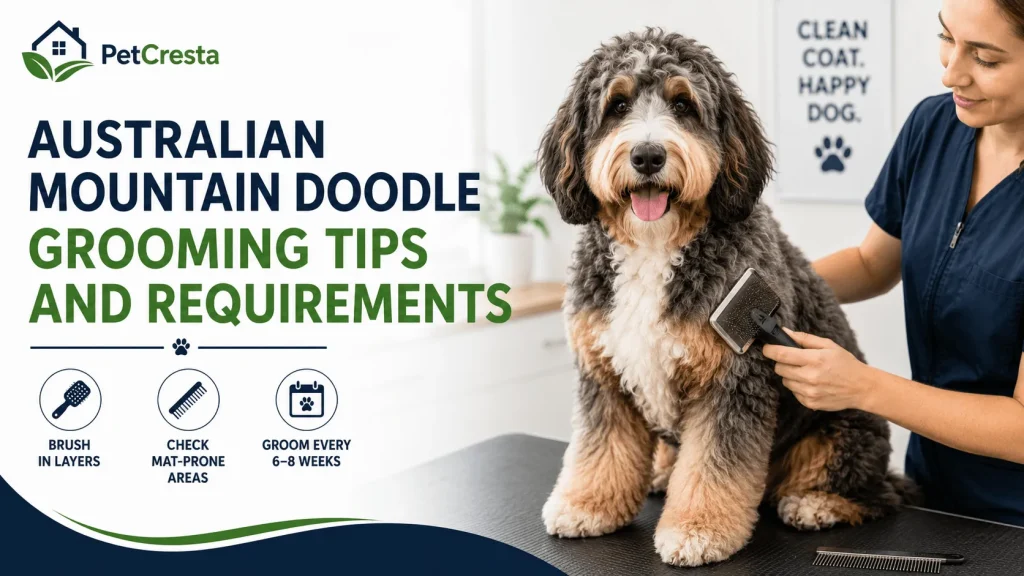
Low shedding doesn’t equal low maintenance. A loose fitting coat can look great on Monday, but by Friday, it might be a tight mat.
Begin grooming as a puppy before the coat becomes too unmanageable. A dog that’s okay with being brushed, combed, dried, clipped, handled by paws, ears and face is safer and easier to care for.
At-Home Brushing
Brush in small layers, not gliding over the top of the skin. Use a metal comb and if the comb cannot go from the skin to the tip, then the coat is not done.
Larger, longer, and curlier coats may require care every other day. Shorter or straighter coats may require less, but may become tangled due to seasonal changes, swimming, harness use, or wet weather.
Mat-Prone Areas
Look behind ears, under collar, under armpits, across the chest, under harness straps, through the groin, around the paws, under the tail and inside facial furnishings. These areas tangle easily due to friction and moisture.
Do not force tight mats to be separated when the dog is not comfortable. They can be safely removed by a groomer and a shorter cut will be better for the skin than maintaining length at the expense of it.
Professional Grooming
Many coats require professional grooming every 6-8 weeks, although the length of the coat and home care may cause the schedule to change. A well-groomed, well-cut dog is also easier on the dog and the household than a long coat that requires constant grooming throughout the year.
| Task | Planning frequency | Adjust when |
|---|---|---|
| Full brush and comb | Several times weekly for many coats | Coat is longer, curlier or mat-prone |
| Friction-zone check | Every brushing session | Harness or collar is used frequently |
| Bath | As needed | Dirt, odor or veterinary advice |
| Nails | Based on growth and wear | Nails touch the floor or affect movement |
| Ear check | Weekly and after swimming | Redness, odor or discharge develops |
| Professional grooming | Often 6–8 weeks | Coat length and home maintenance differ |
Aussie Mountain Doodle Exercise Requirements, Training And Early Socialization
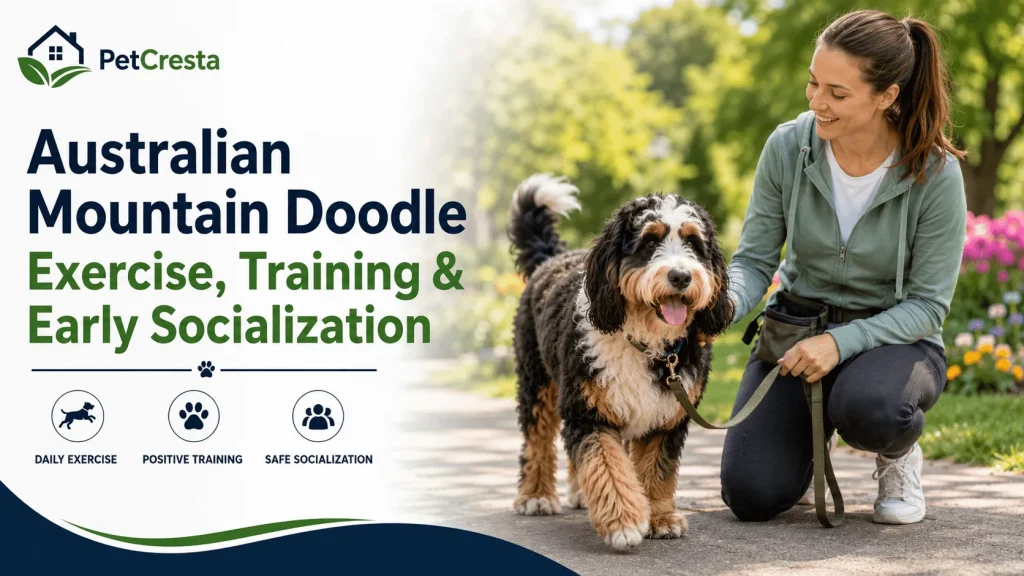
An Australian Mountain Doodle seldom requires a mere stroll around the block. The best exercise is a balance of physical activity, sniffing, learning and play, and rest.
Increased activity doesn’t always lead to improved results. If a dog is always occupied, he can get fit without learning to settle in the house.
Daily Exercise Needs
No standard exists for the exercise for AMD. Competitor pages for breeders give different daily ranges, and it is known that the number is not the most important factor, as age, size, health, arousal and parent lines are all important.
A practical day may consist of a sniff walk, a shorter structured walk, some brief play and a few minutes of training. Puppies should be given age-appropriate activity and a lot of rest; adult dogs can typically be given longer walks if they are gradually introduced to them. Water should remain available before and after activity, particularly in warm weather, and owners should understand how long a dog can go without water and which dehydration signs require veterinary attention.
Mental Enrichment and Settling
The brain can be stimulated without the home becoming an amusement park through food puzzles, scent games, safe chewing games, simple retrieval games, and short training sessions. Vary activities instead of providing all at once.
Practice calm behavior intentionally. Praise the dog for lying down on a mat, not moving around when people are moving around and relaxing after playing.
Training Priorities
Start with name response, recall, loose-leash walking, calm greetings, leave it, drop, grooming handling and comfortable time in a crate/safe pen. Independence training is as important as sitting down.
A sensitive quick learning dog is best suited to reward based training. AVSAB promotes positive, consistent techniques and cautions against punishment or dominance-based techniques.
Early Socialization And Puppy-Raising Practices
Socialization is about safe, positive learning, not making a puppy suffer through everything. The AVMA’s major sensitive period is approximately 3-14 weeks, and suggests that puppies gradually be introduced to people, animals, places, surfaces, handling, and normal activities at a pace that they can handle.
Ask the breeder for examples, dates, and observations. Raised with love is nice; introduced to clippers at 6 weeks; recovered calmly from the dryer and preferred distance from loud children tells you a lot.
| Vague answer | Useful answer |
|---|---|
| “They are well socialized” | Specific exposures, dates, responses and records |
Therapy Dogs, Service Dogs And Emotional-Support Animals
A few individual AMDs might be appropriate for therapy or service training. The breed name does not indicate temperament or task ability.
The U.S. ADA defines a service animal as a dog that is trained to do a service or task directly related to a person’s disability. A dog that is used for assistance is not a pet. Emotional-support animals are regulated differently from therapy dogs, and do not have the same general public-access rights as therapy dogs.
| Role | Main purpose | Public-access status in the U.S. |
|---|---|---|
| Service dog | Performs disability-related trained tasks | Protected in many public settings under the ADA |
| Therapy dog | Provides structured comfort or interaction to others | No automatic ADA public-access right |
| Emotional-support animal | Provides comfort through presence | Not a service animal under the ADA |
Health, Health Testing And Lifespan

The risk of inherited diseases does not go away because of mixed ancestry. It alters the type of risks a breeder will need to be aware of and test for.
There is no breed-wide CHIC protocol for AMD. The process of health planning starts with the real parent breeds, the type of Poodle used and the family history of each dog.
What We Know—And Do Not Know—About AMD Health
Very little population-level research has been focused specifically on AMD health. The term “broad lifespan claims” and “healthier hybrid” are typically estimates from the breeder and not a result of a large, tracked population.
A sensible assessment takes into account formal test scores, family diagnoses, causes of death, body condition, temperament stability and longevity down the line. A single clean DNA panel does not cover all orthopedic, cardiac, eye, immune or cancer issues.
The following are some health concerns that you should discuss with your veterinarian:
Health Concerns To Discuss With A Veterinarian
| Area | Why it is discussed | What buyers should ask for |
|---|---|---|
| Hips and elbows | Orthopedic concerns occur in parent populations | Formal results from age-appropriate screening |
| Eyes | Several inherited eye conditions may occur in parent lines | Current examination or relevant genetic results |
| Cardiac health | Some parent-club protocols include cardiac evaluation | Examiner type, date and result |
| MDR1/ABCB1 | Relevant to Australian Shepherd ancestry | Genetic result shared with the veterinarian |
| Breed-specific DNA conditions | Vary by parent breed and Poodle variety | Full report, not “clear panel” wording alone |
| Skin and ears | Coat density and allergies may affect daily care | Parent and family history where available |
| Cancer history | Particularly relevant when evaluating Bernese lines | Longevity and cause-of-death information in relatives |
A “vet checked” puppy is one that has been examined by a veterinarian to some extent. This is helpful, but it does not equate to formal screening of both parents using a breed-specific test.
Parent-Specific Testing Checklist
The BMDCA currently has hips, elbows, eyes, heart, degenerative myelopathy and another approved option in its minimum recommendations for Bernese ancestry. Australian Shepherds must be hip, elbow and eye evaluated, and other tests like thyroid, CEA and MDR1 are optional in the program. There are different recommendations for poodles based on their size: Toy, Miniature, and Micro.
| Parent ancestry | Records to verify |
|---|---|
| Bernese Mountain Dog | Current BMDCA/OFA recommendations, family longevity and cause-of-death records |
| Australian Shepherd | Hip, elbow and eye results, plus relevant DNA results such as MDR1 |
| Toy Poodle | PRA-prcd, eye and patella results |
| Miniature Poodle | Toy requirements plus hip evaluation |
| Standard Poodle | Hip, eye and current PCA-recommended elective and DNA results |
OFA says that a CHIC number is the result of the required tests being done and published. It is not to say that all the results were normal. Read the record and confirm the dog’s identity and age when tested.
Veterinarian’s view: The best documentation is not a certificate on which the word “clear” is printed in large letters. It is a series of results that are linked to known dogs, and are analysed in conjunction with family history, age and planned pairings.
Everyday Health Management
Keep the dog at a healthy weight, brush teeth regularly, check ears after swimming, and treat itching and lameness promptly. Skin irritation, weight gain, wounds and small lumps can all be covered by thick coats until it becomes obvious on the day of grooming.
Quality of life is supported through regular veterinary care, parasite control, appropriate feed, portion control, and exercise appropriate to the dog. They cannot take away genetic risk, but they provide the dog with a more solid day-to-day foundation. Preventive care also includes maintaining legally required vaccinations, so owners should check how often dogs need rabies shots according to the vaccine certificate, veterinary guidance and local law.
Aussie Doodles Lifespan
Typical estimates on breeder pages are in the low teens, and may be higher for smaller breeds. There is no known average for AMD.
Do not take 10–15 years as a guarantee, but rather as a general planning period. The life span of any particular dog is influenced by adult size, inherited disease, cancer, body condition, preventive care, and chance.
Medical note: No general education can be a substitute for an examination or a veterinarian’s advice.
F1, F1b, F2, And Multigenerational Australian Shepherd Poodle Mix

The generation label does not indicate how well the puppy is. The same label can be used to identify different family trees in different programs when using a three-breed cross. Our explanation of what an F1B Bernedoodle is provides a simpler two-breed example of backcross terminology and the limits of what an F1B label can predict.
| Label | One possible use | Why the label is insufficient | What to request |
|---|---|---|---|
| F1 | First planned cross producing all three ancestries | Parent structures differ among programs | Both parents’ breeds and percentages |
| F1B | AMD crossed back to one parent breed, often Poodle | Backcross parent may differ | Exact backcross breed |
| F2 | Two first-generation dogs | The two F1 dogs may not have identical ancestry | Pedigree and DNA ancestry |
| Multigenerational | Several generations of related crossbreeding | Percentages and goals vary by breeder | Full breeding structure and health records |
Request the true pedigree, probable ancestry, parent test results and mature examples from similar crosses. Allergy tolerance is not guaranteed with F1B and multigenerational is not necessarily healthy or predictable.
Australian Mountain Doodle Price and Ownership Costs

The purchase price is clearly indicated as it is next to the puppy. Grooming, food, veterinary care, training and emergency planning come later and remain longer.
There is a wide range of prices depending on the color, size, training and the breeder’s model. Don’t assume that a high fee means quality, and don’t assume that a low fee means quality. Don’t assume that a high fee means quality, and don’t assume that a low fee means quality.
How Much Does An Aussie Mountain Doodle Puppy Cost?
The prices for active U.S. breeders were approximately $1,800 to $7,500 on eight pages seen on July 30, 2026, and many standard puppy prices were in the $3,000 to $4,500 range. The sample is not a national census and will vary with changes in litters, discounts and programs.
| Breeder/program | Region | Advertised base price | Training included? | Health/testing claims | Date checked |
|---|---|---|---|---|---|
| Crystal Ridge Doodles | U.S. | $1,800–$4,500 | Early puppy work stated | Parent genetic and OFA claims | July 30, 2026 |
| WestPenn Doodles | Pennsylvania | $3,500 | No full training package stated | Program information available | July 30, 2026 |
| Blue Skye Doodles | Oregon | $3,600–$4,500 | Early raising program stated | Genetic and health claims listed | July 30, 2026 |
| Cottonwood Creek Doodles | Utah | $4,500–$7,500 | Not stated as standard inclusion | Program claims health testing | July 30, 2026 |
| PacificDoodles | U.S. | $3,500–$6,500 | Varies | Program claims screening | July 30, 2026 |
| Happily Ever After Doodles | U.S. | $3,500–$4,000 | Not stated | Program claims health and genetic testing | July 30, 2026 |
| Woodland Aussies & Doodles | Michigan | $3,000–$4,500 | Some puppy training mentioned | Vet certificate and guarantee stated | July 30, 2026 |
| Sunny Ridge Doodles | U.S. | $2,500–$6,500 | Varies | Parent testing links stated | July 30, 2026 |
Pupfish are sometimes found with color premiums, especially merle and tri-color. Pay for health practices, care, records and support—don’t pay for scarcity language.
First-Year And Recurring Costs
A realistic budget will cover a lot more than just a puppy and a bag of dog food. The total can vary greatly depending on local veterinary costs, grooming fees, adult size, insurance options and training requirements.
| Expense | Initial or recurring? | What changes the cost |
|---|---|---|
| Purchase or adoption | Initial | Seller, rescue, training package and region |
| Supplies | Mostly initial | Adult size and equipment quality |
| Veterinary care | Both | Region, health and preventive plan |
| Food | Recurring | Adult size, diet and local prices |
| Grooming | Recurring | Coat condition, size, cut and local rate |
| Training | Both | Group, private or board-and-train services |
| Insurance or emergency savings | Recurring | Plan, age and location |
| Boarding/day care | Optional recurring | Household schedule and local price |
Create a Budget for your Household before you reserve a puppy. Grooming every 6-8 weeks can be one of the most predictable expenses, particularly for a large dog or a coat that is matted.
Choosing A Breeder, Buying A Aussie Mountain Doodle Puppy Or Adopting

A great website can welcome a program. It can’t confirm the dogs behind it.
Take the process at a leisurely pace so you can look at identities, records, contracts, and the breeder’s answers to difficult questions. A good seller should be at ease with informed buyers.
What A Responsible Breeder Should Explain
Request the registered names, ages, breeds, weights, health test results, temperament histories and photos of both parents. Ask for the generation structure, probable coat colors, adult animals from similar litters, and why the breeding pair was selected.
The breeder should also cover puppy care, matching, veterinary records, the contract, return policy, and support following placement. Screenshots are easy to crop, public database records are easier to verify.
Puppy-Raising And Socialization Questions
Discuss the location of the litter, the places and sounds puppies will experience, the way grooming and handling start, and how puppies’ reactions are noted. Understand if puppies rest alone, travel, are confined, and recover from excitement in a calm manner.
A good breeder response will contain what happened when a puppy had a problem. Good socialization is tailored to the individual, not given as a checklist, even in the face of fear.
Green Flags And Warning Signs
A warning sign does not necessarily mean that something is wrong. However, a combination of a few poor responses can show a trend that may be worthy of consideration.
| Evidence to look for | Reason to pause |
|---|---|
| Identified parents with verifiable records | Parents described only by call names |
| Health records available before deposit | “Vet checked” used as the only health claim |
| Clear description of ancestry | Breeder avoids stating the actual mix |
| Realistic size range | Exact adult-size guarantee |
| Honest shedding explanation | Non-shedding or allergy-safe guarantee |
| Written return policy | No plan if placement fails |
| Specific socialization records | “Raised with love” with no details |
| Buyer questions welcomed | Pressure to send money immediately |
| Temperament matching | Selection based only on color or deposit order |
| Live communication and identity checks | Stolen photos or refusal to show puppies live |
A question may be required for one missing website detail. If you hear several evasive answers, if the stories change, or if there is pressure to pay, it’s a good sign to leave.
Buying Long-Distance
If appropriate, schedule a video call and request to see the puppy with its caregiver, litter or mother. Check names, address, public health, transport arrangements and the complete contract before wiring money.
Pay with traceable payment methods. Reused photos can be identified with reverse-image searching and discounts that are too good to be true and people who refuse to communicate on the phone should be treated with suspicion.
Aussie Mountain Doodle Adoption Guide And Rehoming
These dogs are not found in many general shelters but may be found in doodle rescues, owner rehoming or mixed breed listings. An adult will be more informative about size, coat and current behavior, but a change in home may cause a brief period of change in behavior.
Ask for veterinary and grooming records, inquire about the reason for the dog’s rehoming, and talk about children, cats, dogs, alone time and handling. Even if the dog appears to be doing well, make an initial vet appointment and a grooming evaluation.
Aussie Mountain Doodle Vs Bernedoodle Vs Aussiedoodle

These crosses are all Poodle crosses, but the other breed varies the range of possibilities. Comparisons are useful as long as they don’t become stereotypes.
| Trait | Australian Mountain Doodle | Bernedoodle | Aussiedoodle |
|---|---|---|---|
| Common ancestry | Bernese + Australian Shepherd + Poodle | Bernese + Poodle | Australian Shepherd + Poodle |
| Typical behavioral emphasis | Social companion with possible herding influence | Often associated with Bernese-style companionship | Often associated with stronger herding and activity tendencies |
| Energy variability | Moderate to high | Moderate to high | Often high |
| Coat variability | High | High | High |
| Grooming | Usually substantial | Usually substantial | Usually substantial |
| Size predictability | Depends on parents and program | Depends on parents and program | Depends on parents and program |
| Main buyer question | Is the line calm enough for my routine? | Is the size and coat manageable? | Can I meet the mental and activity needs? |
| Best basis for choice | Actual dog, parent lines and household fit | Actual dog, parent lines and household fit | Actual dog, parent lines and household fit |
The AMD might appeal to someone who enjoys the Bernese company, but prefers more Australian Shepherd influence than a Bernedoodle. Those looking for a dog that is more of a sport dog might consider an Aussiedoodle, but people can be unpredictable.
Is This Dog Right For You?

The right home wants an interactive dog and has room in the calendar and budget for its care. Cute helps, but cute does not brush armpits at 9 p.m.
| May suit your household when… | Think carefully when… |
|---|---|
| You want an involved companion | You want a quiet background pet |
| Regular brushing fits your routine | Coat care will frequently be skipped |
| Professional grooming fits the budget | Grooming costs would be difficult |
| You enjoy training and enrichment | You want a dog requiring little guidance |
| Someone can provide regular interaction | The dog will routinely be bored and isolated |
| You accept variation in size and coat | You require a guaranteed adult outcome |
| You will verify health records | Color is the main selection factor |
| You can manage adolescent behavior | You expect a fully calm puppy |
Before committing, ask yourself whether you can brush several times weekly, pay for grooming, provide daily activity, teach independence, accept uncertain adult traits, and verify parent health records. A “no” is not failure. It is useful honesty before a dog depends on you.
Final Verdict
With a family willing to engage, an Australian Mountain Doodle can be a loving, funny and highly involved companion. Coat care, training, activity and a dog that may be more aware of your daily routine than you realize.
Select the dog, the records, and the household that fits—not just the name or coat color. The health of the parents, temperament, careful rearing, and an honest breeder or rescue program are more important than any guarantee of a perfect three-breed mix.
FAQ’s
No. An Aussiedoodle generally combines Australian Shepherd and Poodle. An Australian Mountain Doodle also includes Bernese Mountain Dog ancestry.
Many can be, provided the individual dog is suitable and adults manage introductions, supervision, size, chase behavior, and respectful interaction. Careful management still matters, even with a friendly puppy.
Needs vary by age, size, health, and temperament. Most require daily movement, sniffing, training, play, and practice settling calmly.
Many furnished coats need brushing several times weekly and professional grooming about every six to eight weeks. Coat length and texture change the schedule.
Testing should match the Bernese Mountain Dog, Australian Shepherd, and specific Poodle variety behind the litter. Verify public records and read individual results.
They describe breeding structure, but definitions vary. Ask which breeds and percentages are behind both parents rather than relying on the label.
Some can. Quiet behavior, exercise, toilet routines, grooming, and the ability to settle matter more than floor space alone.
There is no confirmed breed-wide average. A broad planning estimate may fall around 10–15 years, with size, genetics, health, and care affecting the individual outcome.
Sources And Research Method
Claims about recognition, genetics, allergies, service-dog law, and health testing were checked against official organizations or peer-reviewed research. Breeder pages were used only for breeder-reported naming, size, origin, generation, and price information.
How This Guide Was Researched
Research was reviewed through July 2026. Priority was given to peer-reviewed canine genetics, veterinary organizations, parent-breed clubs, OFA guidance, official U.S. disability-access information, and current breeder listings for market examples.
Breeder-reported figures were treated as program-specific. Where evidence for Australian Mountain Doodles was limited, the limitation was stated rather than filled with certainty.
Core References
- American Kennel Club recognized-breed directory and breed-standard explanation.
- Orthopedic Foundation for Animals CHIC guidance.
- Bernese Mountain Dog Club of America recommended testing.
- United States Australian Shepherd Association health guidance.
- Poodle Club of America health recommendations.
- Washington State University MDR1 guidance.
- American College of Allergy, Asthma and Immunology pet-allergy guidance.
- Peer-reviewed dog coat and merle genetics research.
- U.S. Department of Justice ADA service-animal guidance.
- AVMA and AVSAB puppy socialization guidance.