Frenchton Puppies: Size, Temperament, Breathing, Shedding & Care Guide

Frenchton is a cross between a French Bulldog and a Boston Terrier. These puppies are known for their expressive faces, small size, and playful nature, which can make them endearing to many.
But that little face doesn’t tell the whole story. Frenchtons are not standardized and may vary in size, body shape, muzzle length, temperament, and health.
The parent breeds are brachycephalic, which means that they have short skulls and muzzles. Even if a Frenchton’s face is not as flat as a normal French Bulldog, it may still have breathing and heat-related restrictions.
This guide explains what life with a Frenchton really entails. You will be informed about growth, temperament, grooming, training, health issues, expenses, breeder documentation, adoption, and home compatibility.
Quick Answer: What Is A Frenchton Dog?
Frenchton is a cross between a French Bulldog and a Boston Terrier. Most are small, short-coated companion dogs, but there is no official Frenchton breed standard governing the appearance and behaviour of the adult dog.
Many Frenchtons are loving, playful and very family oriented. Barking, exercise, alone time, toilet access, and indoor temperature can be managed to work well in apartment living.
A mixed-breed name does not mean that it is easier to breathe or that there are fewer inherited issues. It is more important to the individual dog and the health of both parents than the label.
Quick Verdict: Are Frenchton Puppies Right For You?
A Frenchton might be a good breed for a person who desires a small dog that is a part of the family. A home that is ready to handle training, companionship, body weight, temperature and potential veterinary costs is usually the best match.
The mix can be a bit frustrating for someone who is seeking a non-stop running partner or a particularly independent dog. Even a little puppy can come with a few rather grown-up care needs.
| May suit you if | Consider another dog if |
|---|---|
| You want a companion-focused small dog | You want a running or endurance partner |
| You can provide daily interaction | The dog will often spend long periods alone |
| You can teach calm independent behavior | You cannot manage hot weather carefully |
| You prefer moderate daily activity | You need predictable athletic ability |
| You accept possible veterinary costs | You want minimal health uncertainty |
| You will choose based on health evidence | Color or an extreme face is your main priority |
There is no guarantee of a perfect match with any breed label. Meet the dog, review the health records that are available, and think about how the dog’s needs would fit into a typical day at home.
Frenchton Puppies At A Glance

Frenchtons are a cross between two recognised breeds and there is no single official standard for the cross. Published figures should therefore be interpreted as ‘common estimates’ rather than fixed limits.
A puppy can grow taller or smaller than the average height or weight. Within the same litter, there can also be variation in temperament, coat pattern, muzzle length and exercise tolerance.
| Trait | What to expect |
|---|---|
| Parent breeds | French Bulldog and Boston Terrier |
| Breed type | Mixed breed or designer cross |
| Recognition | Not an AKC-recognized breed |
| Official standard | No single official Frenchton standard |
| Typical reported height | Often around 11–16 inches |
| Typical reported Frenchton weight | Often around 15–25 pounds; some fall outside this range |
| Coat | Usually short and smooth |
| Frenchton Shedding | Light to moderate |
| Hypoallergenic | No |
| Temperament | Often affectionate, playful and people-focused |
| Exercise | Usually moderate and adjusted to weather and breathing |
| Lifespan | Published estimates vary; no official Frenchton population figure |
| Barking | Often situational, but individual behavior varies |
| Apartment fit | Often possible with noise, alone-time and temperature management |
| First-time owner fit | Possible for prepared owners |
| Main concerns | Airways, heat, eyes, skin, spine, kneecaps, teeth and body condition |
The size range quoted is a general indication of the size of the two parent breeds and the Frenchton listing data. Do not use it as a guarantee of final size.
Frenchton Pros And Cons

Frenchtons can be entertaining little house pets. While they are small and easy to manage and have a short coat, their health and emotional requirements can make them more of a responsibility than the initial puppy picture reveals.
A balanced decision involves both the fun and the work that it will take to keep the dog comfortable.
| Pros | Cons |
|---|---|
| Compact size | Possible airway and heat limitations |
| Often affectionate and playful | Not shed-free or hypoallergenic |
| Moderate activity suits many homes | May dislike long periods alone |
| Short coat is usually simple to brush | Medical costs can be difficult to predict |
| Often adaptable to indoor routines | Adult structure is less predictable |
| May suit prepared first-time owners | Eyes, skin, teeth, knees and spine need attention |
Moderate exercise requirements do not necessarily equate to easy ownership. If a dog is tired due to lack of ability to move air comfortably, he needs medical attention, not praise for being naturally relaxed.
French Bulldog And Boston Terrier Parentage
The French Bulldog is a short-coated, muscular, companion dog that is very short-muzzled and has a broad head. The Boston Terrier is also short-faced and compact, but with lighter, balanced, lively dogs as described in the official standard, it has white markings.
The intersection of the two does not yield a nice 50/50 visual average. Puppies may vary in markings, length of muzzle, set of ears, body weight, activity and temperament due to the different combination of genes each puppy receives.
One puppy might be a bit stouter and a bit shorter. Its sibling could become taller, leaner, and more Boston Terrier.
Is A Frenchton An Official Breed?

Frenchton is not an AKC recognized breed. The French Bulldog, as well as the Boston Terrier, are recognized separately by the AKC, each having its own formal breed standard.
Some organizations register crosses as a designer. That document could contain information on ancestry or registry participation, but it does not establish a standard for Frenchton.
| Term | What it tells the buyer | What it does not prove |
|---|---|---|
| Breed registration | Recorded parent-breed registration | Health or breeder quality |
| Hybrid registration | Participation in a mixed-breed registry | Official breed standard |
| DNA parentage | Likely biological parentage | Normal airways or inherited-disease status |
| Health test result | Result of a named examination | Complete freedom from future disease |
Registration, DNA parentage and health screening provide different information. One should not be a replacement for the others for a seller.
Other Names For Frenchton Dogs

Frenchtons can also be referred to as Frenchbos, faux Frenchbos, Boston Frenchies or French Bulldog–Boston Terrier crosses or french bulldog boston terrier mix puppies. Most of the variation is due to regional usage and preference of the breeders.
Different nicknames do not make different breeds. It also can’t determine what size the puppy will grow to be or which parent’s characteristics will be more dominant.
Frenchton History

The history of Frenchton is not well documented. Most accounts refer to it as a relatively recent intentional cross that became more visible with the modern breeding of designer companion dogs.
Some breeders claim that the aim was to develop a dog that had French Bulldog looks, but a slightly more balanced structure. That’s a good idea, but it doesn’t mean that all puppies will be born with a better airway, or that there will be fewer inherited issues.
The parent breeds are much more historical and have set standards. Any statements regarding the original breeding program, first Frenchton breeder or the exact year of its creation should be taken with a grain of salt until substantiated by historical records.
Why People Consider Frenchton Puppies

A compact size is a big plus. Many families also prefer the short coat, jolly expression, and the potential for a dog that will be close to them at home.
Another popular wish is that the Boston Terrier will give the dog a less extreme appearance than a French Bulldog. Appearance alone cannot ensure adequate air movement through the nose, soft palate, larynx and windpipe, although some puppies look more moderate.
The most important reason to select a Frenchton is a good match between the particular pet and the house. The colour, the facial expression and the popularity on social media should be given a much lesser role.
Frenchton Size, Growth And Adult Appearance

These puppies typically stay in the small dog size range, but the adults can be quite sturdily built. An adult might appear heavier than it is because of having a strong chest, muscular frame and compact body.
The size of the parents, the puppy’s inherited frame, nutrition, health and body condition all affect growth. No one can tell you the exact weight of a full grown frenchton from a young photo.
How Big Does A Frenchton Get?
The reported size of many adult Frenchtons is 11-16 inches in height and 15-25 pounds in weight. Some are not in that range because there is no official size standard for the cross. Buyers prioritizing an extremely small dog should also understand the health and marketing concerns surrounding labels such as teacup Maltese dogs rather than choosing primarily by an advertised adult weight.
A Boston Terrier-influenced dog can be lighter and more leggy. More French Bulldog influence will result in a broader chest, heavier bones, and a more compact outline.
A healthy weight will be determined by the dog’s frame, not an online number. A 19-pound dog might be more overweight than a lean 24-pound Frenchton.
What Does A Frenchton Puppy Look Like?
It can be compact with a short, smooth coat and round or prominent eyes, and have an alert expression. They can have erect or semi-erect ears or move with the growth of cartilage.
Muzzle length varies. There are puppies that are definitely short and broad, and there are those that are slightly longer in the nose and jaw.
The chest width, muscle, head size, folds and tail shape become more evident with age. Puppy proportions may change significantly enough to surprise the owner who thought that it would look the same when it was eight weeks old.
Frenchton Colors And Markings

Typically, they come in black and white, brindle, fawn, cream, pied or tuxedo patterns. Commercial listings also feature brown or liver colored coats and mixed markings.
Lighting can make a coat look warmer, darker or more reddish than it does in real life. Photographs are further confused by being edited.
Color should stay towards the bottom of the decision list. Does not indicate good breathing, sound joints, stable temperament or responsible breeding.
Why These Puppies Look Different
Variation occurs even in a single litter, due to mixed inheritance. Puppies born to the same parents can have different ear shapes, markings, muzzle lengths, body frames and adult weights.
Some might appear more French Bulldog at 8 weeks and more of a legged dog later. Others might start out with floppy ears and come in to full upright ears over the following few months.
When based on previous litters and parent size, breeder estimates can be useful. These are still projections, not promises.
What Appearance Cannot Prove?
A photograph cannot confirm normal airflow. It also has no way of excluding eye disease, kneecap instability, spinal issues, dental crowding, heart disease or future skin issues.
Observations may be encouraged by the visible nostrils and the longer looking muzzle. Airway structures remain to be professionally assessed internally.
| Appearance may show | Appearance cannot confirm |
|---|---|
| Coat color and markings | Normal airway function |
| General body proportions | Freedom from inherited disease |
| Visible nostril shape | Long-term heat tolerance |
| Ear position at that age | Adult ear set |
| Current body size | Exact adult weight |
| Immediate behavior | Stable adult temperament |
A calm puppy in the initial meeting is not necessarily healthy or emotionally balanced. A veterinary examination and parent information and medical records are still required.
Frenchton Growth Timeline

Frenchtons have a rapid growth rate in early puppyhood and then fill out as much of their height as they can after that. Beyond the first birthday, muscle development, chest depth and adult proportions may continue to change.
The timeline below describes a general pattern. Not a veterinary growth standard.
| Age | General development |
|---|---|
| 8–12 weeks | Rapid early growth; adult proportions remain uncertain |
| 3–6 months | Height, coordination, chest depth and body shape develop |
| 6–9 months | Many approach adult height while continuing to fill out |
| 9–12 months | Adult frame becomes clearer |
| 12–18 months | Some continue gaining muscle and mature body shape |
| Adult | Final size depends on inherited frame and body condition |
If your dog has poor growth, inexplicable weight loss, an enlarged abdomen or a sudden loss of appetite, it’s time to see a vet. It is not as helpful to compare one puppy to another puppy that is growing more rapidly.
Frenchton Personality And Temperament

A large proportion of the Frenchtons are loving, inquisitive, animated and interested in people. The common tendencies should not be confused for a personality guarantee.
Behavior is influenced by genetics, early experience, health, pain, training and household routine. A puppy that is confident can become anxious after negative experiences, and a puppy that is cautious can thrive with patience.
What Is The Frenchton Temperament Usually Like?

Playful, social and companion-oriented are the typical descriptions. Some people are very food motivated and are willing to train; others get distracted or want to train at their own speed.
Moderate alertness is usual. A Frenchton will not bark continually at visitors and noises in the hallways.
Stubbornness is sometimes an umbrella term. If a dog does not seem to be listening, consider the possibility that he may be tired, confused, uncomfortable, frightened, or asked for too much all at once.
Frenchton Dog Personality In Daily Life
A Frenchton might follow you into the kitchen, watch you cook lunch, and then sit next to your chair as if it needed to be done by a professional. Many like to be around others but not get constant physical attention.
The mix may be best for short play sessions. Activity can be provided without the need for long distance exercise through tug, gentle retrieving, food puzzles, sniffing games and short training.
Puppy training should include calm independence. Training a dog to lie down on its own bed can be as beneficial as teaching a dog to sit or come.
Are Frenchtons Good Family Dogs?
There are many Frenchtons that will live happily in family homes. Success relies on the temperament of the dog, the behavior of the children and the willingness of the adults to supervise.
Falls, squeezing, chasing and rough lifting can injure small dogs. Provide a safe place for the puppy to rest, away from children.
Young children should be supervised in all interactions with adults. The AKC also recommends that children and dogs be supervised, regardless of the breed’s overall family rating.
Are Frenchtons Good With Other Dogs And Cats?
With careful introductions, many can share a home with other animals. Compatibility is more about the people involved than the Frenchton label.
Start with low-pressure meetings. Don’t let food, chews, beds, and favorite toys come into contact with each other until you know how they act around resources.
Cats should have places to get out and places to rest high up. A playful puppy can be friendly, but not necessarily, as he might try to play 20 times before breakfast. A playful puppy may be friendly yet still overwhelm an older cat by attempting twenty invitations to play before breakfast.
Are Frenchtons Aggressive?
Frenchtons are not generally described as a mix selected for aggression. Any dog, however, may growl, snap, or bite when frightened, hurt, trapped, guarding something, or repeatedly handled beyond its tolerance.
Growling is information. Punishing the sound without addressing its cause may remove the warning while leaving the discomfort in place.
Sudden behavioral change warrants a veterinary examination. Pain, eye trouble, dental disease, spinal discomfort, and other medical problems can alter a dog’s reactions.
Barking And Noise Level
Frenchtons may bark in response to events, and not just all day. Common triggers include visitors, sounds from the corridor, frustration, excitement, boredom and distress when alone.
Small sounds are very public in apartment walls. With proper training and management, a few “warning” barks can be avoided and a performance routine can be prevented.
| Common trigger | Practical response |
|---|---|
| Visitors | Reward settling away from the door |
| Hallway sounds | Use distance, sound masking and gradual exposure |
| Attention seeking | Reinforce quiet behavior before giving attention |
| Boredom | Add sniffing, play and short training |
| Alone-time distress | Use gradual training and seek help where needed |
If a dog barks for extended periods when left alone, this could be a sign of anxiety, not disobedience. A camera can help to reveal what has happened once you are gone.
Alone Time And Separation-Related Behavior
A dog that is people oriented may have a hard time with sudden extended periods of time away. Start with short separations when the puppy is calm, safe and comfortable.
Slowly build up the time; don’t jump from a few minutes to a working day. Young puppies require more frequent toilet breaks, feeding, supervision and socialization, too.
If your puppy is vocalizing constantly, making destructive escape attempts, drooling excessively, panicking or using the toilet repeatedly, it may be more than puppy protest. It might be helpful to have a vet or qualified reward-based behavior professional help develop a plan.
Frenchton Vs French Bulldog, Frenchie And Boston Terrier

“Frenchie” is a common nickname for the French Bulldog. A Frenchie and a Frenchton are thus a comparison between a known parent breed and a mixed breed.
A Frenchton does not have to be in the middle of its parents. The Boston Terrier influence can impact build and behavior, but does not necessarily result in a longer muzzle or normal respiratory function.
| Feature | French Bulldog | Boston Terrier | Frenchton |
|---|---|---|---|
| Status | Recognized breed | Recognized breed | Mixed breed |
| Build | Usually compact and heavy for size | Generally lighter and more athletic | Variable |
| Muzzle | Short | Short | Variable, but may remain brachycephalic |
| Activity | Moderate with heat care | Often lively with heat care | Usually moderate; individual tolerance differs |
| Coat | Short and smooth | Short and smooth | Usually short and smooth |
| Predictability | Guided by a breed standard | Guided by a breed standard | Less predictable |
| Health considerations | Airways, heat, eyes, spine, skin and joints | Airways, eyes, kneecaps and heat | May inherit concerns associated with either parent |
| AKC recognition | Yes | Yes | No |
According to the French Bulldog standard, the French Bulldog is a compact, muscular dog with an extremely short nose. Although the Boston Terrier is a brachycephalic breed, the standard calls for a shorter, compact dog that has a lighter, more balanced outline.
Frenchton Health And Breathing

Not all Frenchtons will suffer from a serious medical condition. However, the health problems associated with both breeds should be discussed candidly before a family decides to adopt a puppy.
The sound of a dog’s breathing, lack of exercise tolerance, and heat distress are never to be ignored simply due to a short face. Early assessment can help to enhance comfort and ensure safe daily care.
Is A Frenchton Healthier Than A French Bulldog?
Not automatically. There are some Frenchtons that are more moderate in their visible features than some French Bulldogs, but this doesn’t make them healthier.
There are more factors to airway function than the length of the muzzle alone. Breathing can be influenced by nostrils, nasal structures, soft palate, laryngeal tissue, windpipe, body condition and more.
The result is determined by parent screening, family history, breeding selection, adult anatomy, weight and environment. Unless supported by evidence, “healthier because mixed” is a sales statement.
Breathing Signs To Watch
There are some signs that require a scheduled veterinary evaluation. Others can signal an emergency, particularly in warm weather and when they suddenly appear.
Inquire of your vet beforehand which emergency clinic they recommend. That phone number is much easier to find before anyone is panicking.
| Arrange veterinary assessment | Seek urgent veterinary help |
|---|---|
| Persistent noisy breathing | Blue, grey or very pale gums |
| Poor tolerance of ordinary activity | Collapse |
| Slow recovery after mild play | Severe breathing effort |
| Repeated gagging or disturbed sleep | Failure to recover in heat |
| Frequent heat intolerance | Loss of consciousness |
OFA lists cyanosis, collapse, severe respiratory effort and respiratory difficulty as the signs that are used to grade clinically affected dogs. When a dog collapses, has abnormal gum color or cannot recover, emergency care is warranted.
Other Frenchton Health Problems
Frenchtons can pass on health issues from either parent breed. Not all dogs will be affected by the presence of a risk.
Look for changes, not problems. Any eye pain, weakness, sudden lameness or difficulty breathing should be treated promptly by a professional.
| Concern | Why it matters | Signs that need assessment |
|---|---|---|
| Eyes | Prominent eyes can be vulnerable to injury or irritation | Squinting, redness, discharge, rubbing |
| Kneecaps | Patellar instability may affect movement | Skipping gait, intermittent lameness |
| Spine | Vertebral problems may cause pain or weakness | Reluctance to move, weakness, pain |
| Skin and folds | Moisture and friction can irritate skin | Redness, odor, discharge, itching |
| Teeth | Shortened jaws may crowd teeth | Bad breath, inflamed gums, chewing difficulty |
| Weight | Excess body fat may add airway and joint strain | Reduced stamina and poor body condition |
Hip, eye, patellar and cardiac evaluations are recommended for French Bulldog health screening. Buyers should look at both sides of a Frenchton pedigree because of the health tests that are conducted on the puppy: eye, patellar and BAER hearing tests.
Frenchton Lifespan

The Frenchton lifespan estimates published vary between 10 and 15 years, but there is no official registry to provide a fixed Frenchton lifespan figure. The ranges for commercial breeds vary, due to the limited population data available for the cross.
Longevity can be influenced by airway function, inherited disease, body condition, dental health and prevention, environment and accidents. With excellent care, the likelihood of comfort and early detection of problems is increased, but not a certain age.
Inquire about the ages and causes of death of close adult relatives. Family information is more valuable than an optimistic number on a puppy advertisement.
Frenchton Grooming, Shedding And Allergy Considerations
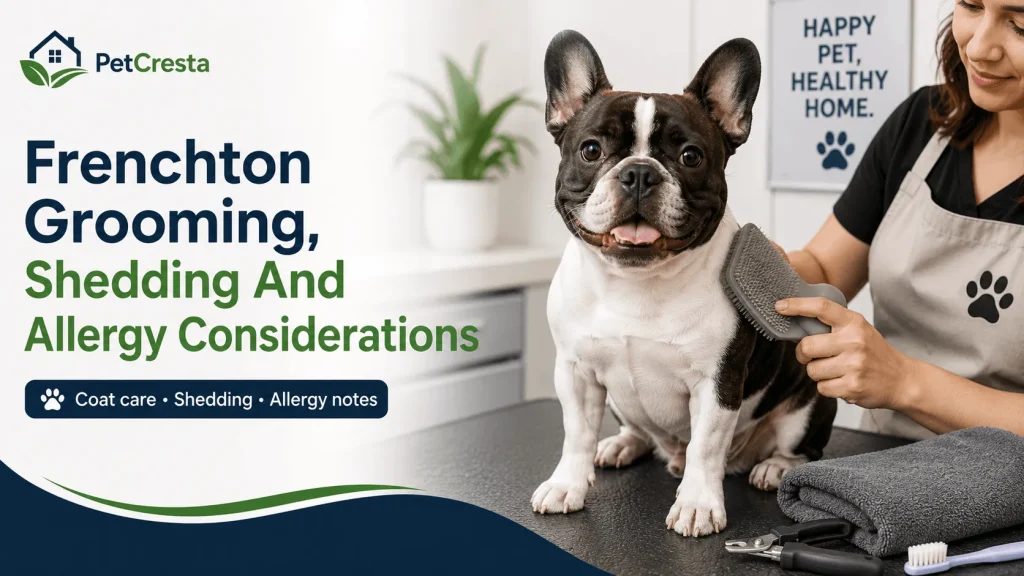
The short coat is apparently simple and, in many respects, it is. A Frenchton will require less coat work than a long haired dog but the eyes, ears, skin, nails, folds and teeth should still be attended to regularly.
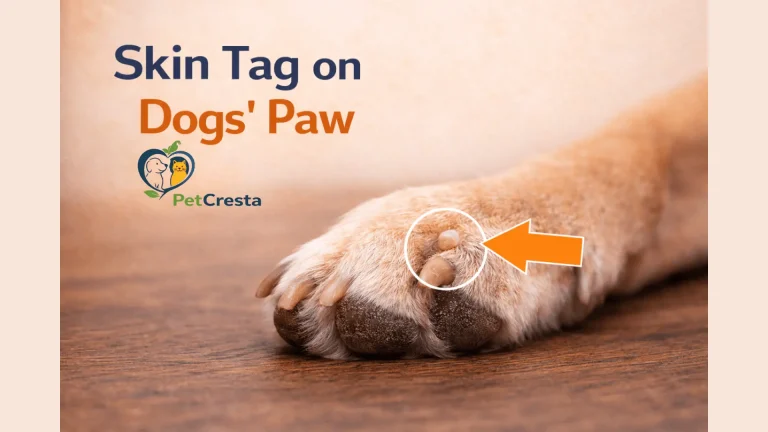
Routine care also provides an opportunity to discover a new lump, sore area, smell, painful tooth, or irritated eye before it gets worse. A newly discovered growth may resemble a skin tag on a dog, but any lump that changes, bleeds, causes pain or grows quickly should be examined by a veterinarian.
Do Frenchtons Shed?
Yes, Frenchtons shed. It is usually not a lot, but can vary with coat density, season, health and inherited factors to cause the loose hair to become more or less visible.
Short hairs are particularly adept at getting into fabric. If you brush your pet’s coat weekly, you can remove some of that fur before the sofa does.
It is impossible to completely prevent shedding. Sudden increase with balding, itching, odor or inflamed skin should be assessed by a veterinarian.
Are Frenchtons Hypoallergenic?
Frenchtons are not considered hypoallergenic. They shed dander, saliva and skin oils which can cause allergies.
Low visible shedding does not equate to low allergen exposure. Allergies should be given time to spend with adult Frenchtons before commitment.
Persons with a history of serious reactions should consult a health care provider. A puppy should not be an allergy test for the family or a rehoming hazard for the dog.
Frenchton Grooming Routine
Groom with a soft brush or grooming mitt once a week or when necessary. Bathe the dog when dirty rather than following an unnecessarily frequent schedule. Use that time to inspect the neck, ears, armpits, groin and paws, since embedded ticks on dogs can be missed even beneath a short coat.
If the dog has facial folds, look for them. Do not use medicated wipes, powders or creams on the skin, and consult your veterinarian first.
Check ears for redness, odor, pain or discharge. Eye discharge, squinting, cloudiness or repeated rubbing should not be treated as a normal cosmetic stain.
Cut nails to suit growth and walking surface. Short jaws can crowd teeth, so dental home care is equally important.
The AVMA suggests routine dental exams, and more frequent evaluation of any of the following symptoms: bad breath, loose or broken teeth, abnormal chewing, drooling, decreased appetite, bleeding or swelling.
Exercise Needs And Climate Limits
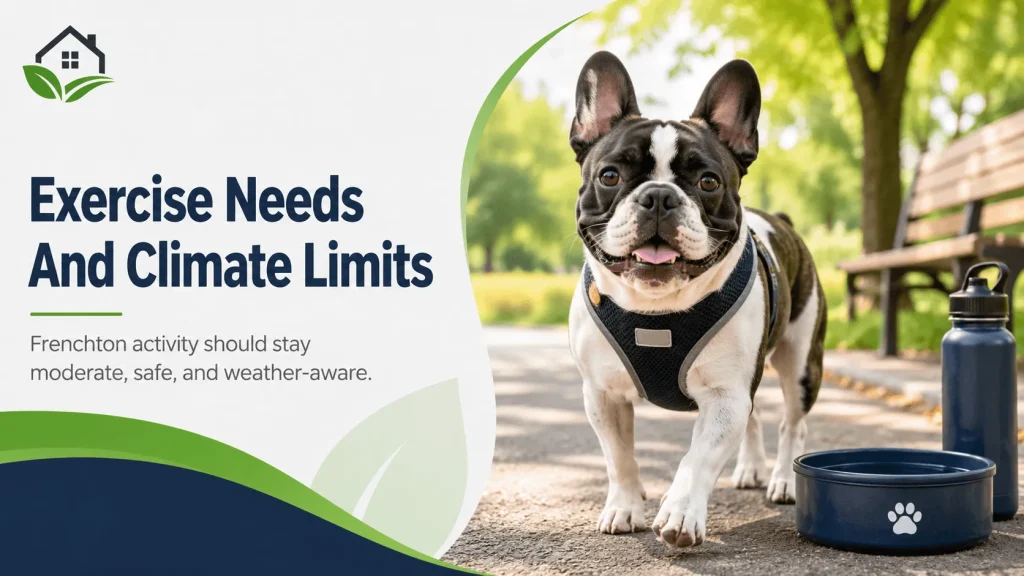
Frenchtons typically like to move and play. Most are more appropriate for moderate activity than for long periods of running or conditioning. Water should remain available during warm weather and after activity, and owners should understand how long a dog can go without water because short-faced dogs may become overheated or dehydrated quickly.
The correct procedure should leave the dog relaxed, interested and recover as normal. If the dog ends up in respiratory distress, exercise is not successful.
How Much Exercise Does a Frenchton Need?
Adult Frenchtons are happy to have short walks, play inside, sniff and have short training games throughout the day. Duration should be based on age, weather, airway function, body condition and general health.
Pupfishes require exercise but do not require repetitive high impact exercise. Safe surfaces, short outings, and free exploration and play are valuable experiences without the boot camp.
It’s not about the intensity, it’s about the consistency. It’s better to have a little activity each day rather than one big activity at the end of the weekend.
When Exercise Becomes Too Much
Reduce speed if the dog is getting louder, lagging behind, not wanting to go any further, looking for shade, or taking longer to recover from the exercise. Compare the dog to his normal response, not another dog on the path.
If the animal collapses, becomes disoriented, has to work hard to breathe, the gums are abnormally colored, or the animal does not recover, it needs immediate veterinary attention. These signs are more worrisome in warm weather.
Never use distance targets from another breed. The plan should be based on the dog’s comfort and respiratory function.
Are Frenchtons Good Apartment Dogs?

Yes, often, but body size is not the only criterion for apartment suitability. Frenchton requires access to the toilet, daily activity, training, company and a comfortable indoor temperature.
Barking can be stimulated by sounds in the hallway, other doors, lifts, and visitors. Helping with early sound exposure and a consistent settle routine.
It may be more difficult to deal with extended absences than limited floor space. A well-behaved small dog in a quiet apartment is more likely to be a good fit than a small dog that is distressed and left alone all day in an apartment.
Feeding, Weight And Daily Care

There is no special food for a Frenchton just because it is a mixed-breed. The diet should be complete, age- and health appropriate, and fed in a quantity that will keep the dog at a proper body condition.
If there is an allergy, digestive upset, dental disease or other medical condition, food choices are more personal. Your veterinarian will be able to help you select a plan.
Feeding Routine And Portion Control
Portion-controlled meals are easier to eat. Some dogs will do well with free feeding, but it may make it more difficult to see that they are gaining weight slowly.
There are many different foods that have very different amounts of calories in a cup. Read the calorie content on the label and count treats, chews, table food and training treats as part of the daily allowance.
Don’t select grain-free foods just because they sound high quality. There is no recommendation for a grain-free diet for the entire breed, and each person should consider changing their dog’s diet for a specific reason.
Daily Care Schedule

Care made easy with a simple routine. It also enables the owners to identify small changes before it becomes a big problem.
The schedule needs to be modified for the particular dog. A Frenchton that has deep folds or chronic ear trouble or dental disease may require more frequent attention.
| Frequency | Care task |
|---|---|
| Daily | Observe breathing, appetite, eyes, energy and skin where needed |
| Several times weekly | Brush and inspect ears, coat and folds |
| Regularly | Trim nails according to growth |
| Daily or as advised | Dental home care |
| Seasonally | Adjust activity for temperature and humidity |
| Veterinary schedule | Preventive care based on age, location and individual risk |
The vaccination and parasite-control program is dependent on location and lifestyle. Listen to the veterinarian who is familiar with the dog and the disease risks in the area. Owners should check how often dogs need rabies shots using the official vaccination certificate, veterinary guidance and applicable local rules.
How To Train A Frenchton Puppy

Short, positive training is effective for frenchtons. Positive reinforcement can be given in the form of food, play, praise and access to desired activities.
AVSAB supports reward-based training methods and discourages training that is based on pain, fear, force or intimidation.
First-Week Priorities
The first week shouldn’t be too hectic. Allow the puppy to rest, eat, go to the bathroom, look around the house, and get used to the bed.
Have a veterinarian check and do not change food unless advised by the veterinarian. Start gentle handling, harness training, toilet training and very brief alone time.
Keep the parade of visitors to a minimum. A puppy doesn’t have to get to know the entire extended family before it knows where the water bowl is.
Toilet Training
Go to the designated toilet spot with the puppy after waking, eating, drinking, playing and being active. Bladder control is a gradual process, so young puppies require frequent opportunities.
Reward the puppy as soon as it is in the right position. If you do not make the connection until you go back inside, it will not be as clear.
Use an appropriate enzymatic product to clean up accidents and do not punish. If the difficulty in getting to the toilet or the need to go to the toilet is sudden or ongoing, it may be a medical issue and should be discussed with your veterinarian.
Crate And Rest-Area Training
Introduce the crate or pen as a comfortable place for rest. Leave the door open at first and place food, treats, or familiar bedding nearby.
Build duration in small steps. A crate should never become a place where panic, overheating, or urgent toilet needs are ignored.
Some puppies settle better in a larger pen or gated room. The goal is safe relaxation, not winning a battle over one type of equipment.
Socialization
Good socialization means positive, carefully managed exposure to people, surfaces, sounds, handling, transport, and suitable animals. It does not mean forcing the puppy to greet everyone.
AVSAB identifies the early months as a major social-development period and supports safe exposure before the vaccination series is fully complete. Disease risk should still be discussed with the puppy’s veterinarian.
Avoid busy dog parks and areas heavily used by dogs of unknown health status. Well-run puppy classes on clean surfaces may provide a safer, more controlled option.
Teaching Calm Alone Time

Start when the puppy is relaxed. Take a few seconds break, come back down, and repeat until the puppy is upset.
Slowly increase time and distance. Offer a cool and safe resting place and a suitable chew or food toy if appropriate.
Avoid practicing on the first full working day. If there is ongoing panic, escape behavior or distress, then longer periods of absence are not the answer, but professional support is.
First Training Priorities
Begin with skills that will make life at home safer and calmer:
- Name response
- Toilet routine
- Crate comfort
- Handling tolerance
- Recall foundation
- Loose-leash introduction
- Polite greetings
- Settling on a mat
- Calm independence
- Safe social exposure
Train for a few minutes at a time. When the puppy is still working, stopping before they finish the exercise will yield more progress than trying to squeeze in a last repetition.
Common Training Mistakes
Changing household rules confuses the puppy. Decide early whether furniture, rooms, and greeting behaviors are allowed.
Punishing accidents can make a puppy hide when it needs to toilet. Better supervision and more frequent outings solve the underlying problem more effectively.
Forced greetings may create fear. Give the puppy room to observe and choose whether to approach.
Long sessions lead to tired, distracted behavior. Keep practice short and useful.
Dominance-based methods can damage trust and welfare. Reward-based training is recommended for ordinary skills and behavior problems.
Bringing A Frenchton Puppy Home

The first few days are quieter for all with preparation. The puppy is leaving behind people, smells, littermates and routines that are familiar, so even a confident puppy might need time to adjust.
Prepare for pick-up. A tired puppy in the shopping cart is not as cuddly as it seems.
Before Pickup
Collect the contract, veterinary record, vaccination information, microchip details, feeding instructions, and copies of parent health results. Confirm what the seller expects if an early medical problem appears.
Prepare a secure crate or carrier for transport. A loose puppy should not travel on a passenger’s lap.
Book the first veterinary appointment and ask whether a stool sample or specific records should be brought. Keep the seller’s food for the initial transition unless the veterinarian recommends a change.
Puppy-Proofing The Home
Move cables, medicines, cleaning products, toxic foods, small objects, and unsafe plants out of reach. Block access to stairs, balconies, open pools, and rooms that cannot be supervised.
Create a cool, quiet sleeping space. They may struggle in a warm room long before an adult person feels uncomfortable.
Provide safe chew options and inspect them regularly. A toy that was suitable yesterday can become a swallowing hazard after enthusiastic renovation.
First Month At Home
Build a repeatable rhythm around food, sleep, toilet trips, training, play, and rest. Overtired puppies often become mouthy, wild, and unable to settle.
Introduce grooming gently during calm moments. Touch the paws, inspect the ears, lift the lips briefly, and reward cooperation.
Monitor breathing during sleep and after ordinary play. Record anything unusual on video for the veterinarian rather than relying on memory.
Continue safe social exposure and alone-time practice. Progress should be steady, not rushed.
Frenchton Puppy Cost And Ownership Expenses

The cost of the purchase is just the initial cost. The cost of equipment, veterinary care, food, training, insurance, boarding and unforeseen treatment are much higher throughout the dog’s life.
With a short-faced cross, health uncertainty should be given special consideration. Being inexpensive at the time of purchase can be costly if medical issues develop in the future and records are not available.
How Much Do Frenchton Puppies Cost?
The advertised price is dependent on the seller, location, age, color marketing, etc. and may vary. On the surface, Frenchton listings on Puppies.com ranged from $500 to $2,500, while Lancaster Puppies had an average price of approximately $1,123, with listings ranging from about $500 to $1,200. One specialist breeder said that the average is around $3,000. The above are asking prices and not verified completed sale prices.
A universal average is misleading due to the wide spread. The figure can be changed by transport, veterinary work, parent screening, seller practices and regional demand.
It is not a sign of good breeding if it costs more. Don’t assume that the lower the price, the better the deal.
| Price research | Detail |
|---|---|
| Region | United States |
| Date checked | July 2026 |
| Sources | Two large marketplaces and one specialist breeder |
| Visible advertised range | Approximately $500–$3,000 |
| Data type | Asking prices, not confirmed sale prices |
| Main limitation | Listings vary in age, location, services and seller quality |
Consider price as a factor in the choice. Health evidence and breeder conduct is more important.
Upfront Costs
A new puppy isn’t just a puppy that needs a collar and a hopeful bag of treats. When you plan for the entire setup, you don’t end up making hasty purchases.
| Category | Examples |
|---|---|
| Acquisition | Purchase, adoption or transport |
| Veterinary | Examination, vaccines, microchip and advised screening |
| Equipment | Crate, bed, bowls, harness, leash and identification |
| Home setup | Gates, cooling and safe confinement |
| Training | Puppy class or individual support |
| Financial planning | Insurance or emergency savings |
The prices are dependent on location and household decisions. The simple safe crate and harness are more important than a set of matching accessories.
Ongoing Costs
There are some costs that come up on a regular basis and are easy to budget. Others are not so easy to predict and that’s where insurance or a dedicated emergency fund can be useful.
| Regular monthly | Regular annual | Unpredictable |
|---|---|---|
| Food | Preventive veterinary visits | Airway treatment |
| Parasite products | Vaccination where required | Eye injury |
| Treats | Dental assessment | Spine or knee care |
| Grooming supplies | Training refreshers | Emergency treatment |
| Insurance premium | Boarding or sitting | Medication |
These categories can be expanded by dental care, prescription food, skin treatment and specialist visits. Budgeting only for food and vaccinations leaves a large gap.
Pet Insurance And Pre-Existing Conditions
Pet-insurance policies differ in waiting periods, exclusions, deductibles, reimbursement rules, and annual or lifetime limits. Read the policy wording before the puppy develops a documented problem.
Many policies exclude pre-existing conditions. Coverage for hereditary, congenital, or brachycephalic-related problems may depend on the plan and whether signs appeared before coverage began.
Ask how airway surgery, specialist eye treatment, spinal imaging, and rehabilitation are handled. Keep written answers and a copy of the policy version you purchased.
How To Find A Responsible Frenchton Breeder

There is no test that will assure a 100% healthy puppy. Even with documented screening, clear family history, some structure in parenting, and appropriate socialization, there is still some uncertainty that can be reduced by responsible contracts.
A good seller should be able to talk about their weaknesses as well as their strengths. When every litter is “absolutely perfect,” it is typically a marketing ploy, not a biological occurrence.
Health Evidence To Request
Request test names, dates, results, registered identities, and links to public records (if available). Documentation is not a verbal “all clear”.
| Evidence | What to verify | What it cannot guarantee |
|---|---|---|
| Parent identities | Registered or documented names | Health by itself |
| Eye examination | Date, examiner and result | No future eye disease |
| Patellar assessment | Result for each parent | Every puppy will have normal knees |
| Cardiac assessment | Type, date and result | No future heart problem |
| Hip assessment where recommended | Registry and result | Perfect mobility for life |
| Respiratory assessment | Formal grading where available | Every puppy will have a normal airway |
| Puppy records | Veterinary examinations and treatment history | Complete inherited-disease screening |
| Family history | Disease, surgery and longevity | Absence of unknown problems |
OFA says a CHIC number is a sign that the tests were conducted and published. Not all results were normal.
Parent-Breed Health Testing
Hip, eye, patellar and cardiac evaluations are included in the CHIC requirements of the French Bulldog Club of America. Further recommended testing and registry use is also discussed.
The Boston Terrier Club of America has a certification program for the year of 2025 that includes eye and patellar certification for the Silver level, and also includes BAER hearing certification for the Gold level. The document also details how its eye certification is renewed and how the formal patellar examination is recorded once the dog reaches the eligible age.
When breeding a Frenchton, it is important to think of both breeds, not just the easier one to test. Recommendations are subject to change; please refer to the latest parent club and OFA information before buying.
Questions To Ask Before Choosing A Puppy
Useful questions request evidence instead of simple reassurance:
- What are the documented names of both parents?
- Where can I verify their health results?
- Have either parent or close relatives needed airway surgery?
- What eye, knee, spine, skin, dental, hearing, or cardiac problems have occurred in the family?
- How do the parents breathe while asleep?
- How do they recover after ordinary activity?
- How are the puppies raised and socialized?
- What veterinary care has each puppy received?
- At what age do the puppies leave?
- What does the contract cover?
- Will the breeder take the dog back if the owner cannot keep it?
- What support is available after pickup?
Listen for specific answers. Names, dates, records, and honest limitations are more useful than repeated claims of “excellent bloodlines.”
What To Observe In The Puppy And Parents
Observe normal behavior of adult dogs when they rest, move and recover from normal activity. Listen for breathing noises, visible effort, movement, eye comfort, skin condition, and ability to settle.
Watch the puppy’s surroundings. Cleanliness is important, but so are safe enrichment, human interaction, rest space and contact with the mother when appropriate.
A short visit is no proof of health. Observation may provide information to prompt further questions, but it cannot be a substitute for formal screening or an independent veterinary exam.
Red Flags Buyers Should Not Ignore
There are different types of sellers and different personalities. The following signs should be treated with extra caution, as they restrict transparency or put sales pressure over the puppy’s wellbeing.
| Evidence to look for | Reasons to pause |
|---|---|
| Verifiable parent identities | Refusal to identify the parents |
| Named health tests and results | “Healthy because mixed” |
| Honest discussion of airway risk | Loud breathing dismissed as normal |
| Opportunity to see the mother | Parking-lot handover only |
| Written contract and return policy | No contract or support |
| Clear socialization plan | No explanation of puppy raising |
| Questions about the buyer’s home | Pressure for immediate payment |
| Original photos and live video | Stock or stolen photographs |
| Appropriate pickup age | Unusually young puppy |
| Health and temperament focus | Rare color dominates the sales pitch |
Records are not something that can be replaced by a well-designed website. A normal-looking breeder who has clear evidence is preferable to a beautifully branded seller who does not ask direct questions.
Before Paying A Deposit
- Verify the seller’s identity.
- Confirm the puppy through a live video call or visit.
- Identify both parents.
- Review the health-test records.
- Read the full contract.
- Confirm refund and return terms.
- Confirm the collection age.
- Understand transport arrangements.
- Keep written communications.
- Use a traceable payment method.
- Arrange a post-purchase veterinary examination.
- Confirm what happens if an early medical problem appears.
Do not allow artificial urgency to make the decision. Another family being “ready to pay right now” is not a reason to skip verification.
Ethical Breeding And Welfare Questions

Both parents are short-nosed. Respiratory, reproductive, eye, spinal, and orthopedic concerns are not eliminated by crossing these.
Some breeders seek more moderate structure, open nostrils, better functional breathing and less exaggerated bodies. Adult assessments, formal tests, family records, and open discussion are all needed to support those goals.
Other breeding programs are more concerned with color, or very small size, or extreme facial appearance. The buyer should think about how those priorities contribute to the dog’s comfort.
Rescue is also an option. The ethical issue is not resolved by a trendy label; it is a matter of breeding, evaluation, upbringing, sales, and maintenance of dogs.
Rescue And Adoption Option

They are not the only route to ownership. Adults and Frenchton-type mixes sometimes enter shelters, small-dog rescues, French Bulldog rescues, Boston Terrier rescues, and established rehoming programs.
Availability can be unpredictable. Patience may produce a better match than rushing toward the first puppy advertisement.
Where To Look
Begin with reputable local shelters and registered welfare organizations. Parent-breed rescues may occasionally accept Frenchton mixes even when the dog is not a pure French Bulldog or Boston Terrier.
Check each organization’s geographic area, adoption process, fees, medical disclosure, and return policy. Avoid sending money to a rescue name that cannot be independently verified.
An adult dog listed under a broader description such as “French Bulldog mix” may still be relevant. Visual identification of mixed ancestry is not always accurate, so focus on the individual dog’s known needs.
Why An Adult Frenchton May Be Easier To Assess
An adult’s height, weight, coat, muzzle, and body frame are already visible. Breathing during sleep and ordinary activity may also be easier to observe.
Foster carers may know how the dog behaves with visitors, children, cats, other dogs, and time alone. Existing veterinary records can provide information that a young puppy has not yet had time to develop.
Adult adoption still carries uncertainty. It simply replaces some puppy-growth questions with more observable information.
Questions To Ask A Rescue
- What medical history is available?
- How does the dog breathe during sleep and activity?
- How does the dog cope with warm weather?
- Does the dog take medication?
- How does the dog behave with children?
- How does the dog behave with dogs and cats?
- Is the dog house-trained?
- How does the dog respond when left alone?
- Is there a bite or guarding history?
- Are there mobility concerns?
- Why did the dog surrender?
- What support is available after adoption?
A good rescue may not know every answer. Honest uncertainty is more useful than a confident guess.
Home And Lifestyle Fit

The questions below focus on practical compatibility. A few honest “no” answers may point toward an adult dog, another breed, or a different time to adopt.
| Question | Why it matters |
|---|---|
| Can you provide daily companionship while teaching independence? | Some Frenchtons are strongly people-focused |
| Can you maintain a cool indoor environment? | Short-faced dogs may struggle with heat |
| Can you adjust exercise to the individual dog? | Endurance and recovery vary |
| Can you maintain appropriate body condition? | Excess body fat can add strain |
| Can you budget for uncertain veterinary costs? | The mix may inherit conditions from either parent |
| Can you manage shedding and routine grooming? | A short coat still requires care |
| Are you choosing based on evidence rather than color? | Appearance does not prove health |
A yard is helpful but not required. It cannot replace training, companionship, observation, or appropriate daily activity. Families comparing small companion mixes can also consider whether a Miniature Cockapoo is a good fit, particularly when coat care, exercise tolerance and breathing structure affect the decision.
First-Time Owner Fit
If you are a first-time homeowner, a Frenchton can be a great option for you if you’re well-prepared. Preparation is more than just getting supplies.
The owner should be prepared to train the toilet, reward quietness, control temperature, check breathing, keep the body condition in check, clean folds if they exist, provide dental care, and seek professional assistance if necessary.
Having a supportive veterinarian and reward-based trainer can make the first few months a lot easier. You should plan for your small dog as you would plan for a larger dog.
Homes That May Prefer Another Dog
A Frenchton might not be the best choice for a long distance running or hiking partner. A dog that is used to being left alone for extended periods of time may not do well in a home where this is a regular occurrence.
If there is no or an unreliable indoor cooling system or if medical expenses are too costly, think about using another method. Those looking for a non-shedding dog should also consider other breeds. Those wanting a lower-shedding companion may compare whether a Cavapoochon is the right dog for them, while remembering that no dog is guaranteed to be allergy-safe and a longer coat brings considerably more grooming.
Those who want a certain size, rare coat and particularly a flat face are probably relying too much on looks. A different adult rescue or a breed with different physical characteristics might be a better fit.
Key Takeaways
Frenchtons are not easy or difficult, just because. The first step to good ownership is realistic expectations and evidence.
- Frenchton is not a recognized breed, but a cross of French Bulldog and Boston Terrier.
- Size, muzzle length, appearance and temperament are variable in adults.
- Having a mixed breed does not mean that there will be fewer airway or inherited health issues.
- Most require moderate activity, temperature control, training, grooming and weight control.
- Color and sales claims should not be used to make a breeder decision.
- A rescue dog or an adult dog may give a better idea of size, temperament and requirements.
The puppy may start the discussion. Comfort, health and household compatibility are the most important factors and should be considered for the long-term.
FAQ’s
They are young dogs produced from French Bulldog and Boston Terrier parentage. They are mixed-breed dogs rather than members of an AKC-recognized Frenchton breed. Appearance and temperament can vary within one litter. The mix does not guarantee an equal blend of both parent breeds.
Many adult Frenchtons are reported to be around 15–25 pounds and 11–16 inches tall. Some become smaller, heavier, taller, or more compact. Parent size, sex, inherited frame, health, and body condition affect the result. No early puppy photograph can guarantee an exact adult measurement.
Many approach adult height between 9 and 12 months. Chest, muscle, head shape, and mature body proportions may continue developing until roughly 12–18 months. Growth rate differs between individuals. A veterinarian should assess poor growth, unexplained weight changes, or an abnormal body condition.
Some do. Both parent breeds are brachycephalic, so Frenchtons may inherit airway restriction, noisy breathing, heat intolerance, poor exercise tolerance, or other BOAS signs. Not every dog is affected to the same degree. Persistent noise, visible effort, slow recovery, or disturbed sleep deserves veterinary assessment.
Many can be affectionate family companions when interactions are supervised. Children should learn gentle handling and leave the dog alone while it rests, eats, or seeks distance. Temperament varies between dogs. Small size does not make rough play safe.
Ask for documented parent identities and current results relevant to both parent breeds. Important categories include eyes, kneecaps, cardiac health, hips where recommended, hearing for the Boston Terrier side, and respiratory assessment where available. Verify public results independently. A CHIC number confirms that required results were submitted and published, not that every result was normal.
Published estimates commonly fall around 10–15 years, but there is no definitive standardized Frenchton lifespan figure. Individual health and family history create considerable variation. Airway function, body condition, inherited disease, dental health, preventive care, and environment may affect both lifespan and quality of life.
References: Breed Background
- American Kennel Club. French Bulldog Dog Breed Information.
- American Kennel Club. Boston Terrier Dog Breed Information.
- American Kennel Club. Official Standard of the French Bulldog.
- American Kennel Club. Official Standard of the Boston Terrier.
Respiratory and Veterinary Information
- Orthopedic Foundation for Animals. Respiratory Function Grading Scheme.
- American Veterinary Medical Association. Warm Weather Pet Safety.
- American Veterinary Medical Association. Pet First Aid.
- American Veterinary Medical Association. Pet Dental Care.
Health Testing
- French Bulldog Club of America. Health Testing and Registries.
- Boston Terrier Club of America. Health Certification Program.
- Orthopedic Foundation for Animals. CHIC Program.
Training and Socialization
- American Veterinary Society of Animal Behavior. Position Statement on Humane Dog Training.
- American Veterinary Society of Animal Behavior. Position Statement on Puppy Socialization.
Price Research
- Puppies.com. Current Frenchton Listings. Checked July 2026.
- Lancaster Puppies. Current Frenchton Listings. Checked July 2026.
- Frenchton Pups. Frenchton Puppy Pricing. Checked July 2026.