Standard Goldendoodle Size, Temperament, Care, Cost, and Family Fit

The largest Goldendoodle size is a Standard Goldendoodle. In most households, this will refer to a large dog, social, a lot of grooming and daily exercise they like to do, which would be easier to enjoy if the house is prepared for them.
This guide is not a description of a breed, but rather a guide to making decisions. It includes full grown size, coat type, exercise, health, cost, and the type of home into which a Goldendoodle fits.
- Size: Large
- Grooming: High
- Lung capacity: Average to good
- Best Fit: Active homes with time for training and coat care.
Quick Answer: What Is A Standard Goldendoodle?
Goldendoodles are hybrids of Golden Retrievers and Poodles, the largest breed. Breed standard descriptions typically specify the standard size as more than 21 inches tall and more than 51 pounds, and many mature adults will weigh anywhere in the range of 50 to 90 pounds or more depending on the sex, the size of the parents, and build.
This typically translates to a large-sized Goldendoodle that may require more space, more training, more grooming, and more planning than a mini and medium-sized Goldendoodle. Beautiful coats are not always low effort, but they can be!
Naming Clarification
There are a number of terms that can be easily confused when it comes to Goldendoodles. Standard, full grown, large, F1, F1B, F2 and multigen are not synonymous.
- Standard is the largest size class of Goldendoodles.
- Full grown means grown to full size
- F1, F1B, F2, and multigen refer to generation.
- Large is not a size designation; it is a casual description.
- All three: size, coat and shedding, will not be exactly the same in one generation.
The size, coat type, generation and breeder records of a parent typically reveal much more than the label does.
Quick Verdict: Is Standard Goldendoodle The Right Fit For You?
| Best fit | Harder fit |
|---|---|
| Active households | Long workday absences |
| Families ready for training | Homes wanting a low-maintenance coat |
| Owners are comfortable with regular grooming | Homes with little time for exercise |
| People want a large social dog | Anyone expecting a fully hypoallergenic dog |
| Homes where the dog is part of daily life | Households not ready for big dog manners |
While a Standard dog may be a good choice for some homes, it’s not always an easy choice for others.
Goldendoodle Home Setup
While a Goldendoodle doesn’t necessarily require a massive yard, it requires adequate daily routine, activity and human interaction to keep it calm. It may be convenient to have a fenced yard, but it is no substitute for walks, training, or supervised activity.
Living in an apartment could be suitable in some homes, particularly if the dog has plenty of exercise, is trained to be calm and has sufficient time spent outside of the apartment. The bigger problem is most often not square footage. It’s the noise, teen energy, elevator or hallway control, and if the family is able to have a large social dog mentally and physically stimulated.
The problem with long absences is much more daunting than with home type. Goldendoodles do not do well alone for extended periods particularly in the wee hours when they are young. Generally, it is best to have someone around who can provide training, exercise, grooming, and routine.
Characteristics Of Goldendoodles At A Glance
| Trait | Snapshot |
|---|---|
| Parent mix | Golden Retriever and Poodle |
| Size class | Standard, the largest Goldendoodle size |
| Height | Usually over 21 inches |
| Weight | Often 51 pounds or more |
| Common full-grown range | Often about 50 to 90 pounds |
| Energy level | Moderate to high |
| Grooming level | High |
| Coat textures | Straight, wavy, curly |
| Common coat colors | Gold, cream, apricot, red, brown, black |
| Lifespan | Often about 10 to 15 years |
| Recognition status | Not AKC recognized as a breed |
| Breed standard reference | GANA maintains a widely used breed standard |
| Best for | Active homes with grooming tolerance |
| Harder for | Very busy homes want a low-effort dog |
Standard Golden Doodle: Breed History And Origin

Goldendoodles first originated in the late 1960s when long-haired poodles were bred with golden retrievers as guide-dogs, and gained considerable popularity later. As more families began seeking a companion dog with a friendly nature and possibly with a less “mutt” coat in the 1900’s and early 2000’s, interest has grown.
What Each Parent Breed Often Contributes
This is why oldendoodles can come in different coat types, energy levels and require different levels of handling. A Golden Retriever will usually bring a sociable, enthusiastic and people-oriented personality. The Poodle may bring athleticism, problem solving skills and even additional coat variety.
Both parties operate concurrently. Some Goldendoodles are more likely to shed and be a retriever type, others are more likely to be a Poodle type in shedding and trainability. That is one reason expectations should stay flexible, especially with mixed-breed dogs. If you are comparing large family-oriented doodles with a heavier build and a different parent mix, Golden Mountain Doodle is a useful next read.
| Parent breed | What it often adds |
|---|---|
| Golden Retriever | Friendly social nature, family focus, outgoing temperament, and retrieving drive |
| Poodle | Trainability, athletic ability, alertness, curlier or lower-shedding coat tendencies |
| Combined result | Large companion dog with broad variation in coat, energy, and handling needs |
What The Mix Does And Does Not Predict
This label is useful to help clarify the breed of a dog, but it doesn’t ensure:
- One exact adult size pack.One actual grown size pack.
- One precise texture of a coat
- One precise shedding level
- One definite temperament type
Generally, the best clues are obtained from the parents, the generation, the breeding line, and the way the dog is raised.
Appearance, Coat Colors, And Adult Look
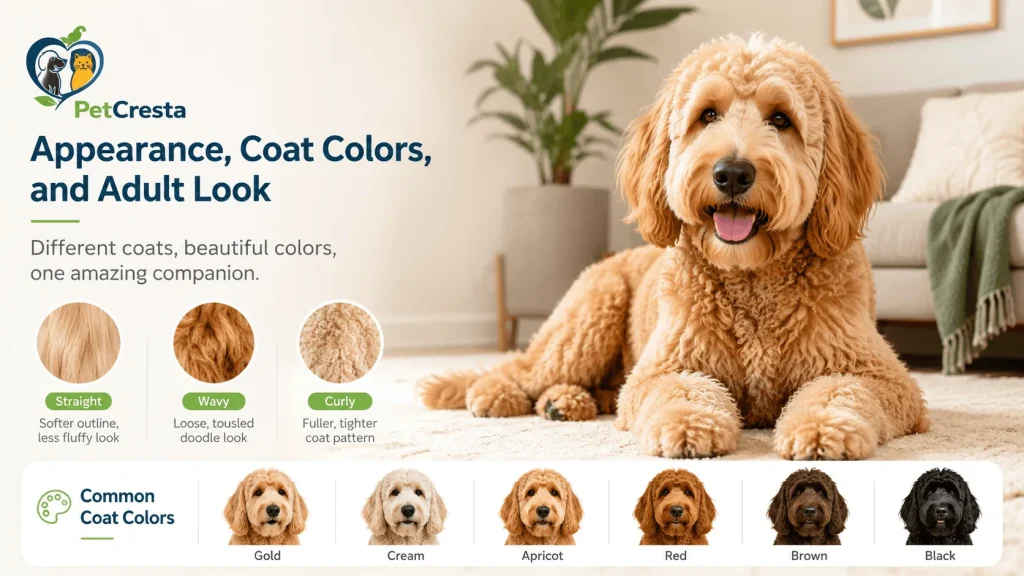
This Dog is typically athletic and not too heavy. They are long-bodied, have a deep chest, soft expression and coats varying in texture and style from shaggy and loose, to tightly curled.
Many also have furnishings, which refers to the presence of fuller facial hair around the muzzle, eyebrows and cheeks. This feature can also give that beloved ‘teddy bear’ look to many owners, but it won’t assure specific shedding.
Coat Textures And How They Affect Appearance
| Coat texture | How it usually looks | Grooming effect |
|---|---|---|
| Straight | Softer outline, less fluffy look | Often easier to comb through but may shed more |
| Wavy | Loose, tousled doodle look | Common middle ground for upkeep |
| Curly | Fuller, tighter coat pattern | Often lower visible shedding but higher mat risk |
Common Coat Colors
Goldendoodles come in a variety of colors such as:
- gold
- cream
- apricot
- red
- brown
- black
Color is genetically determined and may change with maturing coat and/or a shorter clip. A brief cut will give the dog a leaner, darker appearance. The same dog can appear softer, fuller and larger with a longer coat.
Full Grown Standard Goldendoodle Size And Growth

These dogs tend to be large, active dogs. The breed standard size tends to range from over 21 inches in height and over 51 pounds or heavier. Parents determine the amount of weight that many adults lose, usually in the range of 50 to 90 pounds — depending on the individual’s body size, sex, frame size, and condition.
This is an important size for everyday use. A standard dog requires more space in the car, a larger dog crate, better leash control, a higher food budget and more time for grooming than a mini or medium Goldendoodle.
| Measure | Standard Goldendoodle |
|---|---|
| Standard threshold | Over 21 inches and 51 pounds or more |
| Common height range | About 20 to 26 inches |
| Common weight range | About 50 to 90 pounds |
| Overall build | Large, athletic, substantial |
When Do These Dogs Stop Growing?
Most of these dogs are fully grown at approximately 12 months of age, but may be taller when they are fully grown. Adult shape, muscle shape and chest shape can still grow until 18-24 months of age.
A dog that appears to be almost full grown at 1 year can be young, lanky and unsettled.
| Age | What Owners Often Notice |
|---|---|
| 8 weeks | Small puppy body, fast learning, frequent potty and sleep needs |
| 4 months | Noticeable growth, chewing, confidence, and early training needs |
| 6 months | Taller frame, stronger leash presence, adolescent behavior |
| 9 months | Lanky body, uneven maturity, bigger physical presence |
| 12 months | Near adult height in many dogs |
| 18 to 24 months | More finished body shape and fuller maturity |
What Changes Adult Size?
Early puppy appearance is not as important as parents’ measurements and breeding history when determining adult size. A larger size male from larger parents may turn out quite differently from a smaller female from lighter framed parents.
The largest sizes are:
- parent size
- sex
- generation
- body frame
- nutrition
- body condition
- A record of previous litters from the breeder
Generation label affects predicting the adult size, particularly in coat and shedding tendencies. Parent structure and family history are more important than the label.
Male Vs Female Size Differences
Males may be slightly larger than females in size, slightly taller, and slightly wider. Males may be slightly larger than females in size, height, and width but that is not a problem. Even a smaller man can finish ahead of a larger woman.
Sex provides an overall prediction, not an assurance of size. Still, the size and structure of parents are better indicators.
Standard Vs Medium Vs Mini Goldendoodle

Standard is not a medium or mini but it also has other differences. The distinction is in the areas of leash training, grooming time, crate size, food amount, travel space and the amount of adolescent household structure.
| Size Class | Space Needs | Handling Strength | Travel Ease | Grooming Time | Food Cost |
|---|---|---|---|---|---|
| Mini | Lower | Easier | Easier | Moderate | Lower |
| Medium | Moderate | Moderate | Moderate | Moderate to high | Moderate |
| Standard | Highest | Strongest | Harder | High | Highest |
Mini is often more appropriate for homes that are designed with portability in mind. If the family would like something in the middle, medium will work well. Standard suits those who want a big, lively, social pooch and have the time to accommodate.
Standard Goldendoodle Temperament And Trainability

Many 1of these dogs are friendly, social, affectionate, and quick to bond with their families. They often enjoy being near people and may do best in homes where the dog is included in daily routines.
Friendly does not mean automatically easy. A large, young doodle still needs manners, calm routines, leash training, grooming tolerance, and clear boundaries.
Personality And Family Behavior
A properly bred Goldendoodle will be warm, playful, friendly, and focused on people. Children, visitors, other dogs and an active family life are enjoyable for many who are fond of them when introduced and supervised properly.
Size still matters. If impulse control is not well developed, a young standard dog can upset children, push over guests, overwhelm a small pet or knock over a larger pet, or a dog with a weak pull on leash can pull hard.
Trainability And Intelligence
Goldendoodles are smart and are responsive to rewards, praise, repetition and brief training sessions. They are intelligent, which can lead to the quick formation of unwanted habits.
Early training should be done with:
- name response
- recall
- leash manners
- calm greetings
- crate comfort
- grooming handling
- settling on cue
- waiting at the doors
- courtesy of food and toys
Goldendoodles standard that aren’t given enough freedom are typically the easiest to keep. They are assigned regular schedules, sleep, rules and practice.
Common Behavior Problems
Friendly dogs are supposed to be easy, but this is not always true for first time owners. Kids in the mood for doodling can get fidgety, fussy, loud, demanding or restless if routines are weak when they’re older.
The problem is typically one of temperament. It’s over-excitement, sub-optimal impulse control, lack of rest and inconsistent handling.
Common problems include:
- jumping on people
- leash pulling
- barking for attention
- chewing from boredom
- counter surfing
- overexcited greetings
- difficulty relaxing indoors
It’s much simpler to prevent these issues than to resolve them once the dog is on a strong basis.
Do Standard Goldendoodles Bark A Lot?
Not all of them bark naturally, but they can do so when they are bored, excited, are alert, when they are separated from their owners, or when they are not getting a strong daily routine.
Cool training is important, too, but exercise helps. If a dog does not learn to relax, he may remain restless even after a long exercise.
Can Standard Goldendoodles Be Left Alone?
Although many Goldendoodles are not successful with large blocks of time at home, particularly as a puppy or adolescent. They are social animals and may be more prone to distress, barking, chewing or becoming frustrated when they are not with others for long periods.
Alone time should be practiced early and in a positive manner. Long working hours require a realistic schedule for the potty breaks, exercise, enrichment and human interaction for the home.
Are Standard Goldendoodles Good With Kids And Other Pets?
With proper socialization and supervision, many of these dogs get along fine with children, dogs and cats. They are social and this can be a good thing.
The main concern is physical size. It’s possible for a friendly adolescent dog to knock a child over, chase a cat or overpower a smaller dog without training or management.
Energy Level Exercise And Mental Stimulation

A Golden doodle typically has a medium to high-energy level. There are people who require more than one stroll. They generally perform best when they have a routine, structured movements, brain work and time for calm.
Age-Based Exercise Guide
| Life stage | What usually works best |
|---|---|
| Puppy | Short play sessions, brief walks, training games, plenty of sleep |
| Adolescent | More structured walks, controlled play, training, enrichment |
| Adult | Daily walks, active play, enrichment, skill work, rest periods |
Some adults require more than 30 minutes per day of true physical activity, and others require more formal physical activity than this. A high drive standard may enjoy hiking, brisk walking, running with the right conditioning, fetch, swimming, agility foundations, or obedience work.
Mental Stimulation Matters Too
Mental work often matters just as much as physical activity. Useful options include:
- food puzzles
- short training sessions
- sniff walks
- scent games
- structured fetch
- place work
- settle training
- chew enrichment
If a dog never learns to turn off, then he may remain restless even after he’s a lot of fun.
Sample Weekday Routine
| Part of the day | Example routine |
|---|---|
| Morning | Walk, breakfast, short training session |
| Midday | Potty break, enrichment toy, rest |
| Late afternoon | Brisk walk or play session |
| Evening | Dinner, calm family time, brushing or handling practice, final potty break |
Coat Types, Shedding, Hypoallergenic Claims, And Grooming

The fur looks good, but it will generally require regular upkeep.
Golden doodles may have straight, wavy or curly coats. Each texture affects the amount of brushing required, the amount of loose hair visible, and how easily mats can form.
Goldendoodle Coat Types
| Coat type | Visible shedding | Matting risk | Typical reality |
|---|---|---|---|
| Curly | Often lower | Higher | Needs frequent brushing and careful coat care |
| Wavy | Middle range | Moderate | Common balance between look and upkeep |
| Straight | Often higher | Lower to moderate | May shed more than many owners expect |
What Are Furnishings?
Fuller facial hairs, many Goldendoodles have around the face, eyebrows, and cheeks are called furnishings. Many families recognize the look of the mix thanks to the familiar teddy bear appearance they make.
Some dogs might have less visible shedding when furnished, but it does not mean that they are allergy safe dogs or shed free. A very soft looking dog can still shed, mat, or cause allergies in sensitive homes.
Sometimes, two puppies within the same litter may develop different textures of the coat, brushability, and shedding.
Do Standard Goldendoodles Shed?
Many shed less than a Golden Retriever, but shedding varies. Lower shedding is common in some coat types, yet a no-shed promise is not realistic.
Are Standard Goldendoodles Hypoallergenic?
No dog is fully hypoallergenic. Some Goldendoodles may be easier for certain allergy-sensitive homes to live with, especially if the coat is curlier, but allergens are still present.
Matting Hotspots
Mats often form first in areas that rub, stay damp, or get missed.
The most common trouble spots include:
- behind the ears
- armpits
- collar area
- tail base
- legs
Tools That Help
A few tools make coat care easier:
- slicker brush
- metal comb
- grooming spray
Grooming Schedule
| Grooming task | Common routine |
|---|---|
| Brushing | Several times each week |
| Bathing | About every 4 to 6 weeks, as needed |
| Haircut | About every 6 to 8 weeks |
| Ear checks | Weekly |
| Nail trims | About every 3 to 4 weeks |
| Teeth brushing | Several times each week, ideally daily |
A long, fluffy coat looks appealing, but it raises the grooming burden. A shorter trim is often more practical for busy households.
Feeding Weight Control And Bloat GDV Risk

A Goldendoodle should be fed a complete and balanced diet matched to its life stage. Puppies generally do best on an appropriate puppy formula, and many owners prefer a large breed puppy formula during the growth phase to support slower, steadier growth.
Many adults do well on two measured meals a day. Measured feeding matters because this size can gain weight quietly, especially if treats rise and activity falls.
Weight Control Tips
- measure meals
- Monitor body condition
- limit extras
- weigh regularly
- Adjust intake with activity level
Bloat And GDV Warning Signs
Large deep-chested dogs can face a risk of bloat and GDV, which is an emergency.
Warning signs can include:
- Repeated retching with little or nothing coming up
- pacing
- heavy drooling
- swollen abdomen
- sudden distress after eating
Call your emergency vet now if these signs appear.
Practical Prevention Habits
While no prevention plan removes risk completely, common guidance includes:
- feed measured meals
- Avoid heavy exercise right before and after meals
- Do not rush meals
- Stay alert to sudden abdominal changes
- Discuss individual risk with your veterinarian
Standard Goldendoodle Lifespan And Health Issues

Many Goldendoodles live about 10 to 15 years. Size, genetics, weight control, preventive care, and dental care all play a role in long-term health.
No responsible source should promise that Goldendoodles are automatically healthier because they are mixed breed dogs. Crossbreeding may reduce some risks in some lines, but health issues from Golden Retrievers and Poodles can still appear.
A careful health section should focus on prevention, screening, and early signs that deserve veterinary attention.
| Health Concern | Signs Owners May Notice | Why Early Attention Matters |
|---|---|---|
| Hip or elbow dysplasia | stiffness, limping, trouble rising | Joint disease can worsen with age and excess weight |
| Ear infections | odor, redness, head shaking, scratching | Floppy ears and dense coats can trap moisture |
| Skin allergies | itching, licking, hot spots, recurring irritation | Skin problems may become chronic |
| Eye disease | redness, cloudiness, squinting, vision changes | Some eye conditions progress quietly |
| Heart disease | coughing, fatigue, fainting, poor stamina | Early diagnosis can guide care |
| GDV or bloat | retching, pacing, drooling, swollen abdomen | This can become life threatening quickly |
What Health Testing To Ask For
Ask for documentation, not verbal reassurance. A responsible breeder should be able to explain which tests were done, why they matter, and how results affect breeding choices.
Useful records may include:
- hip screening
- elbow screening
- eye exam or CAER records
- cardiac screening
- patella records when relevant
- genetic testing relevant to the parent lines
- clear explanation of known health risks in the line
Routine Prevention And Monitoring
A sensible care plan includes:
- regular veterinary exams
- vaccines and parasite prevention
- dental care
- weight monitoring
- ear checks
- coat and skin checks
- consistent exercise
- early attention to changes in movement, appetite, vision, or behavior
Standard Goldendoodle Puppy Basics

The first year sets the tone for the dog that follows. With a large doodle, early habits matter because unwanted behavior becomes harder to manage once the body is bigger and stronger.
Puppyhood should focus on socialization, grooming comfort, calm routines, handling, rest, and basic skills that matter in a big adult dog.
First-year Priorities
- early socialization exposures
- crate comfort
- leash manners
- calm greetings
- handling feet, ears, and mouth
- grooming desensitization
- safe chewing habits
- recall foundations
- rest and settle practice
Puppies should also be protected from risky disease exposure before vaccine protection is complete. Socialization still matters during this stage, but it should be done thoughtfully and safely.
The First 72 Hours At Home
The first few days should be calm, predictable, and lightly structured. A new puppy needs time to sleep, learn the home routine, and adjust without constant handling or visitors.
Most puppies benefit from:
- a quiet sleeping area
- short potty routines
- predictable feeding times
- gentle crate introduction
- supervised exploration
- calm handling of paws, ears, and mouth
- short name response practice
- limited visitors
- safe chew options
- a planned veterinary appointment
Too much excitement in the first few days can make a puppy overtired and harder to settle. Calm routines usually build confidence faster than constant activity.
Puppy Training Priorities
- Teach name response
- Teach recall foundations
- Teach calm greetings
- Teach loose leash walking
- Teach crate comfort
- Teach grooming tolerance
- Teach handling of paws, ears, and mouth
- Teach settling on cue
- Prevent jumping from becoming a habit
- Expose the puppy to sounds, surfaces, people, and routine changes in a safe way
Puppy Setup Checklist
| Essential | Why it helps |
|---|---|
| Large breed puppy food | Supports growth phase feeding |
| Crate | Rest, routine, and house training |
| Playpen or gate | Safe management |
| Adjustable harness | Better early walk setup |
| Leash | Daily handling |
| Slicker brush and metal comb | Early coat care practice |
| Lick mat or food puzzle | Calm enrichment |
| Chew toys | Healthy outlet |
| Bowls | Measured feeding and hydration |
| Training treats | Fast reward timing |
| Enzyme cleaner | House training cleanup |
Different Types Of Goldendoodles And Generations Of Standard Goldendoodles

Generation labels help explain lineage. They are more useful for understanding coat and shedding tendencies than for predicting a certain personality.
Simple Definitions
- F1 goldendoodle means a first cross between a Golden Retriever and a Poodle
- F1B usually means an F1 Goldendoodle crossed back to a Poodle
- F2 usually means two F1 Goldendoodles bred together
- Multigen Goldendoodle refers to later-generation Goldendoodles
Quick comparison: F1 vs F1b Goldendoodle Vs F2 and Multigen
| Generation | Basic meaning | What it may help predict |
|---|---|---|
| F1 | Retriever and Poodle cross | Broad variation |
| F1B | Backcross, often to a Poodle | Often, a curlier coat and lower visible shedding |
| F2 | F1 to F1 | More variation from puppy to puppy |
| Multigen | Later generation breeding | Sometimes, more consistent coat tendencies |
Generation labels are useful, but they do not remove individual variation.
Cost Of Owning A Goldendoodle

A Goldendoodle can be costly to own, especially once grooming, food, training, and pet care support are included. Standard size often raises costs compared with mini and medium sizes because nearly everything scales up.
Goldendoodle Price Breakdown
| Cost area | What to expect |
|---|---|
| Upfront acquisition | Often from the low thousands into several thousand dollars |
| First year setup | Crate, gates, leash, harness, grooming tools, bowls, bed, puppy classes |
| Recurring annual costs | Food, grooming, preventive care, routine vet visits, parasite control |
| Surprise costs | Illness, injury, emergency care, extra training, pet sitting, or daycare |
Where The Money Usually Goes
Food and grooming are two of the biggest day-to-day cost differences with the standard size. Professional grooming visits add up over the year, and a large active dog generally eats more than a smaller doodle.
The safest way to budget is to expect variation by region and keep some room for surprises.
How To Choose A Breeder, Rescue, Or Shelter Responsibly
A Goldendoodle can come from a breeder, rescue, or shelter. The key issue is not the label alone. It is how honestly the dog is represented and how well health, temperament, and fit are handled.
Documents To Ask For Before Choosing A Puppy
A responsible source should be able to explain the dog’s background clearly. The goal is not to collect paperwork for its own sake. The goal is to understand health, temperament, coat expectations, and adult size risk before committing.
Ask for:
- parent health testing records
- eye and heart screening information when relevant
- genetic testing tied to the parent lines
- vaccination and deworming history
- contract and return policy
- grooming and coat expectations
- adult size history from related litters
- socialization notes
- temperament matching process
Avoid anyone who promises a guaranteed adult size, a completely hypoallergenic coat, or a perfect temperament from the label alone.
Green Flags
| Good sign | Why it matters |
|---|---|
| Full health testing records | Shows real screening, not vague claims |
| Transparent contracts | Sets expectations clearly |
| Temperament matching | Helps place the right dog in the right home |
| Support after placement | Suggests ongoing responsibility |
| Honest discussion of the coat and workload | Reduces unrealistic expectations |
Red Flags
| Warning sign | Why it matters |
|---|---|
| No documentation | Leaves health claims unsupported |
| “Fully hypoallergenic” promises | Not realistic |
| Refusal to show testing | Major concern |
| Size guarantees as certainty | Not realistic in a mixed breed |
| Glossing over grooming | Suggests poor buyer education |
Is A Standard Goldendoodle Right For Your Home?

This is where the decision takes on a more practical meaning. A Goldendoodle is a rewarder dog, but a rewarder dog where the house is prepared for the day. If Bernese influence is also on your shortlist, Bernedoodle puppies are a strong comparison for size, coat burden, and family fit.
Best Fit Homes
- active households
- Families that are ready to be groomed.
- students interested in training.Individuals who like training.
- Dogs in households that are part of the family’s daily routine
- Homes that would like a big personal dog companion.
If you are comparing large companion doodles with a different lineage and coat goal, the Australian Bernedoodle is another useful breed guide to review.
Who Should Think Twice
- Those who wish to have a low-maintenance coat.
- Households where there are long absences each day.
- Anybody who is expecting a highly hypoallergenic dog.
- Families do not have much time to exercise and follow up
- When your house is not well behaved, your dog doesn’t behave with big dog manners either.
For readers who are also considering an even larger doodle with heavier handling demands, st berdoodle is the better comparison to review before deciding.
When This Dog Is Not The Right Fit

Just because it is friendly doesn’t mean it is automatically an easy family dog. The wrong fit occurs when the family desires the appearance and personality and is not prepared for the effort involved.
This breed may not be a good fit for homes that are not prepared for:
- frequent brushing
- professional grooming costs
- adolescent energy
- jumping and leash pulling
- daily exercise
- regular training
- alone time practice
- large dog handling
- coat matting
- realistic allergy expectations
The first key to a better fit is a good set of expectations. They might not be the best choice for families that prefer a low-maintenance, highly independent, or naturally calm dog.
Common Mistakes First-Time Owners Make
- Underestimating adult size
- Underestimating grooming cost
- Adolescence, he expected nothing but calm, expecting perfection.
- If it is assumed that the plant is low shedding, then there is no shedding.
- Isolation: leaving the dog alone for too long.
- Delaying good manners
Final Checklist
- Have sufficient time for daily physical activity and mental effort?
- Can you afford to groom regularly?
- Does the home welcome a big dog, a strong dog?
- Is it likely that the family will maintain consistency in training?
- Do they have someone around them to keep them company, like a social dog
- Have reasonable expectations for shedding and coat maintenance?
The more honest the “yes” answers, the more likely that the fit is sound.
Conclusion
It is a big, extroverted, fastidious pet that can be a great asset to the right family. The allure is not just there, but neither is the daily routine of bathing, walking, training and caring for the dog over the years.
The most positive result is generally when the home is prepared for size, structure, coat and honest expectations. Once these aspects are addressed, a Goldendoodle can be a wonderful family companion.
FAQ’s
These dogs can vary because coat texture, furnishings, body frame, generation, and parent genetics are not identical from dog to dog. One may look lean and retriever influenced, while another may look curlier and more Poodle influenced. This variation is normal in mixed breed dogs
Many begin settling more reliably between 18 months and 3 years of age. Training, exercise balance, sleep, routine, and temperament all affect maturity. A friendly dog can still stay playful and energetic for a long time without calm behavior practice.
Odor can come from damp coat areas, ear infections, trapped moisture, saliva around the beard, skin irritation, or mats close to the skin. If the smell returns quickly after bathing or grooming, a veterinary check is sensible. Ear and skin issues are easy to miss under a dense coat.
Neither size is automatically better. A Standard may suit families wanting a large active dog, while a mini may suit homes needing easier handling and less space. Food cost, grooming time, travel needs, and leash strength usually increase with size.
Apartment living can work when exercise, training, potty routines, and noise management are handled well. The harder issue is often not square footage alone. A large doodle needs enough outdoor time, calm behavior indoors, and consistent handling in hallways, elevators, and shared spaces.
Most of these dogs are over 21 inches tall and at least 51 pounds. Many full-grown adults fall around 50 to 90 pounds, depending on parent size, sex, and build.
This is a Golden Retriever and Poodle cross in the largest Goldendoodle size class. It is not a separate pure breed.
Most need brushing several times each week and professional grooming about every 6 to 8 weeks. Coat type, coat length, and matting tendency can make the workload lighter or heavier.
Many adults need at least 30 to 60 minutes of real exercise each day, and some need more. Training games, sniff walks, enrichment, and active play often matter as much as distance.
Many are friendly, social, people-oriented, and highly trainable. Calm behavior still depends on training, routine, and early socialization.
Many can do very well with children when training, supervision, and greetings are handled properly. Their size still matters, especially during adolescence.
Many do not do well with long stretches alone, especially when young. Their social nature can make them more prone to distress, barking, or nuisance behavior if daily isolation is too long.
Many live about 10 to 15 years. Lifespan can vary with genetics, body size, weight control, preventive care, and overall health.
Many learn quickly and respond well to structured, reward-based training. Intelligence helps, but it does not replace follow-through and routine.
An F1 Goldendoodle is a first-generation Golden Retriever and Poodle cross. An F1B Goldendoodle is usually an F1 Goldendoodle crossed back to a Poodle, which often leads to curlier coat tendencies.
Ask about hips, elbows, heart, eyes, skin and ear history, and any parent-line testing relevant to the breeding program. Request proof, not just verbal reassurance.
Purchase price often falls in the low thousands and can climb much higher depending on breeder, line, and location. Food, grooming, vet care, training, and supplies raise the real cost over time.
It can be, but only when the home is realistic about grooming, training, exercise, and the physical handling of a large social dog.
References
- Goldendoodle Association of North America. Goldendoodle Breed Standard. https://www.goldendoodleassociation.com/about-the-breed/goldendoodle-breed-standard/
- PetMD. Goldendoodle Dog Breed Health and Care. https://www.petmd.com/dog/breeds/goldendoodle
- Chewy. Goldendoodle Characteristics, Care and Photos. https://www.chewy.com/education/dog-breeds/goldendoodle
- Rover. Goldendoodle Dog Facts, Care and Tips to Know. https://www.rover.com/blog/breeds/goldendoodle/
- Rover. Goldendoodle Puppies: The Ultimate Guide for New Dog Owners. https://www.rover.com/blog/goldendoodle-puppies-the-ultimate-guide-for-new-dog-owners/
- Golden Acres Puppies. A Guide to Caring for Your New Standard Golden doodle Puppy. https://goldenacrespuppies.com/a-guide-to-caring-for-your-new-standard-goldendoodle-puppy/
- Premier Pups. Goldendoodle Size Guide. https://premierpups.com/blogs/goldendoodle-size-guide