Doodle Mountain Breed: Types, Size, Temperament, Grooming And Cost

A Mountain Doodle isn’t a single breed of dog. Several crosses of the Poodle are named after the breed, typically a Bernese Mountain Dog, and often a Golden Retriever or an Australian Shepherd.
The confusion that can arise from puppy search names. Two dogs with the same label can grow up to be different sizes, have different coats and require vastly different exercise.
The best way to do this is to ignore the name. Find out what breeds are involved, look at both parents and decide if the puppy (and the grown dog) will be a good fit for your home.
TLDR: Is A Mountain Doodle Right For You?
For those who prefer an active and trainable dog, a Mountain Doodle can be a beautiful pet. Typically, daily interaction and grooming are part of the package.
It might not be a good fit if size and/or low maintenance or extended periods of solitude are essential requirements.
| May suit your home when… | May not suit your home when… |
|---|---|
| You want an involved, social companion | You want a highly predictable standardized breed |
| You can maintain regular brushing and grooming | You want a low-maintenance coat |
| You have time for training and daily interaction | The dog will routinely be alone for long periods |
| You accept variation in size and shedding | You require a guaranteed non-shedding dog |
| You can budget for professional grooming and veterinary care | Appearance is your main selection criterion |
Mountain Doodle Quick Facts
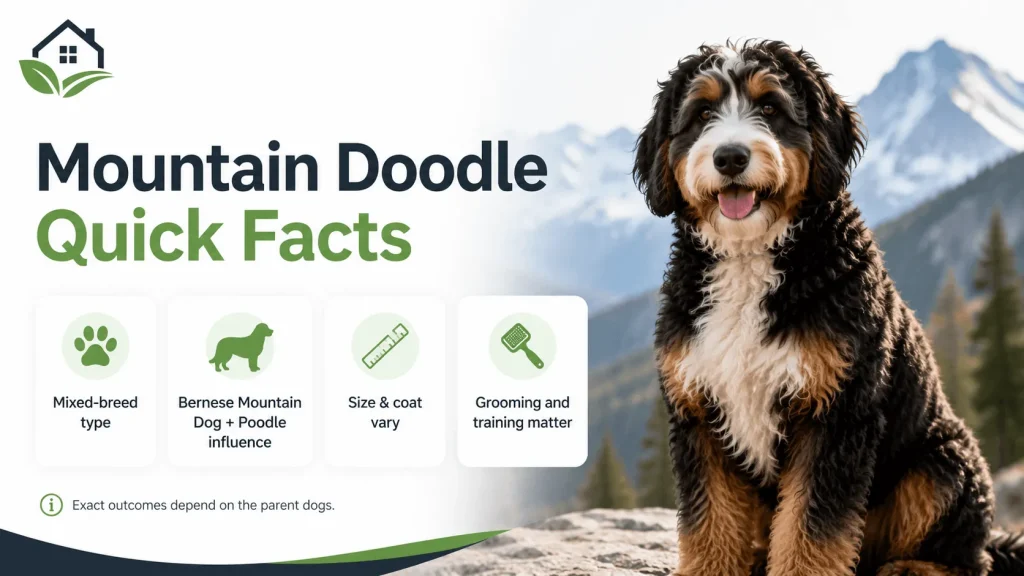
The words on the breed labels can be comforting. One reason responsible breeders provide ranges and not promises is that genetics are less cooperative.
The facts below provide a starting point. A particular family’s parents and previous adult offspring will provide more valuable information.
| Trait | What readers should know |
|---|---|
| Classification | Designer mixed-breed label, not one standardized breed |
| Common ancestry | Usually Bernese Mountain Dog and Poodle influence |
| Possible added ancestry | Golden Retriever or Australian Shepherd |
| Common type names | Golden Mountain Doodle and Australian Mountain Doodle |
| Size | Highly variable; breeder labels are not standardized |
| Coat | Straight, wavy or curly; furnished or unfurnished |
| Shedding | Variable and never guaranteed to be absent |
| Grooming | Usually moderate to high |
| Temperament | Influenced by parents, early development and training |
| Exercise | Moderate or higher depending on the line and individual |
| Lifespan | No reliable breed-wide dataset |
| Recognition | Not an established breed with one official standard |
| Best fit | Owners prepared for grooming, training and uncertainty |
Exact outcomes depend on the parent dogs and breeding program.
What Does “Mountain Doodle” Mean?
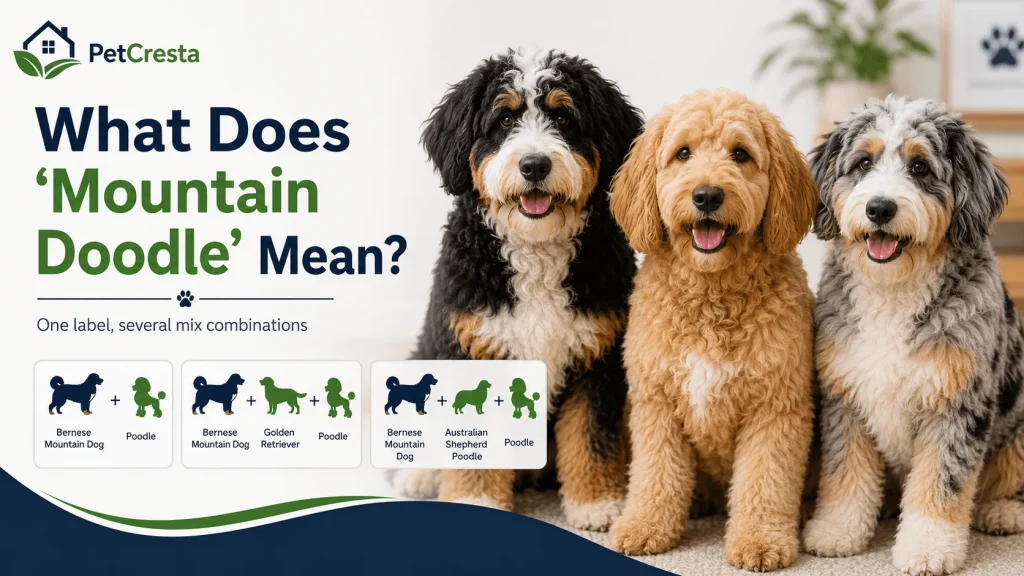
The name is suggestive of one cross. In practice, it is used on a number of related combinations.
Such flexibility is not necessarily a bad thing. Issues arise when a buyer thinks that the label contains information that is not actually given by the breeder.
Why The Name Varies Between Breeders
One program might be for a Bernese Mountain Dog–Poodle cross. Another may keep it for three-breed mixes.
Golden Mountain Doodle is a term used for Bernese Mountain Dog, Golden Retriever and Poodle ancestry. Australian Mountain Doodle usually refers to Bernese Mountain Dog, Australian Shepherd and Poodle ancestry. Within those general descriptions, there are still some differences in terms of breeder formulas, percentages and generations.
The additional layer is added by later generation breeding. A puppy could be a mix of all three breeds but not necessarily the same proportion from each breed.
Request the breeder to list all the breeds that have contributed to the line and display the pedigree. Don’t use a polished nickname as a substitute for that basic information.
Mountain Doodle Name Decoder
It can be easy to confuse similar names when there are multiple names with “Doodle,” “Golden,” or “Mountain.” The table below separates the commonly used meanings.
None of these labels will tell you what a dog will be like. They are just a way of explaining what a breeder says they’re using.
| Label | Common meaning | What must still be confirmed |
|---|---|---|
| Mountain Doodle | Broad breeder-used label | Exact parent breeds and percentages |
| Bernedoodle | Bernese Mountain Dog × Poodle | Generation, parent size and coat |
| Golden Mountain Doodle | Bernese Mountain Dog + Golden Retriever + Poodle ancestry | Formula and generation |
| Australian Mountain Doodle | Bernese Mountain Dog + Australian Shepherd + Poodle ancestry | Formula, energy and merle status |
| Goldendoodle | Golden Retriever × Poodle | Generation, size and coat |
| Aussiedoodle | Australian Shepherd × Poodle | Generation, drive and coat |
A Goldendoodle is a cross between a Golden Retriever and a Poodle. Golden Mountain Doodles are Bernese Mountain Dog crosses, but the route to the cross varies from program to program.
Mountain Doodle History And Origin
The history varies based on the Mountain Doodle type. SwissRidge Kennels attributes the success of producing an early Golden Mountain Doodle litter in 2013 to their pairing of a Goldendoodle with a Bernedoodle. The name was allegedly chosen via the breeder’s online community.
The history of the Australian Mountain Doodle is not as well recorded. The name is now applied to several breeding programs for dogs that are a mix of Bernese Mountain Dog, Australian Shepherd and Poodle.
These accounts are primarily based on the history of the breeders themselves and not from an independent breed register. They tell how the names came into use, but they don’t provide one single formula.
Main Mountain Doodle Types

It is easier to compare the label when it is broken up into common forms. It also ensures that a general description cannot be given to every puppy with the Mountain Doodle name.
Tendencies of the parents may indicate possibilities. They cannot guarantee that a puppy will have the desirable traits of each breed and leave the undesirable traits behind.
| Type | Common ancestry | Possible general influence | Main uncertainty |
|---|---|---|---|
| Bernese-focused Mountain Doodle | Bernese Mountain Dog and Poodle | Substantial build, social companionship | Whether this is simply being marketed instead of “Bernedoodle” |
| Golden Mountain Doodle | Bernese Mountain Dog, Golden Retriever and Poodle | Social, retrieving-oriented, people-focused tendencies | Formula and adult size vary |
| Australian Mountain Doodle | Bernese Mountain Dog, Australian Shepherd and Poodle | Alertness, trainability and greater mental activity | Energy, herding tendency and merle genetics |
Bernese-Focused Mountain Doodle
It’s a Bernese Mountain Dog with a poodle. The Bernese breed’s mountain-dog heritage is still a reason for some breeders to keep using Mountain Doodle.
These dogs can grow to be quite large, have a dense coat and be very family oriented. The size of the poodle, parent build and generation can make a significant difference to the adult size.
Don’t think that a Bernese is always a quiet dog. Bernese Mountain Dogs and Poodles are different individuals and have different levels of confidence, activity, sensitivity and sociability.
Golden Mountain Doodle
Golden Mountain Doodles have a mix of Golden Retriever, Bernese Mountain Dog and Poodle genetics. Some programs are making the Goldendoodle and Bernedoodle combination, and others are using later multigenerational combinations. Our guide to whether a Golden Mountain Doodle is worth it examines this specific three-breed mix in more detail, including its temperament, size, grooming demands and household fit.
Golden Retriever influence can bring about sociability, retrieving behaviour and enthusiasm for people. These remain in addition to Poodle activity and Bernese size and the characteristics of the individual parents.
Do not depend on a cheerful breed summary, but rather view the mature relatives. A warm and supportive parent who has bounced back from new experiences speaks more to you than a list of nice words.
Australian Mountain Doodle
This dog typically has a mix of Australian Shepherd, Bernese Mountain Dog and Poodle. Some programs utilize Miniature American Shepherds in smaller lines, so the breeder should specify the exact breeds instead of using “Aussie” in a loose manner. Read our complete Australian Mountain Doodle guide for a closer look at the mix’s size, activity level, herding tendencies, coat and daily care.
Australian Shepherd influence can include alertness, fast learning, sensitivity to movement and herding behaviour. That responsiveness can be a luxury for the active household, and a challenge for the quiet one.
Australian Shepherds can also inherit Merle coat color. Coat color is a desirable feature but should not be the primary consideration for breeding or temperament and health.
Mountain Doodle Appearance

There is no standard for the Mountain Doodle breed. Mature size may be robust and wide or lighter and more athletic.
Two dogs of the same size can appear very different in terms of their body shape, even if their coat length is similar. A new haircut can expose the “giant teddy bear” to be primarily hair that did a great job with public relations.
Body And Physical Features
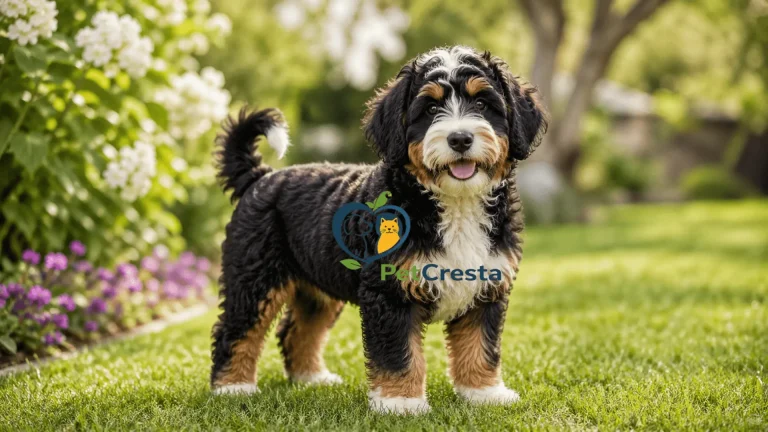
A lot of Mountain Doodles have drop ears, a medium length muzzle, and a well coated tail. The shape of the head can be broad or narrow, depending on which parent traits are passed on.
The body can be solid, like a Bernese Mountain Dog, athletic, like an Australian Shepherd or lighter, like a Poodle or Golden Retriever.
Eye colour could be brown, amber, blue or two colours. Other variations include tail length, carriage, ear shape and facial hair.
All of these details cannot be used to accurately predict temperament, health, or care needs.
Why Puppies May Change As They Mature
Puppy coats are not good crystal balls. As the adult coat grows, a soft, loose coat can become denser, curlier or mat more easily.
Colors can fade or change in intensity. Body proportions change during adolescence, and furnishings around the muzzle and eyebrows become more noticeable.
Request pictures of full-grown dogs from similar combinations. There is no single photo of a puppy that can accurately depict the burden of grooming the puppy in the future, the adult size of the dog, or the adult texture of the coat.
Mountain Doodle Size, Weight And Growth

The most likely to cause buyer disappointment is size, next to almost anything else about the Mountain Doodle. Mini and medium are definite, despite the fact that breeders don’t use the same measurement system.
A range is more truthful than a number. Sometimes Biology doesn’t pay attention to puppy development.
Why Mini, Medium, And Standard Are Not Fixed Categories
One breeder may consider a 35-pound dog to be mini. Another might rate the same dog as medium.
Smaller or mini Mountain Doodles can be bred using Miniature or Toy Poodles or through Miniature American Shepherds or established small multigenerational lines. There are implications for ancestry and predictability in each approach.
Use size labels as guidelines rather than actual size classes. There is no common standard for the terms for Stokeshire, Doodles of Oz and other programs.
How To Estimate Adult Size
Start with measured parent weights and heights. Then ask what the smallest and largest dogs that were produced from similar pairings were.
Body condition is also a factor. Don’t use a dog’s weight to determine how big the puppy will be when it grows up.
Useful questions include:
- What are the measured weights and heights of both parents?
- What type of Poodle or smaller breed was utilized?
- How much did the related puppies weigh at adulthood?
- Was there a healthy body condition when those weights were taken?
- Does the prediction give a range or a guaranteed limit?
- Have they successfully bred adult dogs with this pairing?
There is no equation that can eliminate all uncertainty. Previous adult offspring provide only further support for the estimate.
Compiled Breeder-Reported Size Examples
The following are examples of different descriptions of their dogs written by programs. These are not official ranges and cannot be used to create a universal standard.
The numbers are verified on 30th July 2026. Breeder pages are subject to change as planned litters and breeding objectives change.
| Source or breeding program | Type described | Label used | Reported adult weight | Reported height | Date checked |
|---|---|---|---|---|---|
| Doodles of Oz | Australian Mountain Doodle | Micro mini | 10–24 lb | Not listed | July 30, 2026 |
| WestPenn Doodles | Australian Mountain Doodle | Mini | 20–30 lb | Not listed | July 30, 2026 |
| Fox Creek Farm | Golden Mountain Doodle | Petite/mini | 20–30 lb | Not listed | July 30, 2026 |
| Stokeshire | Mountain Doodle | Medium focus | About 40–50 lb | Program-specific | July 30, 2026 |
| Stokeshire | Australian Mountain Doodle | Standard | 50 lb and over | 20–28 in | July 30, 2026 |
These are breeder-reported examples, not official Mountain Doodle standards. Outcomes may fall outside the listed range.
Growth And Maturity Timeline
A puppy can be a lot taller than he or she will grow before he or she looks or acts mature. Changes in body mass, muscle, coat and emotional control typically persist afterward.
It may take longer for bigger dogs to fill out than smaller dogs. Adolescence may be a time of pulling, jumping, selective hearing and an incredible conviction that all visitors came to see the dog.
| Stage | Physical growth | Coat | Behaviour | Owner focus |
|---|---|---|---|---|
| Young puppy | Rapid change | Puppy coat | Social learning | Handling and routine |
| Older puppy | Continued growth | Transition begins | More independence | Training foundations |
| Adolescent | Nearer adult height | Coat changes | Impulsivity | Consistency and settling |
| Adult | Body fills out | Mature coat | Greater stability | Long-term maintenance |
Any growth should be discussed with the puppy’s veterinarian. Exercise and feeding decisions are influenced by expected adult size, body condition and orthopedic health.
Mountain Doodle Temperament And Daily Life

Mountain Doodles are frequently marketed as loving, smart family pets. Some dogs fit that description well, but the words are so general that they could apply to thousands of different dogs.
Temperament is a product of inherited factors, prenatal environment, early experiences, health, training and home environment. Breed ancestry provides hints, not a complete personality.
Commonly Reported Tendencies
Many are very interested in people and are involved in home activities. Food motivation and responsiveness can make reward-based training enjoyable.
Fun can be a thing in adolescence. Some dogs are physically affectionate, some are not.
Sensitivity deserves attention. A fast-learning dog can also be sensitive to inconsistent handling, unpredictable schedules or repeated social pressure.
Common Challenges Owners May Underestimate
People focused dos may have a problem with a lack of independence. Bright puppies also learn that barking opens doors, jumping gets attention and stolen socks begin exciting family meetings.
Australian influenced dogs may be sensitive to movement, noise or new activity. There is still room for boisterous lines, particularly in the presence of large adolescent bodies, that can be influenced by Bernese or Golden.
| Appealing tendency | Possible related challenge |
|---|---|
| Closely bonded | May struggle with independence |
| Intelligent | May learn unwanted routines quickly |
| Social | May become overexcited around visitors |
| Responsive | May be sensitive to harsh handling |
| Energetic | May become restless without structured outlets |
It’s helpful to get some guidance early, but no puppy comes with a blank page. Inquire about the breeder’s assessment of parent temperament and their response to mild novelty, handling and recovery from surprise.
Family And Household Fit

A Mountain Doodle will do well in various types of residences. Success is more about the size, drive and ability to settle the dog than the family label.
Grooming, training and daily care should be discussed with the household members prior to the puppy’s arrival. Puppies are good at revealing issues that were believed to be resolved.
Families With Children
Most well-socialized Mountain Doodles are like kids. Even excitement and size can cause accidental bumps, scratched arms and toppled snacks.
Supervision is required with young children, particularly. Dogs require safe areas to eat, sleep and get away from people.
Don’t hug, climb on or disturb a resting dog. A tolerant dog should not be tolerant of everything.
Cats, Smaller Animals And Other Dogs
Introductions will be successful depending on the animals themselves. A playful youngster can overpower a shy cat, and Australian Shepherds may be more interested in moving around.
At first use gates, leads and separate safe areas. Encourage quiet looking not chasing as a pastime.
Other dogs should be playmates and tolerant. Just because a dog is comfortable with one dog does not mean it is comfortable with all dogs.
First-Time Owners
A first-time dog owner who is dedicated can have a successful experience with a Mountain Doodle. More important than previous ownership is the willingness to learn.
The more difficult one is: Does the person accept regular professional grooming, adolescent training and an unknown adult size? A person who wants a dog that will be easy to train might feel overwhelmed.
Early puppy training with a certified trainer and puppy classes can make the process a lot smoother. The delay in intervening when behaviour or matting is more serious will inevitably result in a delay in time and expense.
Alone Time And Independence
Most dogs do well when taught to feel safe when they are left alone for short periods. Don’t wait for the first full workday to start.
Offer a suitable resting place and quiet enrichment. Make departures normal; come home before the puppy gets upset during initial training.
If your dog continues to bark, tries to escape, drools, or refuses to eat, it could be a sign of more than just boredom. A vet or a trained behaviourist can be helpful in determining the cause.
Apartments And Small Homes
The size of the apartment in square feet is not the determining factor in whether or not a dog can live in it. The barking, elevator tolerance, toilet access and indoor settling are more important.
While a smaller Mountain Doodle may be easier to handle physically, it doesn’t mean that mental and social needs are not present. Outdoor time is still required.
With proper routine, large dogs can live happily in a small home. A fenced yard, on the other hand, isn’t going to help a dog learn to relax or recall.
| Household factor | Better fit when… | Possible concern |
|---|---|---|
| Young children | Calm adult temperament and supervision | Jumping and size |
| Cats | Low chase drive and careful introduction | Herding or pursuit |
| Apartment | Quiet settling and regular outings | Alert barking |
| Long workday | Midday support is available | Isolation |
| First dog | Owner accepts grooming and training | Underestimating upkeep |
Exercise, Mental Stimulation And Training

There is a wide range of exercise requirements among Mountain Doodle lines. The routine should be based on age, health, adult size and temperament of parents.
Increased activity does not necessarily lead to increased benefits. A dog that never learns to rest may get fit without learning to be calm.
Exercise Needs
Walking, free play, sniffing and off-leash play in safe areas can be considered daily movement. Softer, companion-oriented lines of dogs might require less directed work than those with an Australian influence.
Puppies should not be over-exercised with repetitive high impact exercises. Discuss running, jumping and long walks with a veterinarian based on expected growth and orthopedic development.
Warm weather judgment is also required for dense coats. Plan activities for cooler times of day and ensure that water is available and keep an eye out for sluggishness, heavy panting or inability to catch their breath. Owners should also understand how long a dog can go without water, since warm weather, strenuous activity, vomiting and diarrhea can increase dehydration risk.
Mental Work
A dog will get tired more easily from a short thinking session than from another frenzied walk around the yard. Food puzzles, scent games and basic training can be incorporated into everyday life.
Some dogs enjoy getting games, others find treats or learn household chores. Cooperative grooming practice is particularly helpful as grooming will be a lifetime habit.
Silent work is also good work. Even though it might never look dramatic on social media, it’s a good skill to have when settling on a mat while the family eats.
Training Priorities
Start with skills that will make daily life safer and calmer. Before you can get to the party tricks, recall, loose-leash walking and polite greetings are more important.
Feet, ears, mouth, legs and coat should be handled during practice. Match each touch with food and stop before the puppy gets worried.
Early goals to consider are:
- Coming when called
- Walking without constant pulling
- Greeting without jumping
- Accepting brushing and combing
- Dropping found objects
- Resting on a mat
- Spending brief periods alone
- Staying calm around visitors
Reward-based methods are appropriate for these dogs who are social. It’s not about how hard you push; it’s about how consistent you are.
Sample Day
A good routine is one that involves activity and rest. The dog should not be entertained from breakfast to bedtime.
It is possible to integrate small training moments into normal events. A few seconds to wait before opening the door is a good habit to develop.
| Time | Activity | Purpose |
|---|---|---|
| Morning | Walk, sniffing and short training | Movement and focus |
| Midday | Rest, chew or food puzzle | Calm independence |
| Afternoon | Short handling or grooming practice | Coat-care cooperation |
| Evening | Play, training and quiet settling | Engagement followed by rest |
Make adjustments to the schedule for age and health. Young puppies require more sleep, more toilet breaks and shorter learning times.
Coat Types, Furnishings, Colors And Shedding
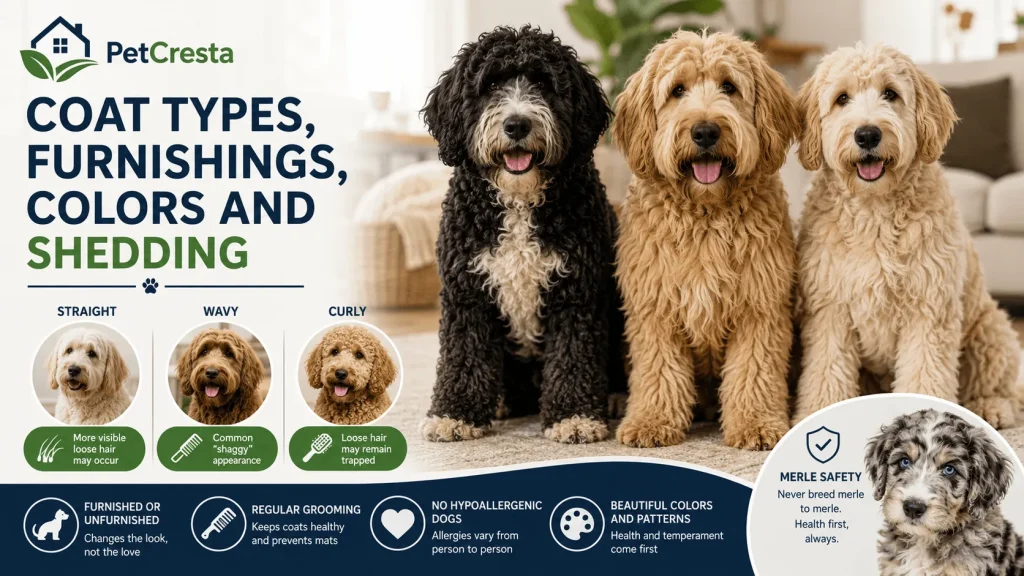
Coat is a factor that can draw people to Mountain Doodles. It can also be the thing they didn’t think of when they bought the car.
The fewer the hairs on the floor, the less the work. Loose hair can sit patiently in a dense coat waiting to become a mat.
Straight, Wavy And Curly Coats
Coat labels provide a general description, not a full picture of grooming. Maintenance is influenced by density, undercoat, length and texture.
Coats may mat badly when long. With curly coats, tangles can be hidden near the skin, but with straight hair, more loose hair might be found around the home.
| Coat description | Likely owner experience | Main uncertainty |
|---|---|---|
| Straighter | More visible loose hair may occur | Density and undercoat vary |
| Wavy | Common “shaggy” appearance | Can still mat heavily |
| Curly | Loose hair may remain trapped in the coat | Higher brushing and mat risk |
Photos of both parents and older, related dogs help. Despite this, there can be more variation in the coat than is anticipated in a litter.
Furnished And Unfurnished Coats
Furnishings are longer facial hairs that form eyebrows, a beard and the familiar shaggy muzzle. An unfurnished dog will have a shorter, flatter face.
The furnishing gene will influence appearance and may be linked to shedding. It cannot predict all coat characteristics or the amount of allergen to which a person may be exposed.
Some breeders refer to an unfurnished puppy as having an “improper coat.” That is not a medical fault, nor is it a comment on the quality of the dog as a companion, but rather a desired Doodle look.
Do Mountain Doodles Shed?
Some parent breeds shed more than Mountain Doodles, though it may not be as noticeable. No breeder can guarantee that 100% of their puppies will be non-shedding.
Unfurrowed coats may shed more hair that is visible. Furrowed coats with curls or density will keep shed hair trapped inside until it can be brushed out.
Inquire about past adult dogs in the same lines. The confidence level of the prediction cannot be estimated solely from the puppy’s coat.
Are Mountain Doodles Hypoallergenic?
There are no hypoallergenic dogs. Allergens from dogs can be found in dander, saliva and other biological material, not just loose hair.
The American Kennel Club’s research revealed that there is no scientific evidence that dogs sold as hypoallergenic emit less household allergen. Dogs of mixed breed that are Poodle dogs will still be unpredictable for people who are allergic to dogs.
If they have a lot of symptoms, they should consult with an allergist before selecting a dog. Time spent with older dogs of a similar coat can be helpful in learning some personal information, but nothing can be guaranteed about future tolerance.
Common Colors And Patterns
Colors may be black, brown, cream, white or tan points. There can also be patterns of Parti, Phantom, Sable and traditional tricolor.
Merle may be used in Australian-influenced lines. Beware of breeders using the ‘fashion’ names for colours – ask for plain descriptions and photos.
Coat color should not be considered the most important characteristic; health and temperament should take precedence. A weird doggie will still need training at 6 a.m.
Merle Safety
Merle is a coat colour, not a breed, nor necessarily a superior quality. There are some subtle or hidden merle patterns that cannot be seen just by looking at the dog.
Double merle puppies can be produced when two merle dogs are bred together. Merle puppies have a significant risk of deafness and severe eye problems, so it is important that merle status is checked prior to pairing.
Request merle testing when either parent might carry the variant. Eye color or coat pattern is no reason to breed an animal if it is not safe to do so.
Mountain Doodle Grooming
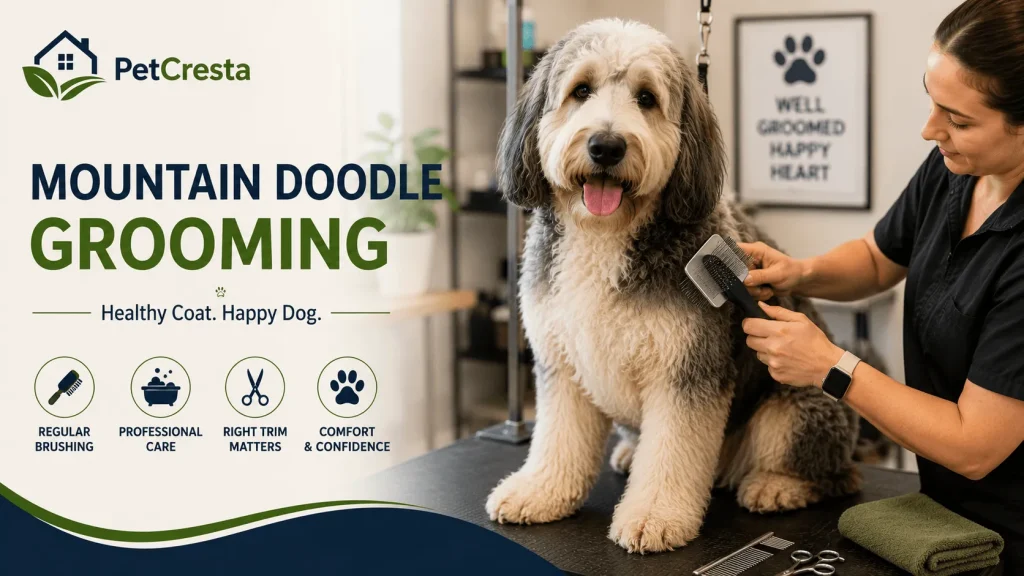
Grooming starts well before the first full haircut. Puppies should be introduced to brushes, combs, dryers, nail care and stillness with care.
If the coat is really matted, the first salon visit may be terrifying. It also makes an ordinary appointment a rescue.
Brushing Schedule
Frequency of brushing depends on coat length, curl, density and activity. Furnished Mountain Doodles require a lot of home care a few times a week, particularly if the coat is long.
Brush and work in small areas. Use a metal comb to follow and prevent hidden tangles under a smooth surface.
Friction goes up with rain, swimming, harnesses and wet collars. Dry and comb those areas shortly thereafter.
Areas Most Likely To Mat
Mats usually develop in areas where hair rubs, bends or remains wet. Even if the coat appears to be in good condition, these areas should be examined.
Focus on:
- Behind the ears
- Under the collar
- Under harness straps
- Armpits
- Chest
- Belly
- Between the hind legs
- Tail base
- Feet and between the toes
A mat that is too close to the skin may be uncomfortable. Do not cut with scissors as folded skin can be easily snagged.
Professional Grooming
A dog should get a complete professional grooming about every six to eight weeks, although the length of the coat and the growth rate of the coat may alter this. The interval is recommended by competitor programs and is similar, but should be determined on a case-by-case basis.
A complete visit can include bathing, drying, clipping, and cleaning the ears and nails. Price and appointment time is dependent on behaviour, size, coat condition and location.
Prolonged de-matting is usually not necessary for severe mats; they may be clipped. A short cut will grow back, damaged trust will take longer.
Choosing A Realistic Coat Length
The prettiest trim is the one that you can keep without making grooming a chore. A shorter coat doesn’t mean it’s a failure.
A practical cut can make brushing more pleasant and less of an emergency appointment for busy families.
| Trim | Home-care demand | Matting risk | Best suited to |
|---|---|---|---|
| Short maintenance trim | Lower | Lower | Busy households |
| Medium coat | Moderate | Moderate | Owners brushing consistently |
| Long fluffy coat | High | High | Owners with time and grooming skill |
Inform the groomer about swimming and outdoor activity, and home brushing. Those details help to form a useful trim, not just one based on a picture.
Mountain Doodle Health Risks And Lifespan

All of the breeds in a Mountain Doodle’s pedigree can pass on health issues. Mixed-breed offspring do not lose their inherited disease.
The odds are better with responsible screening, but not certain. A healthy looking parent can still carry a genetic variant or develop a condition later in life.
Why Mixed Ancestry Does Not Remove Inherited Risk
While there may be advantages to genetic diversity, “mixed” is not a health certificate. Orthopedic and eye examinations, cardiac screening and appropriate DNA testing are still needed for breeding.
The testing plan will vary according to each contributing breed and the size of Poodle used. Testing just the Bernese side or just a broad DNA panel leaves critical gaps.
Family history is also important. Data on siblings, previous children, lifespan and cause of death can show patterns which a single test would not.
Health Concerns To Discuss With A Veterinarian
Orthopedic problems involve hip and elbow dysplasia. Smaller Poodles may also be relevant to the patellar evaluation.
Ancestry-related eye, cardiac and neurologic risks. If the dog is large or deep chested, a discussion about gastric dilatation-volvulus (bloat) may be warranted.
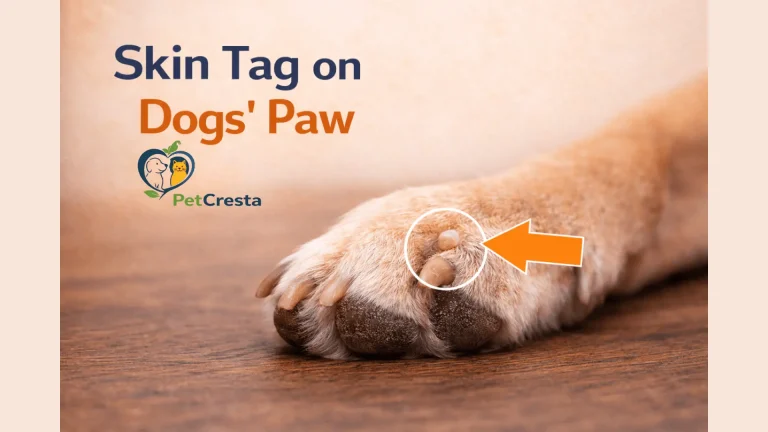
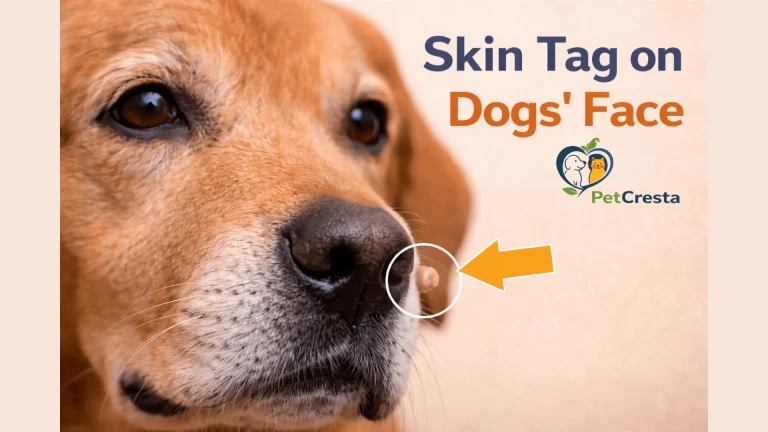
Dense coats can make skin and ear issues more apparent. Normal grooming can be a helpful opportunity to detect irritation, odor, lumps or discomfort early. Not every small growth is an emergency, but owners can review what a skin tag on a dog may look like and when a new, changing, bleeding or uncomfortable lump needs veterinary examination.
There is also a good chance to have an honest conversation about cancer in the Golden Retriever and Bernese Mountain Dog family histories. No screening program will guarantee that a puppy will not develop it.
Parent-Breed Health-Testing Matrix
The matrix below is a starting point, and not a custom breeding plan. When assessing a litter, current parent club requirements should be checked.
There are various recommendations available from the different clubs that breed Bernese, Golden Retriever, Australian Shepherd and Poodle. Poodle testing also varies with the Toy, Miniature or Standard variety.
| Contributing breed | Screening areas the writer should verify from the current parent-club guidance |
|---|---|
| Bernese Mountain Dog | Hips, elbows, eyes, heart, degenerative myelopathy and the current optional requirement |
| Golden Retriever | Hips, elbows, eyes and heart |
| Australian Shepherd | Current ASCA/OFA orthopedic, eye and breed-relevant DNA recommendations |
| Toy Poodle | PRA-prcd, annual eye examination and patellar evaluation |
| Miniature Poodle | PRA-prcd, annual eye examination, patellar evaluation and hip evaluation |
| Standard Poodle | Hips, eyes, thyroid, NEwS and vWD1; review current elective tests |
The Bernese Mountain Dog Club of America currently advises hips, elbows, eyes, heart and degenerative myelopathy, plus one optional test. Golden Retriever guidance requires hip, elbow, eye and heart results to be made public.
The Poodle Club of America has divided the Poodles into Toy, Miniature and Standard Poodles due to their screening priorities. A breeder who states that the Poodle was tested has not provided sufficient information.
How To Verify Ofa And Chic Records
Ask both parents for their full name or registration number. Search the Orthopedic Foundation for Animals database yourself – not just from screenshots.
Check the dog’s identity, test type, date, age and result. Ensure that the dog listed is the correct pedigree for the litter.
If a parent club has a CHIC number, it indicates that the parent club has passed the required tests and has made them public. Does not imply that all results were normal.
Look at relatives where information is available. Both BMDCA and GRCA point to the importance of looking at the whole family of dogs rather than just one dog.
Mountain Doodle lifespan
There is no reliable breed-wide life expectancy data for Mountain Doodles. The label is for dogs of various ancestry and size at maturity, so one confident number would be misleading.
Breeders typically provide estimates of 10-15 years. These are program estimates, not survival data for the entire population.
Longevity is affected by adult size, inherited disease, weight, dental health and preventive care and accidents. Don’t take a marketing range; ask about the ages and causes of death of the parent dogs’ families.
F1, F1B And Multigenerational Mountain Doodles
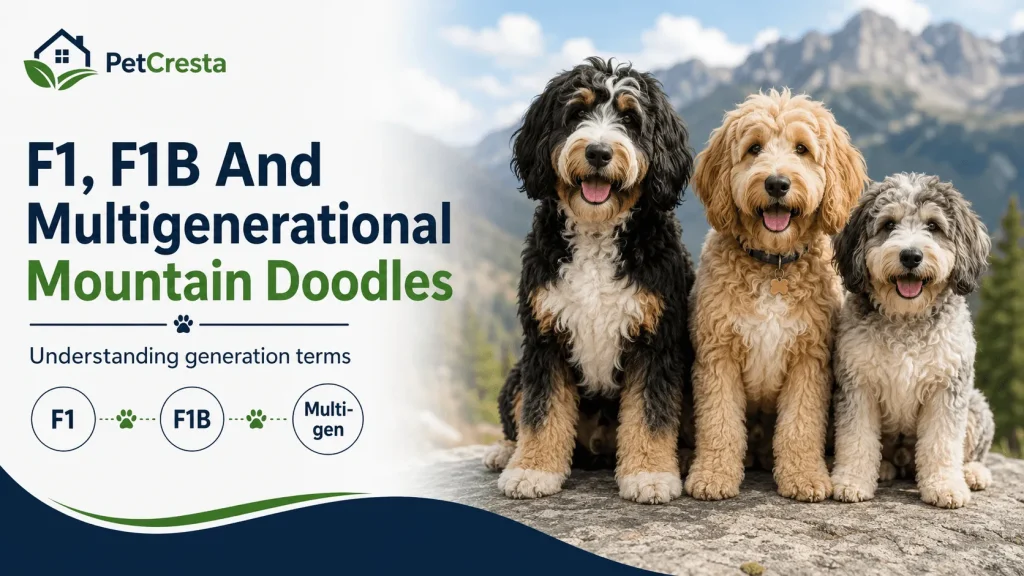
Generation terms refer to a breeding step. They do not judge on health, temperament or quality of the breeder.
When three or four breeds are used, the terms become particularly confusing. If the breeder does not specify the side to which the backcross was made, then “F1B” is incomplete. The generation terminology is easier to understand in a two-breed cross, and our explanation of what an F1B Bernedoodle is shows what a backcross label describes and what it cannot guarantee.
| Term | General meaning | What it does not prove |
|---|---|---|
| F1 | First documented cross between the named parent types | Adult size, coat, health or temperament |
| F1B | An F1 crossed back toward one parent type | Non-shedding coat or allergy safety |
| Reverse F1B | Backcross toward the less-Poodle side | Fixed appearance or behaviour |
| Multigenerational | Later-generation dogs bred from established crosses | Responsible breeding or consistent outcomes |
Request pedigree and estimated breed percentages. The higher the percentage of Poodles, the calmer, healthier or allergy safe the dog will not necessarily be.
Questions regarding parent health, adult outcomes and breeding goals should follow the generation. The letters are only helpful if the underlying formula is understood.
Mountain Doodle Price And Ownership Costs

The first line of the budget is just the purchase price. The dog’s grooming, food, training and veterinary care are ongoing throughout its life.
Present ads also feature a huge price gap. Responsible care can be reflected in cost, but a costly puppy can be a result of a weak program.
How Much Does A Mountain Doodle Puppy Cost?
Five active US breeder programs were reviewed on July 30, 2026, and advertised Mountain Doodle prices ranged from approximately $1,800 to $4,500. The majority of the specific current or planned litter listings were between $3,000 and $4,000.
The sample is not large enough to be representative of the country as a whole. It does demonstrate the need to be careful with a single national “average”.
| Type | Number of programs checked | Range | Median, if supportable | Date checked | Common exclusions |
|---|---|---|---|---|---|
| Golden Mountain Doodle | 2 | $4,000 | $4,000 | July 30, 2026 | Sales tax, transport and added training |
| Australian Mountain Doodle | 3 | $1,800–$4,500 | Not calculated from small sample | July 30, 2026 | Transport, sales tax and optional services |
Advertised prices change by location, breeder, training level, age and included services. A higher price does not by itself prove responsible breeding.
What Changes The Purchase Price?
Prices vary depending on location, demand and puppy age. Puppies that have been started with additional training will typically cost more as the breeder has already given weeks or months of housing and training.
Some programs offer premiums for merle, eye color or a small size. Those are not health or temperament-enhancing features.
Parent screening and careful litter raising is an expense. The buyer should still ask for evidence, not take the seller’s word for it that the work has been done.
What A Well-Supported Puppy Price Should Include
Be prepared for a written description of what the puppy will be bringing home. Common inclusions are veterinary records, age-appropriate preventive care, microchip information and a contract.
The breeder should also be able to give you the parents’ names, health papers and a return policy. Useful context provided by early socialization and grooming records.
Ask about:
- Vaccinations and parasite control
- Veterinary examination
- Microchip registration
- Parent health records
- Feeding instructions
- Socialization work
- Grooming introduction
- Written health terms
- Return or rehoming support
- Transport charges
- Sales tax
- Post-placement advice
A gift bag is pleasant. Searchable health records matter more.
First-Year And Ongoing Costs
A Mountain Doodle may require more grooming than a short coated dog and this can push up maintenance costs for the dog each year. Food, medicine and equipment are also affected by size.
Veterinary expenses are also quite variable in the United States, but the average veterinary expense for a household was $598, according to AVMA’s 2025 survey. This is not a comprehensive dog-care budget and can quickly increase with illness or injury.
| Expense | First year | Ongoing | Why it varies |
|---|---|---|---|
| Purchase or adoption | About $1,800–$4,500 in reviewed breeder listings | — | Breeder, rescue or training level |
| Veterinary care | Obtain a local puppy-care estimate | Annual and unexpected costs | Region and health |
| Grooming | Several professional visits plus tools | Recurring every several weeks for many coats | Coat, size and trim |
| Food | Size-based local estimate | Recurring | Adult size and diet |
| Training | Group class or private support | Optional follow-up | Owner and dog needs |
| Supplies | Crate, gates, bed, leads and grooming tools | Replacement | Size and wear |
| Insurance or emergency reserve | Plan-dependent | Monthly, annual or saved amount | Coverage and location |
Before paying a deposit, contact local veterinarians, groomers and trainers. Their numbers will be much more useful than a national estimate for a given city.
Choosing A Mountain Doodle Puppy

Colour is an easy choice for a puppy. It takes more patience to match a changing animal to a home.
A good breeder watches puppies for a period of time. A single temperament test or a cuddly five-minute visit is no indicator of an adult personality.
Choose Temperament Before Color
Choose a puppy that is active, confident and social in the home. It’s important for a busy family to have a puppy that is easy to settle, and for a quieter family to have a puppy that is more resilient.
The most daring puppy doesn’t necessarily turn out to be the smartest. If your puppy is quiet, it could be relaxed, tired or worried, depending on the circumstances.
Inquire about each puppy’s reaction to handling, brief novelty and brief frustration. Surprise recovery can be as impactful as the initial surprise.
Questions About Early Puppy Development
Gentle, age-appropriate stimulation is better for puppies than constant stimulation. Too many experiences are not necessarily good if the puppy doesn’t have a chance to rest.
Ask whether the litter has experienced:
- Calm human handling
- Nail and coat care
- Household sounds
- Different safe surfaces
- Short car trips
- Age-appropriate crate introduction
- Brief periods away from littermates
- Safe visitors
- Veterinary examination
- Positive recovery time after new events
Branded puppy programs can provide structure, but the label does not guarantee thoughtful execution. Ask what the breeder actually did and how each puppy responded.
How To Choose A Responsible Mountain Doodle Breeder

The task of the responsible breeder is to make verification easier, not harder. A well-styled site is not as convincing as clean records and straightforward restrictions.
Be prepared to answer questions about your home as well. If someone is willing to sell any puppy to any buyer, he or she is not doing meaningful placement work.
Evidence To Request
Ask for specific parent breeds, complete registered names and public health results. The age of parents and mature related dogs, measured sizes and photos are also useful.
A written contract should outline health conditions, ownership obligations and what will occur if placement is unsuccessful. Read it before sending money.
Useful evidence includes:
- Traceable parent identities
- Public orthopedic and health results
- Parent temperament information
- Previous adult outcomes
- Puppy-raising records
- Veterinary documentation
- A written return policy
- Post-placement support
Breeder statements can guide questions. Independent records provide verification.
Questions To Ask
Direct questions usually produce clearer answers. Save the replies so you can compare programs without relying on memory.
Ask:
- What breeds and percentages are represented in this litter?
- What are the measured sizes of both parents?
- Which health tests were completed for every contributing breed?
- Where can I verify those results?
- What adult sizes appeared in comparable litters?
- How do you evaluate and match temperament?
- How are puppies introduced to grooming and separation?
- What happens when a placement does not work?
- May I review the contract before paying?
- Can I contact owners of mature related dogs?
A breeder may not have perfect answers to every question. Honest uncertainty is preferable to a confident promise that genetics cannot support.
Breeder Warning Signs
Be cautious when marketing claims remove every possible drawback. No puppy is guaranteed to be non-shedding, exactly 25 pounds and perfect with all children.
Other warning signs include:
- No parent identities
- Unverifiable health screenshots
- Pressure for immediate payment
- Guaranteed allergy-safe coats
- Guaranteed exact adult size
- Premiums based mainly on rare color
- Unexplained merle pairings
- Many continuously available litters
- No return clause
- Refusal to discuss family health history
- Puppies leaving unusually young
- No contract review before payment
One concern may have an explanation. Several concerns together are a good reason to step back.
Local Breeder, Transported Puppy Or Rescue
While a local breeder will allow you to visit the farm, distance is not a guarantee of quality. There is a possibility of poor breeding that can occur close by.
When welfare arrangements, communication and records are good, transport may be reasonable. Find out who will be taking care of the puppy and how long the trip will take.
Rescue and adult rehoming can provide better information on mature size, coat and behaviour. Labels can be a bit of a guess, but the adult dog in front of you gives proof that no puppy prediction can beat.
| Evidence to look for | Reason to pause |
|---|---|
| Searchable parent records | Unverifiable screenshots |
| Measured adult outcomes | Guaranteed exact size |
| Written return policy | “All sales final” |
| Honest coat range | Guaranteed non-shedding |
| Temperament matching | Pick by color alone |
Mountain Doodle Vs Similar Doodle Mixes

Similar names are not necessarily related to similar ancestry. When the parent breeds are confirmed, it is certain that no accidental comparison of two completely different crosses will occur.
This table is designed to concentrate on definitions and ownership questions. The general trends may not be observed in individual dogs.
| Label | Common ancestry | Main distinction | Typical buyer question |
|---|---|---|---|
| Mountain Doodle | Broad Bernese-based Doodle label | Meaning varies by breeder | What mix is this litter? |
| Bernedoodle | Bernese Mountain Dog × Poodle | More clearly defined two-breed cross | How large and coat-variable? |
| Golden Mountain Doodle | Bernese + Golden + Poodle | Three-breed Golden-influenced cross | How social and how large? |
| Goldendoodle | Golden Retriever × Poodle | No Bernese ancestry by definition | How much shedding and energy? |
| Australian Mountain Doodle | Bernese + Australian Shepherd + Poodle | Three-breed Aussie-influenced cross | How active and alert? |
| Aussiedoodle | Australian Shepherd × Poodle | No Bernese ancestry by definition | How much mental work and drive? |
If you’re looking for a dog with a definite mix of Bernese Mountain Dog and Poodle, the Bernedoodle will be the obvious choice. Goldendoodles and Aussiedoodles eliminate Bernese from the mix.
There is a third breed, Golden and Australian Mountain Doodles. That can widen the range of characteristics, but not necessarily result in a more predictable outcome
Key Takeaways
Although affectionate and interesting, there is a lot of variation in the Mountain Doodle. Clear parent information is the basis for a sensible decision.
Here are some things to remember:
- Mountain Doodle is not a single breed, but a general term for a variety of breeds used by the breeder.
- Golden and Australian Mountain Doodles are different parent breeds.
- Mini or standard labels are not as useful as parent size and previous adult offspring.
- Reduced visible shedding can have increased grooming demands.
- All contributing parent breeds must be health screened.
- The best puppy is the one that fits the house, not the one with the coolest cut.
FAQ’s
The answer varies. Golden Mountain Doodles usually contain Bernese Mountain Dog, Golden Retriever and Poodle ancestry, while Australian Mountain Doodles usually contain Bernese Mountain Dog, Australian Shepherd and Poodle ancestry. Some breeders also use Mountain Doodle for Bernese Mountain Dog–Poodle crosses. Always request the exact pedigree.
Not necessarily. A Bernedoodle specifically describes Bernese Mountain Dog and Poodle ancestry. Mountain Doodle is often used more broadly. A breeder may include Golden Retriever or Australian Shepherd ancestry.
There is no official adult range. Advertised sizes run from small mini dogs to standard dogs weighing more than 50 pounds. Parent measurements and mature dogs from related litters provide the most useful estimate.
Height may approach maturity before the dog has finished filling out. Coat and emotional maturity can continue developing afterward. Larger dogs usually take longer to mature physically than smaller ones. Ask the veterinarian what to expect based on the puppy’s growth and projected adult size.
Many need thorough brushing several times each week and professional grooming every several weeks. A long or dense coat may require more frequent attention. Short maintenance trims can reduce the home-care burden.
Many can live happily with children when temperament, size and training are suitable. Supervision is still needed. Large adolescent dogs may jump or knock over small children without intending harm.
Some can. Success depends on chase drive, previous experience and careful introductions. Australian-influenced dogs may show stronger interest in movement, though individual variation remains large.
Yes, when the dog receives regular exercise and can settle quietly indoors. Barking and toilet access may be greater challenges than floor space. The word mini does not guarantee an easy apartment dog.
Mountain Doodles should learn independence gradually. The safe duration varies by age, health and individual coping ability. Persistent distress deserves professional help rather than longer periods of forced isolation.
Many are responsive and food motivated. Their intelligence can make learning quick. The same dogs may become excitable, sensitive or skilled at repeating behaviour that earns attention. Calm consistency works best.
No reliable population-wide lifespan figure is available. Breeder estimates often fall between 10 and 15 years, but they are not formal survival data. Adult size, inherited health and lifelong care influence the outcome.
The five US breeder programs reviewed in July 2026 advertised puppies from roughly $1,800 to $4,500. Most specific listings were between $3,000 and $4,000. Transport, tax and added training may cost extra.
Testing should address every breed in the pedigree. Common areas include hips, elbows, eyes, heart and parent-breed-specific DNA conditions. Request searchable records and check them independently.
F1B generally means an earlier-generation cross was bred back toward one parent type. With three-breed Mountain Doodles, the label is incomplete unless the breeder names that parent. It does not guarantee size, shedding, temperament or health.
Sources And Research Method
This guide was fact-checked in July, 2026. Breed-label definitions and advertised price examples were compared across active Mountain Doodle breeder programs, while medical and genetic guidance came from parent clubs and established canine health organizations.
Breeder websites were used only to document how programs describe their own crosses, sizes, generations and prices. Their claims were not treated as independent medical evidence.
Primary sources consulted included:
- Orthopedic Foundation for Animals CHIC guidance, including the clarification that a CHIC number records completed public testing rather than universally normal results.
- Bernese Mountain Dog Club of America testing recommendations.
- Golden Retriever Club of America parent-screening guidance.
- Australian Shepherd Club of America health-screening guidance.
- Poodle Club of America testing recommendations by Poodle variety.
- AKC educational material on dog allergens and merle genetics.
Price observations came from five US breeder programs with active pricing visible in July, 2026. The review was a market snapshot, not a complete national survey.
Mountain Doodle terminology remains unstandardized. New health recommendations, breeder prices and available litters should be checked again during future editorial reviews.