What is a Merle Poodle? Guide To Health, Blue Eyes & Breeding Risks

A Merle Poodle is one type of Poodle that has a merle-colored pattern. The coat could appear like it is a little sloppy, flecky or softly broken more than evenly colored. That is why it stands out in photographs.
This visual impact is one of the reasons why this subject is so confusing. A lot of people are first struck by the coat, the color of the eyes or the unique appearance on the dog’s face. But the most important questions do not revolve around appearance alone. They concern breeding decisions and health plans, as well as documentation, in addition to whether the breed is the right choice for the family.
This guide examines the subject in a broad manner. It explains what the word “merle” means as well as what it tells you and does not reveal about the reasons why it is debated, and where the most serious health issues start and what’s most important prior to bringing a dog to a new home.
TLDR; What Is A Merle Poodle, And Is It The Right Fit?
It remains a poodle. Merle alters the color of its pigment and is not the primary characteristic of the breed.
This means that the dog requires the same shrewd grooming, training, exercise structure, and regular involvement that is expected of a dog of a similar size. The most important thing to consider isn’t whether the coat appears odd. The important question would be whether this dog has been raised in a responsible manner and if the home is realistic regarding the long-term health of the dog.
It could fit in with the perfect family. It’s usually an unsuitable choice when the design itself is the primary reason for picking the dog.
| Better fit | Weaker fit |
|---|---|
| Wants the temperament and routine of a Poodle | Wants a striking puppy more than the right dog |
| Comfortable asking detailed breeder questions | Uncomfortable pushing for proof or records |
| Prioritizes sound breeding and long-term fit | Prioritizes color, rarity, or eye color |
| Understands grooming and training commitment | Wants something easier than a typical Poodle |
| Will walk away from unclear answers | Gets pulled in by visual appeal alone |
What Mere Poodle Can Change
Merle may alter the way that pigment is portrayed on the coat. In certain dogs it could also affect the visible color of the nose, eyes or lips. It can also affect the pads of the paws.
What Merle Poodle Does Not Prove
Merle does not prove quality. It cannot show poor health on its own. It isn’t proven whether a pet is better to handle, better bred, or better for a particular environment.
Merle Poodle At A Glance
Merle is a reference to a pattern that is not a different breed of Poodle. The breed is the same breed, and has the same basic needs and the same official sizes: Toy, Miniature, and Standard.
In terms of practicality the most common way to understand it is described this way:
| Topic | Quick answer |
|---|---|
| Breed | Poodle |
| Pattern | Merle |
| Main appeal | Distinct coat pattern and sometimes lighter eyes |
| Main concern | Genetics, breeding choices, and buyer confusion |
| Grooming | High |
| Shedding | Low |
| Training needs | High mental engagement, typical of Poodles |
| Official size varieties | Toy, Miniature, Standard |
| Common buyer mistake | Treating color as proof of quality |
| Best first check | Ask how the dog was bred, not just how it looks |
Quick Buyer Summary: What Matters Most?
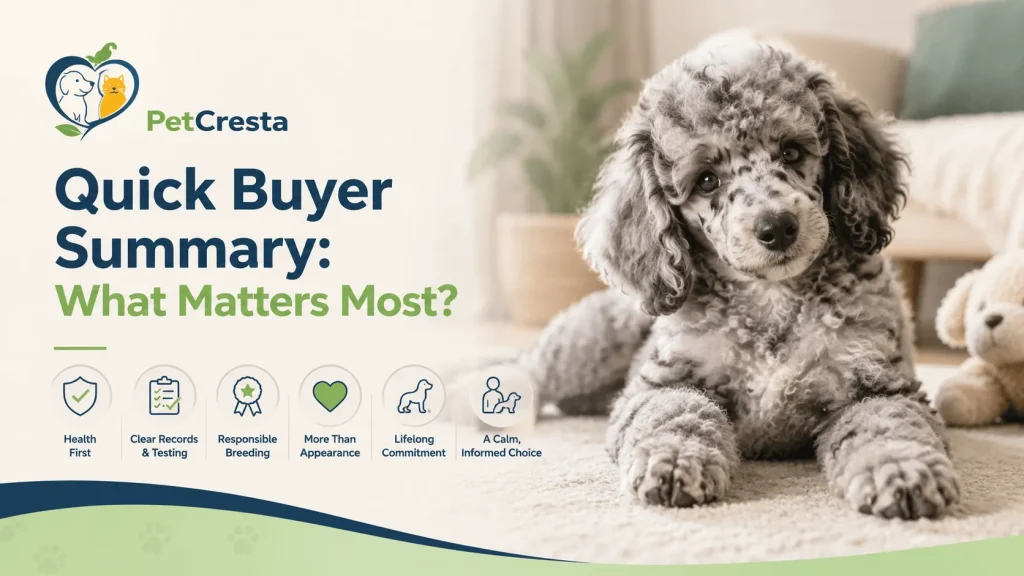
In the case of Poodles, one should never evaluate a merle with just coat pattern. The coat might be one of the first things people notice, but it is not more important than the other points of the decision.
Merle is a colouring. It does not end up making a new type of Poodle, and it does not alter the dog’s basic needs. A merle Poodle, like all Poodles, must be groomed, structured, trained, exercised and cared for in the long term.
The primary question is not if the puppy looks different. The true question lies with how the puppy was bred, if there are any records, and if risky pairings were avoided.
When considering the choice of one, keep these things in mind:
- Merle is not a breed itself; it is just an eye appearance.
- Quality is not determined by coat color.
- Blue eyes aren’t valuable.
- Registering doesn’t solve all the questions.
- Rare color is not important when the breeder is transparent.
- The greatest avoidable risk is merle to merle breeding.
- Appearance should be followed by health testing and clear records.
The first step to making a calm decision is to eliminate the pressure. If the entire discussion is about only color, rarity, or price, then the buyer is not receiving adequate information.
Daily Life With A Merle Poodle
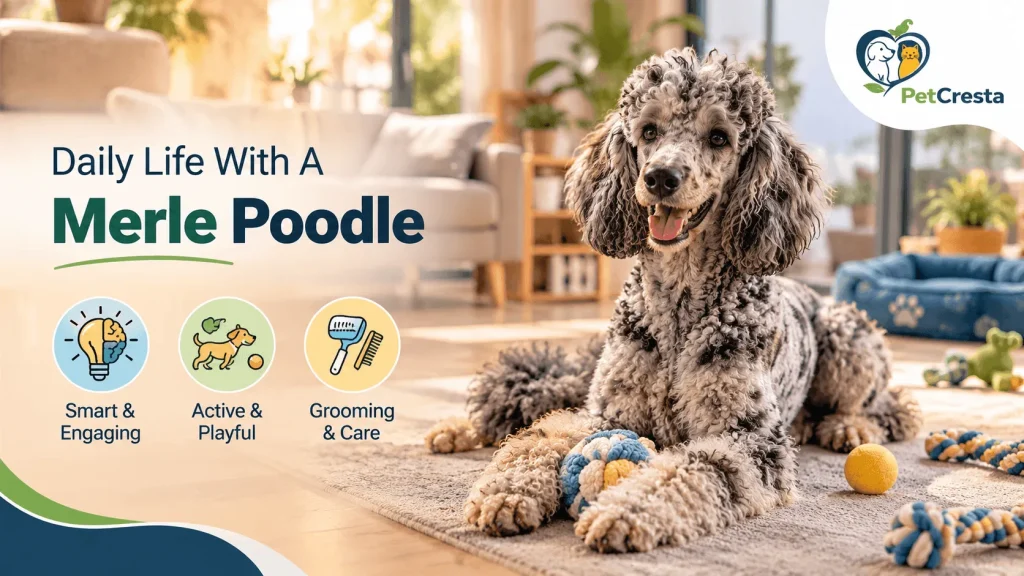
The daily life of this dog is more about the dog being a Poodle and less about the pattern of its coat. In actual terms, that is living with an active, intelligent and grooming-heavy dog, whose needs are dictated by the dog’s temperament, size as well as training and routine more than the color.
Poodle Merle Temperament
The daily life of this dog is the same as that of people who have Poodles. The general rule is that Poodles have a bright personality, are fast to learn, responsive and are extremely attentive to their companions. They usually thrive in homes with regularity, organization, structure, and frequent interaction, rather than treating them as just a decorative pet.
The design does not alter the overall look. A merle coat can attract the attention of others, but it does not alter the socialization, temperament or the dog’s general suitability to be a family pet.
The pattern does not change that. A merle coat may attract attention, but it does not replace temperament, socialization, or the dog’s overall suitability for family life.
Exercise And Mental Engagement
Poodles require both physical and mental exercise. Training, walks, games and regular household interaction all play a role. A dog that has a stunning coat, but with no structure could still be restless and noisy. They may also find it difficult to get settled.
The most important thing to remember is: Merle does not reduce training, exercise requirements or the value of your daily routine.
Merle poodles Grooming, And shedding
Low shedding is not the same as low maintenance. That same grooming reality also matters with a cavapoochon, where a softer, low-shedding coat can still require regular brushing, clipping, and coat care. Poodles are often chosen because they shed minimally, but the coat still needs regular brushing, clipping, and care to avoid matting and discomfort.
This is why commitment to grooming is at the forefront of the process for making decisions. A stunning coat doesn’t simplify the process of caring for your coat. In a lot of homes, the realities of grooming impact the day-to-day routine more than any color will ever do.
What Merle Does And Does Not Mean
Merle can affect appearance. It could alter the pattern of the coat and be connected to the visible pigments of other areas. What it doesn’t do is answer all the questions that people ask about it.
A merle coat doesn’t necessarily mean that the dog is unfit. It doesn’t automatically suggest that it is mixed. It doesn’t prove the dog was selectively bred. It doesn’t prove that the dog meets all breed standards requirements. It is not proof that the dog is valuable due to its unique appearance.
The same cautionary principle is required for eye-catching, simple photographs of puppies. The photo may show color. It is not able to tell if an unwise pairing was avoided and whether health screening was conducted with care, if the reports are reliable or if the adults who were behind the pups were chosen using sound judgment.
The same caution applies when comparing Aussiedoodle puppies, since an eye-catching coat should never matter more than health testing, breeding choices, and clear records.
What Does A Merle Poodle Look Like? Merle Poodle Colors, Patterns, And Labels

There is no one standard merle style. A dog might display bold contrast and a clearly patterned. Other dogs may display subtle patterns that are less apparent.
Labels are often used by people like:
- Blue Merle Poodle
- Chocolate Merle Poodle
- Poodles with brown merle
- Red merle poodle
- black merle poodle
- Silver merle poodle
- Sable merle Poodle
These labels describe visible appearance. They don’t establish separate breeds or kinds of worth.
Merle Vs Parti, Phantom, Sable, And Brindle
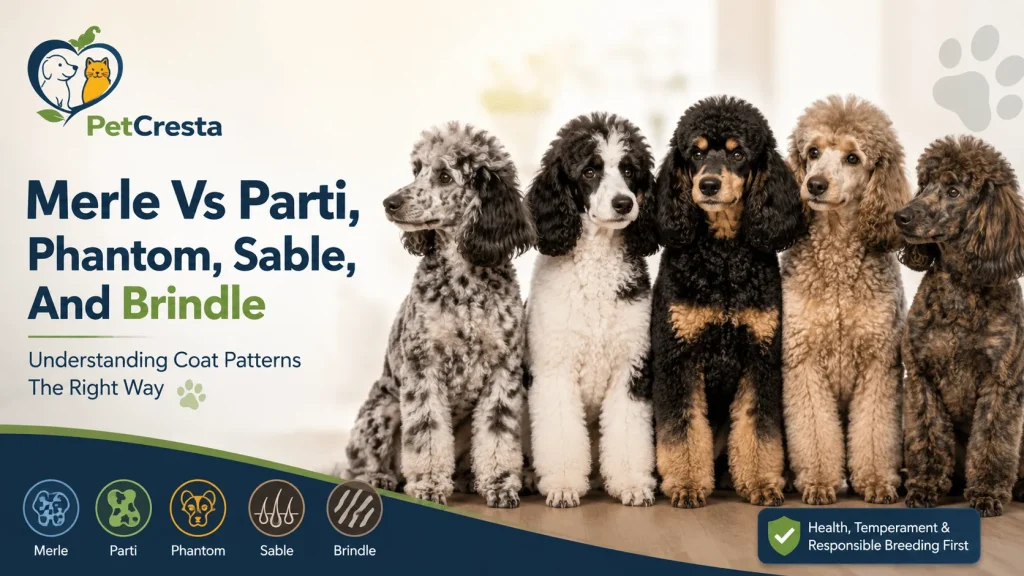
There can be several terms used together, making it difficult to interpret what’s involved in a coat label. Puppeys can be merle, parti, phantom, sable, and even stacked, such as merle Parti Phantom. The easiest way to do it is to isolate the terms.
The pigment is typically broken, marbled or patchy when it is described as merle. Parti is generally a coat with prominent white sections of the coat with colored patches. Phantom is a pattern of markings that may occur in particular areas like above the eyes, on the muzzle, chest or legs or underneath the tail. Usually means shading, tipping or color change throughout the coat. Brindle typically refers to darker lines on a lighter base color.
These labels refer to the look of the object. They are not a health or temperament gauge, nor do they indicate health or responsible breeding.
An expression like “blue merle phantom parti Poodle” might seem unique and precious, but it needs to be dissected into its components. The harder the term is to understand, the more questions there are to ask regarding records, health testing, parent dogs and breeder decisions. Use of colour language to cue the dog. Should not detract from the dog.
Some Dogs Are Labeled With Stacks Of Labels Like:
- Merle Phantom Poodle
- phantom merle
- merle parti poodle
- Blue merle phantom Poodle
- blue merle parti poodle
These phrases may sound more complicated than they seem to. The best approach is to break down the terms and consider what each is talking about rather than interpreting the entire phrase as a distinct grouping.
A quick way to grasp the terms used in common coats is to look at the following:
- Merle typically is a reference to broken or marbled pigment.
- Parti is usually a reference to large white areas of space with colored patches
- Phantom is a reference to a marking layout that is based on a point.
- Sable means shading or tipping over the coat
If coat labels are stacked over each other, the clarity is usually improved as the pet is evaluated in its entirety rather than through marketing-style language.
Can Poodles Have Blue Eyes?
Yes, a few Poodles may have eyes that are lighter. Eye color can vary, and blue eyes or those with lighter shades are more noticeable based on the coat as well as the pigment.
Eye color is not an indicator of quality. Blue eyes do not confirm strong breeding. They don’t indicate poor health. They don’t prove whether the pet is useful. They’re just one feature in a long list of traits.
The same principles of calmness apply whether discussing a white poodle that has blue eyes or a brown poodle with blue eyes or a poodle with blue eyes. The eyes appear green in certain lighting. Eye color might draw some attention, but it must not be a reason to avoid discussion about the health, temperament, structure dimensions, and breed choices.
How Merle Genetics Works
Merle affects pigment distribution. This is the reason why the coat can appear to be broken or marbled instead of being uniform in the same color.
One duplicate of the pattern could produce visible Merle. But the expression in real life can vary significantly. A dog with a merle look is striking and clear. A different dog may appear more gentle. This is the reason visual perception isn’t as good.
Why Do Some Merle Dogs Look Different?
The pattern’s visibility may change depending on base colors, the pigment depth, as well as the intensity with which the pattern is expressed. Two dogs that are described by the same label could appear very different.
Hidden Or Cryptic Merle
Certain varieties of merle might appear to be obscure. It’s because appearance alone isn’t always enough to determine the quality of a pair of breeding. A breeder shouldn’t rely solely on what the eye observes when discussing the status of parents or pairing decisions.
Why Genetic Testing Matters More Than Coat Photos
A photo can tell you the coat pattern, but it can’t tell you the genetics. There are two types of merle dogs, one with obvious merle markings and the other with merle that is more difficult to see.
This is important because it should not be based on appearance alone when selecting a breeding stock. You can see the pattern lightly on the dog, faded, or almost solid but there is still a merle related result that is important for future pairings.
There may also be difficulty making visual judgments with light coat colors. Patterning may not be as evident in cream, apricot, red or pale dogs. This is why it is essential to test, and not guess, when breeding responsibly.
A merle breeder should be able to describe the merle status of both parents. The answer should be clear, steady and with records.
A buyer doesn’t have to be familiar with all the technical aspects. The question is just as easy: Was testing used as a tool to avoid a risky pairing? If the response is uncertain, changes while talking or is only based on pictures, it’s better to take a break.
Why Pairing Matters
The most important concern in genetics isn’t how dramatic a puppy appears enough to warrant the term Merle. The most important thing to consider is what genetic combination created the puppy.
A non-merle-to-merle pairing doesn’t have the same risk as a merle-to-merle pairing. The safety issue that needs the most attention is when both parents have the merle.
What Happens In A Merle To Merle Pairing?
The only way to truly determine merle risk is to see the pairing, not just the puppy. Breeding two merle carriers does not cause any unnecessary harm although the puppy with the merle coat is not ill.
Some pups may be merle on both parents. Such puppies are frequently referred to as “double merles.
There is a strong possibility that double merle puppies will have serious eye and hearing issues. This can include deafness, abnormal development of the eyes, poor vision or sensitivity to light, or other related pigment problems.
This is why responsible breeders do not breed two merle dogs. The aim is to produce not just an appealing coat, but to produce a coat that is more appealing. The aim is to ensure the health and comfort of the puppies before they are born.
It is important for a buyer to inquire directly if both parents were merle carriers. If the seller doesn’t answer or gives a vague response to the question such as “the puppy looks healthy,” but doesn’t explain the pairing, it’s not sufficient.
Why Merle Poodles Are Controversial
The debate over this dog goes beyond coat preferences. The majority of the time, it involves multiple separate concerns that often mix. Those questions include:
- If Merle is part of the Poodles
- whether or not the pattern is a reflection of the history of outcrossing
- Which color is considered in this breed
- If appearance is often valued too much
The discussion is clearer when these questions are separated instead of being condensed into one debate. It is often helpful to think of four layers:
- Ancestry
- Registration
- breed-standard expectations
- Ethics and well-being
These layers overlap, but they’re not interchangeable.
Are Merle Poodles Purebred? Registration, Pedigree, And Show Status
Purebred could refer to different things based on the person who uses it. Some people mean ancestry. Other people refer to pedigree documents. Other terms refer to whether a dog meets breed-standard expectations in a conformation context. It is for this reason that a one-word answer can conceal more than it clarifies.
Registration will only answer a portion of the question. It will show whether a dog’s information is stored within a system, and also how it is categorized. What it can’t do by itself is to determine the breed quality, health standards and ethics, or determine if the dog is a real prospective show dog.
Similar to that, breed-specific questions should not be viewed as the same as household fit. A dog can be discussed in one manner in the registry but ask separate questions regarding the breeding decision or long-term placement within a home with a family.
The best method is to treat the ancestry, documentation as well as standard fit and welfare issues as distinct questions and address each in its own way.
Registered Does Not Always Mean Breed Standard
While registration may be helpful, it isn’t an all-solution. There may still be other points to discuss such as colour, choice of breed, show eligibility, health testing and long term suitability, etc., with a registered dog. These questions need to be well separated.
Ancestry queries about the origin of the dog. People fill in their dog’s registration at the time of registration. In the discussions in the breed standard, the question is whether the colour and structure are in line with the accepted standard. Pet suitability questions include if the dog is healthy, stable, well-matched, and well cared for.
One word, “Registered,” should not be enough for a buyer to believe that everything is fine. Registration is not a substitute for health testing. It cannot be used to demonstrate responsible pairing. It is not proof of the dog being a show prospect. It also does not indicate that the dog is a right fit for a house.
The most helpful questions for a pet home are practical. Is the dog healthy? Was the breeding carried out sensibly? Are the records legible? Is the dog’s size, personality, grooming requirements and energy level a good match for this household? The clear breeder will not try to evade further questioning through registration.
Are Merle Poodles Healthy? Double Merle Risk and Main Health Concerns
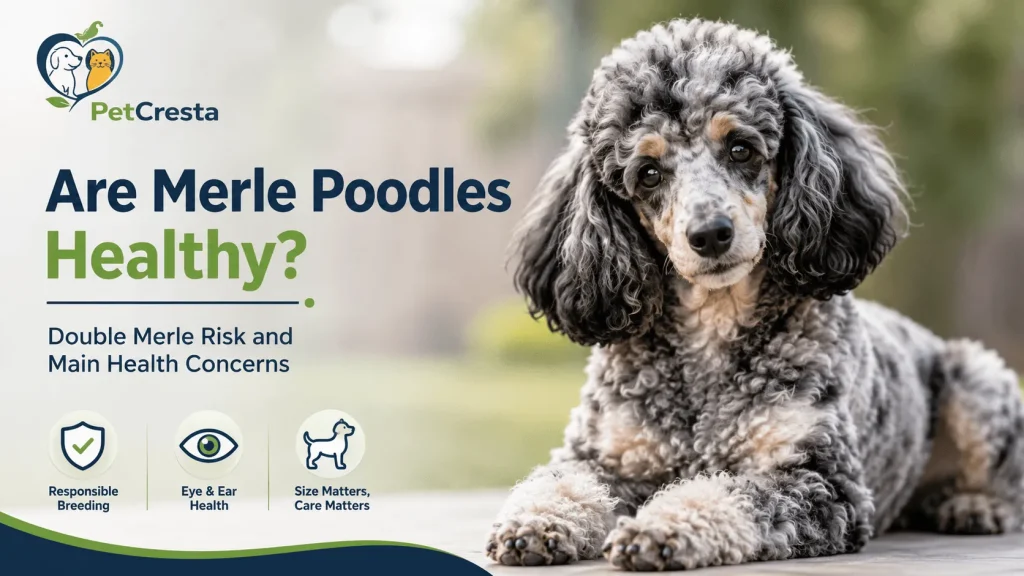
A poodle with a merle coat is not always unhealthy simply because it’s the merle breed. It is the fact that matters.
The main issue is the breeding mix. A health concern that requires the most attention occurs when dogs inherit the merle of both parents. It’s called the double-merle issue and this is the point at which the possibility of developing serious ear and eye issues is much greater.
Why Merle-To-Merle Breeding Is The Main Welfare Concern
A dog can be beautiful but come from a relationship that shouldn’t have happened. This is why the appeal of the image isn’t enough. The issue is not how the puppy’s photos are taken. It’s the breeding decision that is behind the puppy.
Main Health Concerns
The most frequently discussed in double-merle situations are:
- Hearing impairment, also known as deafness
- Vision abnormalities
- microphthalmia, which means the eyes are abnormally small or poorly formed.
- Light sensitivity
- Eyes-related pigment-related problems and ear
However, this does not mean that all breeds of merle dogs have the same issues. This means that the risk of averting it increases when two parents with a merle pattern are in a relationship.
Myth Vs Reality
A few simple corrections can aid in keeping the discussion on track.
- All dogs that eat merle are unhealthy, false.
- Merle is not harmful to healthis is also false
- Colors tell you everythingFalse
- The appearance alone can assess safety, but it is not true.
The rationale is this: Merle alone is not the only issue and breeding decisions do matter greatly.
Size Varieties and Common Marketing Labels
Poodles are available in three sizes:
- Toy
- Miniature
- Standard
This is more relevant to everyday life than the pattern of your coat. The Toy Poodle and the Standard Poodle are not compatible with the same rhythm of a household in the same manner. Size influences exercise, real-time grooming, handling time, space requirements, and the day-to-day management.
This is the reason why labels like miniature merle poodle, mini blue merle miniature poodle and merle standard dog should be interpreted in two parts. The merle portion describes the appearance. The size part typically gives you more details about the daily activities.
The terms such as medium royal, teacup, or medium can cause confusion. They might seem official, yet they typically serve more as labels for marketing instead of clear official categorization. Any buyer who is calm should return to the official size framework first. That same size first approach helps when comparing a Miniature Cockapoo, since day-to-day life is shaped more by realistic adult size and care needs than by sales wording.
Do Merle Poodles Need Different Care?
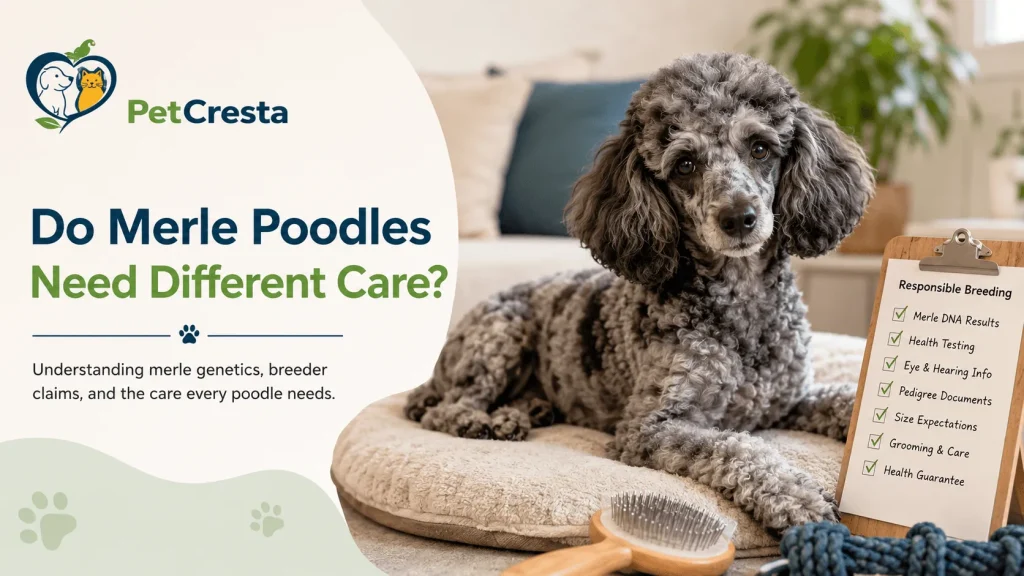
In general terms, there is in general terms, no. Care is based on the requirements of the breed, and the dimensions of the dog are more important than the design.
It requires regular brushing, clipping and training, exercise and daily engagement. The coat’s pattern doesn’t reduce the normal amount of dedication required for Poodles. Poodle.
How to Read Breeder Claims Without Overreading Them
A clear explanation should be simple, concise, and precise. It should contain the status of the parent merle, the reason for that pairing and health test results and realistic expectations of size and a simple explanation of what the dog does and not being portrayed as.
A weak explanation can make a different sound. It is often based on words like rare color, high-quality eyes, unique pattern or registered, indicating that everything is in order. It could avoid direct replies and may alter information during a conversation, or insist on rapid commitment before records are checked.
The trick here isn’t being untruthful. It’s about being steady. A calm buyer demands clarity and remains more focused on documentation than sales language. That same careful reading helps with an F1B Cavapoo, where generation labels and coat promises still need to be backed by clear records and realistic expectations.
Records To Ask For Before Choosing A Merle Poodle Puppy
A careful purchaser must request records prior to making a purchase. With genetics, health testing and breeding decisions, words don’t suffice.
The breeder should be able to let you know what has been tested, why the pairing was made and what is expected of the puppy.
Ask for:
- The DNA result of both parents indicates merle status.
- There is no evidence that two merle breeders were bred together.
- Health Test records appropriate to the size of the poodle variety
- Eye screening information (where available)
- If anyone has any concerns about the hearing, they will receive information.
- Pedigree documents or registration documents
- Adult size expectations are based on parents.
- Temperament notes from the parent dogs
- The expectations for grooming a puppy’s coat type.
- A written support, return or health policy
The responsible breeder ought not to be offended at these questions. These are typical inquiries from a buyer to grasp health, welfare, and long term fit. If the breeder provides only photos, provides more information about the rare color, or provides no record, the buyer should cut back.
What Responsible Breeding Looks Like
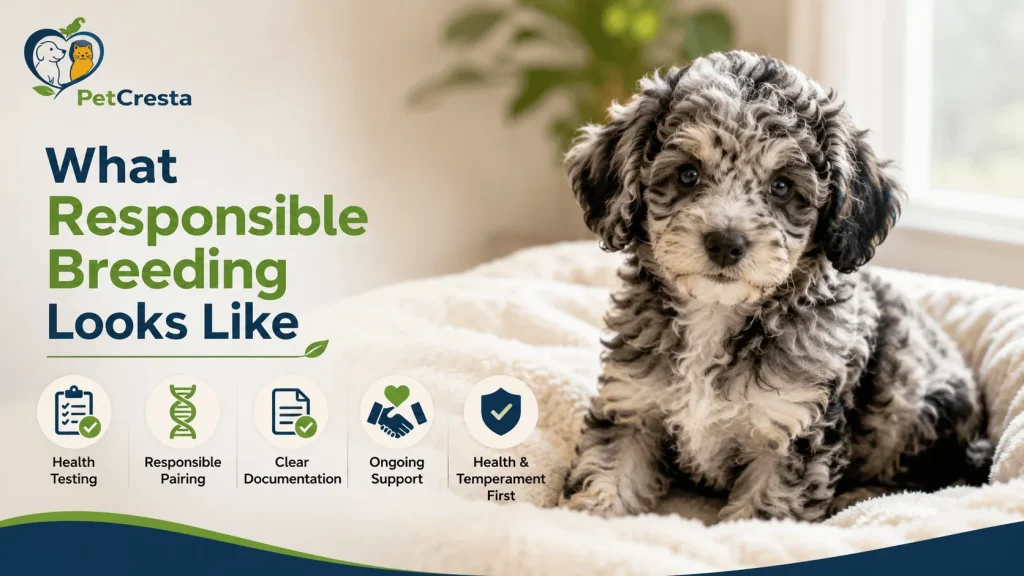
Responsible breeding isn’t determined by the appearance of novelty. It is determined by clear reports, logical planning and a determination to push the dog ahead of the standard.
In practice, it refers to:
- Being aware of the status of Merle for the parents
- avoiding merle-to-merle pairings
- conducting health tests that are appropriate for the amount and type of test.
- Being clear on paperwork
- Discussing structure and temperament honestly
- offering realistic expectations of the size of an adult and grooming requirements
A clear and thorough discussion of the breeding doesn’t hide in the fur. It clarifies the pairing and provides room for more thoughtful questions.
Merle Poodle Puppy Checklist Before Placement
The puppy’s evaluation should be based on the same criteria as other puppies. This pattern is not a substitute for simple answers.
Prior to placement, the questions below must be answered:
- What is the status of merle of parents?
- Did Merle-to-merle breeding not occur?
- What health tests were conducted?
- What is the ideal adult size?
- How is the puppy socialized?
- What kind of support is provided in the aftermath of the placement?
- Do you think the dog is being portrayed as a performance dog or a show potential?
These are good reasons to stop and reconsider:
- no documentation
- changing answers
- pressure to decide quickly
- marketing that is color-first
- no serious health discussion
What’s more important than the physical appearance is the character and structure, health planning and the health of the household.
When To Walk Away From A Merle Poodle Seller
Leaving when the answers are not congruent with the seriousness of the topic can be the safest option. A lovely puppy picture shall never be used in place of confusing breeding details.
If the person who sells the dog has a narrow focus, for instance, they are only interested in rare color or blue eyes, or show a heavy emphasis on price or urgency, use caution. These details are likely to be interesting, but they don’t really solve the big problems.
It is also problematic if the parents cannot provide documentation of their merle status, refuse to provide testing results or state that they don’t need to test because the dogs “look fine.” Appearance is not enough for responsible pairing decisions.
Some other indicators are:
- The need to wire money quickly
- No parent information found.
- No serious discussion of health testing that is.
- A general description of “purebred” or “registered.”
- A description of the risk associated with double merle is not included.
- Making changes to the color or parent dogs
- No written support following placement.
- Little to no concern of whether the home fits the puppy.
A reputable seller will desire a puppy placed well. In case the conversation seems hurried, focused or evasive, the best strategy is to pause and continue to scan for more signs.
Better Questions Than “Is This Puppy Rare?”
Rarity isn’t the most important question to consider when looking at a merle Poodle. A good plan doesn’t necessarily lead to a rare looking coat, and a good coat doesn’t necessarily mean a dog is well-bred. Improved questions are oriented toward caring, welfare and evidence.
Inquire if the parents have been tested. Question to see if merle to merle breeding was avoided. What health screening was done on the size variety? Inquire about the puppy’s socialization, handling, grooming and preparation for everyday living.
It’s also important to get an idea of what the breeder expects from the dog he or she is offering. A clear answer will contain size, coat maintenance, temperament, activity, and any limitations.
Rare” is not as significant as a stable, healthy, well matched Poodle in a dog that is being carefully considered. The dog may have color, but it shouldn’t be the deciding factor.
The easier goal is simply to select the right dog (and not the most noticeable coat).
Common Myths And Seller Claims That Confuse Buyers
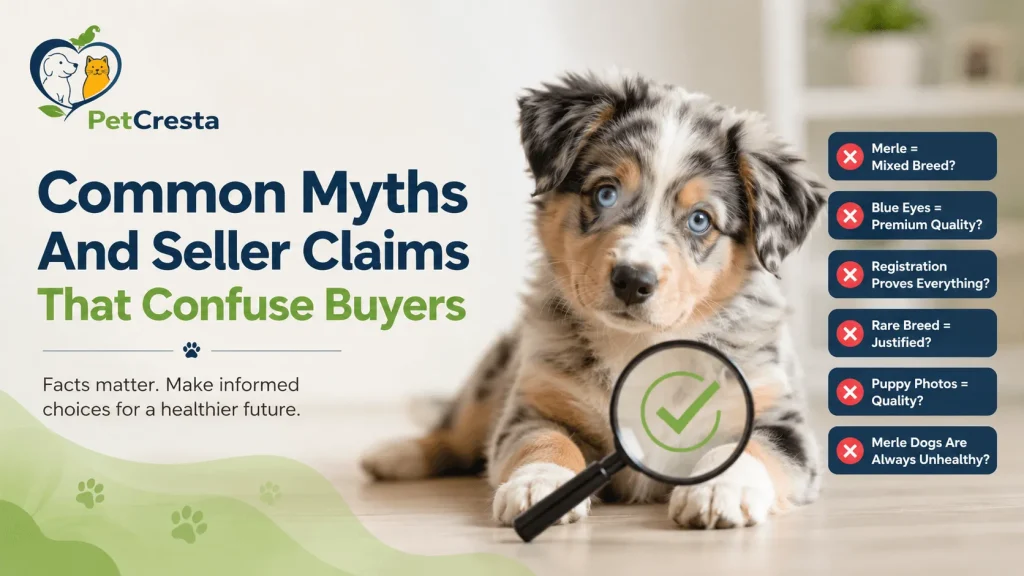
Merle is a synonym for mixed breed.
Not necessarily. The ancestry and pattern are two separate concerns.
Blue eyes mean premium quality.
No. The color of eyes is a visual attribute, not a qualitative test.
The registration process is what proves everything.
No. Registration is only a part of a discussion.
Rare breeds justify the choice of breeding.
No. Visual scarcity doesn’t outweigh health plans or well-informed decision-making.
Puppy photos prove quality.
No. Photos may show an appearance, not the thought-provoking breeding.
All dogs that are merle are unhealthy.
No. The primary risk to avoid is due to bad pairing choices, particularly breeding merle-to-merle.
Conclusion
Merle changes its appearance. This does not alter the fundamental nature of the breed.
The most important questions remain the same for any Poodle health plan and temperament, structure realistic expectations of size grooming commitment, as well as authentic record keeping.
The coat could be the first thing that people notice. But it shouldn’t be the sole item they weigh. They should be evaluated as a complete dog. If the pattern is the primary focus, judgment is usually weaker.
FAQ’s
Yes, Poodles can show merle patterning, but the pattern should be looked at carefully. The bigger concern is how merle entered the breeding line and whether responsible breeding choices were made. A merle Poodle should come with clear health testing, coat-color transparency, and honest breeder records.
Merle Poodles are less common than many solid-colored Poodles, but rarity does not automatically mean better quality. A rare coat pattern should never be the main reason to choose a dog. Health, temperament, breeder honesty, and proper genetic planning matter far more than color alone.
The merle gene affects how pigment appears in the coat, which can create a marbled, patchy, or broken color pattern. It may also influence eye color in some dogs. The pattern itself is about pigment, but breeding decisions around merle carry serious health considerations.
Merle-to-merle breeding is avoided because it raises the risk of double-merle puppies. Double-merle dogs have a much higher chance of serious hearing and vision problems. Responsible breeders avoid this pairing because the health risks are preventable.
Merle-to-merle breeding is genetically possible, but it is not a responsible choice from a welfare standpoint. The pairing can produce double-merle puppies, which may face avoidable hearing or vision issues. Ethical breeding should focus on health and safety, not producing a certain coat pattern.
Some merle dogs can be healthy, but health concerns increase when risky breeding decisions are involved. The biggest concern is double-merle breeding, which can raise the chance of hearing and vision defects. A single merle pattern is not the whole issue; the breeding plan and genetic testing matter.
Merle dogs are not automatically unhealthy. A single merle dog can be healthy when bred responsibly and screened properly. The concern becomes much greater when two merle dogs are bred together or when the breeder cannot explain the dog’s genetic background.
Yes, some Poodles can have blue eyes, especially when merle patterning is involved. Blue eyes alone do not prove that a dog is healthy, unhealthy, rare, or well bred. Eye color should be considered along with health testing, temperament, and responsible breeding history.
Yes, a blue merle miniature Poodle can be healthy if the dog was bred responsibly and risky pairings were avoided. The merle pattern alone does not automatically mean poor health. The safer question is whether the breeder used genetic testing, avoided merle-to-merle breeding, and provided clear health records.
References
Breed standard and size
Breed-specific health testing
- Poodle Club of America — Health Testing in Poodles (PDF)
- Poodle Club of America — Poodle Information Online
Breeding ethics and breeder responsibilities
Merle genetics
Double merle, hearing, vision, and registration policy