Aussiedoodle Puppies: Size, Temperament, Shedding, Care, And What To Expect
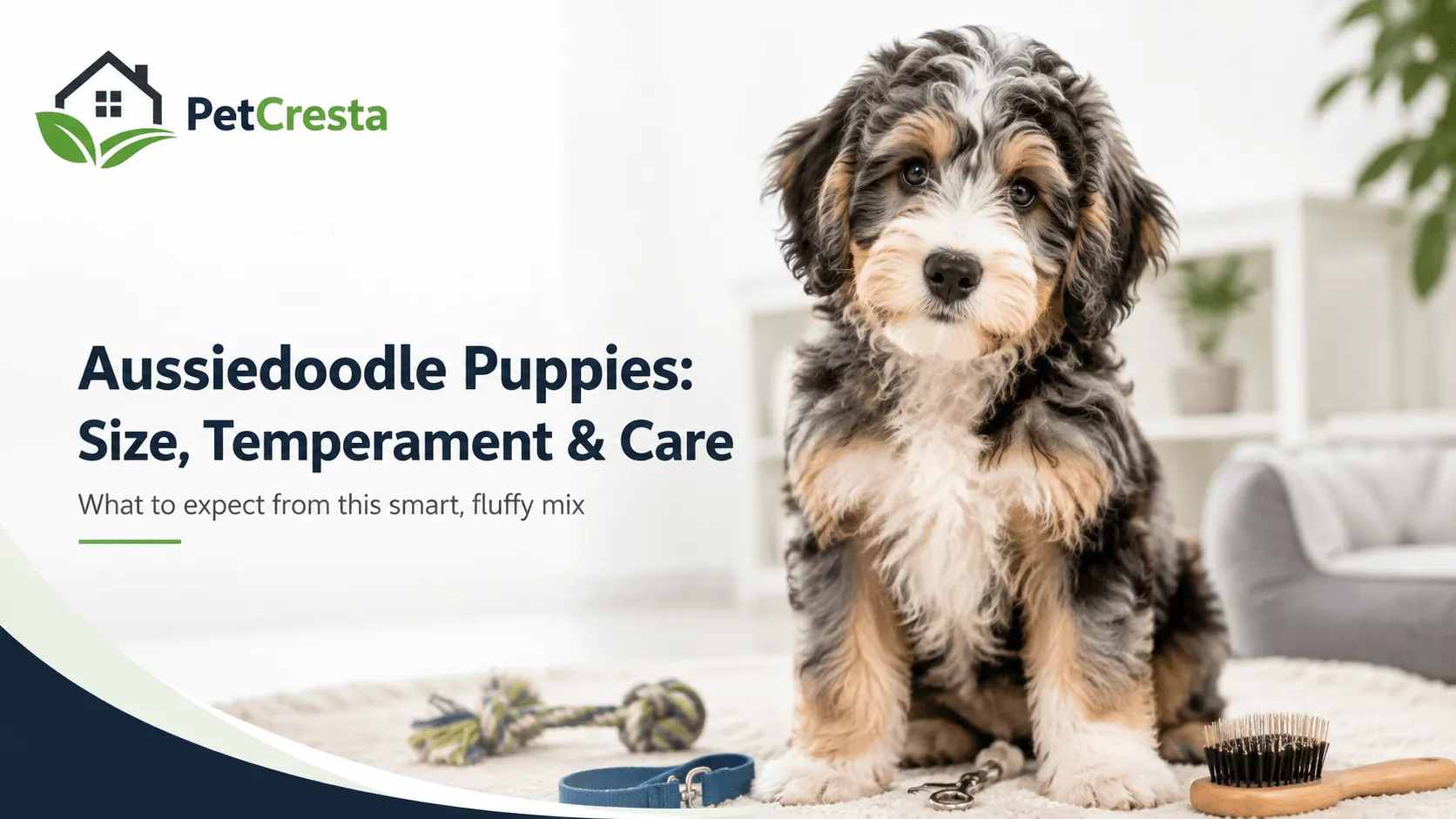
Aussiedoodle puppies is a mix of an Australian Shepherd and a Poodle, but this doesn’t mean there is only one type of Aussiedoodle. Some become smaller, curly, bark more easily, and/or respond more strongly to activity and movement near them, or they become larger, loose, and/or more responsive to movement and activity near them.
The parents, extended family, early life experiences, health, and life experiences all influence adult size, coat type, energy level and temperament. A fluffy puppy picture won’t give you an idea of the grooming, exercise, training and daily upkeep that may be required for the adult dog.
This guide goes beyond the surface to offer an understanding of what life with an Aussiedoodle can be like. It includes size and growth, temperament, shedding, grooming, training, health testing, feeding, costs, breeder claims, rescue and the first year at home.
Quick Verdict: Is An Aussiedoodle The Right Fit?
Aussiedoodles may be a good choice for an active family looking for an energetic and engaging pet. They tend to be more difficult to control when the family wants an easy coat, extended periods of time alone, or a puppy that will do okay on its own.
Neither column guarantees success or failure. It just indicates which activities of the day tend to help this combination and which ones may lead to frustration.
| Better fit | Harder fit |
|---|---|
| Active, involved household | Wants a low-maintenance coat |
| Time for short daily training | Leaves a young puppy alone for long periods |
| Comfortable with regular grooming | Expects intelligence to replace training |
| Ready for supervised socialization | Needs a guaranteed low-shedding dog |
| Flexible about adult size and coat | Chooses mainly by color or curls |
| Prepared for adolescent behavior | Cannot budget for professional grooming |
A family that can offer structure, rest, training, and coat care is off to a good start. Families who are attracted by the fluffy puppy look might have a hairy shock, literally.
Aussiedoodle Traits At A Glance
There is no one single chart for all Aussiedoodles. However, a planning snapshot can assist you in seeing which details you may want to scrutinize before you welcome your puppy into your home.
| Topic | Planning answer | What changes it |
|---|---|---|
| Breed type | Mixed-breed dog | Parentage and breeding generation |
| Parent breeds | Australian Shepherd and Poodle | Poodle variety and parent selection |
| Adult height | Commonly about 10–25 inches | Parent height, sex, build, and family line |
| Adult weight | Commonly about 15–75 pounds | Poodle variety, parent weight, and genetics |
| Informal size labels | Toy, Mini, and Standard | Breeder definitions are not uniform |
| Temperament | Often alert, social, responsive, and active | Parent temperament, early development, health, and training |
| Exercise needs | Moderate to high | Age, size, health, and individual energy |
| Trainability | Often strong | Motivation, environment, consistency, and emotional state |
| Shedding | Low to moderate in many dogs, but variable | Coat genetics and adult coat type |
| Grooming | Moderate to high | Curl, density, length, and matting tendency |
| Barking | Variable; may increase with arousal or boredom | Genetics, environment, reinforcement, and routine |
| Alone-time tolerance | Limited during puppyhood | Gradual training, age, confidence, and health |
| Lifespan | Often around 10–15 years | Size, genetics, preventive care, and illness |
| Best household fit | Engaged home prepared for training and grooming | The individual dog and household routine |
There is not a standard Aussiedoodle size as published breed guides have different ranges for height, weight and lifespan. The measurements of parents or other documented relatives are more useful than the terms “micro,” “tiny,” or “petite.”
What Is An Aussiedoodle Puppy?

The Aussiedoodle puppy is a cross between an Australian Shepherd and a poodle. It is not a standard size, purebred dog with a uniform coat, working ability or temperament.
Every puppy has a unique mix of inherited traits. How those traits manifest in everyday life is then influenced by early care and later experiences.
Australian Shepherd And Poodle Mix Parentage
Australian Shepherd ancestry can include alertness, movement awareness, interaction with humans, stamina and herding tendencies. Poodles can have curly hair, be well-furnished, be easy to train, be athletic, be alert, and have a significant amount of coat maintenance. Readers interested in a three-breed cross with similar Australian Shepherd influence can also review the Australian Mountain Doodle, which also includes Bernese Mountain Dog ancestry.
Those are possibilities, not neat halves. Not all puppies with a curly coat are more Poodle-like in temperament and not all merle puppies are more driven or active.
| Parent | Traits that may appear | What cannot be predicted |
|---|---|---|
| Australian Shepherd | Alertness, herding behavior, motion sensitivity, stamina, close engagement | Exact energy, confidence, sociability, or chasing behavior |
| Poodle | Wavy or curly coat, trainability, athleticism, alert behavior, grooming demands | Shedding amount, allergy response, calmness, or ease of ownership |
| Mixed outcome | Any combination of parent traits | A fixed personality, coat, size, or care level |
Both parent breeds have been bred to work closely with humans. An Aussiedoodle can thus be trained quickly and yet patiently, with planned rest, and an outlet for activity.
Why Puppies In The Same Litter Can Differ
Littermates don’t inherit the same set of genes. Some might inherit a thicker coat, some might grow bigger, and some might be more wary of new motions.
Development is also influenced by early health, maternal care, nutrition, handling, sleep, and social experiences. Don’t judge the puppies based on a brief visit or one happy picture; ask the breeder or foster caregiver how each puppy acts over time.
What F1, F1B, F2, And Multigenerational Mean
Generation labels describe breeding relationships. They can help you understand the family tree, but they cannot promise a particular adult result. Our guide explaining what an F1B Bernedoodle is provides another clear example of backcross terminology and why an F1B label cannot guarantee coat, shedding, size or temperament.
Breeders do not always apply these labels in exactly the same way. Confirm the identity, breed, size, and health records of the actual parents.
| Label | Common meaning | What it may influence | What it cannot guarantee |
|---|---|---|---|
| F1 | Australian Shepherd crossed with a Poodle | Range of parent traits | Size, shedding, health, coat, or temperament |
| F1B | Commonly an F1 Aussiedoodle crossed back to a Poodle | Greater chance of some Poodle coat traits | Non-shedding or allergy safety |
| F2 | Two first-generation Aussiedoodles bred together | Broad trait combinations | Consistency within the litter |
| Multigenerational | Later-generation Aussiedoodle breeding | Selection for chosen family traits | A uniform breed result |
An F1B puppy can still shed. A later-generation puppy can still develop inherited disease. Health evidence from both sides of the family remains necessary.
Names And Brief History
Aussiedoodles are also known as Aussiepoos, Aussiepoodles or Australian Shepherd–Poodle crosses. With the increased popularity of Poodle crosses in the 1990s, deliberate breeding was more prevalent, although there is no reliable record of any one first breeder or first litter.
There is no one official breed standard that governs size, coat, structure, and temperament. It is helpful to carefully assess the parents, breeding objectives, and specific puppy. Similar naming uncertainty appears across the broader Mountain Doodle category, where breeders may use one label for several different Poodle-cross combinations.
Aussiedoodle Size, Growth, And Full-Grown Expectations

One of the first questions to address is the aussiedoodle puppy full grown. It impacts travel, handling, food, equipment, exercise, housing, and the force an excited adolescent can exert on a leash.
Breeder labels are just a starting point. Use measured parent size for better information.
Toy, Mini, And Standard Aussiedoodle Size
The terms Toy, Mini and Standard are not official size classifications, but rather are descriptive terms used for Aussiedoodles. There is some variation in published ranges and dogs may fall outside of the range estimate.
Chewy reports that Miniature Aussiedoodles weigh 15-40 pounds, while Standard Aussiedoodles weigh 40-70 pounds. Toy-influenced dogs are typically under 20 pounds, according to Daily Paws, which provides a broader overall range.
| Informal size label | Approximate adult height | Approximate adult weight | Parent information to check |
|---|---|---|---|
| Toy or very small line | About 10–14 inches | About 10–20 pounds | Toy Poodle size, other parent size, adult relatives |
| Mini line | About 12–18 inches | About 15–40 pounds | Miniature Poodle size, both parents, previous litters |
| Standard line | About 18–25 inches | About 40–75 pounds | Standard Poodle size, Australian Shepherd size, family build |
These are planning ranges, not promises.
Be cautious when a seller guarantees a narrow adult weight without explaining the parents’ measurements. Terms such as “micro” and “teacup” may describe a marketing target rather than a predictable class.
Mini Aussiedoodle Vs Standard Aussiedoodle
A Mini Aussiedoodle is often easier to lift, fit into a vehicle, or manage in a compact home. Smaller size does not remove the need for grooming, training, mental work, or gradual alone-time practice.
Standard Aussiedoodles may require more food, larger equipment, greater physical control, and more room to move comfortably. Their adolescent enthusiasm can feel rather substantial when attached to the end of a leash.
| Ownership factor | Mini Aussiedoodle Dog | Standard Aussiedoodle |
|---|---|---|
| Handling | Usually easier to lift and carry | More strength and physical management needed |
| Travel | Often easier in small vehicles and carriers | Requires larger equipment and more space |
| Food use | Usually lower | Usually higher |
| Grooming | Can still be intensive | More coat surface may increase time and cost |
| Exercise | May be highly active despite smaller size | Often needs substantial activity and training |
| Equipment | Smaller crate, bed, and harness | Larger and often more expensive equipment |
| Young children | Less body weight, but may be delicate or excitable | More risk of accidental knocking or pulling |
| Mobility-limited owner | Easier to handle physically in some cases | Strength may be difficult during adolescence |
Neither size is automatically calmer. Choose the dog whose expected adult needs fit the household rather than assuming smaller means simpler.
Aussiedoodle Puppy Growth Timeline
Growth is not a single event! Development of height, body mass, teeth, coat, coordination and self-control do not occur simultaneously.
Bigger dogs may require more time to develop physically. Emotional maturity can be delayed well beyond the time of physical maturity.
| Age | Body and coat changes | Behavior owners may notice | What helps |
|---|---|---|---|
| 8–12 weeks | Rapid growth, soft puppy coat, developing coordination | Short attention span, mouthing, frequent sleep | Routine, toilet trips, gentle handling, rest |
| 3–5 months | Teething, stronger movement, coat beginning to change | Greater curiosity, chewing, bursts of confidence | Safe chewing, socialization, short training |
| 6–9 months | Nearing adult height in some lines | Adolescent inconsistency, jumping, pulling, chasing | Management, reinforcement, calm repetition |
| 9–12 months | Continued filling out and coat development | More stamina, selective listening, social changes | Structured activity, rest, ongoing training |
| 12–18 months | Body and adult coat continue settling | Better control may emerge gradually | Consistent expectations and suitable outlets |
| Later maturity | Some larger dogs continue developing | Adult behavior becomes more stable | Long-term routine and appropriate exercise |
A big dog can be a big puppy. This is normal and can make the living room seem slightly smaller than it was 6 months ago.
Estimating Adult Size
The most useful information is the measured height and weight of both parents, the Poodle variety, relatives of the adults and the results of previous litters from similar crosses. A veterinarian may use regular growth records to determine if growth is on track.
Paw size, loose skin and internet calculators are much less powerful tools. Do not treat an adult-size estimate as a contractual certainty.
What Do Aussiedoodles Look Like?

Aussiedoodles may appear very different from one another. The texture of the coat, furnishings, color, markings, build, ear set, eye color and tail appearance can all be different.
While appearance is a plus, it should be lower on the list than health, temperament, adult size and daily care.
Coat Textures And Adult Coat Change
There are some Aussiedoodles that have straight coats with some visible feathering. Others grow loose waves, curls or thick hair around the face and legs.
When the adult coat comes in, the puppy coat can get thicker and matted. The amount and allergy tolerance of the shed is not guaranteed by curl.
Common Colors And Patterns
Colors may be black, brown, red, cream, gray, silver, blue-toned and white markings. Dogs can be solid, bi-color, tri-color, parti-colored or merle.
Not all colors are used consistently as color terms. A rare-looking pattern does not necessarily mean good health, greater intelligence or a more desirable temperament.
Merle Aussiedoodle Puppies And Responsible Breeding
Merle produces irregular patches of lighter and darker color. The pattern may be dramatic and sometimes sellers make colour the focus of the buying discussion.
When two merle dogs are bred together, their puppies may be double merle with a higher likelihood of hearing, eye, skeletal and other abnormalities. UC Davis suggests genetic testing because the appearance does not necessarily indicate the full merle genotype.
When merle is present, request the colour genetic status of both parents. No picture will ever replace a genetic record or a responsible breeding plan.
What Appearance Cannot Predict?
A puppy’s face and coat will not give you an indication of how an adult dog will react to strangers, children, grooming, frustration or time alone. Appearance does not indicate health or trainability.
Appearance cannot reliably predict:
- Adult temperament
- Final shedding
- Allergy response
- Ease of grooming
- Adult size
- Health
- Suitability for children
- Compatibility with other pets
After the meaningful questions have been answered, select appearance. That’s the order that can save years of unnecessary mismatching.
Aussiedoodle Temperament And Puppy Behavior
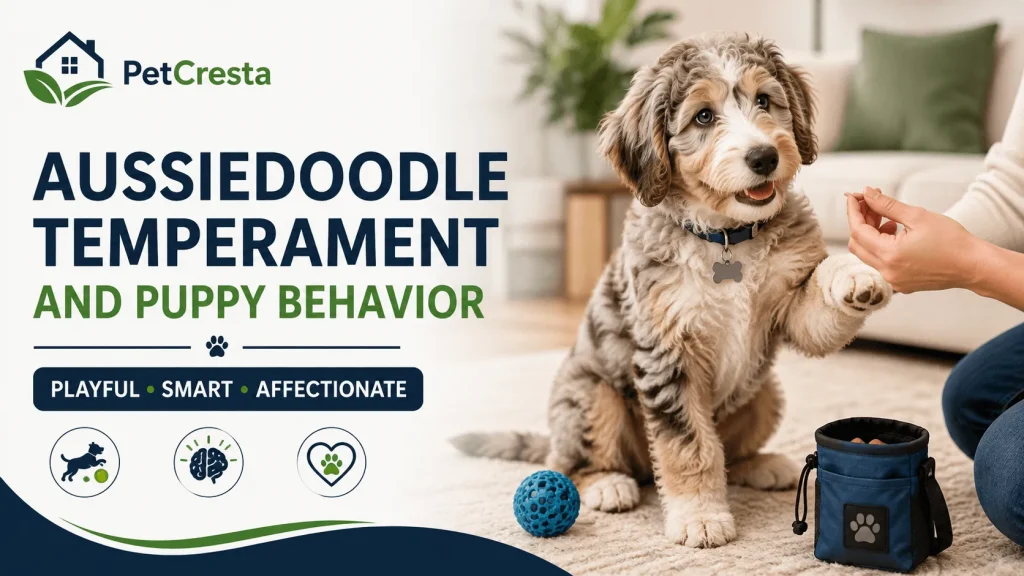
Aussiedoodles are known to be smart, affectionate, playful and active. Those words are helpful only when accompanied by a sincere description of what they might appear like in a house.
A puppy that is socially interested might crave attention. A quick learner might also discover that barking opens doors, jumping starts play, and stealing socks starts an exciting family chase.
Common Aussiedoodle Behavioral Tendencies
Aussiedoodles love interacting, moving, playing and learning. Some are self-assured and sociable; others are sensitive, alert, or hesitant to adapt to new situations.
Behavior is influenced by parent temperament, early care, sleep, pain, illness, social exposure, and training. A puppy should never be chosen because of a cheerful description of the breed.
Herding, Chasing, And Motion Sensitivity
Australian Shepherd ancestry may contribute to staring, circling, chasing, barking at movement, or attempting to control running children, bicycles, cats, and other dogs. These behaviors are not guaranteed, but they deserve early management.
Use gates, leashes, distance, recall practice, and rewards for disengaging from movement. Do not encourage a puppy to chase children as a game. Persistent stalking, nipping, or an inability to disengage may require help from a qualified reward-based professional.
Barking And Alert Behavior
They may bark in response to visitors, movement outside, excitement, frustration, boredom, or being left alone. The same sound can have different causes, so management should begin with the trigger.
Reward quiet observation, reduce repeated access to windows or fences when those areas create rehearsal, and teach a brief alert followed by a calm behavior. Prolonged barking after departures, combined with pacing, drooling, destruction, or escape attempts, may indicate separation distress rather than ordinary alert barking.
Separation And Alone-Time Training
Young puppies are not ready for a full workday alone. Bladder control, emotional security, feeding needs, and developmental stage limit what they can manage.
Begin with brief, comfortable separations while the puppy has a safe activity and is still below the point of distress. Increase time gradually.
Repeated escape attempts, heavy drooling, self-injury, prolonged vocalization, refusal of food, or panic before departures may indicate more than boredom. A veterinarian or qualified behavior professional should assess those signs.
Puppyhood, Adolescence, And Adult Behavior
Behavior rarely improves in a straight line. A puppy may respond beautifully for several weeks and then appear to forget everything when adolescence arrives.
That change does not mean training has failed. Development, hormones, confidence, distractions, and greater physical ability can temporarily expose weak spots in the routine.
| Life stage | What owners may notice | What helps |
|---|---|---|
| Early puppyhood | Curiosity, mouthing, frequent sleep, short focus | Supervision, routine, gentle training |
| Later puppyhood | More confidence, teething, stronger play | Chewing outlets, socialization, clear limits |
| Adolescence | Pulling, jumping, selective responses, chasing | Management, repetition, suitable exercise |
| Young adulthood | Improving control with occasional setbacks | Continued reinforcement and predictable expectations |
| Adulthood | More stable habits if earlier needs were met | Ongoing activity, training, rest, and health care |
Is An Aussiedoodle A Good Family Dog?

An Aussiedoodle can be a cuddle buddy and a fun addition to any family. The match will be determined by the dog’s temperament, the ages and temperaments of family members, and the family’s capacity to control activity and grooming.
The term “good with families” does not mean “needs no supervision.” Even friendly puppies have teeth and speed and not a lot of respect for a freshly folded pile of laundry.
Aussiedoodles And Children
A good Aussiedoodle can play, walk, train and be a companion to children. When jumping, mouthing, chasing, guarding, and physical excitement are not controlled, problems can occur.
Young children should always be supervised by adults. Provide a quiet resting place for the dog and ensure children do not disturb it when eating, chewing, sleeping or trying to move away.
Toddlers might not be as resilient as older children with a rambunctious teenager. The puppy’s adult size and playfulness also play a role.
Aussiedoodles And Cats
There are some Aussiedoodles that get along with cats. Others have a strong need to seek out movement, particularly if they are not introduced to it or exposed to it early on.
Utilize gates, leashes, high escape areas, separate resources and short controlled sessions. Never force face-to-face contact.
A foster home that has documented cat observations will be more useful than a quick meeting with a puppy. When the match is unsafe due to persistent stalking, chasing or inability to disengage.
Aussiedoodles And Other Dogs
Compatibility is dependent upon play style, size, age, sociability, guarding behavior, and the needs of the resident dog. A senior resident dog may not appreciate being treated like a trampoline by an energetic adolescent.
When possible, introduce dogs in a neutral space. During the adjustment period, keep food, chews, high-value toys and rest areas separate.
Apartment Living
Yes, an Aussiedoodle can live in an apartment as long as they can access a toilet, get enough exercise, have mental stimulation, are trained quietly, and their triggers in the hallway or window are managed. While a yard is a convenient space, it is not a place for learning to settle or a substitute for interaction.
Think about exposure to the elevator, common entrance, barking, neighbor proximity, and handling a bigger adolescent. The address is not as important as the daily plan.
How To Train An Aussiedoodle Puppy
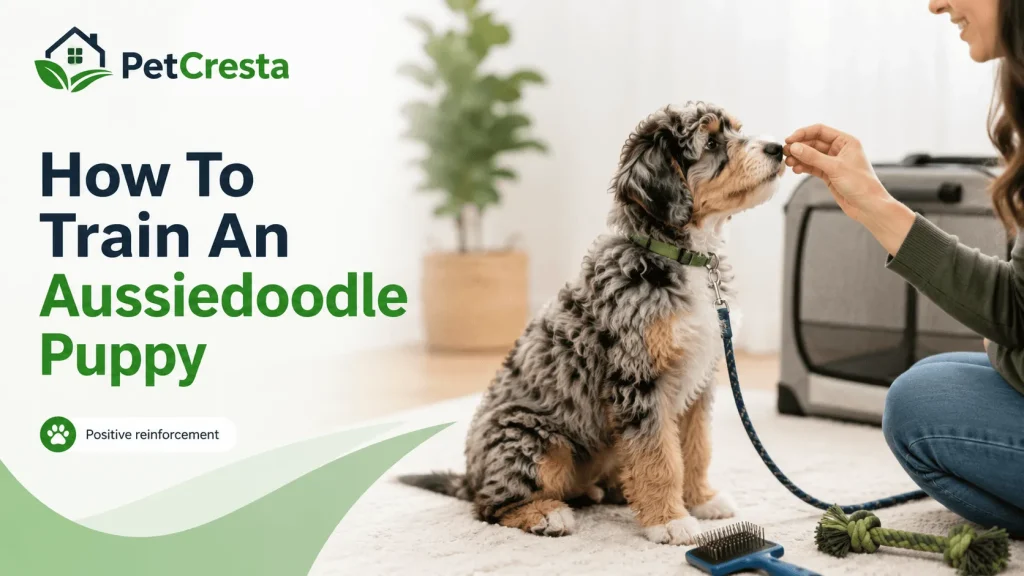
Although Aussiedoodles are fast learners, they are not necessarily good house pets. They require explicit instructions, structured opportunities and positive reinforcement for the desired behavior.
Reward-based training is recommended by the American Veterinary Society of Animal Behavior, and punishment through pain, intimidation, force, and flooding are discouraged.
First-Month Priorities
The first month should be about communication and safety. Fancy tricks are for when the puppy can rest, reliably go to the bathroom, tolerate handling, and respond to normal distractions.
Focus on:
- Name response: Say the name once and reward orientation toward you.
- Toilet routine: Take the puppy out after sleep, meals, drinking, and active play.
- Crate or pen comfort: Pair the area with food, rest, and safe chewing.
- Bite inhibition: Redirect to toys and pause play when arousal becomes painful.
- Leash introduction: Begin in a quiet area with light, comfortable equipment.
- Grooming handling: Pair brief touching, brushing, and combing with rewards.
- Socialization: Introduce new experiences without forcing contact.
- Calm recovery: Notice and reward relaxed behavior.
Short sessions are more effective than long sessions. If the puppy is successful, stop!
House Training
After waking, feeding, drinking and playing, take the puppy to the same suitable spot. Reward as soon as they are on the toilet, not when you get home.
Many accidents are avoided with supervision and a safe area for the animals. Use an enzymatic cleaner to clean up errors and avoid punishment.
Rapid change in toilet habits may be due to a medical reason. If accidents occur with straining, urination, diarrhea, vomiting, pain, excessive thirst or lethargy, contact your veterinarian.
Crate And Pen Training
Introduce the crate/pen with meals, treats, rest, and open door exploration. The space should be predictable, not the place where fun ends.
Some puppies like to have a bigger pen or puppy-safe room. If drooling is severe, frantic escape behavior, injury, or increasing panic calls for another plan and professional evaluation.
Do not leave equipment that may snag in the puppy’s enclosure unless your vet or trainer has said it is safe to do so. Never use a crate as a punishment.
Socialization Without Overwhelming The Puppy
Socialization is safe, positive exposure to sights, sounds, people, animals, surfaces, handling, vehicles, veterinary care and grooming. It does not mean having the puppy say hello to all the people.
AVSAB recognizes the first three months of life as a critical social-development window and advocates for safe exposure prior to the completion of the vaccine series. Uncontrolled, heavily trafficked areas that are frequented by dogs from unknown health status should be avoided by puppies, and local disease risk should be discussed with a veterinarian.
Monitor the puppy’s body language. Learning is generally better when distance, food, play and the opportunity to get away are present than when they are not.
Recall, Leash Skills, And Impulse Control
Don’t expect to be successful around wildlife, children, traffic, or other dogs until you have built the recall first! Use a happy cue, large rewards and a long line in safe outdoor areas.
Practice on the leash should encourage connection and movement close to you. Impulse control exercises can involve waiting for a short time before going through a door, before eating, before putting a toy down, or bringing attention back after excitement.
Avoid stressing a puppy repeatedly by putting him in situations where he is likely to fail. The more the environment is structured for success, the more reliable the training will be.
Teaching An Aussiedoodle To Settle
If a puppy is continually exhausted, he will become a dog that wants constant entertainment. Rest is a taught component of the routine.
Use positive reinforcement for spontaneous calm, offer safe chewing toys, establish predictable nap times and teach the puppy to settle on a mat. Reduce household activity before bedtime.
If a puppy is unable to settle, he may be overtired, overstimulated, uncomfortable, frightened or sick. Training should not be done in a calm manner to ignore distress or pain.
Exercise, Mental Enrichment, And Daily Structure

There is a relationship between exercise, physical health and behavior, but too much is not necessarily good. Young joints and growth plates are still developing, coordination is not yet fully developed and emotional control is not yet fully developed.
A balanced day involves movement, sniffing, short training, food, social interaction, independent activity and lots of sleep.
How Much Exercise Does An Aussiedoodle Puppy Need?
Unfortunately, there is no universal number that will work for all Aussiedoodle puppies. Age, adult size, health, surface, type of activity, weather and individual recovery are all factors.
Suitable puppy activity may include gentle play, brief training, free movement in a safe area, short walks, and sniffing. Don’t let the puppy jump repetitively, run too much, or do long high-impact sessions that are based on tiring the puppy out.
Look for signs of lagging, lying down, loss of coordination, frantic biting, irritability or inability to recover. Discuss activity with your veterinarian if the puppy is in pain, lameness, ill, or orthopedic.
Adult Exercise Expectations
Most adult Aussiedoodles require a lot of exercise every day. Dogs that like to retrieve, hike, swim, train, do scent work, or participate in dog sports may not be content with just walking. Active households comparing sporting and working Poodle crosses may also consider whether a Springer Doodle is a good fit, although its spaniel ancestry creates a different activity and temperament profile.
Increase build-up of duration and intensity over time. The plan should be based on the weather, fitness, body condition, age, and joint health.
Mental Enrichment
Examples of mental work are food puzzles, scent games, toy searches, shaping activities, safe chewing, retrieving, and short skill sessions. Sometimes it’s better to switch some activities than to purchase a mountain of puzzles and make a second job for yourself.
Enrichment should make the dog feel full, not frenzied. Select activities that promote thinking, sniffing and healing.
Example Daily Routine
A schedule should remain flexible. Toilet frequency, meals, sleep, and activity change with age and the individual puppy.
The examples below show balance rather than a medical prescription.
| Part of day | Puppy need | Example activity | Recovery |
|---|---|---|---|
| Early morning | Toilet, food, connection | Toilet trip, breakfast, 3-minute training | Quiet rest |
| Mid-morning | Movement and exploration | Short sniffing walk or safe play | Nap |
| Midday | Toilet and meal for younger puppy | Calm handling, food toy | Rest in pen |
| Afternoon | Social learning | New surface, visitor at a distance, grooming practice | Quiet chewing |
| Early evening | Activity and family time | Play, short leash practice, toilet trip | Settle on mat |
| Night | Security and sleep | Final toilet trip, calm routine | Overnight rest |
An adolescent may need longer walks or more structured activity but usually still benefits from planned recovery. A busy schedule without downtime can make behavior worse.
Signs The Puppy Needs More Rest, Not More Exercise
When puppies are overtired, they may appear more active than sleepy. When the puppy starts to get too much, it may get frantic mouthing, zoom around wildly, grab at clothing, bark, lose focus, or become irritated.
Go to a quiet place, provide a safe chew, reduce stimulation and promote sleep. If behavior changes, if weak, painful or unusual lethargy is present, it’s time to see the vet.
Aussiedoodle Grooming, Shedding, And Allergies
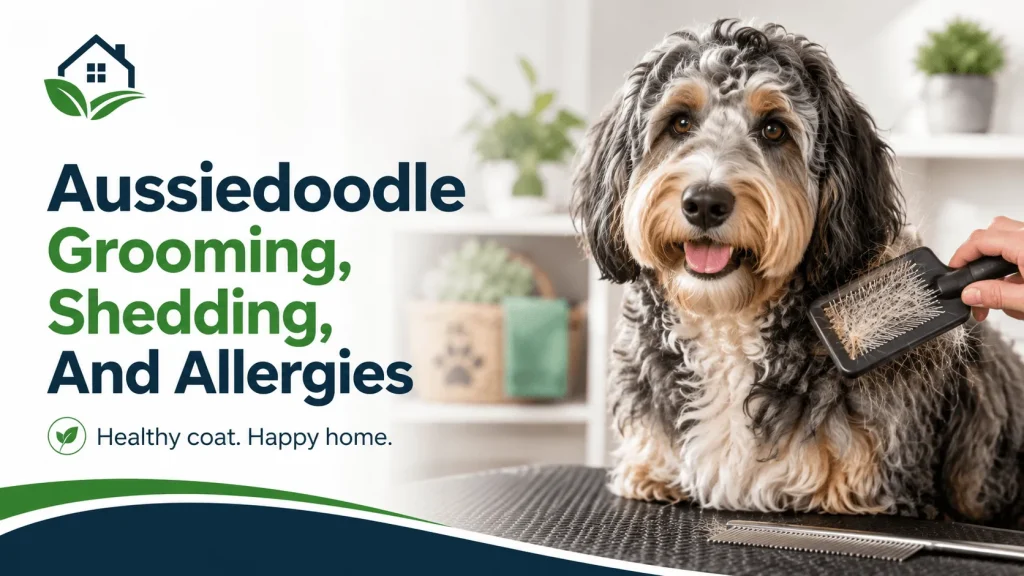
One of the biggest continuous responsibilities you will have with an Aussiedoodle is coat care. If your dog sheds less around the house, he will need more brushing and professional grooming.
It’s best to wait until the first serious mat to start grooming, because it’s more likely to become a fight than a game.
Do Aussiedoodles Shed A Lot?
Aussiedoodles can shed. This amount is low to evident, depending on the individual coat.
Loose hair can be trapped in the coat, reducing shedding and increasing tangles and matting in curlier coats. Coats that are straighter can shed more hair into the environment.
Appearance of the puppies and generation label cannot guarantee the adult shedding pattern. According to Chewy, Aussiedoodle coats are low shedding to shedding frequently.
Are Aussiedoodles Hypoallergenic?
There are no 100% hypoallergenic dogs. Dog allergens are found in the dander, saliva, hair and urine of a dog and can vary from person to person and dog to dog.
Some people may find a lower shedding dog easier for them, but it’s not a medical certainty. Asthmatics or those with severe dog allergies should consult an allergist and spend time with the particular dog before committing.
Grooming By Coat Type
The type of coat will affect the manner in which hair is lost, where tangles occur and when professional assistance might be required. The density is as important as the curl.
Use the table as a planning guide. The individual dog’s groomer can further tailor the routine.
| Coat tendency | Visible shedding | Matting risk | Home care | Professional care |
|---|---|---|---|---|
| Straighter or loose coat | Often more visible | Moderate | Brush and comb several times weekly | Trim as needed |
| Wavy coat | Low to moderate | Moderate to high | Thorough brushing and comb checks | Regular trimming is common |
| Curly coat | Often less visible | High | Frequent line brushing and combing | Scheduled clipping is commonly needed |
| Dense changing coat | Unpredictable | High during transition | Increase checking as adult coat arrives | Early groomer support can prevent severe matting |
A brush can pass over the top while knots remain close to the skin. Follow brushing with a metal comb that reaches through the full coat.
Puppy-To-Adult Coat Transition
The adult coat can get thicker, curlier, coarser, or harder to comb. Matting can escalate rapidly in the transition.
Introduce the groomer when the coat is not too long. Small, positive contacts can help to create comfort with tables, dryers, clippers, feet handling, and facial work.
Weekly Grooming Routine
Frequency is dependent on coat length, density, activity and skin condition. A dog that has a lot of friction points, like a dog with a lot of curls, might require more attention than a dog with less curl and fewer friction points.
Ear checking and ear cleaning are two different jobs. Clean only under veterinary supervision and using the correct product.
| Grooming task | Typical planning frequency | Why it matters |
|---|---|---|
| Brushing | Several times weekly; more for dense curls | Removes loose hair and separates tangles |
| Metal-comb check | After brushing | Finds knots close to the skin |
| Ear observation | Weekly and after swimming | Detects odor, redness, pain, discharge, or moisture |
| Nail care | Based on growth and wear | Supports comfortable movement |
| Toothbrushing | Daily when possible | Helps reduce plaque and supports oral health |
| Bathing | As needed | Cleans coat without unnecessary drying |
| Professional grooming | Often every 6–8 weeks for maintained curly coats | Controls length and reduces matting |
The AVMA recommends routine oral exams and home toothbrushing, if possible, daily. Do not use human toothpaste.
Common Matting Areas
Look under the ears, under the collar, under the harness, under the armpits, around the legs, near the tail and wherever the coat rubs when the animal is moving.
Mats can be very tight and cause pain. Avoid cutting tight mats at home as folded skin may be concealed within the mat.
Feeding And Healthy Growth During The First Year

Puppy feeding should promote steady growth and not promote excess weight gain. The correct amount will vary based on the calorie density of the food, the expected adult size, activity, body condition and health.
A small bowl to a person could have more calories than the puppy needs. The most accurate way to measure food is better than estimating by eye.
Choosing A Puppy Food
Select a complete diet for growth and suitable for the puppy’s adult size. Look at the nutritional adequacy statement, not terms like “premium,” “holistic,” or “natural.”
WSAVA recommends asking the following questions: Is the food complete for the life stage it is intended for? Who made the food? How is the quality controlled? Does the company provide detailed nutritional information?
Replace foods slowly, unless the veterinarian advises otherwise. All treats, chews, toppers and training rewards add calories.
Meal Frequency By Life Stage
It is better to feed several small meals than to feed one big meal daily for young puppies. As the puppy grows, the frequency of meals may be reduced.
Every dog is an individual, so follow your veterinarian’s and the manufacturer’s feeding guidelines.
| Life stage | Common planning pattern | Main goal |
|---|---|---|
| Young puppy | Three to four measured meals | Stable intake and growth support |
| Older puppy | Often two to three meals | Adjust portions as growth rate changes |
| Adolescent | Commonly two meals | Maintain healthy body condition |
| Adult | Often two measured meals | Support weight, activity, and digestive comfort |
Do not leave food available all day unless there is a medical or management reason. Scheduled meals make appetite changes easier to notice.
Body Condition Matters More Than Bowl Size
Weight alone is not a good indicator of a healthy weight. Check the waist, touch the ribs, monitor growth and ask your veterinary team to check the body condition.
Adjust for changes in growth rate, activity, treats, or food calorie content. Excess weight can put an unnecessary strain on developing joints when it comes quickly.
Feeding Larger Aussiedoodles And Bloat Awareness
Standard Poodles are one type of dog that is known to be at risk for GDV, and larger Aussiedoodles may warrant a conversation with their vet about bloat risk. GDV is a distention of the stomach that can twist, reducing circulation and leading to shock quickly.
If the animal keeps retching without producing any food, is restless, drooling heavily, its abdomen is distended, it is weak, unable to breathe or collapses, it is a serious emergency and needs immediate attention. Don’t wait to see if the dog gets better at home.
Meals may be smaller and slower eaten as part of a veterinary prevention discussion. There is no feeding practice that can guarantee absolute prevention.
Aussiedoodle Health Issues And Parent Testing

Aussiedoodles may pass on health issues from either parent line. A person’s mixed ancestry does not preclude the need for screening.
A long DNA panel is not a substitute for orthopedic examinations, eye testing, physical assessment, and family history. Evidence in the form of evidence.
Health Concerns At A Glance
The conditions below are possibilities, not predictions. There is variation in risk depending on Poodle variety, parent results, family line, body structure, age and the individual dog.
Review the table to learn what can be screened prior to breeding and what should be evaluated by the veterinarian.
| Concern | Possible signs | Parent-screening option | General urgency |
|---|---|---|---|
| Hip dysplasia | Stiffness, difficulty rising, reduced activity | OFA or PennHIP evaluation | Routine to prompt, depending on pain |
| Elbow dysplasia | Forelimb lameness, stiffness | OFA elbow evaluation | Prompt if persistent or painful |
| Patellar luxation | Skipping gait, intermittent hind-leg lifting | Patellar evaluation in relevant Poodle lines | Routine to prompt |
| Progressive retinal atrophy | Night-vision difficulty, progressive vision loss | Relevant DNA testing and eye examinations | Prompt veterinary eye assessment |
| Hereditary cataracts | Cloudiness or visual change | Eye examinations and relevant DNA testing | Prompt |
| Thyroid disease | Weight change, skin or coat changes, low activity | Thyroid evaluation in relevant lines | Routine to prompt |
| Sebaceous adenitis | Scaling, hair loss, coat change | Biopsy screening in Standard Poodles | Routine veterinary assessment |
| Epilepsy | Recurrent seizures | Family-history assessment; no complete screening test | Emergency for prolonged or repeated seizures |
| Von Willebrand disease | Abnormal bleeding | DNA testing in relevant Poodle lines | Urgent if active bleeding |
| MDR1-related sensitivity | Adverse reaction to certain medicines | DNA testing | Urgent if a reaction occurs |
| Ear or skin disease | Odor, itching, discharge, redness | No single breeder test | Routine to prompt |
| GDV | Retching, enlarged abdomen, collapse | No breeder screening test that rules it out | Emergency |
The Australian Shepherd Club of America and the Poodle Club of America recommend breed-specific screening rather than a generic statement that parents were “health checked.”
Australian Shepherd Parent Testing
Ask for documented hip, elbow and current eye results for the Australian Shepherd parent at a minimum. Depending on the dog and family line, relevant DNA testing can be performed on MDR1, HSF4-associated hereditary cataracts, CEA and PRA.
ASCA recommends that buyers request proof, not a verbal statement. Australian Shepherd health resources also emphasize that screening reduces risk, but do not guarantee that all puppies will be disease-free.
Family history remains important for some diseases that do not have a perfect predictive test, such as epilepsy and some immune-mediated diseases. Inquire of parents, siblings, previous offspring, and older family members.
Poodle Parent Testing By Size
There are different Poodle testing plans depending on the Poodle variety. Ask what size the parent is (Toy, Miniature or Standard) and don’t take “Poodle” as sufficient.
The Poodle Club of America’s December 2024 health statement makes the following recommendations for core evaluations:
| Poodle variety | Recommended testing to verify |
|---|---|
| Toy Poodle | PRA-prcd DNA test, annual eye examination, patellar evaluation |
| Miniature Poodle | PRA-prcd DNA test, annual eye examination, patellar evaluation, hip evaluation |
| Standard Poodle | Hip evaluation, eye examination, autoimmune thyroiditis evaluation, NEwS DNA testing, von Willebrand disease type I testing |
The club also lists cardiac evaluation and sebaceous adenitis biopsy as elective procedures listed for Standard Poodles. Recommendations for testing may vary; please consult the parent club statement for the latest information before publishing or buying.
What A CHIC Number Does—And Does Not—Mean
A CHIC number means the dog completed the parent club’s required health screenings and the results were made publicly available. It does not mean every result was normal or that the dog is free from inherited disease.
Follow a straightforward verification procedure:
- Ask for each parent’s registered name and registration number.
- Search the public OFA record.
- Open each result rather than checking only for a CHIC number.
- Confirm that the dog in the record is the documented parent of the litter.
If a claimed result cannot be found, ask for clarification. OFA advises that absence from its searchable records may mean the dog was not screened through OFA or that an abnormal result was not authorized for disclosure.
MDR1 Medication Sensitivity
The MDR1 (ABCB1) mutation is related to the transport and elimination of some drugs. Some medications can have serious side effects in dogs with the mutation.
The mutation has been found in Australian Shepherds and may be seen in herding breed crosses, according to Washington State University. The best way to determine an individual dog’s status is to perform the proper genetic testing.
Include in the dog’s medical file and inform all vets treating the dog. Never change a prescription without veterinary advice using an online medication list.
Merle Genetics
Merle is a part of the appearance and health talk. A good breeder will be aware of the merle status of the parents and will not breed merles with merles.
In not all cases, visual inspection is sufficient. Variants may not be apparent from the coat and can be identified through genetic testing.
Puppy Health Planning During the First Year
Schedule an initial veterinary exam shortly after the puppy arrives. Take all vaccination, parasite, feeding, microchip, medication and breeder/rescue records.
The plan may include:
- Individual vaccination schedule
- Parasite testing and prevention
- Growth and body-condition checks
- Skin and ear assessment
- Dental-development checks
- Microchip and identification review
- Grooming tolerance
- Behavior discussion
- Reproductive-health planning
- Emergency-care information
Vaccines are categorized by AAHA as core and individual-risk vaccines. The final schedule should be based on the puppy’s age, previous records, location, health and exposure risk. Owners should also check how often dogs need rabies shots using the puppy’s certificate, veterinary guidance and local legal requirements.
When To Contact A Veterinarian
Puppies can get worse very rapidly if they are sick. If you are unsure, contact your veterinarian’s office, particularly with a very young, small or medically fragile puppy.
The following examples are not all inclusive.
| Urgency | Examples |
|---|---|
| Emergency | Collapse, severe breathing difficulty, suspected GDV, significant toxin exposure, severe injury, inability to urinate, prolonged or repeated seizures |
| Same-day or prompt assessment | Repeated vomiting or diarrhea, marked lethargy, eye pain, sudden visual change, persistent limping, painful ears, rapid swelling, food refusal with other symptoms |
| Routine appointment | Recurring itching, mild weight concerns, grooming-related skin problems, gradual coat changes, non-urgent behavior concerns |
Collapse, serious breathing difficulties, extreme changes in mental state and a few other conditions that rapidly deteriorate are among the conditions Merck considers warranting immediate veterinary care.
Choosing An Aussiedoodle Puppy, Breeder, Rescue, Or Rehoming Source

The origin of the puppy influences the amount of health, temperament and early-care information available. There is no safe source and no irresponsible-looking website.
Take your time in making the decision. A good source should be able to talk about what is known, what is not known, and what the puppy will require upon placement.
Responsible Breeder Evidence
A good breeder should have registered names of both parents, health test results, adult size measurements, and a reason for selecting the pair. A direct discussion should also be held regarding parent temperament and rearing environment of the puppies.
Look for:
- Publicly verifiable parent health results
- Current eye and orthopedic records where applicable
- Relevant DNA results
- Honest parent measurements
- Family health history
- Early socialization records
- Veterinary records for the puppy
- Written contract
- Return or rehoming provision
- Post-placement support
- Questions about your household
- Honest limits on size, coat, and temperament predictions
Registration is not a guarantee of health or responsible breeding. It states the dog and pedigree; the supporting evidence needs to be verified.
Questions To Ask The Breeder
A good discussion should be relaxed and detailed. Polished answers are not as important as evasive answers.
Ask:
- What are both parents’ registered names?
- Where can I verify their health results?
- How tall and heavy are the parents?
- What are the parents like inside the home?
- Why was this pairing selected?
- How are the puppies raised and socialized?
- How have grooming and handling been introduced?
- How are puppies matched with households?
- What veterinary care has the puppy received?
- What contract and return support are provided?
- What adult traits cannot be predicted?
Save copies of records rather than relying on links that may disappear later.
How To Read Common Marketing Claims
Marketing jargon tends to shorten a complex characteristic into a friendly phrase. Your task is to inquire about evidence that supports it.
A careful breeder should be at ease with replacing certainty with a range of possibilities.
| Claim | What it may mean | Evidence to request |
|---|---|---|
| “Hypoallergenic” | Lower visible shedding may be expected | Adult coat history and honest allergy limitations |
| “Non-shedding” | Seller expects little loose hair | Parent coats and acknowledgment that shedding varies |
| “Mini” | Smaller adult size is the goal | Measured parent size and prior adult offspring |
| “Micro” | Very small size is being marketed | Parent identity, health, structure, and realistic range |
| “Perfect family dog” | Puppy is being promoted broadly | Parent temperament and individual observations |
| “Therapy prospect” | Puppy may have social potential | Stable behavior over time; no guarantee |
| “Easy to train” | Parents or puppies may be responsive | Early training records and realistic behavior discussion |
| “Health guaranteed” | Contract may cover limited conditions | Full written terms and parent screening records |
| “Rare color” | Appearance is being used to justify demand | Health evidence unrelated to color |
| “Low maintenance” | Broad promotional wording | Grooming, exercise, training, and cost details |
Warranty is not prevention. Read what will happen if the condition occurs, what conditions are included, and if there are unreasonable requirements in the contract.
Puppy Listing Red Flags
Be careful when a seller is trying to rush you or not providing documentation. You should not ask for a deposit until you have identified the parents and have some evidence.
Warning signs include:
- Immediate payment pressure
- No registered parent identities
- No verifiable health results
- Price based mainly on color
- Guaranteed adult weight
- Guaranteed temperament
- Puppies constantly available
- Unclear living environment
- No return policy
- No questions about your household
- Selection based only on photographs
- Delivery offered without a meaningful conversation
One warning does not automatically prove poor practice. A pattern of pressure, vagueness, and missing records is more concerning.
Rescue And Rehoming
Aussiedoodles can be found in general shelters, mixed-breed rescues, Poodle rescues, Australian Shepherd rescues, or private rehomes. An adult foster dog may provide more consistent details on size, coat, energy, cats, children and time alone.
History is not complete. Ask for veterinary history, observations of behavior, why the animal was surrendered, tolerance for grooming, feeding history, and if they have been reported to be fearful, guarding, biting, or distressed.
Rescue isn’t a short-cut. The match is based on the dog and home, not the placement source label.
Choosing The Individual Puppy
Do not choose just because a puppy is a certain color, size or the first one to reach you. The bolder puppy in a brief encounter is not necessarily the best family pet.
Inquire about recovery from novelty, frustration, play style, human interest, grooming comfort and ability to disengage from the caregiver who has observed the litter over time. Those repeated observations are more helpful than a “home-made test.
Avoid frightening, restraining, dropping, rolling or startling puppies to test temperament. Welfare protection is the focus of ethical assessment.
Aussiedoodle Prices And Ongoing Costs

Ownership is more than just a purchase price. Grooming, veterinary care, training, food, insurance, equipment and pet care go on and on after the puppy arrives.
The price can differ significantly from country to country and region to region so that a single price figure can be misleading. Review the information in your area and record the date of each quote.
Purchase Price
A recent PetMD article provides a very wide range for the U.S. of $500 to $5,000, which is an example of how little a universal number can tell you. Prices are subject to change depending on location, source, demand, care included and marketing.
More is not necessarily better in terms of health practices. A smaller number does not mean that the dog is cheap in the long term.
| Placement source | What the payment may include | What to verify |
|---|---|---|
| Breeder | Puppy care, veterinary records, microchip, contract, early socialization | Parent testing, identities, support, written inclusions |
| Rescue or shelter | Basic veterinary care, identification, adoption support | Known history, medical records, behavior observations |
| Private rehoming | Varies widely | Ownership, records, reason for rehoming, health and behavior |
Ask for a written breakdown. Do not treat a deposit as refundable unless the contract clearly says so.
First-Year Costs
The first year often includes several one-time purchases and more frequent veterinary visits. A growing puppy may also outgrow equipment quickly.
Plan for:
- Veterinary examinations
- Vaccinations and parasite care
- Emergency fund or insurance
- Food
- Grooming
- Training classes
- Crate or pen
- Bed and washable covers
- Harness, collar, leash, and identification
- Brush and metal comb
- Safe chew items
- Enzymatic cleaner
- Pet sitting or boarding
- Replacement equipment
Use local prices to build a household budget before paying a deposit. Add a buffer for unplanned care.
Recurring Adult Costs
Adult ownership still includes recurring food, grooming, veterinary, dental, training, and care expenses. Parasite prevention, dental care, grooming, boarding, training support, and replacement equipment.
Insurance rates can vary by age, location, coverage and medical history. Look at exclusions and reimbursement terms rather than just the monthly cost.
How Size And Coat Affect Cost
A bigger dog will require more food and bigger equipment. Professional grooming time may be longer for a dense or curly coat, regardless of body size.
Even small dogs can be costly to groom. The bill is influenced by coat condition, handling behavior, haircut length and appointment frequency.
Aussiedoodle Lifespan And Long-Term Care
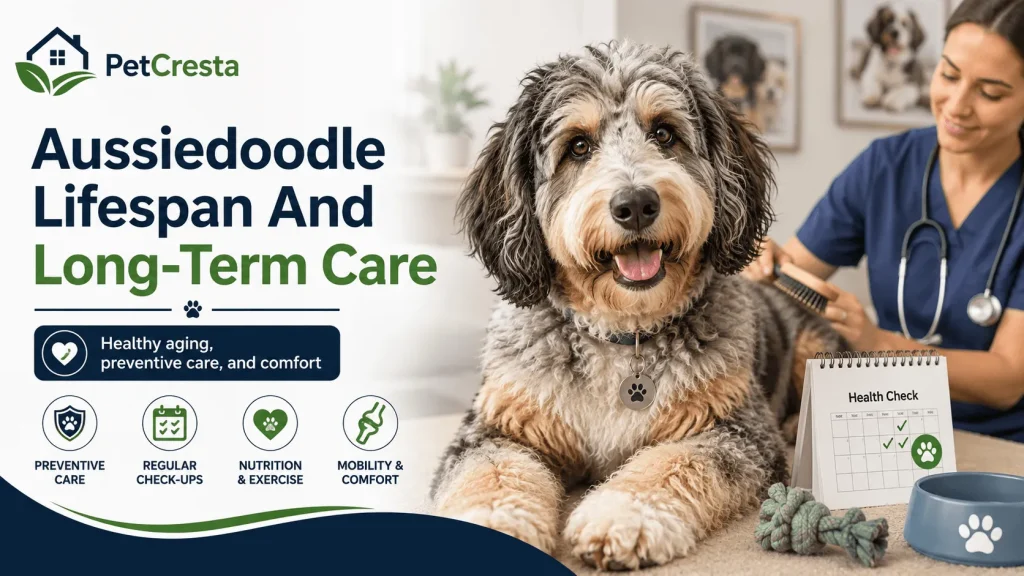
There are varying estimates of Aussiedoodle lifespan, but it is generally believed to be 10-15 years. There are many factors that determine the individual outcome such as size, genetics, disease, body condition, preventive care and chance.
No one can guarantee a specific age when good care is provided. It can help maintain comfort, early detection, healthy weight, dental health, mobility and a manageable relationship with veterinary and grooming care.
Puppy training has consequences. The easier it is for the dog to be handled when it’s a puppy, the easier it will be when it’s a senior.
Bringing An Aussiedoodle Puppy Home
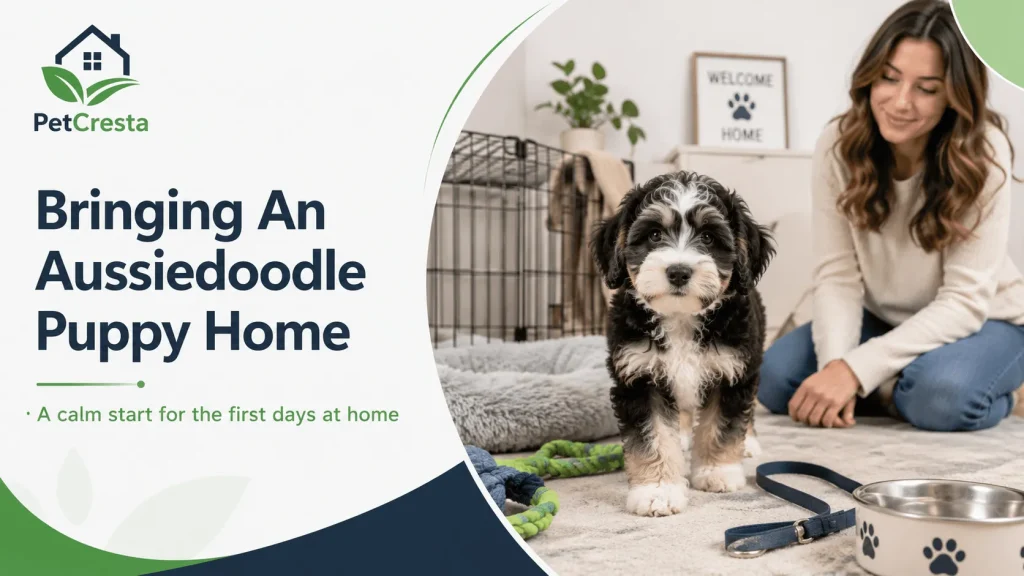
The first days should be quiet and predictable. A new puppy has lost familiar people, smells, routines, and littermates all at once.
Excitement is understandable, but a packed visitor schedule can wait. Sleep, food, toilet access, safety, and gentle connection come first.
Before Pickup
Prepare the home before the puppy arrives. Trying to buy a crate while supervising a newly arrived puppy is an excellent way to discover how many household objects can fit inside a small mouth.
Arrange:
- Veterinary appointment
- Current food and feeding instructions
- Medical and vaccination records
- Microchip information
- Contract or adoption paperwork
- Crate, pen, or safe room
- Washable bedding
- Enzymatic cleaner
- Harness, leash, collar, and identification
- Brush and metal comb
- Safe chew items
- Household rules
- Emergency clinic details
Check fencing, electrical cords, plants, medicines, cleaning products, bins, and small swallowable objects.
The First 72 Hours
Keep the arrival calm. Show the puppy the toilet area, sleeping space, water, and a limited part of the home.
Continue the familiar food at first unless veterinary advice requires a change. Observe appetite, drinking, urination, stool, energy, breathing, and comfort. New owners should understand how long a dog can go without water and seek veterinary advice when reduced drinking occurs with vomiting, diarrhea, weakness or unusual lethargy.
Some puppies become quiet because they are uncertain or stressed. Do not assume the first-day personality is the permanent one.
The First Week
Build a simple rhythm around meals, toilet trips, naps, short play, gentle training, and quiet handling. Limit freedom until the puppy understands the environment and can be supervised reliably.
Introduce household members and resident pets gradually. Keep sessions short and allow the puppy to leave.
Complete the veterinary visit, review medical records, and discuss local vaccination and parasite risks. Ask about any vomiting, diarrhea, coughing, skin problems, appetite change, or unusual behavior.
First-Month Priorities
The first month should reinforce house training, name response, crate or pen comfort, grooming cooperation, social learning, leash skills, and calm recovery.
Avoid trying to teach everything at once. A puppy that feels safe, sleeps well, and understands the daily routine has a stronger base for later training.
Final Verdict
Aussiedoodle puppies can make affectionate, clever, amusing companions for families that are active and involved in their dog’s life. They can also need more grooming, structure, supervision, and behavior work than they seem to.
Don’t be fooled by general claims. Review both parents’ medical history, physical size, temperament and family history. Plan for coat change, adolescence, slow introduction to alone time, and an adult dog that might not neatly fit into a box.
A good match is based on flexibility and honest planning. Before making your decision, ask one last question:
Would this still be the right dog if the puppy was the same dog as the adult, but larger, more active, more vocal, or more grooming?
FAQ’s
Adult weight may range from roughly 15 to 75 pounds, with smaller and larger outcomes possible. Parent size, Poodle variety, sex, build, and family history provide better clues than labels such as Toy, Mini, or Standard.
Many reach much of their adult height during the first year, but larger dogs may continue filling out afterward. Coat development, coordination, and behavioral maturity can continue after height growth slows.
They may be good family companions when temperament, size, training, and supervision fit the household. Jumping, chasing, mouthing, and physical excitement can make some puppies difficult around very young children.
Yes, some can. Success depends on toilet access, barking management, daily activity, mental work, and the dog’s ability to settle rather than the presence of a yard.
There is no universal daily amount. Use short age-appropriate periods of walking, sniffing, play, exploration, and training, balanced with generous sleep and recovery.
Many are responsive and quick to learn. That does not make them effortless. Excitability, sensitivity, chasing, and weak settling skills can still require steady reward-based training.
Testing should match both parent breeds. The Australian Shepherd parent commonly needs hip, elbow, eye, and relevant DNA results. Poodle requirements differ among Toy, Miniature, and Standard varieties.
Many curly or dense-coated Aussiedoodles are groomed about every six to eight weeks, although coat length, condition, and haircut preference change the schedule. Home brushing and combing are still needed between visits.
Prices differ widely by region, breeder, rescue, and included care. Evaluate documented health testing, contracts, early care, and long-term costs rather than using purchase price as a quality score.
Check general shelters, mixed-breed rescues, Poodle rescues, Australian Shepherd rescues, and foster-based organizations. Adult foster dogs may come with useful observations about size, grooming, children, cats, and time alone.
No. The Aussiedoodle is a mixed dog and is not recognized as an AKC breed with its own breed standard. Eligible mixed dogs may participate in certain AKC activities through programs for mixed-breed dogs, but this is not the same as purebred registration.
Aussiedoodles can be high-maintenance dogs, especially when it comes to grooming, exercise, training, and mental stimulation. Wavy or curly coats may need brushing several times a week and professional grooming every six to eight weeks. Many Aussiedoodles also need daily activity, short training sessions, and help learning to settle calmly. The workload varies by coat, size, temperament, age, and individual energy level.
Aussiedoodle puppies can become affectionate, playful, and responsive family companions when their needs match the household. They usually do best with owners who can provide regular training, supervised socialization, grooming, exercise, and gradual alone-time practice. They may be less suitable for someone seeking a quiet, independent, or low-maintenance puppy. Temperament also varies, so assess the individual puppy and both parents rather than relying only on the breed name.
Aussiedoodle prices vary widely by location, size, breeder, rescue organization, and included care. In the United States, published prices may range from about $500 to $5,000, although this broad range should be treated as a planning estimate rather than a measure of breeding quality. Ask what the price includes, such as veterinary care, microchipping, early socialization, health records, and breeder support. Grooming, food, training, insurance, and veterinary care should also be included in the long-term budget.
Aussiedoodles are commonly estimated to live about 10–15 years. Smaller dogs may sometimes live longer than larger ones, but no lifespan can be guaranteed. Genetics, inherited disease, body condition, dental health, preventive veterinary care, exercise, accidents, and access to treatment all affect the individual outcome. Responsible parent health screening may reduce certain inherited risks, but it cannot guarantee a disease-free life.
Many Aussiedoodles with maintained wavy or curly coats need professional grooming about every six to eight weeks. Dogs with longer, denser, or quickly matting coats may need shorter intervals. Home brushing and a full metal-comb check are usually needed several times each week and may be required daily during coat changes. Pay close attention behind the ears, beneath the collar or harness, around the legs, under the arms, and near the tail.
References
The medical, genetic, nutrition, training, and preventive-care guidance in this article was checked against the following organizations and veterinary resources:
- Orthopedic Foundation for Animals, CHIC Program and breed-screening records.
- Australian Shepherd Club of America, health screening and DNA-testing guidance.
- Australian Shepherd Health & Genetics Institute, screening and family-history guidance.
- Poodle Club of America, health-testing recommendations by Poodle variety.
- University of California, Davis Veterinary Genetics Laboratory, merle testing and inheritance.
- Washington State University College of Veterinary Medicine, MDR1 medication sensitivity.
- American Veterinary Society of Animal Behavior, puppy socialization and reward-based training.
- American Animal Hospital Association, canine vaccination guidance.
- World Small Animal Veterinary Association, pet-food selection guidance.
- American Veterinary Medical Association, dental-care guidance.
- Merck Veterinary Manual, GDV and emergency-care guidance.
- American College of Allergy, Asthma & Immunology, dog-allergen guidance.
- Chewy, Daily Paws, and PetMD breed guides for published Aussiedoodle planning ranges and general competitor context.
Medical disclaimer: This article provides general educational information. It does not diagnose illness or replace care from a veterinarian who has examined the individual dog.