What Are Mini Golden Retrievers? Full-Grown Size, Price, Health, And Care

A Miniature Golden Retriever is typically a smaller breed that is bred from Golden Retriever stock and one or more smaller breeds. Though the name sounds neat, these dogs are not a single breed with a set of rules for size, coat or temperament.
Some can be very similar to a mini Golden Retriever. Some get curly coats, spaniel ears, lighter frames, or temperaments that show more of their mixed blood. While it’s not a negative sign of uncertainty, it does require additional information beyond a cute puppy picture and a promise of adult weight.
These dogs can be referred to as mini, miniature, small, tiny, pocket, or even teacup Golden Retrievers. They are seen all over the puppy market, but they are not all referring to the same kind of puppy.
Miniature Golden Retriever At A Glance
Below is a list of some common Mini Golden Retriever dog descriptions. It is not intended to be confused with an official breed standard, as there is no official standard for all breeders that use the name.
Some dogs may be outside of the listed ranges. The word “mini” is typically not as informative as parent measurements or mature dogs from previous litters.
| Trait | Practical Answer |
|---|---|
| Breed status | Not a separate AKC-recognized breed |
| Common type | Smaller Golden-influenced cross or breeder line |
| Common parent breeds | Golden Retriever, Poodle, Cocker, Cavalier |
| Advertised adult weight | Often around 20–45 pounds |
| Advertised height | Often around 14–20 inches |
| Coat | Straight, wavy, curly, or furnished |
| Shedding | Variable |
| Hypoallergenic | Not guaranteed |
| Lifespan | Commonly estimated around 10–15 years |
| Exercise | Moderate to high |
| Grooming | Coat dependent |
| Main buyer concern | Unclear ancestry or unverifiable claims |
What Is A Miniature Golden Retriever?

The name is typically used to refer to a planned cross that is intended to create a smaller, Golden colored companion. Golden Retrievers can be bred with Miniature Poodles, Cocker Spaniels, Cavalier King Charles Spaniels, and other dogs from previous mixed breeds.
That gives rise to a large family of dogs, not one breed. Pedigree is important because it is the genes from all the breeds that are involved that can impact size, structure, coat, behavior, and health.
Are Mini Golden Retrievers Real?
Yes, Puppies are bred and marketed under that name and many families welcome them into their homes.
The miscommunication is due to the fact that “real dog” and “recognized breed” are two different questions. These dogs do exist, but there is no universal definition of the label. One breeder might work with Golden–Cavalier crosses, another with Golden Retriever, Poodle and Cocker Spaniel crosses.
Is A Miniature Golden Retriever A Recognized Breed?
The American Kennel Club has an official standard for the Golden Retriever, but not a separate standard for a Miniature Golden Retriever. A mixed dog can be registered in some programs, or can be entered in some sporting events, but this does not make it a purebred miniature or small Golden Retriever breed.
Golden Retrievers are 23-24 inches tall and 65-75 pounds in weight, per the AKC standard. Females are 21.5-22.5 inches long and 55-65 pounds. The above figures refer to recognised Golden Retrievers and not to mixed dogs with the Mini Golden label.
Breed identification is different from the quality of the breed. Registration papers do not mean a puppy has been responsibly produced and a crossbred dog can be produced in a responsible manner and with good health considerations.
Which Breeds Are Used To Produce Mini Golden Retrievers?
There is no need for a specific combination. Today’s breeders advertise litters with a percentage of Golden Retriever, Cocker Spaniel, Poodle and Cavalier King Charles Spaniel.
Every pairing offers potentialities, not a package of desired features. Genetics don’t work out like a build-your-own puppy menu.
| Parent Combination | Possible Influence | What Cannot Be Guaranteed |
|---|---|---|
| Golden × Miniature Poodle | Curl, furnishings, smaller frame | No shedding, exact size |
| Golden × Cocker | Compact sporting build, feathering | Golden-only appearance |
| Golden × Cavalier | Smaller companion build | Heart health or exact temperament |
| Multigenerational line | More breeder selection | Uniformity without records |
| Smaller purebred Golden | Golden ancestry | A separate miniature variety |
Poodle ancestry can help with shedding less and having a lighter body, curl and facial furnishings. The characteristics of the Cocker Spaniel can influence ear length, feathering, sporting drive and body proportions. While there is a possibility that a Cavalier may be smaller than other Golden Retrievers, there are also health screening requirements that should not be overlooked just because the puppy appears Golden.
Families considering a smaller Cocker–Poodle companion can also compare whether a Miniature Cockapoo is a good fit, particularly when adult size, coat care and spaniel temperament influence the decision.
Is A Small Purebred Golden Retriever The Same Thing?
A Golden Retriever that is not a purebred may grow smaller than the breed standard. That means the dog is not a miniature breed, but rather is an undersized Golden Retriever.
There are also several reasons why a small size may occur. A small size can be a normal genetic characteristic, or it may be a result of poor nutrition, chronic disease, hormonal disorders, or abnormal bone growth. Never show unhealthy growth as a desirable way to a small adult.
Before declaring a small dog to be a Golden Retriever, pedigree documentation will be required. Looks do not necessarily signify ancestry, particularly when there are several Golden-related crosses that look very similar.
What Do F1, F1B, And Multigenerational Mean?
These labels describe how the dogs were bred, not which traits a puppy will inherit.
- F1: A Golden Retriever crossed with another breed.
- F1B: An F1 dog bred back to one parent breed.
- F2: Two F1 dogs bred together.
- Multigenerational: Several generations of planned crossbreeding.
Our guide explaining what an F1B Bernedoodle is provides a clear example of backcross terminology and why an F1B label cannot guarantee adult size, coat, shedding or temperament.
Ask for the exact parent breeds, pedigree, adult sizes and health records. Generation labels alone do not prove predictability or responsible breeding.
How Big Do Mini Golden Retrievers Get?

The Mini Golden Retriever size is sold at about 20-45 pounds at maturity and 14-20 inches. This range is helpful for orientation purposes but is not a standard and should not be considered a guarantee.
The most accurate prediction is from the size of the parents, grandparents and mature dogs already bred from the same line. Yet, there are some very tiny and very big babies in the litter.
Mini Golden Retriever Full Grown Size And Weight
The Mini Golden Retriever is full-grown at 18 months old.
| Type | Commonly Reported Weight | Commonly Reported Height | Status |
|---|---|---|---|
| Recognized Golden Retriever | 55–75 lb | 21.5–24 in | Official range varies by sex |
| Mini Golden label | Often 20–45 lb | Often 14–20 in | Advertised estimate |
| Golden–Cavalier line | Line specific | Line specific | Ask for breeder records |
| Golden–Cocker line | Line specific | Line specific | Parent size matters |
| Golden–Poodle line | Highly variable | Highly variable | Generation matters |
A formal breed standard sets the standard for Golden Retriever measurements. Mini Golden measurements are derived from the breeder program and individual dogs and will depend on the quality of the breeder’s records.
The Mini Golden weight is around 9-20 kilograms and 36-51 cms in metric measurements. Those conversions are not official, but they help to understand the range.
Context is also important for body weight. A 40 pound dog with a muscular build will not have the same frame, condition and care requirements as a 40 pound dog that is overweight.
When Is A Miniature Golden Retriever Full Grown?
Many small to medium sized dogs reach their adult size in their first year. They might still keep changing their chest, muscles, coat and proportions after that.
The development of behavior is often on its own timetable. A dog can be grown up, but still behave like a furry wrecking ball.
The rate of development may be affected by parentage. Do not use a single growth chart – monitor body condition, height, weight, movement and development with your veterinarian.
What Determines Adult Size?
Parent and grandparent measurements are the best place to begin. The results can change depending on sex, litter variation, genetic inheritance, health, nutrition and age at measurement.
Breed percentages are not a linear size equation. A puppy with a higher percentage of Golden Retriever can get a smaller frame, and a sibling with the same percentages can get much closer to the standard Golden frame.
The goal should always be to maintain a healthy body condition. Feeding restrictions to make a dog seem small can cause medical issues and disrupt development.
Can A Mini Golden Retriever Breeder Guarantee Exact Adult Size?
A responsible breeder will be able to give an estimate using mature relatives. It would be much harder to guarantee one exact adult number, particularly in a mixed litter.
If the weight is specified, ask if it is an estimate, a guarantee, or a marketing term. Ask for the height and the weight of healthy adult dogs from other dogs that have been measured, not from photos with the clever furniture.
Contracts should clarify what will occur if a puppy grows up beyond the estimate. A refund clause is not a sign of a medical certainty of the size prediction, but rather an indication of the breeder’s backing of the language used.
Are Teacup, Pocket, Or Tiny Golden Retrievers Real Breeds?
The pocket, tiny, and teacup Golden Retrievers are not recognized sizes of Golden Retrievers. They are marketing terms that can mean a small cross, a rather small Golden or a puppy whose size at maturity has been optimistically estimated.
When one of these labels is used, ask for specific parentage. Adults that have been measured are more informative than terms like “micro,” “toy” or “will stay tiny.”
Smallness should not be the primary breeding goal. It would be unfair to repeatedly select runts, ignore poor development or market dogs with a skeletal or endocrine issue, putting appearance above welfare.
What Does A Full Grown Mini Golden Retriever Look Like?

Some adults look like miniature Golden Retrievers and can make strangers do a double-take. Others have a physical appearance of Poodle, Cocker and Cavalier.
Mini Goldens are not all the same shape, color or type of coat or body outline. The potential buyer should be at ease with the possible look of the dog in question.
Common Body And Coat Variations
An adult with a Golden influence can be broad headed, have a soft expression, have a feathered tail and a straight golden coat. The spaniel blood can result in longer ears, a smaller body, finer nose and eyes, or thicker leg and chest feathers.
Poodle influence can result in curls, waves, facial furnishings, longer legs or a narrow outline. When the non-Golden ancestry permits, coat colors may be cream, gold, deep gold, red, buff, black, or mixed markings.
The official Golden Retriever standard outlines rich, lustrous gold colors and does not consider extreme pale or dark body color to be separate breeds. Golden retrievers are not the only dogs with mixed color expectations.
Can A Puppy’s Appearance Predict Its Adult Look?
An 8-week-old coat is still a work in progress. A puppy’s appearance may change due to feathering, curl, density, furnishings, and color.
Examine several older members of the family, as well as both parents. Adult siblings are particularly helpful because they show the breeder what the pairings have actually resulted in instead of what a puppy may turn into.
The dog’s age and measurements should be included in photographs. A 35-pound dog can appear like a pocket puppy or an oversized giant, depending on how much the photographer crouches to get close to the dog.
Do Mini Golden Retrievers Shed?

The majority of these dogs shed to a certain extent. Coat inheritance plays a big role in the amount of loose hair, matting potential and grooming needs.
The coat that sheds less doesn’t necessarily shed more easily. Hair that remains close to the skin will need to be brushed and combed out before it forms a mat.
How Much Do Mini Golden Retrievers Shed?
Typically, shed hair is visible all year long, and can be heavier in certain seasons, with straight coats that look like golden hair. Spaniel-type coats can also shed and develop tangles around the ears, legs, chest and tail.
Loose hair can get stuck in a coat, or there may be less hair left on furniture if the coat is curly or furnished. Tangled hair can get caught near the skin, making it harder to comb.
Some puppies may shed more than others within the same litter. No one puppy’s coat can be used to predict what all puppies will do.
Are Mini Golden Retrievers Hypoallergenic?
A Mini Golden Retriever is guaranteed to be hypoallergenic. According to the AKC, there are no purebred, mixed-breed or designer breeds that are 100% hypoallergenic.
It’s not just about the hair that’s visible. Proteins in dander, saliva and other secretions can cause allergic reactions, so a dog with little hair can still cause symptoms.
Those with severe allergies should consult their doctor or allergist before adopting a puppy. Time spent with older related dogs can provide practical information that is useful, but it can’t predict the reaction of one individual to one puppy.
How Much Grooming Do Golden Retrievrs They Need?
Coat type should be considered before coat label. A surprisingly deep layer of knots can be found underneath the surface.
| Coat | Visible Shedding | Matting Risk | Likely Grooming |
|---|---|---|---|
| Straight | Moderate to high | Moderate | Regular brushing |
| Wavy | Variable | Moderate to high | Brushing and possible trims |
| Curly | Often less visible | High | Frequent brushing and grooming |
| Furnished | Variable | High around friction points | Regular professional care |
Combs the coat down to the skin, particularly behind the ears, under the collar, under the armpits and along the legs. Nail trimming, dental care, ear checks and paw care should also be part of the routine.
Curly or furnished coats may require professional appointments every few weeks. Before buying a puppy, the willingness to pay that price should be taken into account, as enthusiasm for the teddy bear style can quickly fade during the first serious matting bill.
Mini Golden Retriever Temperament And Household Fit

Breeders are trying to produce friendly, trainable, Golden-like personalities. Those goals are reasonable, but the tendency to a certain behavior can be passed down in the pedigree from all breeds.
The adult dog is influenced by parent temperament, early development, social experiences, health and training. Don’t assume that size will determine whether a puppy will be calm, sociable, sensitive, vocal, or extremely active.
What Is A Mini Golden Retriever’s Temperament Like?
Many are loving and kind, enjoy people, love to play, and are trainable. The retrieving trait can make for enthusiasm about carrying toys, following family members, and making a simple trip to the kitchen a family affair.
Cocker Spaniel influence may be sporting drive, sensitivity, excitement or alertness. Cavalier lineage can lend a personality that is companion oriented and Poodle influence can add rapid learning, activity, alertness, or independence.
None of those attributes comes easily. If possible, meet the parents and find out how they act around strangers, handling, noise, other dogs and when they are not moving.
Are Mini Golden Retrievers Good Family Dogs?
Often, yes. Golden retrievers are loving pets that love playing with children, socializing and being an integral part of the household.
However, they aren’t pets that can be played with and plugged in. Early socialization, a respectful handling of control, and clear rules for the household still influence the final outcome.
Many can make wonderful family pets and ESA dogs in homes that are ready to train, exercise, groom and live in close quarters with them. They’re smaller than a 70 lb Golden, but that doesn’t mean it’s easy.
A dog that is friendly can be chaotic if the environment isn’t well-organized.
Can They Live With Dogs, Cats, And Small Pets?
Mini Goldens can live in harmony with dogs and cats, particularly if they are introduced slowly and carefully. Compatibility is based on the person’s social history, confidence, play style and chasing tendency.
Cats require resting areas above ground level and off the dog. Food, litter boxes, beds and valuable toys should be supervised until everyone’s behavior is predictable.
Small animals such as rabbits, birds, rodents and other small animals must be securely separated. Chasing/carrying can occur in a friendly dog, regardless of the breed, as can be seen in retrievers and spaniels
Do They Bark Or Dislike Being Alone?
Barking can be a sign of excitement, alertness, boredom, frustration, fear or separation. There are certain breeds that can affect voice, such as Cavalier, Cocker and Poodle, but training and routine are also important.
Alone-time skills should be taught in a gradual fashion. Puppy schedules cannot begin the day after they arrive, as they need frequent toilet trips, frequent meals, supervision and rest.
If your dog is an adult, they can be left alone for reasonable amounts of time after training. A dog that is naturally social and is left alone for a full day on a regular basis can become stressed, barky and destructive. Management, exercise, and companionship matter more than the floor plan.
Stairs deserve thought when raising a puppy or caring for a dog with orthopedic trouble. Building rules, lift access, nearby walking routes, and emergency transport also affect daily life.
Can A Mini Golden Retriever Live In An Apartment?
Yes, it’s possible for the right person to live well in an apartment. The floor plan is not as important as indoor settling, toilet access, barking management, exercise and companionship.
Puppy stairs or dog orthopedic issues should be thought of when raising a puppy or caring for a dog with orthopedic issues. Other factors such as building rules, lift access, surrounding walking routes and emergency transport also impact everyday life.
Having a garden is helpful but not a substitute for shared activity. Once a dog has checked out all the grass in the yard, the yard doesn’t seem to matter much.
Mini Golden Retriever Care Needs
The term “mini” sometimes makes people think they are not being cared for as much, but these dogs still require daily care. Training, veterinary care, exercise, and grooming are not eliminated by a smaller food bowl.
Develop a plan based on the dog’s age, health, coat, energy level, and settling. Consistency is usually a much simpler companion to have than to tire out the dog when trouble strikes.
Exercise And Mental Enrichment
Walking, retrieving, sniffing, swimming (if safe), short training sessions and play are all enjoyed by healthy adults. Watch the dog’s behavior, fitness and recovery, rather than one fixed number of exercises.
Puppies should not be forced to do long distance activity; they should be allowed to explore gently and move around freely. Jumping, running and strenuous exercise should be added as the animal grows and as advised by the veterinarian.
The brain has useful work to do in food puzzles, scent games, toy searches, cooperative care and calm chewing. Rest is important as well – an overtired puppy may seem like one that needs another walk.
Training Priorities
Begin with house training, name response, recall, loose-lead walking, handling, and settling. Reward-based strategies foster cooperation without fear or physical punishment.
Don’t make a house-warming game of the puppy getting objects. Comfortable grooming practice is particularly beneficial as ears, feet, mouth and coat will require frequent handling.
Short sessions can be more effective than long drills. Stop when the dog is still engaged in the skill and then practice it in normal life.
Feeding And Healthy Weight
Select an all-inclusive food that’s suitable for the dog’s age and use a food scale to determine the correct amount of food, not boundless enthusiasm for eating. Rewards, treats and chews are included in daily calories.
It’s more beneficial to focus on body condition rather than a single weight goal. The WSAVA offers a set of body-condition and nutrition tools to evaluate the dog’s shape, diet history and personal calorie requirements.
Don’t just cut back on feedings to keep a small size. Puppy growth requires adequate energy and nutrients for proper bone, muscle, organ, and immune system development.
Routine Preventive Care
Vaccination planning, parasite protection, dental health, ears, skin, body condition, movement and any concerns from the pedigree should be covered. Vaccine recommendations are not based on the vaccine schedule of another dog, but instead are based on age, health, location, and lifestyle.
A microchip and visible identification increase the likelihood of being reunited after escaping. The quieter times between visits to the clinic are taken up with nail care, home dental care, coat maintenance, and regular weigh-ins.
Health And Mini Golden Retriever Lifespan

The term Mini Golden Retriever is not unique, as it may refer to multiple combinations of genetics. It is not possible to use the same screening checklist for a Golden–Poodle cross as it is for a Golden–Cavalier cross.
Health testing minimises unnecessary risk, but does not provide a medically guaranteed puppy. The family history, breeding decisions, development, body condition, preventive care and plain luck all continue to play a part.
What Health Problems Can This Dog Develop?
Potential concerns depend on ancestry. Orthopedic disease includes hip or elbow dysplasia and patellar luxation; inherited eye and heart disease should be considered in several contributing breeds.
Long or waxy ears are more susceptible to moisture, wax and inflammation. Skin irritation can be hidden by dense, curly or furnished coats and may only be discovered during grooming.
Other conditions that can present include dental alignment, allergic skin disease, and inherited disorders that are passed down from parents. Owners should not be convinced that all dogs will get sick, but rather be guided by a list of possibilities for screening and veterinary care.
Are Mixed Breeds Automatically Healthier?
Crossing two breeds can alter genetic risk, but does not necessarily eliminate inherited disease from either breed.
In a 2024 study, researchers compared the health of Labradoodles, Cockapoos and Cavapoos to their parent breeds, and discovered that 86.6% of the health comparisons they studied were not statistically different. Some conditions were more prevalent in the crosses and others less prevalent, and this defies the general notion that designer crosses are invariably healthier or less healthy.
Even with responsible breeding, a careful choice of parents is important. The health and structure of both sides is more important than a blanket statement of ‘hybrid vigor’.
What Health Tests Should The Parents Have?
Testing should be done after each breed in the planned litter. The Golden Retriever screening does not address the health issues that may be brought in by a Poodle, Cocker Spaniel or Cavalier parent
| Parent Breed | Screening Categories To Verify |
|---|---|
| Golden Retriever | Hips, elbows, eyes, cardiac examination |
| Miniature Poodle | PRA-prcd, eyes, patellas, hips |
| Cocker Spaniel | Hips and current eye screening; check current club guidance |
| Cavalier King Charles Spaniel | Cardiac, hips, patellas, eyes |
The Golden Retriever Club of America advises screening for hips, elbows, eyes and heart in breeding dogs. It also helps to promote public records that can be checked by the buyer by the name of the dog or its registration number.
DNA testing for PRA-prcd, annual ophthalmology exams, patellar and hip evaluation are all recommended for Miniature Poodles.
The American Spaniel Club (ASC) currently recommends hip evaluation and eye screening from an ophthalmologist for Cocker Spaniels. Hips, cardiac evaluation (done by the cardiologist), patellas and eye screening are included in Cavalier guidance
What Does A CHIC Number Mean?
A CHIC number indicates that the dog has passed the tests required by his/her parent club at that time and the results have been entered into the public database. It does not imply that all the results were normal.
Look through the record and read each entry. Verify the dog’s identity, age at testing, result, examination date and if periodic re-examination is recommended.
OFA clearly states this: CHIC certification is for completion and public disclosure, not for a clean result on all tests.
Why Is A DNA Panel Not Enough?
Some known variants can be identified by DNA testing. It is not a substitute for hip and elbow radiographs, specialist eye examination, cardiac evaluation, patellar assessment or a well documented family history.
A puppy can test negative for all the conditions listed on one commercial test and still have conditions that do not have a simple genetic test. Discuss what was tested, why it was chosen, and which suggested tests are still to be done.
“Vet checked” has a different meaning as well. A routine puppy exam will evaluate the animal in front of the veterinarian, but this does not replace the parents’ inherited-disease screening.
How Long Do Mini Golden Retrievers Live?
The average life expectancy for a Mini Golden Retriever is 10-15 years. There is no single, reliable average for all dogs labeled, so that range should be considered as a general guideline and not a breed statistic.
For comparison, the AKC lists the recognized Golden Retriever’s typical life expectancy as 10–12 years. The future may be different if the individual is mixed-race, but it is not necessarily different if they are smaller.
Longevity is affected by parent health, inherited disease, body condition, nutrition, preventive care, accidents and treatment. A good breeder can give you a better chance of a good puppy, but no one can give you a reliable time limit (or bonus time) for a puppy. Miniature Golden Retriever Price And Ownership Cost
Miniature Golden Retriever Price And Ownership Cost

The price of a Mini Golden Retriever in the U.S. is typically several thousand dollars. There are many differences in parentage, testing programs, contracts, puppy-raising and training packages, which result in a wide range of prices.
The asking price is just the start-up cost. Food, grooming, veterinary care, equipment, training, insurance and emergency treatment go on long after the deposit has been forgotten.
How Much Does A Mini Golden Retriever Cost?
As of July 2026, one U.S. Mini Golden breeder posted several litters in the works, ranging in adult weight from 15-45 pounds. This is one program, not the national average.
Other published Mini Golden guides give wider ranges, some as wide as from about $3,500 to $6,000. These numbers combine various sellers and standards, and should not be used as evidence of fair value.
If the stated price is not inclusive of anything, ask what is not included. The amount due may increase due to sales tax, transport, optional training, breeding rights and supplies.
What Affects The Price?
The price can vary based on location, demand, ancestry, breeder reputation, health screening, training, and the veterinary care included. Availability may also be affected by the timing of the litter and the breeders’ waiting list.
Sometimes premiums are paid for unusual colors or unusually low predicted weights. Neither of these shows good health, good temperament, or responsible breeding.
The price doesn’t necessarily indicate that there’s any investment being made, but it does indicate that the price is higher. Documentation needs to do the work.
What Should The Price Include?
You should be able to see the parents’ ID, the age of the animal, veterinary records, the microchip information, a written contract and an explanation of health testing. Puppy feeding information, current routine, socialization notes and collection instructions should be sent with the puppy.
A good breeder will also offer a return policy. That means that when the owner can no longer keep the dog, it will have a safe place to go rather than be resold or passed through several homes.
Post-sales support is worth its weight in gold when questions come up regarding coat development, size, behavior, or health. However, friendly messages are not a substitute for missing records.
What Does The First Year Cost?
Actual costs vary by area, coat, condition and services provided. A dog that is a curly coat and requires more care and attention from a professional may be more expensive to keep than a straight coated sibling, even if both are eating less than a standard Golden.
| Expense | Initial Or Recurring | What To Include |
|---|---|---|
| Puppy or adoption fee | Initial | Purchase price, tax, transport |
| Veterinary care | Both | Exams, vaccines, parasite prevention |
| Food | Recurring | Age, size, and diet dependent |
| Grooming | Recurring | Coat-dependent professional care |
| Training | Both | Classes and private help where needed |
| Equipment | Initial | Crate, bed, lead, harness, gates |
| Insurance or reserve | Recurring | Policy cost or emergency savings |
| Boarding or walking | As needed | Work and travel support |
A smaller dog may consume less food than a full-sized Golden Retriever. Veterinary emergencies, grooming appointments, boarding, and training do not shrink neatly in proportion to body weight.
How To Find A Responsible Mini Golden Retriever Breeder

The name that is given to the puppies is less important than the evidence that the breeder provides. A clean website may display handsome dogs but not attest to their parentage, health or ethical treatment.
Make sure to research claims off the sales page of the breeder. A good breeder will be glad to take careful questions, not be offended by them.
What Should You Ask Before Paying A Deposit?
Request specific breeds and percentages in the litter, and the registered names of both parents. Whenever possible, ask for links to health records instead of screenshots.
Talk about the parents’ age, size, coat, behavior, and why they are mated. A previous litter of mature dogs may help you determine the consistency of the line.
Puppy raising questions are important as well. Inquire about the location of the litter, how puppies are introduced to people and home experiences, veterinary care, litter collection time, and support after collection.
How Can You Verify Adult Size And Coat Claims?
Ask for adult weights and heights of parents. Photographs can only be helpful if they show the dog, age, litter relationship and approximate size.
Search for multiple older siblings or half-siblings instead of the smallest adult in the history of the species. A breeder who has seen the full litter can give a range, rather than showing one dog that is exceptionally small.
History of adult coat aids in shedding predictions. Inquire about the frequency of professional grooming among related dogs, and if owners notice any matting, seasonal shedding or significant changes in a dog’s coat after puppyhood.
What Are The Main Breeder Red Flags?
Stop when a breeder guarantees an exact adult weight, a completely hypoallergenic coat, perfect Golden temperament, or lifelong freedom from disease. Biology doesn’t enter into sales contracts.
The term “health tested” should result in named examinations and verifiable results. A DNA panel is not sufficient, especially if orthopedic, eye, cardiac, or patellar screening is recommended.
Other red flags are hidden parentage, copied photos, pressure to wire money, non-traceable requests, puppies being available at all times, no written contract, no return policy, and no questions asked about your household.
What Should The Contract Cover?
The agreement should include the puppy’s name, parents, seller, buyer, price, and deposit. Veterinary records, known conditions, collection arrangements and any health-guarantee process should be clearly worded.
Return terms should clarify what to do if the dog is not able to stay with you. Restrictions on breeding, transfer conditions, registration information and obligations of the owner should also be clear prior to payment.
Read exclusions carefully. When requirements, deadlines, replacement-only clauses, or proof standards are considered, a “lifetime guarantee” might apply to very little.
How Should Common Marketing Claims Be Interpreted?
A claim is not the end of a question, but the start. Convert sales jargon into something that can be verified.
| Claim | Evidence To Request |
|---|---|
| Mini | Parent and related-adult measurements |
| Low shedding | Adult coat history |
| Hypoallergenic | Honest allergy limitation |
| Health tested | Searchable breed-specific records |
| Mostly Golden | Pedigree |
| Therapy temperament | Parent behavior and puppy assessment |
| Lifetime guarantee | Complete written terms |
| Vet checked | Details of the examination |
“Mostly Golden” tells you little without a documented pedigree. Likewise, “therapy temperament” cannot guarantee that a young puppy will mature into a suitable working dog.
Can You Adopt Mini Golden Retriever Puppies Or Dogs?

They occasionally appear through shelters, mixed-breed rescues, Golden Retriever rescues, and breeder rehoming programs. Their ancestry may be unknown because shelter labels are often based on appearance rather than genetic documentation.
Try terms such as Golden Retriever mix, small retriever mix, Golden–Cocker, Golden–Poodle, Golden–Cavalier, and Mini Goldendoodle. An adult dog offers one considerable advantage: size, coat, shedding, and much of the temperament are already visible.
Mini Golden Retriever Vs Similar Dogs
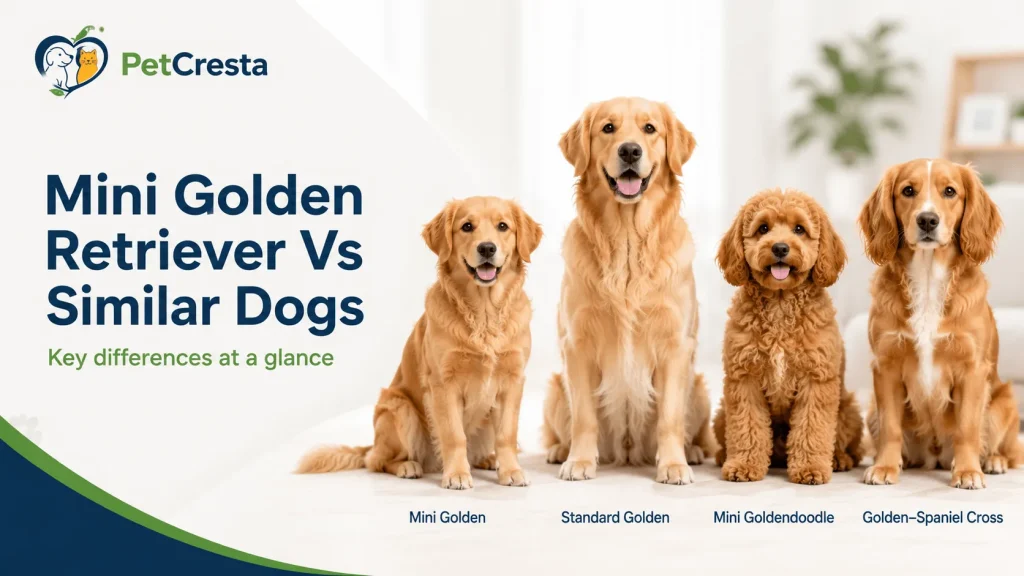
| Trait | Mini Golden Label | Standard Golden | Mini Goldendoodle | Golden–Spaniel Cross |
|---|---|---|---|---|
| Official standard | No | Yes | No | No |
| Parentage | Variable | Golden × Golden | Golden × Poodle | Golden × spaniel |
| Adult size | Variable | Established range | Variable | Variable |
| Coat | Variable | Double coat | Often wavy or curly | Usually straight or wavy |
| Shedding | Variable | Regular | Variable | Usually present |
| Grooming | Moderate to high | Moderate | Often high | Moderate to high |
| Health screening | Every parent breed | Golden-specific | Golden and Poodle | Golden and Spaniel |
A Golden Mountain Doodle also includes Golden Retriever and Poodle influence in many breeding programs, but Bernese Mountain Dog ancestry usually creates a larger and physically different ownership profile.
Mini Golden Retriever Vs Standard Golden Retriever
A standard Golden Retriever offers more established expectations for adult size, structure, coat, and breed character. The recognized breed also has clear parent-club health-screening guidance.
A Mini Golden may be easier to lift, transport, or manage physically. In exchange, you accept more uncertainty about appearance, behavior, grooming, and mature measurements.
Someone who wants the closest possible match to classic Golden Retriever type may be happier with a responsibly bred standard Golden. A household that values smaller size and accepts variation may prefer a carefully produced cross.
Mini Golden Retriever Vs Mini Goldendoodle
A Mini Goldendoodle will have a clear Golden Retriever–Poodle mix, but there are still some variations in generations and parent sizes. It can be a Poodle, Cocker, Cavalier or any combination of the three under the Mini Golden name.
While curly and furnished Goldendoodles may shed less visibly, they may need more extensive grooming. No dog should be guaranteed as allergy-safe.
For both, ask: Who are the parents, how big are related adults, what is their coat like, and have they had any health tests done?
Mini Golden Retriever Vs Golden Cocker Or Golden Cavalier
Golden Cocker or Golden Cavalier dogs are more likely to be found in the UK. Golden Cocker or Golden Cavalier dogs are more common in the UK than mini Golden Retrievers.
The two original breeds, Golden Cocker and Golden Cavalier, are more easily recognized than the larger term Mini Golden Retriever. This makes it easier to do research on probable characteristics and health screening requirements.
Cocker may have a shorter body type, longer ears, feathering and activity. A smaller companion shape may be possible with cavalier ancestry, but needs cardiac screening. Readers interested in another Cavalier-influenced small companion mix can review whether a Cavapoochon is the right dog for them, while comparing grooming, attachment, parent screening and adult-size variation.
Both crosses are not completely predictable. The name is not as helpful as the parents’ and the breeder’s proven track record.
Is A Mini Golden Retriever Right For You?
A Mini Golden can make a cozy, cuddly pet for those who don’t mind some variation in breeds. The dog still needs time, grooming, training, exercise and a realistic medical budget.
Think about the adult dog, not just the irresistibly cute puppy photo. Puppies can make a good judgment call and leave the room.
Pros And Trade-Offs
All good attributes have compromises. It helps to see both sides before deciding on a commitment to avoid frustrations later on.
| Potential Advantages | Possible Trade-Offs |
|---|---|
| Smaller than many standard Goldens | Exact size is uncertain |
| Often social and trainable | Temperament varies |
| Several possible coat types | Grooming may be demanding |
| May suit smaller homes | Still needs exercise and training |
| Golden-like appearance may be possible | Appearance is not guaranteed |
This Dog May Suit You If
When you take in an adult that is outside of the expected weight range, a Mini Golden may be a good fit. You’ll also need to have daily companionship, training, mental stimulation and coat care that fits your schedule.
The family should be ready to provide health results and professional grooming if the coat requires it. The selection of the particular dog is more important than getting the smallest or the most Golden dog.
Think Carefully If
Reconsider when an exact adult size, a guaranteed non-shedding coat, or an appearance that is exactly like a purebred Golden Retriever is required. A mixed line that is varied is not reliable for those expectations.
It can also be a problem if you have to isolate for long periods or if you have a limited amount of training time or if you cannot afford to groom your horse every day. A “teacup” promise should never take precedence over health, temperament and responsible breeding.
Conclusion: The Best Mini Golden Retriever Is The One You Can Verify
A smaller Golden-looking companion can be an appealing idea, and many of these dogs become deeply loved family members. The name alone, though, cannot tell you what the puppy will look like, how much it will shed, or which health risks require attention.
Before paying a deposit, verify both parents, read every health result, examine mature related dogs, and decide whether the likely adult fits your home. Choose the dog supported by honest evidence—not the most polished promise.
FAQ’s
This breed is not recognized by the AKC. The recognized Golden Retriever has an official standard, while Mini Goldens are generally crosses or informal breeder lines.
Many are advertised at 20–45 pounds and 14–20 inches when mature. Parent measurements and full-grown relatives offer better guidance because no official size standard exists.
Many approach adult height within their first year. Muscle, body shape, coat, and behavior can continue maturing after height growth slows.
Published estimates commonly fall around 10–15 years, but no official breed average exists. Parent health, inherited disease, body condition, preventive care, and accidents affect lifespan.
No recognized teacup Golden Retriever breed exists. Teacup, pocket, and tiny are marketing descriptions that should be replaced with exact ancestry and measured adult examples.
References
- American Kennel Club: Official Golden Retriever standard and breed information. (AKC Images)
- Golden Retriever Club of America: Parent health-screening guidance. (Golden Retriever Club of America)
- Orthopedic Foundation for Animals: CHIC certification and public health records. (OFA)
- Poodle Club of America: Miniature Poodle screening recommendations. (The Poodle Club of America)
- American Spaniel Club: Cocker Spaniel health-registry requirements. (American Spaniel Club)
- American Cavalier King Charles Spaniel Club: Cavalier CHIC guidance. (ACKCSC)
- PLOS One: Comparative health research on designer crosses and their parent breeds. (PLOS)
- WSAVA: Nutrition assessment and body-condition resources. (WSAVA)