Cavapoochon Breed Guide: Size, Temperament, Health, Grooming And Cost
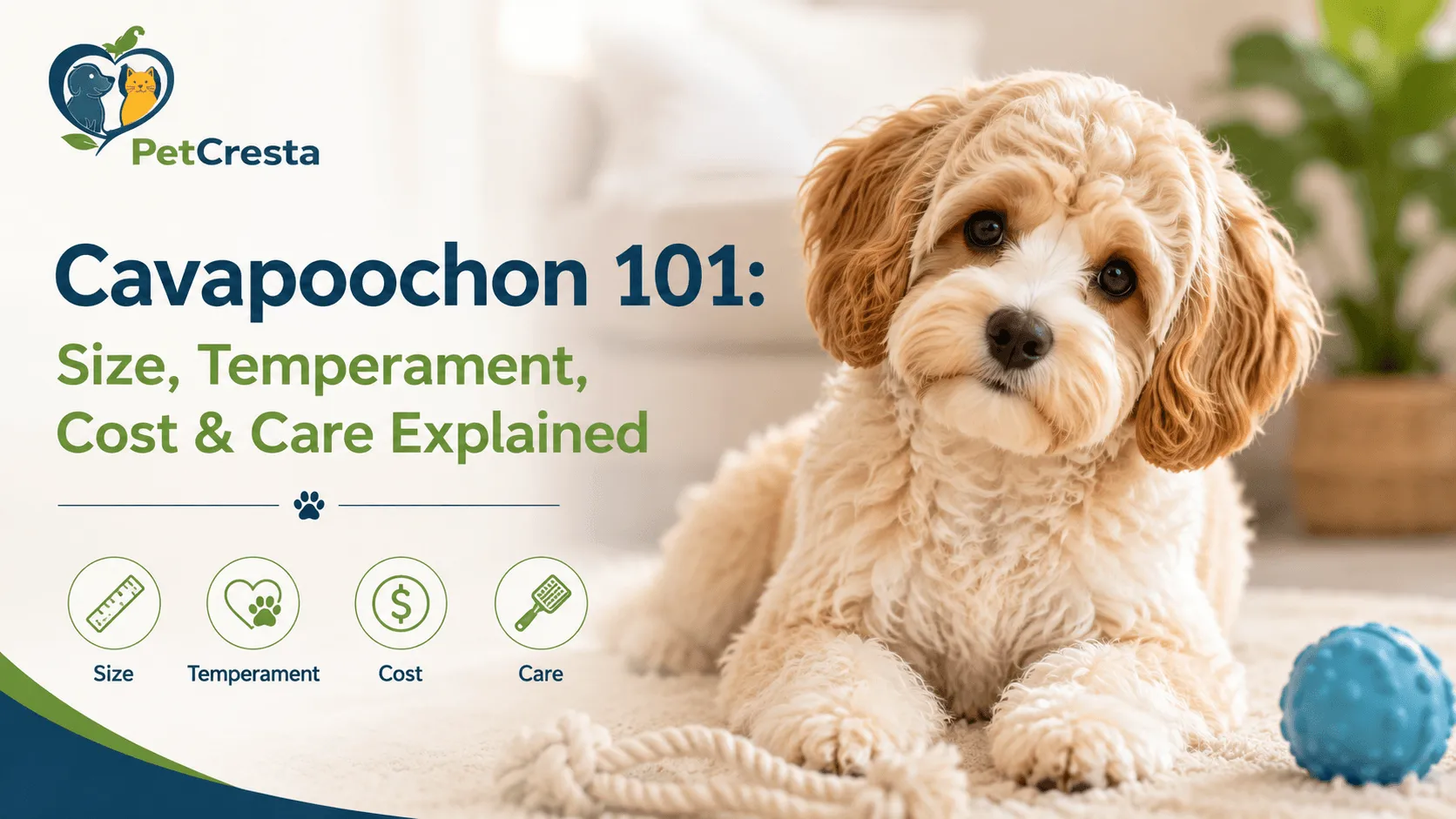
Cavapoochon is a small companion dog breed that is a cross between the Cavalier King Charles Spaniel, Bichon Frise and Toy or Miniature Poodle. A lot of them have soft coats and expressive faces and are very cuddly and cute.
The sweet face is just a part of the story. Coat care can be demanding, close attachment may develop into separation trouble, and inherited health risks do not disappear in a mixed-breed dog. Anyone who wants to consider one should not be fooled by the “forever puppy” tag and should think about the work that goes into the day-to-day.
TLDR: Is A Cavapoochon Right For You?
This dog might be a good choice for a person who desires a close, friendly companion and isn’t afraid of investing time into grooming their coat. The match is not so comfortable when a household desires a very independent or low maintenance dog.
| Good match | Think carefully if |
|---|---|
| Someone is home regularly, or support is arranged | The dog would be alone through most workdays |
| You want a dog involved in household life | You prefer a highly independent pet |
| Professional grooming fits your budget | Grooming costs would become a burden |
| Regular brushing feels manageable | You want a coat that needs little attention |
| You can begin positive training early | You expect affection to replace training |
| Children can handle a small dog calmly | Young children may chase, squeeze, or drop the dog |
| You accept variation in coat and adult size | You require an exact size, color, or curl |
| Allergy expectations are realistic | You need a guaranteed allergy-safe dog |
| Some barking would be acceptable | You expect a silent apartment dog |
The soft look can make it seem easier to own than it really is. A household which is ready for grooming, companionship, training and veterinary attention is far more likely to enjoy the relationship.
Cavapoochon Dog At A Glance
If you’re not sure if the remainder of the guide is what you need, you can use a quick facts table to help make your decision. These are expectations, not promises.
| Trait | Typical expectation | What can vary |
|---|---|---|
| Dog type | Small mixed companion dog | Breeding method and breed proportions |
| Parent lines | Cavalier King Charles Spaniel, Bichon Frise, and Poodle | Toy or Miniature Poodle may be used |
| Recognition | Not an AKC-recognized pure breed | Mixed-breed activity enrollment may be available |
| Adult height | Commonly reported around 9–14 inches | Parent size, sex, and breeding line |
| Adult cavapoochon weight | Commonly reported around 10–20 pounds | Some dogs fall below or above the range |
| Lifespan | Often quoted around 12–15 years | Genetics, health, weight, and preventive care |
| Energy | Moderate | Age and individual temperament |
| Temperament | Often affectionate and socially engaged | Confidence, sensitivity, and independence |
| Shedding | Often low in visible shedding | Coat genetics and individual dog |
| Grooming | Moderate to high | Coat length, curl, and brushing routine |
| Trainability | Often responsive to reward-based training | Motivation, sensitivity, and consistency |
| Barking | Usually low to moderate | Alertness, boredom, and separation stress |
| Time alone | Often prefers regular company | Training and individual confidence |
| Children | Can do well with gentle children | Handling, supervision, and socialization |
| Other pets | Often sociable with careful introductions | Prey interest and previous experience |
| Apartment suitability | Often workable with the right routine | Barking, toilet access, and alone time |
| Best suited to | Homes wanting an involved companion | Daily schedule and care budget |
| Main ownership challenge | Grooming and close attachment | Health, behavior, and coat needs |
There is no breed standard for this breed, so some of them may fall outside these ranges. Sometimes the parent breeders and grown-up family members say more than a brief description of the breed.
What Is A Cavapoochon?

It is a modern mixed breed companion dog made up of three established breeds. It is usually bred from a Cavachon and a Toy or Miniature Poodle, but can also be bred from other multigenerational crosses and sold as this dog. Generation labels are more commonly used for some other Poodle crosses; our explanation of an F1B Bernedoodle shows what an F1B label describes and what it cannot guarantee.
No kennel club regulates one standard so the percentage of each breed cannot be determined by the name alone. Nor can it guarantee any specific adult size, curl pattern, temperament or medical outcome.
Cavapoochon Parent Breeds And Common Breeding Route
A Cavachon is normally a Cavalier King Charles Spaniel and Bichon Frise mix. If that dog is bred with a Poodle, the resulting combination is the common three-line combination that is associated with this dog.
The Cavalier line can offer a more laid-back and friendly appearance. Bichons tend to be fun-loving and happy; Poodles are very responsive and alert. But puppies don’t inherit a tidy dose of the best of both parents. Genetics was not so considerate.
The texture of the coat, sociability, sensitivity, body shape and activity level can be very family oriented. The parents’ measured size, temperament, and health records are more useful than a percentage label.
Why These Dogs Are Called “Forever Puppies”
“Forever puppy” is a term used to describe how a puppy looks, not how they are developing. An adult can maintain a youthful appearance by having round eyes, a small body, soft facial hair, and a fluffy cut.
Often that label leads to an unhelpful expectation that the dog will also be unusually easy. Even the adult needs some training, dental care, grooming, exercise, veterinary care, and the chance to deal with stress in a non-threatening way. Puppy-like appearances might persist. Puppy rules should not apply.
Cavapoochon History And Origin
They are said to have been developed and popularized at Timshell Farm, which is a specialty three-breed cross. The current accounts from Timshell and DogPack tie the early program to Steve and Linda Rogers and date the program’s origins to the early 2000s in the United States.
The blend later gained popularity in the media and was replicated in other breeding programs. This history is told mostly by the accounts of breeders and the media and not an independent breed registry.
Timshell is best considered as the widely credited originator rather than every aspect as formally documented breed history. Today’s Cavapoochons may be very different from the original program.
Is The Cavapoochon An AKC-Recognized Breed?
No. This is not eligible for the traditional American Kennel Club purebred registry as it is a mixed dog and does not have an AKC breed standard.
Eligible mixed dogs can join the AKC Canine Partners program and take part in activities such as agility, obedience, scent work, tracking, and rally. This is not full purebred registration.
A certificate from a mixed-dog registry can include the dog or its ancestry, but it is not proof that the parents were health screened. Registration and responsible breeding are two questions.
Cavapoochon Size, Growth And Appearance
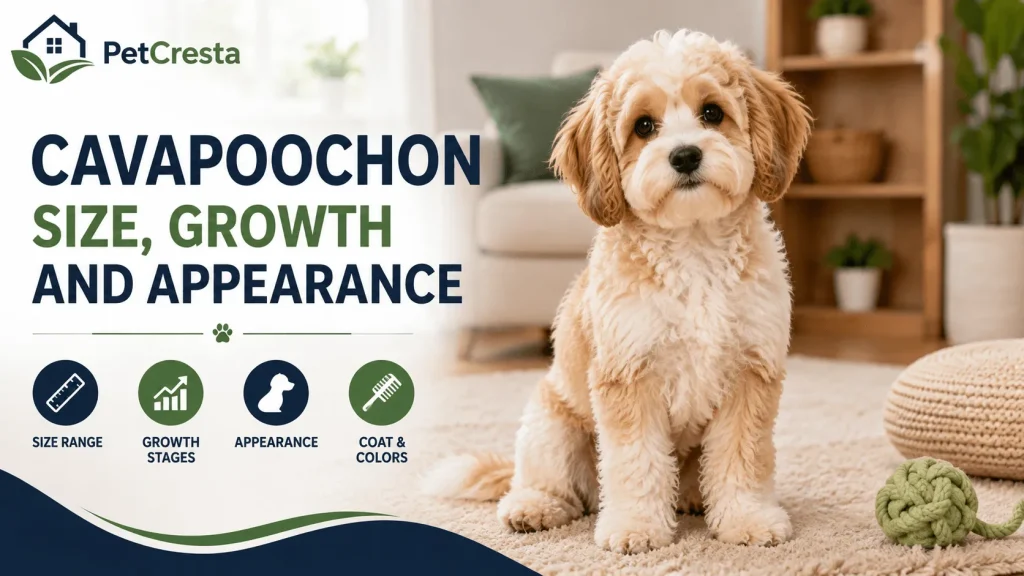
The majority of these dogs stay in the small-dog class. They are also easy to lift, travel with and live in an apartment, but a small body doesn’t mean a small training and care requirement.
Appearance is variable due to the use of three parent lines. A cavapoochon puppy might have loose waves and have a smaller frame, while another littermate may have a tighter curl and a bigger frame.
How Big Do Cavapoochons Get When Fully Grown?
Typical cavapoochon adult size is about 9-14 inches and 10-20 pounds. DogPack currently has a range of 9-14 inches and 12-20 pounds, but there is no official standard to confirm one correct number.
The parents give more clues. A Cavachon puppy bred from a smaller Cavachon and a Toy Poodle could turn out differently than a Cavachon puppy bred from a larger Cavachon and a Miniature Poodle.
Ask for the measured heights and weights of both parents. Another helpful reference is adult dogs from previous litters, particularly if the same pair has been used previously.
When Do These Dogs Stop Growing?
Growth tends to be rapid in the first few months. While muscle, body shape, coat and behavior continue to mature after the first year, many small dogs reach adult size within the first year.
| Age | What commonly changes |
|---|---|
| 2–4 months | Fast growth with distinctly soft puppy features |
| 4–6 months | Noticeable gain in height, weight, and coordination |
| 6–9 months | Legs and body begin to look less puppy-like |
| 9–12 months | Many approach adult height |
| 12 months and beyond | Body composition, coat, and behavior continue maturing |
No online growth chart will be 100% accurate for a specific puppy. Regular weight checks and body condition checks with a vet are safer than attempting to fit a young dog into a standard curve.
What Does “Mini Cavapoochon” Mean?
The terms “mini”, “petite”, etc. are breeders’ terms and do not represent a specific Cavapoochon variety. A mini dog from one breeder could be a standard size dog from another. Similar caution is needed with labels such as “teacup,” and our guide to whether a teacup Maltipoo is worth it explains why parent size, health and breeding practices matter more than a marketing term.
The useful questions are wonderfully unglamorous: How big are the parents? What type of poodle was it? How big were the puppies in the past? Those details are more powerful than a cute label next to a deposit button.
Never sacrifice size for good structure, safe breeding and parent health. A guaranteed weight for adults is a risky option.
Cavapoochon Coat Types
They can have a loose wavy, wavy-curly, or tightly curved coat. There is also a difference in density; two coats that look alike may react very differently to a brush.
Loose hair can be pulled towards the skin with tighter curls. This can help to minimize the amount of hair that is visible on furniture, but it can also lead to more tangles and matting. Loose waves may also knot, especially at points of friction, such as the harness, collar, legs and ears.
Puppy texture may change as the adult coat comes through. A puppy that is lightly waved doesn’t necessarily stay that way.
Cavapoochon Colors And Adult Coat Changes
Cream, apricot, red, white, black, sable, parti and mixed markings are among the more common colors. These are not official Cavapoochon color categories.
Pigment may fade or change with age in puppies. Under a longer coat in adulthood, a rich red may fade to apricot, dark ear shading may fade, and mixed markings may become less noticeable.
The use of color should be a choice and not a quality indicator. Breeders who are more inclined to talk about “rare” shades than heart, eye, knee, or hip records might be thinking the wrong thing.
Cavapoochon Temperament And Personality
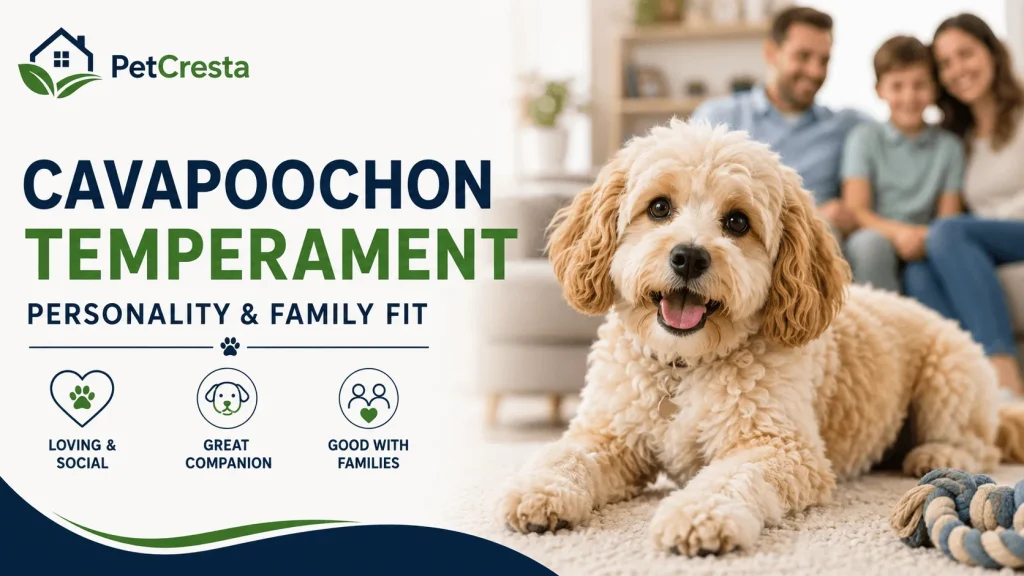
A Cavapoo is a loving, social, and eager-to-please dog. Temperament continues to be genetically determined, shaped by early care, social learning, health, and everyday experience.
Breed ancestry may offer clues. It can’t guarantee how all puppies will be at two years.
Affection And Companion Intensity
One of the biggest charms is their close bond with their humans. Some like to follow someone from room to room, lie down close to them and join in with normal family activities.
It’s a nice feeling until the dog can’t relax unless they are physically touching. Independence is a skill, not a lack of bond.
Avoiding the chair, providing a safe area for activities, and setting up brief separations can help keep affection healthy instead of anxious.
Are Cavapoochons Good Family Dogs?
They can make great family pets if they have time to interact, groom, train and supervise them every day. The term “family” does not necessarily mean much.
A dog that is left alone all day at a busy home might be more difficult to care for than a single person’s house with a more flexible schedule. First time owners can also be successful if they are willing to learn and don’t assume that the dog will know how to behave.
A home with a dog that is involved in the social life and one that can give predictable care is the best fit.
Are Cavapoochons Good With Kids?
There are many children who live happily with calm and considerate children. Even if the dog is friendly, rough handling is a serious concern due to their small body size.
Children should never chase a puppy, never let the puppy walk away from them, never chase the puppy while it is sleeping or eating, and sit them down when holding a puppy. Lifting should be with the assistance of adults until the child can lift the body safely.
Each dog should also have a place to rest and not be followed by children. Supervision is a safeguard for both the friendship and the person being supervised.
Are Cavapoochons Good With Dogs And Cats?
These dogs that are socialized early are likely to live well with other dogs and cats. Compatibility is not only about the breed label, but it’s still dependent on the animals themselves.
Introduce at a distance that is comfortable for the dog. Make early meetings short, keep food and high-value items apart, offer individual resting spots and be alert for staring, hiding, stiff posture and repeated pursuit.
A little dog isn’t necessarily a safe dog for a cat, and a gentle big dog isn’t necessarily safe for a little puppy. Enthusiasm and size can be a problem even if there is no aggression.
How Do Cavapoochon Behave Around Strangers?
Some welcome strangers as if they’ve been waiting all week for them. Some require time to observe before approaching.
Confidence increases as a result of peaceful, free experiences. If a shy puppy is forced into someone’s arms, it can escalate from shyness to fear.
Even friendly dogs can jump, bark or get overexcited. The four paws on the floor are generally more helpful than an apology when the dog is climbing up the visitor’s trousers.
Are Cavapoochons Aggressive?
They are not typically considered to be an aggressive combination breed. Despite this, any dog can growl, snap or bite if frightened, hurt, trapped or pushed past their threshold.
Behaviours may be affected by pain, resource guarding, rough handling or poor social experiences. A growl is informative and should NOT be punished out of the dog.
If there is a sudden change in personality, it’s worth getting a veterinary examination. Multiple threatening behaviors require assistance from a qualified reward-based behavior professional.
Do Cavapoochons Bark A Lot?
Typically, barking is easily controlled, although some dogs are more prone to barking than others. Different things may cause similar sounds of alertness, excitement, boredom, frustration and isolation.
| Barking type | Common trigger | Helpful response |
|---|---|---|
| Alert barking | Door, hallway noise, or visitor | Teach a brief alert followed by a settle cue |
| Attention-seeking barking | Wants play, food, or contact | Reward calm requests and avoid reinforcing noise |
| Frustration barking | Barrier, boredom, or unmet activity need | Adjust routine and provide suitable activity |
| Separation-related vocalization | Distress after a person leaves | Use gradual absence work and professional support |
| Fear-related barking | Unfamiliar person, dog, or situation | Increase distance and build positive associations |
But if you don’t know what is causing the sound, then stopping it is a short-term solution that will not last long. Hallway noise and separation barking should be a special concern for apartment owners.
Can Cavapoochons Be Left Alone?
It should be able to handle reasonable alone time but many like to have a lot of human company. Puppies need shorter breaks due to the need to be supervised, to be taken outside, fed, rested and socialized.
The practice should begin with quiet absences of seconds or minutes. Add time gradually, but not if the dog is stressed out.
Howling, pacing, drooling, attempts to escape, destruction around doors, or refusal to eat may be a sign of separation distress. Those signs require more than a busier toy.
Are Cavapoochons Good Apartment Dogs?
Apartment living isn’t a thing that happens automatically because of the size of the apartment. Whether or not the arrangement works depends on toilet access, hallway encounters, elevator manners, shared walls, and barking.
When walks, training, play and enrichment are given regularly, a yard is not required. If there are strict rules about noise or pets, then it is important to consider the building before taking a puppy home.
An apartment Cavapoochon should also learn not to treat every trip to the lobby as a parade, passing neighbors and dogs without treating them like they’re in the way.
Cavapoochon Training And Intelligence

It tends to be very receptive to reward based training, particularly if sessions are brief and unambiguous. Being a poodle doesn’t guarantee learning speed, but it doesn’t mean that repetition is not necessary.
Undesirable behaviors are as easily learned as helpful ones in bright dogs. Household rules are important.
Cavapoochon Training Tips Or Priorities For The First Year
More focus on practical skills than an impressive trick list. A puppy that can settle, tolerate handling and come when called is easier to live with than a puppy who can turn around in three directions and panics when left.
| Priority | Everyday value |
|---|---|
| Name response | Builds attention around distractions |
| Toilet routine | Supports reliable household habits |
| Handling comfort | Helps with grooming and veterinary care |
| Crate or safe-area comfort | Provides secure rest and confinement |
| Calm settling | Reduces constant attention-seeking |
| Short alone-time practice | Builds confidence during absences |
| Recall foundations | Improves safety |
| Loose-leash walking | Makes daily outings calmer |
| Polite greetings | Reduces jumping and overexcitement |
| Drop and leave cues | Helps prevent swallowing unsafe items |
Reward the behavior you want to see more of. Patience is better than correcting errors, and it is not fun for anyone.
House Training
Take a puppy outside after waking, eating, drinking, active play and before bedtime. If possible, use the same toilet area and reward the puppy as soon as he or she is done.
Many accidents are avoided with supervision and a manageable safe space. If one does occur, clean it up and make schedule changes without punishing the dog.
AVSAB does not recommend reprimanding puppies for indoor accidents as punishment may encourage a puppy to hide rather than learn the toilet habit.
Crate And Safe-Area Training
A crate is not a penalty box; it’s a comfortable resting place. Offer it with food, soft bedding (if safe), short periods, and an open door.
Some puppies feel more comfortable in a pen or a room that is puppy-proofed. The aim is to make sure the dog gets a good night’s sleep, rather than to make all dogs fit into the same model.
Travel, grooming, recovery and vet visits can be easier with the comfort of confinement. It should never excuse the restriction of a puppy for an unreasonable length of time.
Teaching Calm Independence
Start by giving the puppy a reward for lying down a short distance away, while still keeping an eye on him. A mat, chew or food toy can help make quiet separation normal.
Short absences must be returned before distress sets in. Gradually change the length, so the dog doesn’t get the idea that all closed doors mean a long period of time away.
Relaxed boundaries are not the same as ignoring panic. If a puppy is unable to eat, settle, or stop crying, the plan must be adjusted.
Early Socialization
Socialization involves teaching a puppy to feel comfortable with people, animals, sounds, surfaces, handling, travel and new places. It doesn’t mean cuddling the puppy around until everyone has had a cuddle.
The American Veterinary Society of Animal Behavior recognizes the first three months as a critical social-development time and suggests that exposure during this period be both safe and positive, prior to the completion of the vaccination series. Experiences should not be frightening, withdrawn or overwhelming.
Add quiet dogs, various terrain, trips in the car, grooming implements, household sounds, quiet handling of body, and time spent alone. Quality is more important than getting the most encounters.
Training Methods To Avoid
Scolding, correction, forced greetings and punishment for growling can harm trust. If the dog is frightened by the thing, he may react even worse when he is flooded with it.
Reward-based training is linked to improved welfare and reduced behaviour issues compared to intimidation-based training. AVSAB promotes reinforcement-based, humane teaching.
Inconsistency in the home leads to problems. A puppy doesn’t know why it’s cute to jump on Tuesday and not on Saturday when guests come over.
Cavapoochon Exercise Needs, Play And Mental Enrichment
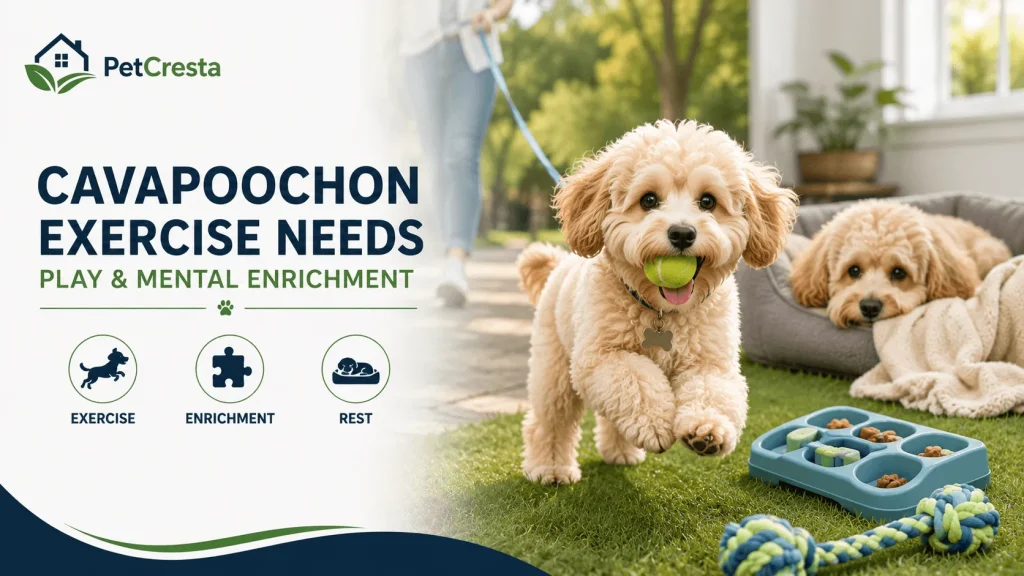
These dogs typically require moderate exercise, mental stimulation and rest. Excessive stimulation can result in a dog who can’t turn off.
The day goes from walking to sniffing, training to play, eating to grooming and sleeping. Time for quiet should be included in the plan.
How Much Exercise Does A Cavapoochon Need?
Most healthy adults need about 30-60 minutes of activity a day, spread out between walking, playing and training. At present, DogPack offers a comparable general range, but with age, fitness, weather, and health taken into account, the actual range should be determined.
Puppies require less exercise and more rest. Running, jumping and long endurance walks are not good substitutes for gentle exploration during growth.
Older pets might enjoy a less vigorous walk and short play sessions. If your dog is coughing, limping, showing unusual fatigue or is reluctant to move, seek veterinary advice, not a harder workout.
Mental Enrichment
If a dog’s life is all the same, it can become noisy and restless. The brain has a job to do when it is engaged in mental activity, but it doesn’t require constant physical effort.
| Activity | Skill or need supported | Suggested use |
|---|---|---|
| Food puzzle | Problem-solving and slower eating | Part of a meal |
| Sniffing game | Natural scent work | Indoor or garden search |
| Short training session | Focus and communication | Three to five minutes |
| Toy rotation | Renewed interest in familiar toys | Change a few toys weekly |
| Hide-and-seek | Recall and scent use | Quiet indoor play |
| Calm settle practice | Emotional regulation | After walks or play |
| Gentle indoor fetch | Movement on poor-weather days | Short, controlled sessions |
Enrichment should be designed to make the dog feel good, not keep him or her constantly occupied. Sometimes, there’s nothing exciting going on, and that’s something this dog must learn.
Sample Daily Routine
A practical routine allows for flexibility of household schedules and individual needs. The following example is more appropriate for a healthy adult than a young puppy.
| Time | Example activity |
|---|---|
| Morning | Toilet break, walk, breakfast, and short training |
| Late morning | Quiet rest while the household works |
| Midday | Toilet break and a sniffing game |
| Afternoon | Rest, chew, or food puzzle |
| Evening | Walk, play, or social time |
| Later evening | Brief grooming check and calm settling |
| Before bed | Final toilet break |
There is no military timetable for any dog. Predictable rhythms make meals, rest and toilet habits easier to understand.
Cavapoochon Shedding, Allergies And Grooming
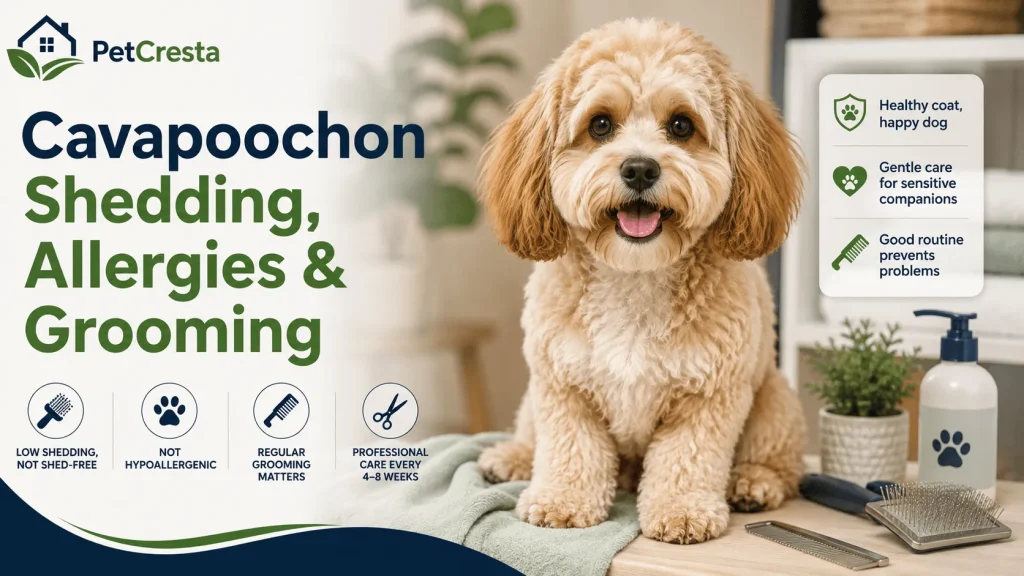
One of the largest practical responsibilities for this dog is grooming. It may seem like a convenient thing to do, but lower shedding can also lead to loose hair getting trapped in the coat and creating painful matting.
A fluffy teddy-bear trim will need some work in between appointments. The longer the coat, the more often you’ll want to brush.
Do Cavapoochons Shed?
Breeds that shed a lot of loose hair are not as noticeable as many Cavapoochons. However, not all dogs are non-shedding.
Hair may not fall onto the floor but stay trapped in a thick wavy or curly coat. When hair is not brushed, it mixes with the friction and moisture to create knots.
The puppy coat may differ in texture and/or adult shedding. It is impossible to make a definite prediction of the final coat at such a young age for any breeder.
Are Cavapoochons Hypoallergenic?
There are no allergen-free dogs. Allergies to dogs are not just a response to the hair of the animal, but to proteins in their dander, saliva, urine, and skin secretions.
Low-shedding breeds can also cause severe reactions, and homes with dogs that are labeled hypoallergenic do not always have lower allergen levels.
Time spent with the individual dog may give you some useful information, but it does not ensure tolerance. A person who suffers from asthma or severe allergy symptoms should consult with an allergist prior to committing.
Cavapoochon Grooming Schedule
The routine is influenced by coat length, curl, density, activity and skin health. Use the schedule below as a guideline.
| Task | Typical starting schedule | Adjust when |
|---|---|---|
| Brushing | Several times weekly | Daily for long, dense, or easily tangled coats |
| Mat check | Several times weekly | More often after rain, swimming, or harness use |
| Eye-area cleaning | As needed | Discharge, redness, or irritation develops |
| Ear check | Weekly | Odor, moisture, redness, or head shaking appears |
| Tooth brushing | Ideally daily | Follow the veterinarian’s dental plan |
| Nail trim | Every few weeks | Nails touch the floor or affect movement |
| Bath | As needed | Dirt, odor, or veterinary treatment requires it |
| Professional grooming | Often every 4–8 weeks | Coat length and home care change |
In many markets, the total grooming cost for a small dog is approximately $45 to $80, and high maintenance curly coats may be more expensive. The final price is dependent on location, matting, behavior and requested style.
If you book your next appointment before you leave the salon, you won’t have to deal with the common “How did 8 weeks go by already?” scenario.
Popular Cavapoochon Haircuts
The puppy cut maintains a puppy length for the body. A teddy-bear trim will create a rounder face and fuller legs, and a short all-over clip will minimize daily care.
Long natural coats can be beautiful, but need more brushing. Style should be reflective of the owner’s realistic home-care routine, not a photo from social media.
A haircut changes coat length, but it does not change the dog’s inherited coat type or eliminate allergen production. Additionally, shaving will not make a curly coat straight or prevent it from shedding.
Why Does A Cavapoochon Smell?
A healthy, dry and well-groomed coat should not give off a strong, continuous smell. Smell can be caused by wet hair, ear disease, dental issues, skin irritation, infection or anal-sac issues.
Often a bath or two will mask the issue and make irritated skin worse. If the odor persists, itching, redness, discharge or discomfort is a sign that it needs a veterinary exam.
Cavapoochon Lifespan And Health
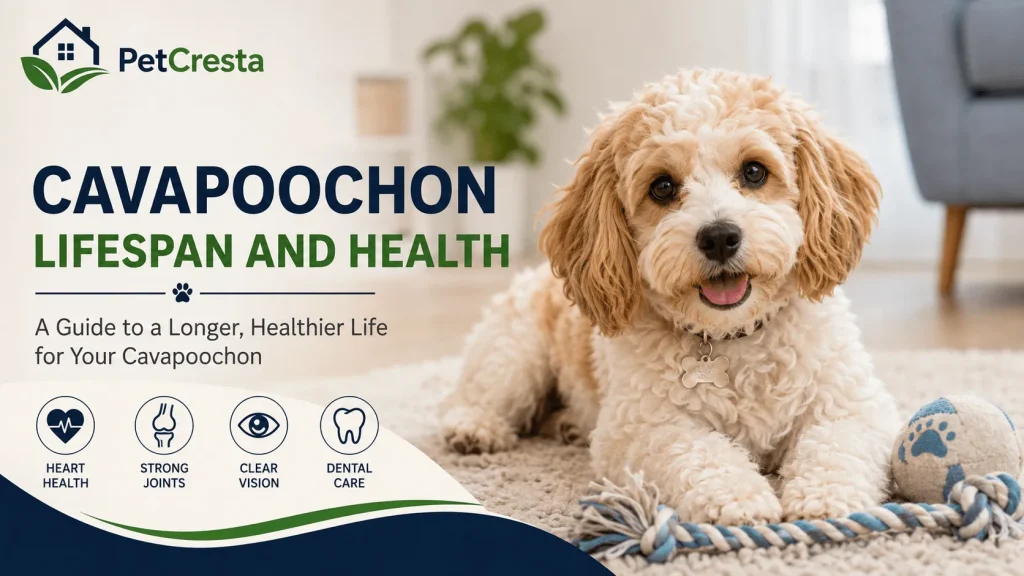
Lifespan is generally estimated at 12-15 years. There is no definitive average at this time, as there is no large standardized Cavapoochon registry, so it should be considered an estimate, not a promise.
Long-term outcome will be dependent on inherited risk, body condition, dental health, preventive care, accidents, environment, and access to treatment.
How Long Do Cavapoochons Live?
A well-maintained Cavapoochon can live to the early/middle teens. Some will live for less and some for more than the usual range reported.
A cross does not necessarily have a longer lifespan than either of the parent breeds. While there is still risk, health-screened parents and a healthy weight can help minimize unnecessary risk.
Cavapoochon Health Problems Worth Knowing
Health issues may be inherited or acquired by a Cavapoochon from either of its parent breeds. The following is a list of concerns to understand, not conditions all dogs will have.
| Concern | Why it may be relevant | Signs to discuss with a veterinarian |
|---|---|---|
| Mitral valve disease and other heart concerns | Cavalier lines carry meaningful cardiac risk | Coughing, fainting, tiring easily, or breathing changes |
| Patellar luxation | Small breeds can develop unstable kneecaps | Skipping gait, limping, or briefly holding up a leg |
| Hip concerns | Hip screening is recommended in several parent lines | Stiffness, difficulty rising, or reluctance to exercise |
| Legg-Calvé-Perthes disease | Can affect small dog breeds | Ongoing hind-leg pain or lameness |
| Inherited eye disease | Eye screening is recommended across parent breeds | Squinting, cloudiness, discharge, or vision change |
| Otitis externa | Floppy, hairy ears may retain moisture | Odor, redness, scratching, or head shaking |
| Skin disease | Allergies, moisture, and matting can irritate skin | Itching, sores, hair loss, or persistent odor |
| Periodontal disease | Small companion dogs often need close dental attention | Bad breath, tartar, bleeding gums, or painful chewing |
Mitral valve disease, eye problems, patellar luxation, hip dysplasia and other inherited issues are highlighted in the Cavalier parent club’s breed information. Other organizations, such as the Poodle and Bichon clubs, also suggest that screening should be performed for the eyes, knees and hips.
Many conditions have overlapping symptoms. An article cannot tell you why one dog is coughing, limping or scratching.
Mixed Breed Does Not Mean Risk-Free
Crossbreeding can introduce more genetic variation, but it does not remove any undesirable variants that are present in the parents. Any breed in a puppy’s background can pass a disease-related gene or physical weakness on to the puppy.
For instance, cardiac screening for Cavalier does not need to be eliminated if the dog has Poodle and Bichon ancestry. Marketing copy isn’t read by the heart.
AVMA recommends that breeders take into account the occurrence of inherited disease, temperament, genetic diversity, veterinary care, socialization, housing and recordkeeping when making breeding decisions.
Health Tests To Ask For By Parent Breed
Testing should be similar to the parent breeds and the Poodle variety in question. The term “all parents” does not include orthopedic, cardiac, or specialist eye exams.
| Parent breed | Core tests to verify | Notes |
|---|---|---|
| Cavalier King Charles Spaniel | Cardiologist heart clearance, ophthalmologist eye examination, patella evaluation, and hip evaluation | Heart, eye, and patella examinations may need repeating |
| Bichon Frise | Hip evaluation, patella evaluation, and annual eye examination | The parent club lists further optional screening |
| Toy Poodle | PRA-prcd DNA test, annual eye examination, and patella evaluation | DNA testing does not replace the specialist eye examination |
| Miniature Poodle | Toy Poodle tests plus hip evaluation | Confirm whether the Poodle parent is Toy or Miniature |
The Cavalier King Charles Spaniel Club suggests that all Cavaliers should be bred from dogs that are cardiologist, eye, patella and hip cleared. The Bichon Frise Club requires hips, patellas and annual eye exams as part of their CHIC requirements. The Poodle Club of America requires PRA-prcd, eye and patella testing for Toy Poodles and hip testing for Miniatures.
Ask for the real sire and dam’s registered names. A general panel from one family member does not indicate that the puppy’s parents have taken the tests.
How To Verify Ofa And Chic Records
Once you know what you are looking for, OFA records can be helpful. Do not take a certificate screenshot for granted; follow the trail.
- Ask for each parent’s registered name and OFA number.
- Search each parent separately in the OFA database.
- Confirm the breed, sex, identity, and permanent identification details.
- Open every listed test and read the result.
- Check the dog’s age and the date of the examination.
- Confirm whether time-sensitive examinations remain current.
- Review related dogs where enough data is available.
- Ask for clarification when a recommended result is absent.
If a parent club has a CHIC number, then their required tests were conducted and published. This does not imply that all test results were normal.
A lack of evidence is not a failing test. It does imply that the buyer must have documentation prior to making a decision.
Preventive Care
Regular check-ups with a veterinarian help establish a baseline prior to the onset of disease. The age, health, location and lifestyle of the dog should be taken into account when planning vaccination, parasite control, dental care and reproductive decisions. Rabies timing is determined by age, vaccination history, the product used and local law, so check how often dogs need rabies shots rather than applying one schedule to every Cavapoochon.
Maintaining a healthy weight is important at any age. When you’re familiar with your dog’s normal behavior, ear, eye, coat, gait, appetite and behavior changes are more noticeable.
Using a pet insurance policy or a special emergency fund can help ease the financial stress of an unexpected illness. Each policy is unique, which means exclusions, deductibles, reimbursement terms and waiting periods should be carefully read.
When To Contact A Veterinarian
If there is minor pain, it may be fine to wait for a scheduled visit, but if there is sudden pain or difficulty breathing, then it’s not. It’s always a good idea to call the clinic if you have any doubt.
| Routine appointment | Same-day advice | Emergency care |
|---|---|---|
| Mild recurring tear staining | New or persistent limping | Difficulty breathing |
| Dental tartar or bad breath | Eye redness or squinting | Collapse or loss of consciousness |
| Gradual weight change | Repeated vomiting or diarrhea | Known or suspected toxin exposure |
| Repeated ear wax | Sudden behavior change | Severe trauma or uncontrolled bleeding |
| Mild coat or skin change | Painful mats or skin sores | Seizures, severe weakness, or inability to stand |
Breathing difficulty, toxin exposure, seizures, severe bleeding, trauma, unconsciousness, serious eye injury and persistent vomiting or diarrhea are among the conditions that warrant immediate veterinary attention according to the AVMA and AAHA.
Never try to induce vomiting or administer medication following a possible poisoning unless directed to do so by a veterinarian or poison-control professional.
Cavapoochon Feeding And Weight Management
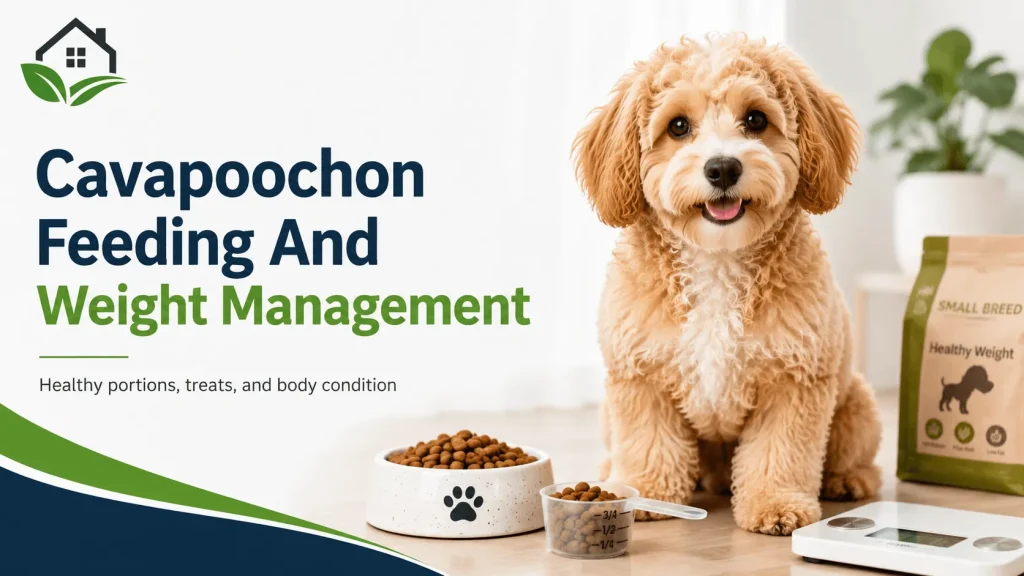
It is easy for a little dog to become overweight. Simple meals can add up to double the calories for the day with treats, chews, table scraps and training rewards.
The amount of food a dog eats should be based on his body condition and the calorie content of the food, not on a standard scoop size.
What Should A Cavapoochon Eat?
Choose a complete and balanced dog food labelled for the appropriate life stage. There are different nutrient levels and feeding rates for puppy, adult, gestation and maintenance diets.
AAFCO states that the nutritional adequacy statement is used to determine a food’s completeness and balance for a specific life stage. Feeding directions give a starting amount and not a fixed prescription.
Some foods are more calorie dense than others, which means that one cup of one food can provide a lot more energy than one cup of another. Use weight trend, body condition, activity, treats and vet advice to adjust the portion.
Fresh water should be kept available. Vet recommended supplements are typically not required for a healthy dog on a proper complete diet.
How To Monitor Body Condition
The ribs should be palpable under a thin layer of tissue, but not if you press too hard. The body should have a waist behind the ribs when viewed from above.
A healthy abdomen will rise up towards the hind legs, not hang at the level of the chest when viewed from the side. Use your hands as well as your eyes to coat volume; it can mask shape.
Body condition scoring is a sensible method to estimate fatness and to make changes to food. Body condition scoring is a sensible method to estimate fatness and to make changes to food – WSAVA recommends this.
Treats And Training Calories
Training treats are considered food, even if they are small. Cut soft foods into small pieces or set aside a portion of the daily food allowance for practice.
Table scraps can be high in fat, salt and calories and low in balanced nutrition. There are also some human foods that are poisonous to dogs.
If there is a sudden change in appetite, drinking or body weight, it should be discussed with a veterinarian and not just change the scoop.
Cavapoochon Pros And Cons

A fair decision involves a happy part and the work that goes on after the puppy photos cease. Neither side is to be taken as universal.
| Benefits | Trade-offs |
|---|---|
| Often affectionate and companion-focused | Close attachment can contribute to separation trouble |
| Compact size suits many homes | Small bodies need gentle handling |
| Frequently responsive to positive training | Consistency is still required |
| Can adapt to apartment life | Barking and toilet access need planning |
| Lower visible shedding is possible | Dense coats can mat quickly |
| Often enjoys family involvement | Long periods alone may be difficult |
| Moderate exercise may suit many households | Mental activity and daily engagement are still needed |
| Soft, youthful appearance | Professional grooming is a recurring expense |
| Several coat colors and textures occur | Adult coat and color cannot be guaranteed |
| Mixed ancestry may increase variation | Health testing across all parent lines takes work |
The balance will depend on what you like doing. A person who enjoys being brushed might have a different perception of the coat than a person who hates grooming.
Cavapoochon Price And Ownership Costs

The only entry fee is the purchase price. Grooming, preventive care, training, dental care, supplies and emergency planning all continue throughout the dog’s life, as do food and grooming.
The costs in the United States are significantly different in different parts of the country. These are only estimates and not guarantees from breeders or service providers.
How Much Does A Cavapoochon Puppy Cost?
On July 28, 2026, a review of seven US Cavapoochon breeder profiles was performed and public prices listed on Good Dog. The advertised amounts ranged from about $1,250 to $5,500 before taxes and some fees, with an approximate median midpoint of $3,150 within the program range.
| Market and date | Listings reviewed | Observed advertised range | Approximate median midpoint | Common extra charges | Research limitations |
|---|---|---|---|---|---|
| United States, July 28, 2026 | 7 breeder profiles | About $1,250–$5,500 | About $3,150 | Tax, delivery, training, payment fees, and supplies | Public program prices, not completed sales; health quality not independently verified |
The sample consisted of Razberry Meadows, Timshell Farm, Forever Puppies 4U, Cavapoochon Central, Heartland Puppies, Doodle Puppy Crew, and Apricot Lane Puppy. Their published totals and ranges were quite different.
However, Good Dog’s overall Cavapoochon page indicates a more focused national range of $2,500–$3,200. Variations may be due to the different breeders, puppies, deposits and additional programs included.
Responsible breeding is not confirmed by price. A number that looks good is not as important as documents and independently verifiable testing.
First-Year Costs
A first year involves set-up costs as well as more regular veterinary, training and puppy-care costs. The price of the puppy should be separated out so that the commitment continues to be visible.
| Cost area | Planning range in the US | What changes the amount |
|---|---|---|
| Crate, pen, bed, bowls, harness, and leash | $200–$500 | Product quality and items already owned |
| Grooming tools and starter supplies | $50–$150 | Coat length and tools selected |
| Initial veterinary and preventive care | $300–$1,000+ | Included breeder care, location, and medical needs |
| Training classes | $150–$500 | Group classes versus private help |
| Professional grooming during the first year | $400–$1,000+ | Appointment frequency, coat, location, and matting |
| Food and treats | $350–$800 | Brand, calorie needs, and treats |
| Microchip and licensing | $25–$100 | What the breeder includes and local fees |
| Insurance or emergency savings | $500–$1,000+ | Policy design or savings target |
| Spay or neuter, when applicable | Varies by clinic and region | Timing, size, and medical circumstances |
MarketWatch’s 2025 US analysis estimated an average $2,127 in initial dog costs and about $2,489 in annual ongoing care, though the puppy purchase price and a grooming-heavy coat can push a Cavapoochon household higher.
Build the budget before choosing a puppy. Falling in love first and opening a calculator later can be a rude little meeting.
Monthly And Annual Ownership Costs
Predictable expenses are easier to manage when separated from emergencies. Some months will be quiet, while grooming and veterinary months may feel noticeably heavier.
| Cost category | Monthly or annual | Typical frequency | What changes the cost |
|---|---|---|---|
| Food and routine treats | $30–$70 monthly | Ongoing | Food type, calories, and treat use |
| Professional grooming | $45–$100+ per visit | Often every 4–8 weeks | Location, coat, cut, behavior, and matting |
| Routine veterinary care | $250–$700+ annually | Exams and preventive visits | Region, age, and testing |
| Parasite prevention | $150–$350+ annually | Monthly or seasonal | Location, weight, and product |
| Dental care | Home care plus possible professional cleaning | Daily and as advised | Dental health and anesthesia needs |
| Training | $150–$500+ | Often heavier in the first year | Group or private support |
| Pet insurance | Often $40–$75+ monthly | Monthly | Age, location, deductible, and coverage |
| Replacement supplies | $100–$300+ annually | As needed | Toy and equipment choices |
| Walking, daycare, or boarding | Highly variable | Household-dependent | Local rates and frequency |
MarketWatch’s 2026 quote analysis placed average US accident-and-illness premiums around $43 per month for puppies and $52 for adult dogs under its sample settings. Actual quotes can differ widely.
An emergency fund remains useful even with insurance because reimbursement policies may require payment at the clinic first.
Why The Cheapest Puppy May Cost More Later
A low price is not proof of poor breeding. It can, however, become less attractive when parent testing, early veterinary care, socialization, a contract, and post-purchase support are missing.
Untreated disease, fearful behavior, severe matting, and incomplete records can create expenses that were merely hidden at purchase. A high price does not guarantee those safeguards either.
Compare evidence rather than price tags. Health records, parent identity, living conditions, and breeder accountability are harder to fake than polished puppy photographs.
How To Find Responsible Cavapoochon Breeders
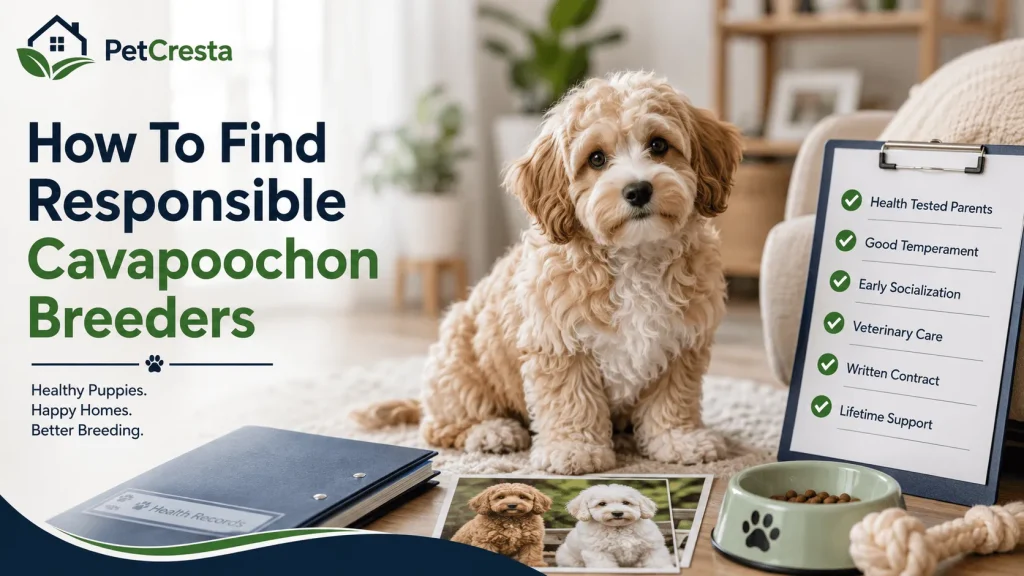
A responsible breeder should know the dogs behind the puppies, not only their colors. Clear answers about health, temperament, structure, socialization, and contracts are basic parts of the conversation.
The AVMA recommends hereditary screening, temperament consideration, veterinary partnership, clean housing, early socialization, owner education, and accurate records in breeding programs.
What A Responsible Breeder Should Provide
Look for identifiable parents, relevant health results, honest adult-size expectations, veterinary records, and a written agreement. The breeder should also explain how puppies are handled, exposed to normal household life, and matched with homes.
Useful evidence includes:
- Registered names or permanent identification for the parents
- OFA or equivalent health records
- Relevant DNA reports
- Parent ages, sizes, and temperaments
- Puppy examination and vaccination records
- Deworming and parasite-control records
- Socialization and handling information
- Feeding and transition instructions
- A contract and health terms
- A return-to-breeder policy
- Support after pickup
- Clear pickup or transport arrangements
“Vet checked” only confirms that a veterinarian examined the dog at some point. It is not the same as completing parent-breed screening.
Questions To Ask A Cavapoochon Breeder
Specific questions make vague answers easier to recognize. A careful breeder should welcome the discussion rather than rush toward payment.
| Question | What a useful answer includes | Warning sign |
|---|---|---|
| What are the registered names of both parents? | Names that can be checked independently | Parent identity is withheld |
| Which health tests were completed? | Tests relevant to Cavalier, Bichon, and Poodle lines | “They had a DNA panel” with no details |
| Can I verify the records? | OFA links, official reports, or registry numbers | Cropped screenshots only |
| Is the Poodle parent Toy or Miniature? | Clear variety and measured adult size | The breeder does not know |
| How large are the parents? | Actual height and weight | Exact puppy-size guarantee without parent data |
| What are the parents like? | Strengths, sensitivities, and daily behavior | Only “perfect temperament” |
| How are puppies socialized? | Handling, sounds, surfaces, people, rest, and routine | No structured early experience |
| What veterinary care has the puppy received? | Examination, vaccines, deworming, and records | Verbal claims without paperwork |
| What food is the puppy eating? | Product, amount, schedule, and transition plan | No consistent feeding information |
| How is grooming introduced? | Brushing, face handling, feet, ears, and bathing | No coat-care preparation |
| What happens if I cannot keep the dog? | A clear return or rehoming clause | No responsibility after sale |
| Can I see where the puppies are raised? | Visit, live video, or transparent explanation | Parking-lot handoff only |
| How does transport work? | Safe method, timing, and responsible handler | Unclear third-party delivery |
A breeder should also ask you questions. Someone placing a social, grooming-intensive puppy without discussing your routine may be more interested in the sale than the match.
Cavapoochon Breeder Red Flags
One concern may have an innocent explanation. Several concerns together deserve a pause.
Watch for:
- Pressure to pay immediately
- Refusal to identify the parents
- No independently checkable testing
- “Completely hypoallergenic”
- “No inherited health problems”
- Exact adult-size promises
- Guaranteed adult color or coat
- Heavy emphasis on rare colors
- Many litters available at all times
- No questions about your home
- No written contract
- No return policy
- Puppies leaving unusually young
- Stock images or reused puppy photographs
- Unclear transport arrangements
- Claims that registration replaces health testing
A responsible seller can explain limitations without becoming defensive. Honest uncertainty is usually more reassuring than a flawless sales pitch.
Registration Does Not Prove Breeding Quality
Registration may document identity, ancestry, or participation in a program. It cannot show that a dog has a healthy heart, stable knees, clear eyes, or a suitable temperament.
Mixed-registry certificates also do not create an official Cavapoochon breed standard. Verify the parents and their individual results rather than relying on a logo printed on the puppy folder.
Cavapoochon Adoption And Rescue

These dogs do enter rescue, although shelters may list them simply as Poodle mixes, Cavalier mixes, Bichon mixes, or small companion dogs. Appearance-based labels are often estimates.
Adoption can suit someone open to an adult whose final size and current coat are already visible. Medical and behavior history may still be incomplete.
Can You Adopt A Cavapoochon?
Yes, though finding the exact label may take patience. General shelters, small-dog rescues, Poodle-mix rescues, Cavalier rescues, and private rehoming situations are all possible routes.
Search by size, coat, age, and temperament rather than relying only on “Cavapoochon.” A suitable adult mix may meet the household’s needs even when its ancestry cannot be confirmed.
Rescue should not be treated as automatically easier or harder than buying a puppy. It offers a different type of information and uncertainty.
Questions To Ask Before Adopting
The aim is to understand the dog in front of you rather than reconstruct every detail of its ancestry. Honest gaps are normal, especially when the dog arrived as a stray.
| Question | Why it matters |
|---|---|
| Has the dog lived with children? | Helps assess family experience |
| Has the dog lived with dogs or cats? | Guides introductions and management |
| Is the dog house trained? | Shows what routine may be needed |
| How does the dog handle being alone? | Reveals possible separation stress |
| Does the dog guard food or objects? | Helps plan safe management |
| How does the dog respond to grooming? | Coat care will be ongoing |
| Are medical records available? | Supports veterinary planning |
| What medications are needed? | Clarifies daily care and cost |
| Is any bite history known? | Supports a safer placement decision |
| Does the dog bark frequently? | Matters in shared-wall housing |
| Is foster-to-adopt available? | Allows a more informed household match |
Ask how the dog behaves in a home, not only in a kennel. Foster observations may show settling, toileting, noise sensitivity, and attachment patterns more clearly.
Preparing For An Adult Rescue Mix
Give the dog a quiet place, predictable meals, gentle walks, and time to observe the household. Crowded outings and a stream of visitors can wait.
Arrange a veterinary examination and grooming assessment early. Introduce other animals gradually, and do not test the dog by removing food or forcing handling.
Serious fear, guarding, or aggression needs qualified help. Patience helps, but patience and professional support are allowed to work together.
Cavapoochon Compared With Similar Companion Dogs
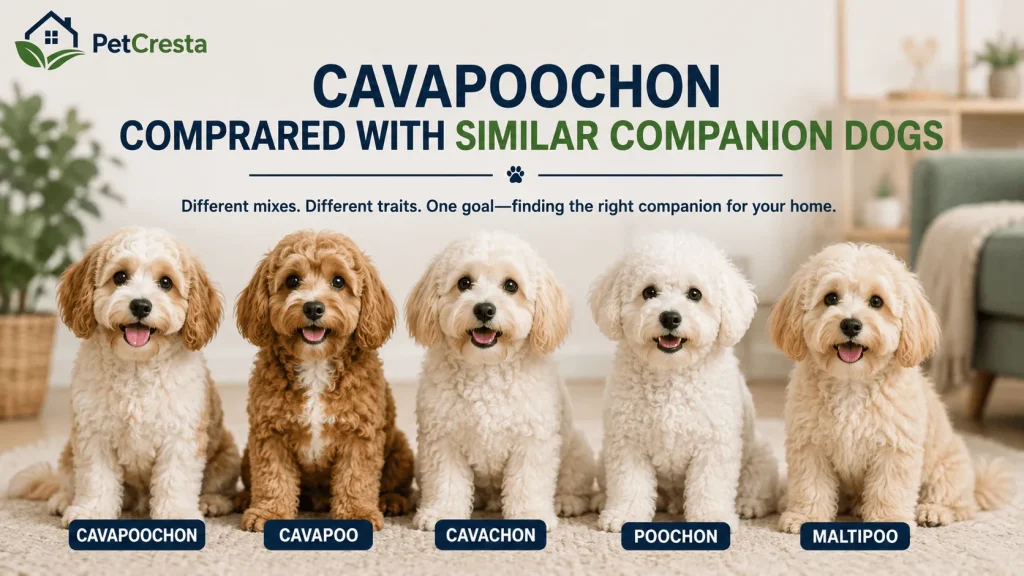
Several small companion mixes share soft coats, friendly marketing, and overlapping adult sizes. The better choice depends on the actual parents, individual dog, grooming tolerance, and household routine. A Miniature Cockapoo is another small Poodle mix worth comparing when size, grooming demands, sociability and time alone are important parts of the decision.
No comparison can guarantee which dog will be calmer, healthier, or less allergenic.
Cavapoochon vs Cavapoo
A Cavapoo usually combines Cavalier King Charles Spaniel and Poodle lines. A Cavapoochon includes Bichon Frise ancestry as well.
Both may have wavy or curly coats, affectionate temperaments, moderate energy, and significant grooming needs. Their appearance and behavior can overlap enough that a photograph may not reliably separate them.
Health screening should match the actual parents rather than the name of the mix. Neither is universally better.
Cavapoochon vs Cavachon
The Cavachon usually combines Cavalier King Charles Spaniel and Bichon Frise ancestry. A common Cavapoochon breeding route adds Toy or Miniature Poodle influence.
Poodle ancestry may increase the chance of a curlier coat or strong training responsiveness, but neither result is guaranteed. Cavachons can also shed lightly, while Cavapoochons can shed more than expected.
Choose by parent health, temperament, coat, and household fit rather than assuming the three-breed mix is an upgraded version.
Cavapoochon vs Poochon
A Poochon is normally a Bichon Frise and Poodle mix. The Cavapoochon adds Cavalier King Charles Spaniel ancestry. Readers considering the Bichon–Poodle combination can also see our complete Bichonpoo breed guide for more information about its size, temperament, coat care and daily needs.
Both can be compact, socially engaged, and grooming-heavy. The Cavalier line may influence facial shape and companion style, but individual variation remains large.
| Dog | Parent breeds | Common size category | Coat-care expectation | Companion style | Main uncertainty |
|---|---|---|---|---|---|
| Cavapoochon | Cavalier, Bichon, and Poodle | Small | Moderate to high | Often close and socially involved | Three-line variation |
| Cavapoo | Cavalier and Poodle | Small to medium | Moderate to high | Often affectionate and responsive | Parent size and coat |
| Cavachon | Cavalier and Bichon | Small | Moderate to high | Often cheerful and people-focused | Shedding and coat density |
| Poochon | Bichon and Poodle | Small | Moderate to high | Often playful and alert | Curl, sensitivity, and barking |
| Maltipoo | Maltese and Poodle | Small | Moderate to high | Often affectionate and lively | Size, coat, and confidence |
A well-matched individual from transparent parents is usually a better choice than a dog selected because one mix is fashionable. Households comparing small companion mixes may also want to review the Havapoo’s size, cost and care requirements, especially when grooming, apartment suitability and attachment are major concerns.
Final Verdict
The Cavapoochon can be a warm, funny, deeply affectionate companion for a household that wants a dog involved in everyday life. Its compact size and responsive nature suit many homes, including apartments and first-time owners who are prepared to learn.
Three commitments deserve a clear yes before moving forward: regular coat care, patient independence training, and careful verification of parent health records. Those needs remain long after the first fluffy puppy photographs.
Compare your schedule, grooming budget, and expectations with the quick-verdict table. When the practical pieces fit as well as the emotional ones, this dog may be a very rewarding choice.
FAQ’s
They can be. A first-time owner needs to be comfortable learning about grooming, house training, socialization, dental care, calm boundaries, and alone-time practice. The dog is friendly in many homes but not maintenance-free.
Many need an appointment every four to eight weeks. Long, dense, or quickly matting coats may require shorter intervals. Brushing between appointments remains necessary.
Testing should cover the parent breeds involved. Ask about Cavalier heart, eye, patella, and hip testing; Bichon hip, patella, and eye testing; and Toy or Miniature Poodle eye, patella, PRA-prcd, and relevant hip testing. Verify the individual records rather than accepting a general statement.
Yes. Texture, density, curl, and color may change as the adult coat develops. A breeder can discuss patterns in related dogs but cannot promise the exact adult result.
They are often responsive to reward-based training because their parent breeds are generally people-focused and capable learners. That does not mean every puppy trains quickly or without repetition. Short sessions, consistent household rules, early socialization, and rewards for calm behaviour usually work better than punishment. House training, polite greetings, grooming tolerance, recall, and short periods alone should be introduced from an early age.
Many of them need professional grooming every four to eight weeks, depending on coat length, curl, density, and how quickly the hair mats. Brushing is usually needed several times each week and may be required daily for longer or tightly curled coats. Pay close attention behind the ears, beneath the collar or harness, around the legs, under the arms, and near the tail, where tangles commonly develop.
It combines Cavalier King Charles Spaniel, Bichon Frise, and Poodle ancestry. One common breeding route pairs a Cavachon—a Cavalier and Bichon mix—with a Toy or Miniature Poodle. Other multigenerational routes may also be used, so the breed percentages can differ between dogs. Ask the breeder about both parents rather than assuming the name guarantees a particular size, coat, temperament, or breed proportion.
Neither mix is automatically better. A Cavapoo combines Cavalier King Charles Spaniel and Poodle ancestry, while a Cavapoochon also includes Bichon Frise ancestry. Both may be affectionate, trainable, compact, and grooming-intensive. The better choice depends on the individual dog, parent health records, adult-size expectations, coat-care needs, temperament, and your household routine. A well-bred, well-matched Cavapoo is a better choice than a poorly matched Cavapoochon, and the reverse is also true.
Sources And Medical Review
Medical and breeding information in this guide was checked against the following source groups:
- Orthopedic Foundation for Animals and the Canine Health Information Center.
- Cavalier King Charles Spaniel Club health-testing guidance.
- Bichon Frise Club of America CHIC requirements.
- Poodle Club of America health recommendations.
- American Veterinary Medical Association breeding and emergency-care guidance.
- American Academy of Allergy, Asthma & Immunology dog-allergy guidance.
- American Veterinary Society of Animal Behavior socialization and training material.
- AAFCO pet-food labelling and life-stage nutrition guidance.
- Public US Cavapoochon breeder prices reviewed on July 28, 2026.
Health recommendations can change as parent clubs revise screening protocols. Breeder records and current source guidance should be rechecked during future article updates.