Can Dogs Have Autism? A Vet Guide to Signs, Causes, and Care

The dogs aren’t officially diagnosed with autism as humans are. Certain dogs exhibit similar behavior patterns to those of an autism sufferer but the real issue isn’t whether a dog has a human-like label. The main issue is what could be causing the behavior, and how to assist the dog to function more safely and comfortably.
A lot of people inquire about this when they observe repetitive behaviors, sensory sensitivity, abnormal social reactions or difficulties in dealing with changes. The patterns may be real and deserve to be addressed although, they could also be a part of anxiety disorders, compulsive disorders, neurologic diseases, pain, sensory loss, socialization or developmental issues.
This guide explains what dog owners typically mean when they inquire whether their dogs are autistic and what signs that suggest autism for dogs could appear like, what typically appears similar, what research has actually proven, the way that veterinarians assess the instances, and what assistance might be available.
TLDR
- Dogs aren’t formally diagnosed with autism, just like humans, in a typical veterinary practice.
- Certain dogs exhibit similar behaviors to those of autism. These are often they are referred to as dog dysfunction or atypical repetitive behavior.
- Anxiety, disordered compulsive behaviour and pain, as well as sensory loss and neurologic disorders, can appear.
- A veterinary assessment is more important than the label.
Can Dogs Have Autism Or Be Autistic?

Dogs don’t receive an official diagnosis of autism under an established veterinary framework as humans do. Some dogs exhibit behaviors that are described by owners as autism-like. This is especially true when the behaviour is abnormally repetitive, socially atypical, excessively rigid, or extremely sensitive.
This is the reason why questions such as “Can dogs be autistic? ” are asked frequently in searches. The owners are typically trying to pinpoint the pattern that is unusual or is difficult to understand and are not seeking an official diagnosis in the human way.
In reality the label is less important than identifying the root of the problem as well as the pattern.
| Term | What It Means In Practice |
|---|---|
| Human autism | A defined neurodevelopmental diagnosis used in human medicine |
| Autism-like behavior in dogs | A descriptive phrase for unusual behavior patterns that may resemble some human autism-related traits |
| Canine dysfunctional behavior | A limited, cautious term sometimes discussed in relation to atypical repetitive or social behavior in dogs |
Why Does This Question Get Confusing
The majority of confusion stems from the application of an animal term to human behavior. It is logical from a pet’s viewpoint because certain behaviors appear strange or repetitive. or even difficult to read at home.
The dog might appear abnormal to a pet’s owner if the dog is agitated, slows down in noisy environments and reacts in a strange way to contact, or has difficulty with normal social interactions. The observations make a difference. The issue is that the same behaviour could be a result of very different reasons.
The key takeaway here is that the behavior pattern is worthy of consideration; however, the label should not be used to replace the need for a proper evaluation.
Signs Of Autism In Dogs That Make Owners Wonder

There is no single piece of evidence to prove anything. The most important thing is what the patterns are, the frequency at which it occurs as well as how intense and if the dog is able to disengage and resume normal functioning.
Repetitive Behavior
This is among the most frequent reasons pet owners inquire about dogs that have autism. In its mild form the dog might have an odd behavior which is not a problem. In more severe cases the dog appears to be stuck in his behavior, especially when stressed or under-stimulated.
Common examples include:
- spinning
- tail chasing
- Pacing
- Circling
- repeated licking
- fixation or stare
- Chewing repeatedly without a specific reason
These behavior patterns become more alarming when they occur frequently or are difficult to interrupt such as eating, sleeping, and learning or routine.
Social Differences
Certain dogs appear to be socially unique instead of being scared or shy. They may exhibit a lack of interest in social interaction, strange greeting patterns, weak play with others, trouble understanding other dogs, or a flat, emotional appearance in stimulant surroundings.
Sometimes, the dog may not seem to be terribly scared, but it doesn’t engage in the way the majority of dogs do.
Owners may be able to notice:
- Beware of eye contact
- Interactions with low interest
- A lack of cooperation during play
- Unusual greeting behavior
- It’s looking like a flat emotional experience in the midst of busy environments.
- It is difficult to read other dogs.
These are not exclusive to dogs with autism but they merit consideration when they create an unison pattern.
Communication Differences
Certain breeds exhibit strange canine signals and responses. It could be due to unorthodox vocalization, being less responsive to cues, unusual body language, or a lack of greeting habits, or erratic signals during stressful situations.
This can be described as a response and communication issue that is not a human-like communication diagnosis. The most important question concerns whether the animal is responding in a different way regardless of the context.
Sensory Sensitivity
Some dogs seem to be extremely sensitive to touch, sound grooming, noisy environments, textures, or even surfaces. Some dogs struggle to settle following stimulation, which most dogs can manage more easily.
Common patterns are:
- strong response to the sound
- Touch aversion
- grooming stress
- overloaded in busy environments
- Surface avoidance or texture
- difficulties in settling down after stimulation
It can also be a result of fear, anxiety or pain, sensory loss as well as many other conditions. That is why it helps to have a vet rule out pain, neurological problems, and other underlying causes before trying dog CBD or any other calming support.
Routine Rigidity
Certain dogs are distressed when their routines shift. They may be troubled by new guests, spaces and schedule changes, changed walks, or minor disturbances to the household.
It could manifest as a refusal to settle, inability to eat, or agitation following routine shifts or a pattern of behavior that begins following a shift.
Early-Life Clues
Sometimes, owners will say that their dog’s behavior has changed since the time of its puppyhood. Initial signs may be that the dog is not engaged in interactions with other dogs, strange playing behavior, routines that began young, or a sense of sensitivities that first appeared.
These signs do not prove autism. The development of differences, fear periods and poor socialization in the beginning as well as neurologic problems and early stress, may all be contributing factors.
Quick Owner Checklist
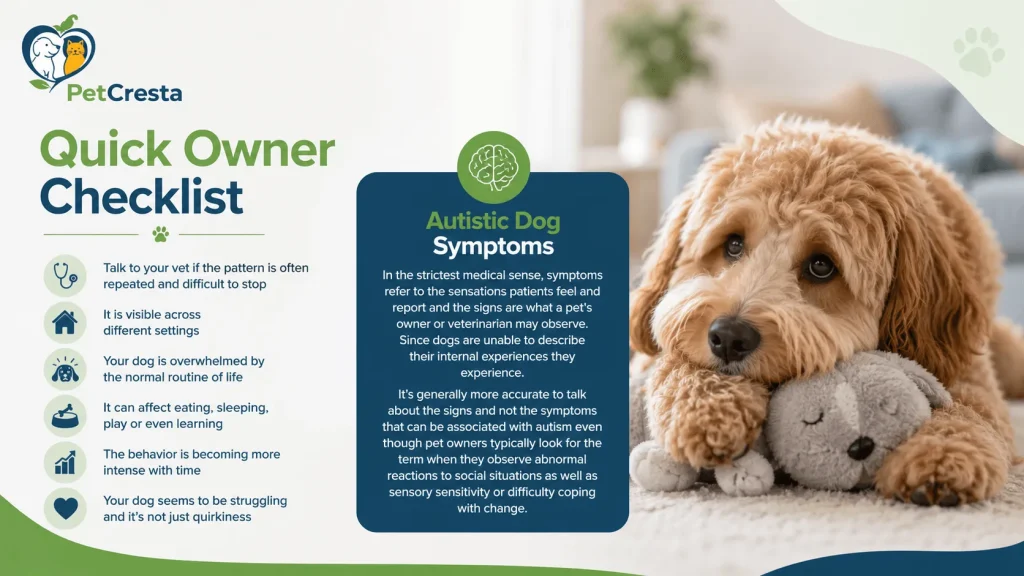
You might want to talk about the pattern with a vet if:
- The pattern is often repeated and difficult to stop
- It is visible across different settings.
- Your dog is overwhelmed by the normal routine of life.
- The pattern can affect eating, sleeping, play or even learning
- The behavior is becoming more intense with the passage of time.
- Your dog seems to be struggling and it’s not just quirkiness.
Autistic Dog Symptoms
In the strictest medical sense, symptoms refer to the sensations patients feel and report and the signs are what a pet’s owner or veterinarian may observe. Since dogs are unable to describe their internal experiences they experience.
It’s generally more accurate to talk about the signs and not the symptoms that can be associated with autism even though pet owners typically look for the term when they observe abnormal reactions to social situations as well as sensory sensitivity or difficulty coping with change.
What Looks Like Autism In Dogs But Often Is Not

This is among the most crucial aspects of the conversation. Some dogs that look autistic to their owners may be having a problem with their behavior or health that requires a separate plan.
| What Owners Notice | Common Explanation | What Makes You Look Closer |
|---|---|---|
| Pacing, shutdown, overreaction | Anxiety or chronic stress | Clear triggers, poor recovery, generalized tension |
| Tail chasing, licking, repetitive movement | Canine compulsive disorder or abnormal repetitive behavior | High frequency, hard to interrupt, self-trauma risk |
| Withdrawal, irritability, odd movement | Pain or discomfort. | Touch sensitivity, mobility changes, guarding, sleep disruption |
| Confusion, circling, altered awareness | Neurological problem | Sudden onset, disorientation, seizure-like episodes, progression |
| Poor response to sound or cues | Sensory deficits | Hearing or vision concerns, inconsistent orientation |
| Unusual social behavior | Poor socialization or an overstimulating environment | Developmental history, fear-based patterns, context-specific behavior |
A good evaluation does not start by asking whether the dog matches a label. It starts by asking what else could explain the pattern more accurately and what needs to be ruled out first.
What Research Actually Says About Autism-Like Behavior In Dogs
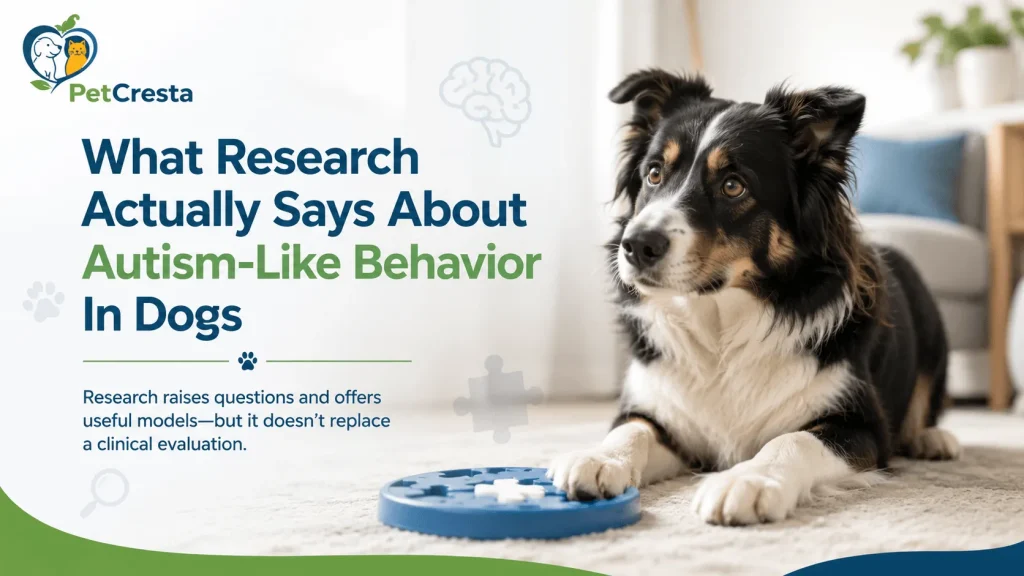
The research currently being conducted is fascinating; however, it is limited. There isn’t any definitive diagnosis of autism for dogs that are owned by a pet owner. The literature available doesn’t support autism as a standard vet diagnosis.
Some research has looked at Bull Terriers with tail-chasing behavior and reported elevated neurotensin and corticotropin-releasing hormone in affected dogs, alongside a discussion of a phenotype that may resemble some autism-related traits. Some studies have suggested that dogs as a model for translation for autism research. Studies on the genetics behind canine compulsive disorders have found variants in genes like CDH2 and other related loci.
It is useful scientifically however, it’s not the same in the same way as saying that pets could be diagnosed clinically with autism.
| What Research Supports | What It Does Not Prove |
|---|---|
| Some repetitive and socially unusual canine behaviors have been studied as analogs for aspects of human neurodevelopmental disorders | That ordinary pet dogs can be diagnosed with autism, the way humans are |
| Bull Terrier tail-chasing and related biomarker work suggest there may be measurable biologic differences in some affected dogs | That tail chasing automatically means autism |
| Dogs have been proposed as a translational model for autism research | That every autism-like behavior in a dog reflects the same underlying mechanism |
| Canine compulsive disorder genetics have implicated pathways involving CDH2 and related loci | That compulsive disorder and autism are interchangeable diagnoses in dogs |
The main point is that research raises questions and offers useful models but it doesn’t substitute for the clinical evaluation.
What May Contribute To Autism-Like Behavior In Dogs
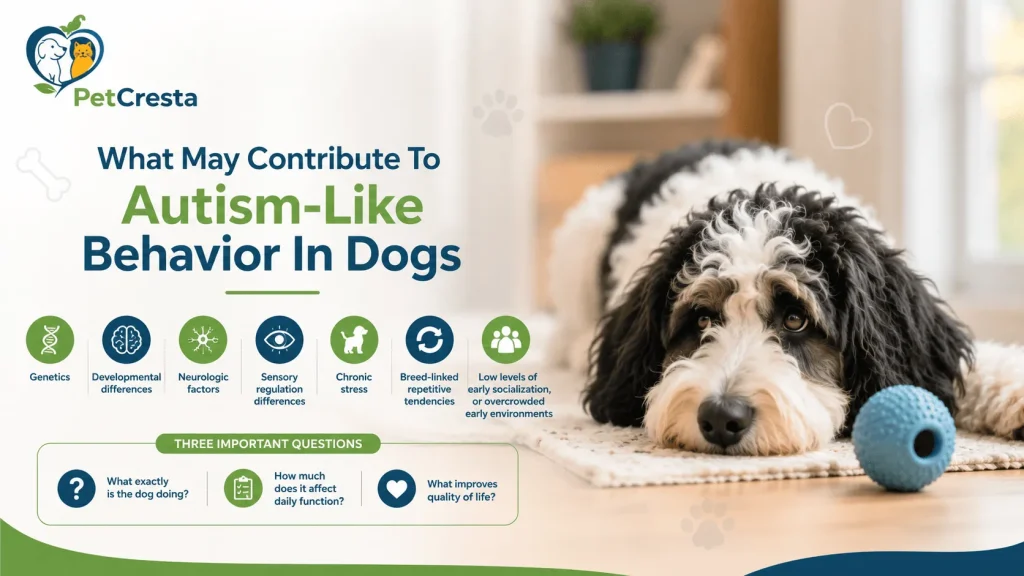
The evidence is not conclusive; the field must be viewed with caution. Instead of discussing what causes dogs to be autistic, it’s more appropriate to discuss the factors that contribute to the autism-like behaviors.
Potential contributors could include:
- Genetics
- developmental differences
- neurologic factors
- sensory regulation differences
- chronic stress
- breed-linked repetitive tendencies
- low levels of early socialization, or overcrowded early environments
Three important questions in the context of practicality are crucial:
- What exactly is the dog doing?
- How much does it affect daily function?
- What improves quality of life?
How Veterinarians Evaluate Autism-Like Behavior In Dogs

A thorough assessment is among the most important aspects of behavior therapy that is good. It is not the intention to put a label on the problem. The objective is to grasp the pattern sufficiently to create a practical strategy.
1. Behavioral History
A vet’s history begins with:
- The behavior began to escalate
- How often does it occur?
- What causes it?
- If it is possible to interrupt
- If it’s getting worse
- Exercise, sleep, diet, and history of medications
- What was the dog like when he was an infant
- The videos of each episode should it be available if they are.
2. Physical And Neurological Exam
A dog that exhibits behavior that is similar to autism requires a medical exam when the signs suggest it.
This could include a check for:
- Pain
- skin disease
- the pain in the spine
- Gastrointestinal issues
- hearing or vision deficits
- Issues with the endocrine system
- neurologic abnormalities
Skin checks during the exam can also identify less obvious discomfort sources, including irritation from embedded ticks that may be driving restlessness or touch sensitivity.
3. Functional Assessment
The next issue is how the behavior impacts the dog as well as the family.
A useful assessment looks at:
- Frequency
- Intensity
- Duration
- Time to recover
- Safety risk
- impact on sleep, eating effects on learning, sleep, and the family impacts on sleep, eating, and family
4. Referral When Needed
A referral is usually a good option when:
- extreme repeated behavior that is extremely repetitive
- self-injury
- Extreme shutdown
- aggression
- possible seizures
- Inadequate response to the initial management
What To Bring To The Appointment
Bring:
- videos that show the behavior
- Notes on triggers
- The duration of the episode and recovery time
- Current medication or supplements
- routine details
- Recent household changes
Support And Treatment For Autism In Dogs

There isn’t a single autism treatment that dogs can receive, since treatment must be based on the issue at hand and not just the diagnosis. It is most effective when it is designed around the dog’s stress levels as well as their daily activities or triggers, as well as medical research findings.
What Helps
Home environment
- predictable routine
- quiet safe space
- reduced chaos
- protected sleep
- fewer overwhelming exposures
- clearer daily structure
Behavior Support
- desensitization
- counterconditioning
- reinforcing calm behavior
- trigger management
- consistent handling
What Usually Makes Things Worse
- punishment
- flooding
- forced social contact
- repeated overstimulation
- chaotic training
- inconsistent handling
Medication And Specialist Care
Medication may help when the problem includes severe anxiety, compulsive behavior, inability to settle, major distress, or self-trauma risk. That decision should be made by a veterinarian based on the actual clinical picture.
Home-Support Checklist
- keep daily routines predictable
- Give the dog a quiet recovery space
- protect sleep and rest
- avoid pushing overwhelming situations
- track triggers consistently
- Reward calm behavior clearly
- Look for slow weekly progress, not overnight change
Common Myths About Autism and Dogs

- Myth: that dogs can be treated precisely like humans.
The truth is that dogs aren’t typically diagnosed with autism in the standard framework of veterinary medicine, as humans are. - Myth: Tail-chasing implies autism.
Realistically, tail chasing could be a sign of compulsive behavior as well as stress, neurologic issues or any other cause and needs to be viewed in the context of. - Myth: A dog that is withdrawn has always been autistic.
Realistically, withdrawal can signal pain, fear and illness, as well as sensory loss and social isolation, or even chronic stress. - Myth: Dogs can’t connect or learn.
The reality is that many dogs who exhibit unusual behavior patterns still be taught, bond and grow with the right guidance. - Myth: If it appears like a behavior, it’s not medical.
The reality is that neurologic diseases, pain as well as endocrine disorders, skin disease, and sensory impairments are all factors that can alter the way you behave.
Can Dogs Have Special Needs?
Yes. Dogs can absolutely have special needs, whether those needs are physical, sensory, neurologic, behavioral, or developmental.
A dog may need special support if it struggles with movement, vision, hearing, social function, coping, learning, or behavior regulation in everyday life. The helpful question is not whether the dog fits a broad label. It is what kind of support the dog needs and what makes life easier and safer.
When To Call A Vet Quickly
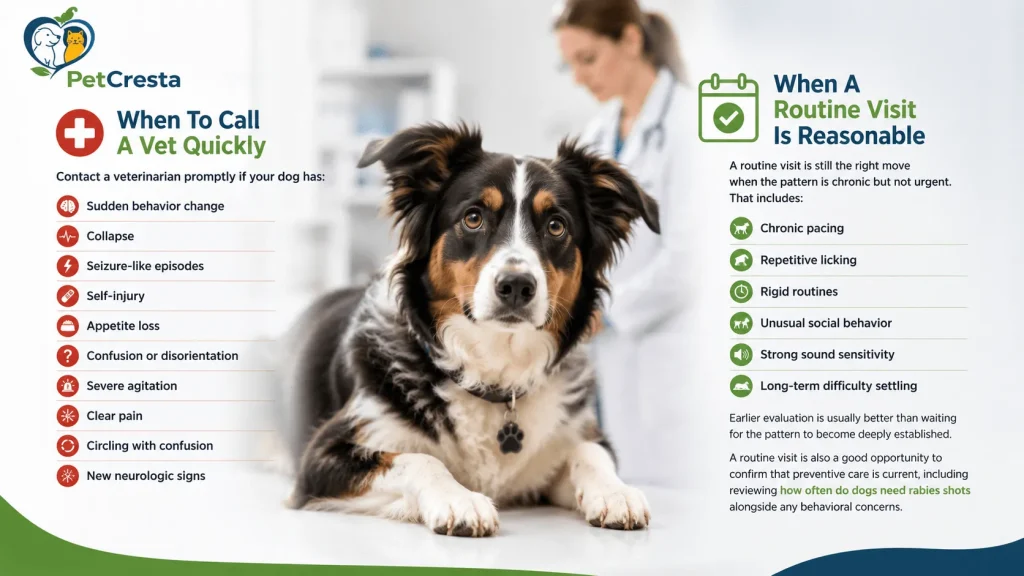
Contact a veterinarian promptly if your dog has:
- sudden behavior change
- collapse
- seizure-like episodes
- self-injury
- appetite loss
- confusion or disorientation
- severe agitation
- clear pain
- circling with confusion
- new neurologic signs
When A Routine Visit Is Reasonable
A routine visit is still the right move when the pattern is chronic but not urgent.
That includes:
- chronic pacing
- repetitive licking
- rigid routines
- unusual social behavior
- strong sound sensitivity
- long-term difficulty settling
Earlier evaluation is usually better than waiting for the pattern to become deeply established. A routine visit is also a good opportunity to confirm that preventive care is current, including reviewing how often do dogs need rabies shots alongside any behavioral concerns.
Conclusion
So, do dogs get autism? In the standard practice of veterinary medicine, dogs aren’t officially diagnosed with autism in the same way that humans are. However, some dogs exhibit behaviors that resemble those of autism, and these behaviors require careful observation instead of dismissal or speculation.
The most important question to ask isn’t whether the dog can be classified under an appropriate label. It’s about what is driving the behavior and what type of assistance is required.
When a pattern of behavior, unusual emotional responses to social situations and sensory sensitivity or trouble coping with change shows repeatedly, an accurate assessment will lead to better decisions and better treatment. This is where the most effective assistance begins.
FAQ’s
Dogs are not formally diagnosed with autism the way humans are. If your dog seems unusual, the better question is what may be driving the behavior.
Start by tracking what the behavior looks like, when it happens, and how intense it is. Then schedule a veterinary visit, especially if the pattern is frequent, worsening, or affecting daily life.
You usually cannot know that from behavior alone. A veterinarian needs to look at the full history, triggers, exam findings, and possible look-alikes.
Often, something else may be contributing, including anxiety, compulsive behavior, pain, or neurologic disease. That is why evaluation matters more than the label.
There are dogs with autism-like behaviors, but not a routine formal autism diagnosis used the same way as in humans. The wording is still cautious in veterinary medicine.
It is more accurate to say some dogs may show autism-like behavior patterns. Current evidence does not support a standard human-style autism diagnosis for pet dogs.
Common concerns include spinning, pacing, shutdown, unusual greeting behavior, or trouble coping with change. These signs overlap with many other conditions, so they need context.
The better question is whether the dog has autism-like behavior and what may be causing it. That usually needs veterinary evaluation rather than guessing from online checklists.
Common concerns include repetitive movement, sensory sensitivity, rigid routines, and unusual social behavior. These are better treated as warning signs to evaluate, not proof of autism.
There is no single look. Owners usually notice behavior patterns such as shutdown, pacing, fixation, circling, or unusual response to social or sensory input.
Licking can be part of a repetitive behavior pattern, but it is not specific to autism-like behavior. It can also be linked to anxiety, skin irritation, pain, nausea, or compulsive disorders.
Autism-like behavior in dogs is not a common formal diagnosis, but unusual repetitive or socially atypical behavior is not rare as an owner concern. What matters most is whether the pattern is persistent, disruptive, and affecting the dog’s quality of life.
Bull Terriers are among the breeds most often mentioned in autism-like behavior research, especially in tail-chasing studies. Some canine compulsive behavior research has also looked at other breeds with repetitive-behavior tendencies.
References
- Tsilioni I, Dodman N, Petra AI, et al. Elevated serum neurotensin and CRH levels in children with autistic spectrum disorders and tail-chasing Bull Terriers with a phenotype similar to autism. Transl Psychiatry. 2014.
- Topal J, Gergely A, Erdos D, et al. The dog (Canis familiaris) as a translational model of autism: It is high time we move from promise to reality. Wiley Interdiscip Rev Cogn Sci. 2019.
- Tang R, Noh HJ, Wang D, et al. Candidate genes and functional noncoding variants identified in a canine model of obsessive-compulsive disorder. Genome Biol. 2014.
- Merck Veterinary Manual. Diagnosis of Behavior Problems in Animals.
- Merck Veterinary Manual. Behavior Problems of Dogs.
- Merck Veterinary Manual. Behavior Modification in Dogs.