Dog Skin Tag on Leg: Symptoms, Diagnosis, and Vet Treatment Guide
Skin tags on dogs legs is often a benign skin growth, but this location deserves closer attention than many other body sites. The leg handles pressure, motion, licking, grooming, and outdoor contact throughout the day. Even a small lesion can become irritated if it sits near a joint or another high-contact area.
This guide stays focused on the leg only. It explains what these growths usually look like, why the location matters, when home monitoring may be reasonable, and when a veterinary visit is the safer next step. For a broader overview of causes, diagnosis, and common skin growth patterns, see skin tags on dogs.
Quick Verdict: Is This Growth On Your Dog’s Leg Likely A Skin Tag?
A growth on dog leg skin tag may be a skin tag if it is small, superficial, soft to slightly firm, and unchanged over time. Many dogs have harmless surface growths that do not cause pain or affect movement.
The leg is still a high-use area. A lesion here is more likely to get rubbed, licked, bumped, or reopened than a similar growth on a quieter part of the body. That means even a harmless tag can become bothersome because of location alone.
Dog Skin Tag Leg: Characteristics At A Glance
| Feature | Often fits a calm pattern | Needs veterinary review |
| Size | Small and unchanged | Enlarging or changing quickly |
| Surface | Smooth or mildly textured | Crusted, ulcerated, or irregular |
| Color | Skin colored, pink, gray, or evenly pigmented | Sudden darkening, uneven color, or marked redness |
| Base | Small surface attachment or narrow stalk | Broad base, deeper feel, or fixed appearance |
| Comfort | Not painful and not licked | Painful, tender, or repeatedly chewed |
| Function | No effect on walking or rest | Rubbing during movement or lying down |
| Discharge | None | Bleeding, oozing, odor, or pus |
| Change over time | Stable for weeks to months | New, suddenly noticed, or clearly changing |
What Is A Skin Tag On A Dog’s Leg?
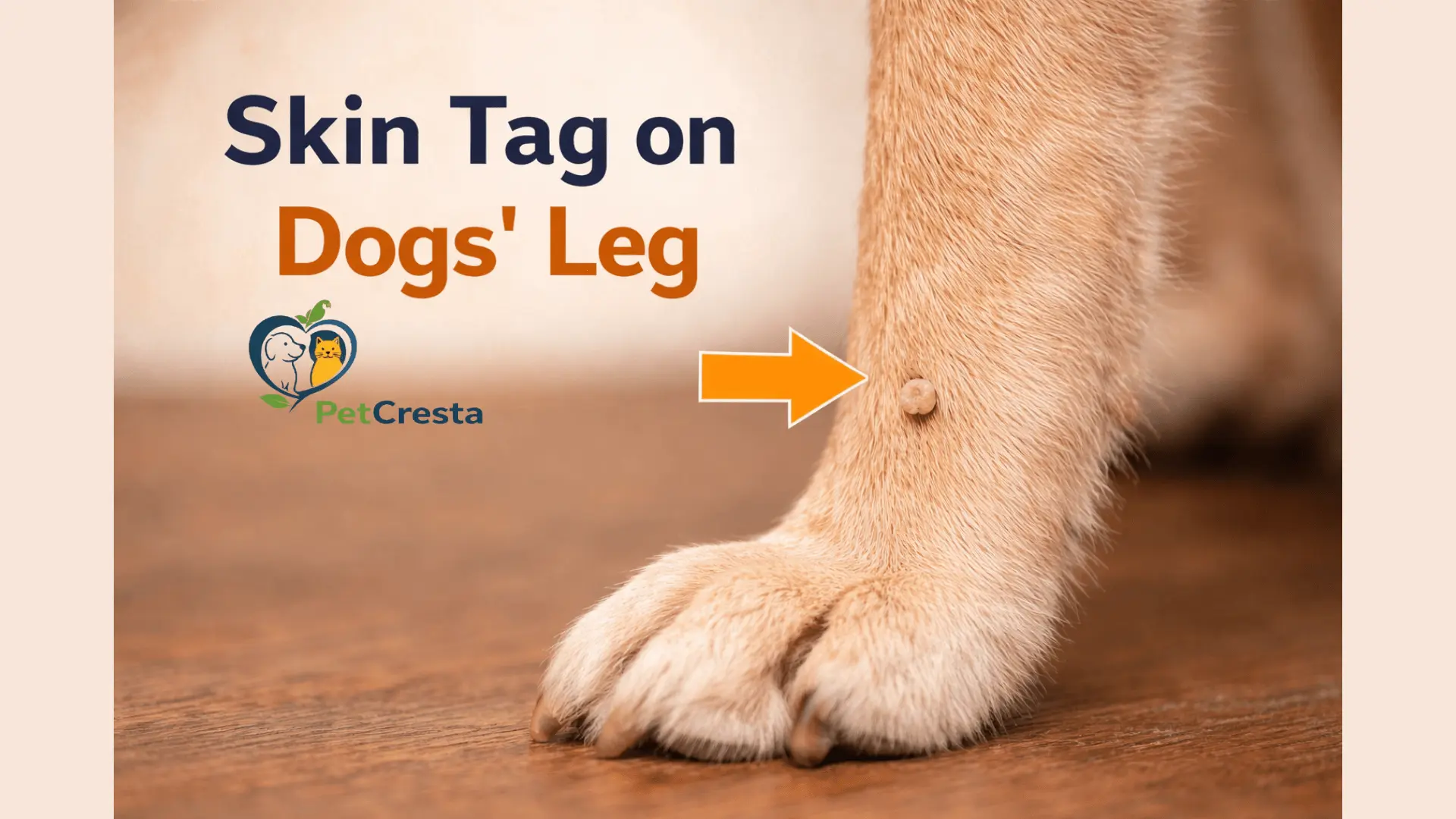
A skin tag on dogs leg is usually a small growth that sits on the surface of the skin. It may be soft or slightly firm and can appear flesh colored, pink, gray, brown, or darker than the surrounding skin. Some attach with a narrow stalk, while others sit closer to the skin.
Skin Tag On Dog Leg
A dog skin tag leg often looks like a small piece of skin that projects from the surface. Some are soft and flexible. Others feel a little firmer. They may be smooth, slightly wrinkled, round, oval, or attached by a narrow stalk.
Owners often notice them during bathing, brushing, drying, or while checking a limb after outdoor activity. A darker lesion is not always dangerous, but a very dark color, fast change, or a firmer, broader base deserves more caution because some other masses can resemble a skin tag. A growth may also seem to have appeared suddenly when it was only noticed for the first time after grooming or irritation made it more obvious.
Types Of Dog Leg Growths
- True skin tag: usually a small surface growth that may feel soft or slightly firm and may hang from a narrow base.
- Wart-like growth: often looks rougher, thicker, and more attached to the skin.
- Cyst-like lesion: may feel rounder, fuller, or slightly deeper under the surface.
- Broader skin mass: may have a wider base and not fit the usual skin tag pattern.
- Darker or firmer growth: deserves more caution because some lesions that look like skin tags are not true skin tags.
The leg deals with constant motion, pressure, and licking, so even a mild growth may become irritated faster in this location. If the lesion is new, enlarging, bleeding, very dark, painful, or affecting movement, it should be checked rather than judged by appearance alone.
Skin Tag Vs Tumor On Dog Leg
A classic skin tag is usually superficial, soft to slightly firm, and attached to the surface. It often looks like a small flap, raised tag, or bit of skin on a narrow attachment point. It may stay stable for a long time and cause no discomfort unless it is rubbed.
A tumor or another type of mass may feel deeper, broader at the base, firmer, fixed, rapidly enlarging, ulcerated, or uneven in color. That does not mean every concerning-looking lesion is cancer, but appearance alone is not enough for certainty. A veterinary exam, fine needle aspiration, biopsy, or lab review may be needed to tell the difference.
| Looks more like a skin tag | Less clear | More concerning features |
| Small, superficial, soft, stable | New lesion with limited history | Fast growth, firmness, ulceration, broad base |
| Narrow stalk or light surface attachment | Mild dark pigment or surface irritation | Very dark, irregular, bleeding, or fixed to deeper tissue |
Skin Tag Vs Wart Or Tick On Dog Leg
A tick usually has a visible body and legs and does not grow from the skin the way a skin tag does. A wart often looks rougher, more attached, or cauliflower-like. A cyst may feel rounder, fuller, or deeper under the skin.
A skin tag is more often a surface growth that may hang from a narrow base or project lightly from the skin. If the appearance is not clear, it is better not to guess. Do not pull, twist, or cut anything at home. For lesions closer to the ground where walking friction matters most, see a skin tag on a dog’s paw.
Why The Leg Location Matters
The leg is one of the busiest areas on the body. Skin here moves during every step, bends near joints, presses against surfaces during rest, and is easy for many dogs to lick. A small lesion that would stay quiet on the side of the body may keep reopening on the leg.
Location changes management. A growth near the eye behaves very differently from one on the leg, as explained in skin tags on dogs’ eyes. On the leg, repeated motion and contact lower the threshold for irritation, bleeding, and discomfort.
Skin Tag On Dog Front Leg And Back Leg Patterns
Front leg lesions are often easier for a dog to reach. The elbow area also deals with repeated pressure during rest, especially on firm flooring. A small growth here may crust or bleed simply because the site is used so often.
Back leg lesions may be harder to notice early, especially if they sit behind the limb or closer to the inner thigh. Near the knee, repeated bending can keep even a benign lesion irritated.
Skin Tag On Dog Near The Joint Friction
A growth beside a joint may be pulled and rubbed each time the limb flexes. That repeated motion may lead to redness, crusting, soreness, or occasional bleeding.
This does not automatically make the lesion dangerous. It does mean the site can turn a mild problem into a persistent one.
Skin Tag On Dog Lower Leg
Lower leg sites are exposed to brush, mud, towels, grooming tools, rough play, and contact with bedding or flooring. A small lesion in this area may catch on debris or get nicked during coat care more easily than one on a quieter body site.
Because these areas are close to the ground and often easy to lick, irritation can build quickly once the surface is disturbed.
Skin Tag On Dog Leg Causes
Several factors can make a skin tag more likely to appear on the leg or more likely to become noticeable there. Repeated friction, pressure, licking, local irritation, and age-related skin changes are some of the most common reasons these growths are noticed in this area.
Elbows, knees, and other contact points handle more daily stress, especially on firm flooring or during repeated movement. Minor grooming injury, active play, and repeated scratching can also keep the area irritated. These growths are seen more often in middle-aged and older dogs, and larger dogs may deal with more friction at pressure points. If the growth sits near a pressure point, skin tags on a dog’s elbow give more detail on rubbing and hard surface irritation.
When It Is Usually Fine To Watch At Home
Home monitoring can be reasonable when the lesion looks stable, and the dog is not bothered by it. Monitoring does not mean guessing forever. It means watching carefully and bringing useful information to the next veterinary visit.
Signs That Fit A Stable Pattern
A quiet lesion may be watched if it stays the same size, keeps the same color, does not bleed, and is not being licked or chewed. The dog should still be walking, resting, and using the leg normally.
Stable means unchanged over time, not just small. A tiny lesion that is clearly changing still deserves attention.
How To Monitor It Correctly
Take a clear photo from the same angle once a month. Note the exact location, the rough size, the color, and whether the lesion sits on a narrow stalk or a flatter base. A ruler or coin beside the lesion can make size changes easier to notice.
Also, pay attention after exercise, grooming, or outdoor play. A growth that looks calm at rest may show rubbing or crusting after activity.
What Monitoring Does And Does Not Mean
Monitoring means looking for change. It does not replace a veterinary exam for a new lesion, a changing lesion, or one that is starting to bleed, hurt, or interfere with the dog’s comfort.
When A Skin Tag On The Leg Needs A Vet Visit
A veterinary visit is the better choice when the lesion is no longer quiet. Any new growth deserves review, and sooner if it is changing or causing irritation.
Fast Changes
An enlarging growth, a lesion that changes color, a surface that becomes rougher, or a tag that feels firmer than before deserves attention. Some owners say the growth suddenly appeared, but the more important question is whether it is truly changing now.
A sudden shift matters more than the exact size alone.
Surface Problems
Bleeding, crusting, ulceration, redness, swelling, discharge, or odor suggest the site is irritated or no longer following a calm pattern. A leg lesion can be reopened easily if the dog keeps licking, scratching, or bumping it.
Comfort And Function Problems
Pain when touched, repeated chewing, limping, guarding the limb, or discomfort when lying down are all important signs. Even a small lesion may need attention if it sits where movement keeps aggravating it.
Monitor Or Book A Vet Visit
| Usually okay to monitor | Book a veterinary visit |
|---|---|
| Small and unchanged | New growth or rapid change |
| Even color | Very dark, inflamed, or uneven color |
| Not bleeding | Bleeding or discharge |
| Not painful | Painful or tender |
| Not licked or chewed | Repeated licking or chewing |
| No effect on walking or rest | Limping or discomfort during rest |
| Low-friction location | Near joint rubbing or repeated trauma |
How Veterinarians Check A Skin Tag On Dogs Leg
A veterinary exam does more than confirm that a lesion exists. It helps determine whether the appearance and behavior fit a benign tag or whether more testing is warranted.
Physical Exam
The veterinarian will assess the exact location, size, surface, color, base, and how the lesion sits on the skin. The exam also considers whether the site is being irritated by movement, pressure, or licking.
Fine Needle Aspiration When Needed
In some cases, a fine needle sample may help gather more information, especially when the lesion does not look straightforward or the appearance has changed. Not every superficial lesion gives a full answer this way, but it can still be helpful.
Biopsy Or Removal
A definite diagnosis may require biopsy or removal with lab review. This is especially useful when the lesion is changing, bleeding, unusually firm, or not behaving like a simple skin tag.
Why Appearance Alone Is Not Always Enough
Some skin growths look harmless at first glance. That is why a veterinarian may recommend testing instead of relying on appearance alone, particularly on a site that keeps getting irritated.
Vet Treatment Dog Leg Lump And Removal Options
Not every leg lesion needs treatment. The best plan depends on how stable the lesion is, how much the dog notices it, and whether the appearance truly fits a benign pattern.
When No Treatment May Be Needed
A small, quiet lesion that stays unchanged, causes no discomfort, and does not sit in a high-friction location may only need monitoring and routine rechecks.
When Removal Makes Sense On The Leg
Removal becomes more reasonable when the lesion bleeds, gets licked, sits near a joint, catches during grooming, or is repeatedly traumatized during rest or activity. Removal may also be advised when the diagnosis remains uncertain.
How Removal May Be Handled
The method depends on the lesion and the dog. Some cases may be managed with a local anesthetic, while others may need sedation or a more controlled procedure. Tissue may be submitted for lab review when needed.
Basic Aftercare
After removal, the main goals are to keep the site clean, dry, and free from licking. Many dogs need a cone or another barrier to stop self-trauma while the area heals.
Owners should watch for redness, swelling, discharge, odor, or renewed soreness. Activity may need to stay limited for a short time because the leg is a high-motion site, and healing can be slower if the area keeps bending or rubbing.
How Long Does Dog Leg Tumor Removal Take
Dog leg tumor removal can be a fairly short procedure or a much longer one, depending on the tumor’s size, depth, exact location on the leg, and whether wider margins or more difficult closure are needed. Some simple mass removals take only a few minutes, while larger or more invasive removals can take hours under anesthesia. Surgeries on the leg may also take longer when skin closure is tight or reconstructive techniques are needed after the mass is removed.
What Affects Cost
Cost varies by clinic and case. The total may depend on the exam, the need for a sample or biopsy, whether sedation or anesthesia is used, the exact leg location, and whether the tissue is sent for pathology.
A small, straightforward lesion may cost less than one that is bleeding, in a difficult spot, or needs more precise closure because of constant movement.
What Not To Do At Home
Home treatment is not a safe shortcut for a leg lesion. The area moves constantly, is easy to lick, and can be reopened with normal daily activity.
Do Not Cut, Tie Off, Burn, Or Pick At It
These methods can cause pain, bleeding, infection, and delayed diagnosis. A small growth can become a much larger problem once it is traumatized.
Be Careful With Random Products
Unapproved topical products may irritate the skin or make the lesion harder to evaluate later. A calm surface can become inflamed after home treatment.
Why Home Treatment Is Worse For The Leg
The leg is a high movement site. Even a mild wound there may reopen with walking, lying down, grooming, or licking. That makes healing less predictable and complications more likely.
How To Reduce Repeat Irritation On The Leg
The goal is not to promise that every skin tag can be prevented. The goal is to reduce the daily friction that makes a calm lesion turn into an irritated one.
Reduce Pressure On Elbows And Knees
Softer resting surfaces can help reduce repeated pressure at elbow and knee contact points. This matters most for larger dogs or dogs that spend time on firm flooring.
Reduce Friction Around The Lesion
Brush gently around the site. Dry the area with care after baths. Pay attention to any wraps, clothing, or gear that might rub against the lesion if such items are used.
Address Repeat Licking And Skin Irritation
If the dog keeps licking the area, the cause of that irritation should be addressed. Repeated self-trauma can keep the lesion sore even if the growth itself is benign.
Monthly Tracking Checklist For A Leg Skin Tag
| What to record | Why it matters |
|---|---|
| Photo date | Creates a clear timeline |
| Exact leg location | Shows whether the site is near pressure or joint areas |
| Approximate size | Helps identify gradual enlargement |
| Color | Helps spot darkening or redness |
| Shape or base | Shows whether it stays stalked or becomes broader |
| Bleeding or crusting | Indicates trauma or irritation |
| Licking or chewing | Explains repeated inflammation |
| Change after exercise | Shows whether movement worsens the site |
| Change in walking or resting | Helps identify function-related discomfort |
| Change since last month | Highlights trends that are easy to miss |
A photo taken from the same distance and angle each month can be very helpful. One close photo and one wider photo of the limb often give the clearest record.
Conclusion
A growth on dog leg skin tag is often a minor finding, but the location can turn a small, harmless lesion into a repeated source of rubbing, licking, and discomfort. That is why the leg deserves more attention than a quiet body site.
A stable lesion that stays small and calm may be watched with regular photos and notes. A growth that changes, darkens, bleeds, becomes painful, or interferes with normal movement should be checked by a veterinarian without delay.
FAQ’s About Skin Tag on Dog Leg
A skin tag on a dog’s leg often appears as a small surface growth that may be soft or slightly firm. It can be flesh colored, pink, gray, brown, or darker than the surrounding skin. Some hang from a narrow stalk, while others sit closer to the skin surface. The exact look can vary, which is why new or changing lesions should not be judged on appearance alone.
Recovery depends on the size of the lesion, the depth of removal, and how much the site moves during healing. Leg wounds often need more protection than other body sites because walking, bending, lying down, and licking can all slow recovery. Most cases need close monitoring, licking prevention, and a short period of reduced activity. If the site becomes red, swollen, open, or starts draining, the dog should be rechecked.
They are often linked with friction, pressure, and repeated local irritation. On the leg, this may involve elbow pressure, knee movement, grooming contact, or repeated licking of one spot. Age may also play a role, since these growths are seen more often in middle-aged and older dogs. The location often makes the lesion easier to notice because it gets used so much.
Some lesions may stay unchanged for a long time, and some may become less noticeable if irritation settles down. Most true skin tags do not simply disappear predictably. If a growth seems to change rapidly, shrink, crust, or fall off, it is worth asking whether it was really a skin tag or whether trauma changed the surface.
There is no single price because cost depends on the clinic, the exact location, the size of the lesion, and whether testing, sedation, stitches, or pathology are needed. A straightforward superficial removal may cost less than a lesion in a high-motion spot that needs more careful closure. The most useful approach is to ask for an estimate after the veterinarian has examined the growth.
Yes. Skin tags can appear on many parts of the body, including the legs. They are generally benign, are more common in older dogs, and may appear as stalk-like surface growths. On the leg, they tend to get more attention because motion, pressure, and licking can make even a mild lesion more irritating.
A veterinary visit is the safer choice for any new growth, and it becomes more important if the lesion is changing, bleeding, darkening, painful, or being licked often. Skin tags can look similar to warts, cysts, ticks, and even tumors, so appearance alone is not always enough to confirm what it is. A biopsy may be recommended when the diagnosis is uncertain.
No. Cutting, tying off, burning, or picking at a skin growth at home can cause pain, bleeding, infection, and delayed diagnosis. This is especially risky on the leg because the area moves constantly and is easy for a dog to lick, scratch, or reopen. Safe treatment starts with a veterinary exam, not home removal.
Bleeding after scratching usually means the surface has been traumatized, not that the lesion is harmless. Leg lesions are more likely to reopen because of movement, bedding contact, grooming, and licking. If the area keeps bleeding, looks ulcerated, smells bad, or becomes swollen and painful, it should be checked rather than watched casually at home.
Yes. Skin tags are common in dogs, especially in older dogs, and they may be single or multiple. They can occur in many breeds and body locations. Even so, common does not mean every small growth should be assumed to be a skin tag without a proper exam.
Some leg tumors are benign, and some are malignant, so danger cannot be judged by location alone. The features that raise more concern are rapid growth, firmness, ulceration, bleeding, dark or uneven color, pain, or a mass that feels fixed rather than superficial. A veterinarian may need cytology or biopsy because visual appearance alone cannot reliably separate a benign growth from a tumor.
A definite diagnosis cannot be made at home just by looking at the lesion. At home, the most useful observations are whether the growth is superficial or deep, soft or firm, stalked or broad-based, stable or changing, and whether it is bleeding, ulcerated, or affecting walking. The next step is a veterinary exam, and in unclear cases, the diagnosis may require fine needle aspiration or biopsy.
A wart-like lesion on the leg can be benign, but it should not be assumed to be normal without context. Warts, skin tags, ticks, cysts, and tumors can resemble one another, especially when the surface is rough or irritated. If the lesion is new, growing, bleeding, or being licked often, a veterinary check is the safer choice.
Safe treatment starts with the right diagnosis. Do not cut, tie off, burn, or medicate the growth at home. Instead, monitor size and color, prevent licking, and book a veterinary visit if the lesion is new, changing, bleeding, painful, or interfering with movement. If removal is needed, aftercare usually includes restricted activity and protection of the healing site.
Safe treatment starts with the right diagnosis. Do not cut, tie off, burn, or medicate the growth at home. Instead, monitor size and color, prevent licking, and book a veterinary visit if the lesion is new, changing, bleeding, painful, or interfering with movement. If removal is needed, aftercare usually includes restricted activity and protection of the healing site.