Bernedoodle F1B: Size, Shedding, Temperament & Care Guide
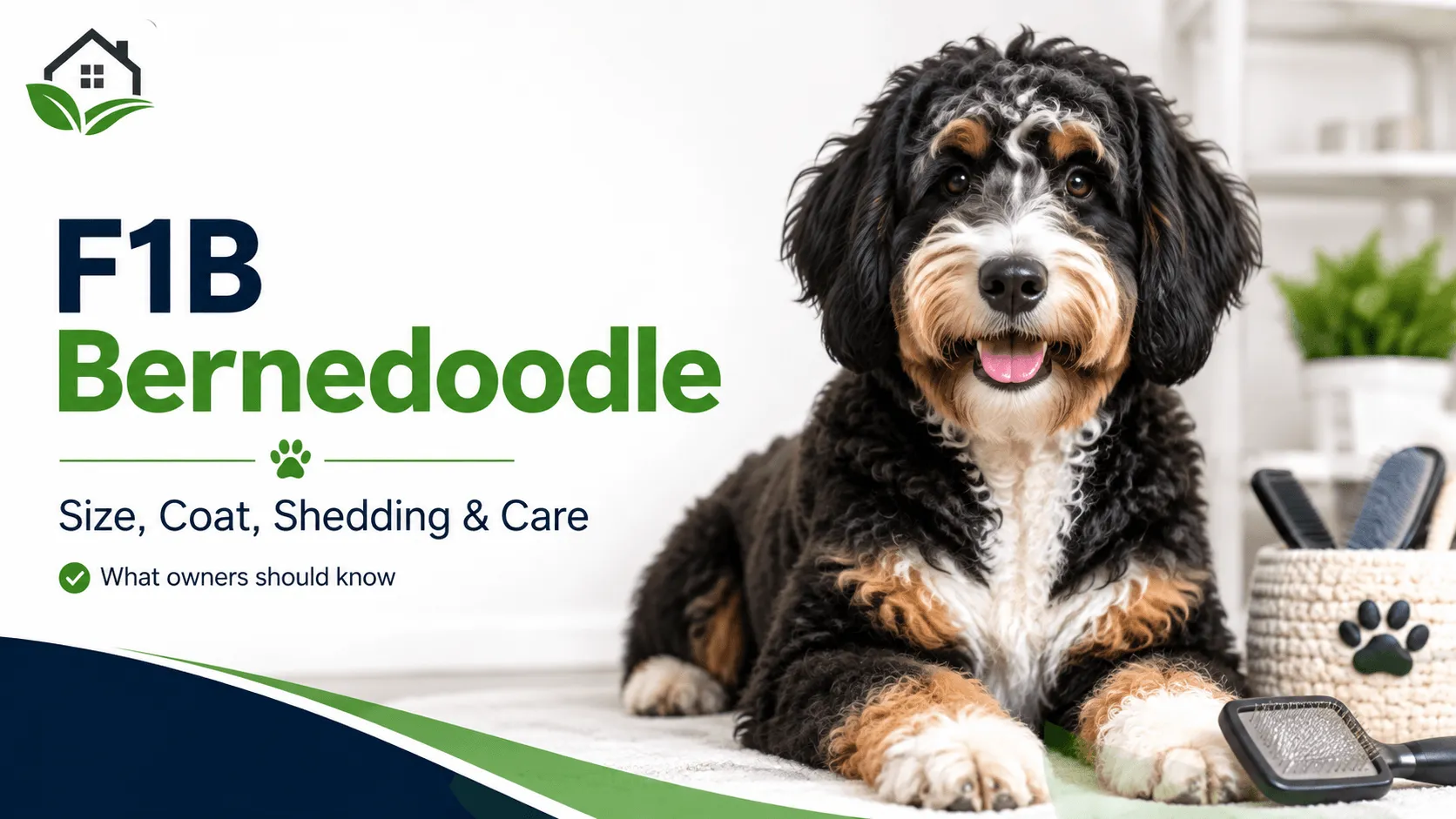
An F1B Bernedoodle is typically an F1 Bernedoodle bred back to a Poodle, resulting in a 75% Poodle and 25% Bernese Mountain Dog. Those percentages refer to parentage, not an exact percentage of each trait.
Many families want a dog that is social and doesn’t shed so much. The compromise might be increased coat maintenance and no allergy guarantee.
Quick Answer: What Is An F1B Bernedoodle?
This is often an F1 Bernedoodle bred with a Poodle. May be wavy or curly and shed less than some breeds, but size, temperament, health and allergy sensitivity will vary.
The label does not imply a guaranteed result. Allergy safety cannot be guaranteed
F1b Bernedoodle At A Glance
This snapshot is a summary of typical behaviors, not guarantees. The individual puppy/family record remains significant.
| Topic | Typical F1B tendency | Important limitation |
|---|---|---|
| Usual parentage | F1 Bernedoodle × Poodle | Verify the actual parents |
| Expected ancestry | About 75% Poodle and 25% Bernese Mountain Dog | Ancestry does not guarantee individual traits |
| Adult size | Mini, medium, or standard breeder categories | Size labels and ranges vary |
| Coat | Often wavy or curly and furnished | Littermates can differ |
| Visible shedding | Often lower than in many F1 dogs | Not always non-shedding |
| Grooming | Usually frequent home care and professional trimming | Curlier coats may mat quickly |
| Temperament | Often social, affectionate, and trainable | Parent temperament and socialization matter more than the label |
| Exercise | Daily movement and mental work | Needs vary by age, health, and size |
| Allergy suitability | Some households may notice fewer loose hairs | No dog is guaranteed allergy-safe |
| Best fit | Owners prepared for grooming, training, and interaction | Poor choice for someone seeking a low-maintenance coat |
F1B Bernedoodle Pros And Cons

There are many attractive attributes that go hand in hand with the responsibility. Less free hair may lead to more combing, and more free hair may result in the need for independence training.
| Possible advantages | Possible drawbacks |
|---|---|
| Often lower visible shedding than many F1 coats | Lower-shedding coats may require more brushing and combing |
| Commonly has a furnished, wavy, or curly appearance | Coat can mat close to the skin |
| Often responsive to reward-based training | Intelligence does not make puppy behavior effortless |
| May form strong social bonds | Some dogs struggle when independence is not taught |
| Available in several breeder-used size categories | Adult size is not guaranteed by the label |
| May work for some allergy-conscious households | No dog is reliably hypoallergenic |
| Can suit active family life | Grooming, training, and veterinary costs can be substantial |
What Is An F1b Bernedoodle?
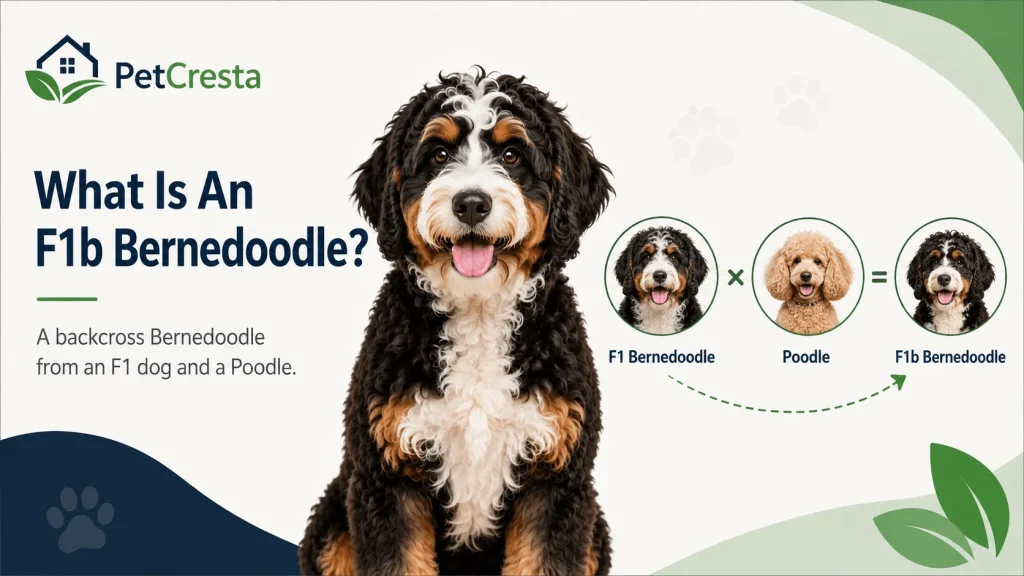
F means filial generation, 1 is the first-generation parent of the Bernedoodle, and B means backcross. The typical pairing of breeds is an F1 dog to a Poodle. Bernedoodles are also sometimes grouped under broader Mountain Doodle terminology, although buyers should confirm the exact parent breeds rather than relying on a general label.
While expected ancestry can influence coat trends, curl, size, personality and health cannot be guaranteed by the label.
How Is An F1B Bernedoodle Bred?
The F1 generation of a Poodle x Bernese Mountain Dog is a Bernedoodle. If that F1 dog is bred to a Poodle, it will yield an F1B.
The sire or dam can be either of the two dogs. The breeder should clearly mark both parents.
Bernedoodle Generations Explained
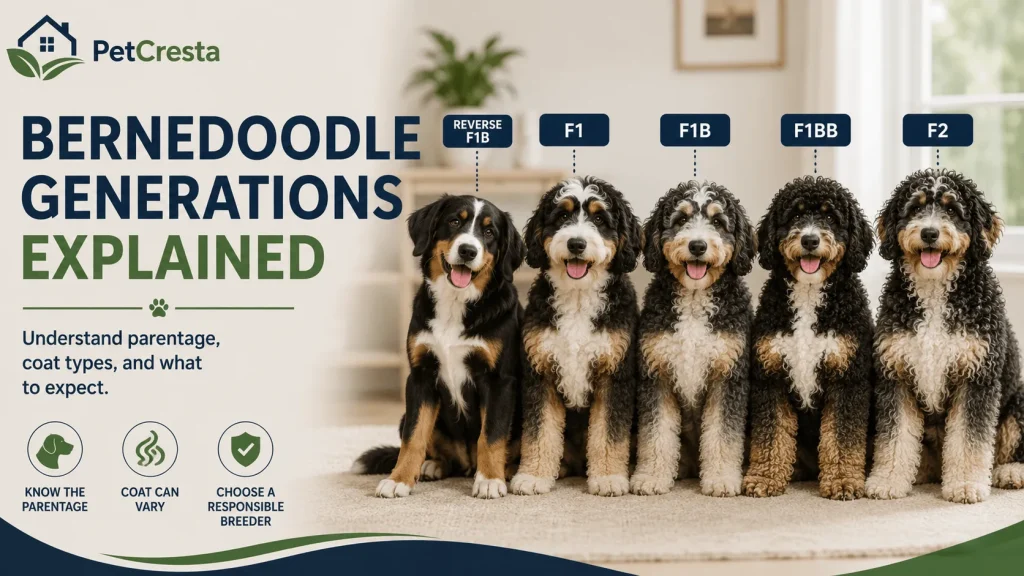
Parentage is grouped into generations; however, breeders may define this differently. Request the full word for the shortened form.
| Generation | Commonly used parentage | Expected ancestry direction | General coat variability | Main buyer caution |
|---|---|---|---|---|
| F1 | Bernese Mountain Dog × Poodle | Approximately equal parent contribution | Broad | Coat and shedding may vary considerably |
| F1B | F1 Bernedoodle × Poodle | Greater expected Poodle ancestry | Often somewhat narrower | No guarantee of curl, size, temperament, or allergy response |
| F1BB | F1B Bernedoodle × Poodle | Still greater expected Poodle ancestry | Often Poodle-influenced | Greater Poodle ancestry does not mean zero shedding |
| Reverse F1B | F1 Bernedoodle × Bernese Mountain Dog | Greater expected Bernese Mountain Dog ancestry | Often straighter or wavier | May have greater shedding potential |
| F2 | F1 × F1 | Mixed second generation | Often broad | Do not infer coat from the label alone |
| F2B | F2 Bernedoodle × parent breed, commonly Poodle | Depends on mating | Depends heavily on the line | Ask for the exact parentage |
| Multigenerational | Later-generation Bernedoodle mating | Depends on pedigree | Depends on selection and testing | The term alone provides little detail |
F1 coats can come in a variety of different shades. F1B and F1BB dogs may exhibit more Poodle-like coat characteristics and reverse F1B dogs may exhibit more Bernese-like coat characteristics.
Generation labels become even less straightforward in three-breed crosses such as the Golden Mountain Doodle, which may combine Bernese Mountain Dog, Golden Retriever and Poodle ancestry through different breeding routes.
What Generation Labels Can Predict And What They Cannot
A generation label can indicate parentage, coat direction, shedding pattern, and grooming burden. It can also indicate the size plan’s Poodle variety.
The label does not guarantee size, curl, color, temperament, health, lifespan or allergy tolerance. Parent records and adult relatives are more helpful. The same limitation applies to an Australian Mountain Doodle, where Bernese Mountain Dog, Australian Shepherd and Poodle ancestry can be combined in several ways.
F1 vs F1B Bernedoodle: What Is The Difference?

The primary difference is the direction of the coat. Both generations have some degree of Poodle-like coat influence, and the F1B generation may exhibit more.
| Feature | F1 Bernedoodle | F1B Bernedoodle | What owners should understand |
|---|---|---|---|
| Usual mating | Bernese Mountain Dog × Poodle | F1 Bernedoodle × Poodle | Verify the actual parents |
| Expected ancestry | Approximately equal parent contribution | Greater expected Poodle contribution | Trait expression is not divided neatly by percentage |
| Coat | Straight, wavy, or curly possibilities | Often wavy or curly | Littermates can still differ |
| Visible shedding | Variable | Often lower | Neither is guaranteed non-shedding |
| Grooming | Moderate to high | Often high | Lower shedding can increase matting work |
| Allergy expectations | Uncertain | Sometimes chosen by allergy-conscious homes | Individual reaction cannot be predicted from generation alone |
| Adult size | Depends on parents | Depends on parents | F1B does not automatically mean smaller |
| Temperament | Individual | Individual | Parent temperament and rearing matter more |
| Best fit | Owners comfortable with broader coat variation | Owners prepared for greater coat maintenance | Neither is universally easier |
While an F1B might leave behind less free hair, it doesn’t necessarily mean it is allergy-free. Some F1 coats are easier to groom if they are looser.
New owners should consider budget, time at home, training patience, size tolerance, and coat care. There is no easy generation.
F1B Bernedoodle Size: Mini, Medium And Standard

There is no standard size for F1B Bernedoodles. Breeder labels are less useful than parent measurements or previous litters or mature relatives.
| Breeder-used size label | Commonly advertised adult range | Factors affecting outcome | Questions to ask |
|---|---|---|---|
| Mini | About 20–45 pounds | Poodle variety, parent sizes, sex, line | What did full siblings and previous litters weigh as adults? |
| Medium | Often around 40–60 pounds; no universal definition | Parent combination and selection | How is “medium” defined in this program? |
| Standard | About 60–100+ pounds | Standard Poodle and F1 parent size | What are the adult weights of both parents? |
Veterinary overviews place minis around 20–45 pounds and standards around 61–100 pounds. “Medium” remains breeder-defined, so every range is an estimate.
F1B Mini Bernedoodle
A mini is easier to lift and move around, but requires exercise, training and coat care. Inquire about the type of Poodle and the weight of the grown-up family members.
Medium F1B Bernedoodle
A medium is not as cumbersome as a standard that is very small. The label is variable, so parent measurements and mature siblings are more important.
Standard F1B Bernedoodle
A standard requires more food, bigger equipment, firm leash skills and longer grooming times. Some large dogs with a tall, narrow chest are also at a higher risk of developing GDV.
Growth And Adult Development

Growth rates of height, body weight, coat and emotional development vary. A big teenager can be a puppy!
Birth to 6 Months
Growth, teething, house training and handling lessons in early months. Later care is helped by calm exposure to grooming, sounds, people and appropriate dogs. There is no correlation between early and final weight.
6 to 12 Months
Jumping, pulling, mouthing and coat changes can occur during adolescence. Brief, regular training instills valuable routines before the dog is physically at his full strength.
12 to 24 Months
Most dogs reach their full size, but some larger breeds continue to grow. Emotional maturity may not catch up with size.
Exercise with caution based on age, condition, weather, and veterinary recommendations.
Coat Types, Furnishings, Shedding And Allergies

The length, curl, furnishings, density and hair retention are different coat characteristics. They are frequently grouped together in marketing, causing confusion.
What Coat Can An F1B Bernedoodle Have?
F1B can be straight, wavy or curly and can vary within the litter. Puppy coats can change, so make sure to compare predictions with parent coats and older family members.
Furnished vs Unfurnished F1B Bernedoodle
Furnished dogs have longer brows and longer hair on their beards and muzzles, whereas unfurnished dogs have a smoother face. This feature does not ensure the hair is curly, does not shed or is allergy tolerant.
Coat Genetics In Plain English
There are inherited variants that affect furnishings, curl, coat length and shedding. UC Davis correlates RSPO2 to furnishings, KRT71 to curl and FGF5 to coat length.
| Coat feature | What it may influence | What testing may help estimate | What it cannot promise |
|---|---|---|---|
| Furnishings | Beard, brows, and muzzle hair | Probability of furnished facial hair | Allergy compatibility |
| Curl | Straighter, wavy, or curlier tendency | Broad texture direction | Exact adult coat |
| Coat length | Relative hair length | Likely length tendency | Low grooming needs |
| Hair retention and shedding traits | Amount of loose hair seen | Relative trend | Zero shedding or low allergen exposure |
DNA results do not provide certainty; they enhance estimates. The coat remains subject to the influence of age, density, grooming, environment and other genes.
Do F1B Bernedoodles Shed?
F1B Bernedoodles shed. Many leave less visible hair than some F1 dogs, but “less” is not “none.” Loose hair can get caught in the coat, resulting in less floor hair and more combing.
Are F1B Bernedoodles Hypoallergenic?
Allergens are produced by all dogs. They are found in dander, saliva, urine and skin secretions, so low shedding does not mean low symptoms.
Households with a history of allergies should always see the dog and close adult relatives before making a decision.
Coat Colors and Changes With Age
Colors can be tricolor, bi-color, phantom, sable and merle. Coat length, lighting and grooming can all affect the appearance of shade and pattern.
Testing and mate selection are important because merle-to-merle breeding may result in puppies with health issues. Health and temperament should outweigh rarity.
What Can A Breeder Explain About Coat Predictability?
Parent coats, furnishing status, testing, adult siblings, previous litters, and grooming reports should be discussed with a breeder. Honest answers may be uncertainty, not a promise of exact curl, no shedding or allergy safety.
Grooming And Maintenance Requirements

The teddy-bear look is the result of coat care. Tight mats near the skin can be concealed by a neglected coat.
How Often Does An F1B Bernedoodle Need Grooming?
Some coats require multiple brushings per week and professional grooming every 6-8 weeks. If your dog has a dense, long, wet, or friction-prone coat, then more is needed. A comb should not catch in the hair.
Practical Grooming Schedule
Change the timing of coat, activity, weather and history. Use the table as a starting point.
| Task | Common starting frequency | What changes the frequency | Owner check |
|---|---|---|---|
| Brush and line-comb | Several times weekly for many coats | Coat length, curl, friction, moisture | Comb reaches the skin without snagging |
| Professional clip | Commonly every 6–8 weeks | Style and matting tendency | Coat remains manageable |
| Ear check | Weekly and after swimming | Moisture and ear history | No odor, redness, pain, or heavy debris |
| Nail trim | Based on growth and wear | Activity and surface | Nails do not affect normal stance |
| Beard and face care | As needed | Food, water, coat length | Skin remains clean and dry |
| Dental care | Regular home dental routine | Veterinary recommendations | Mouth remains comfortable |
| Paw-pad trim and inspection | As needed | Coat growth and outdoor activity | No mats, debris, or irritation |
How To Brush To The Skin
Divide the coat, brush small sections, then use a metal comb. Start at the ends and work towards the skin.
Never pull or cut tight mats without looking. Ask for assistance if they are near the body.
Areas Most Likely To Mat
Inspect under collars and harnesses, under the legs, armpits, tail base, sanitary area, paw pads, and behind the ears. Mats form rapidly due to friction and moisture. It is easier to deal with tangles if they happen early. Check these areas after walks through grass or woodland as well, because embedded ticks on dogs can be difficult to find beneath a dense, furnished Bernedoodle coat.
What Happens When Grooming Falls Behind?
Mats tighten the skin, hold moisture and cover up irritation or wounds. If the matting is very bad, a short cut may be necessary as comfort is more important than appearance.
Teaching a Puppy to Accept Grooming
Use short sessions on non-slip surfaces, touch each body part, add tools slowly, and reward quiet responses. Don’t let the puppy get overstimulated.
F1B Bernedoodle Temperament And Family Life
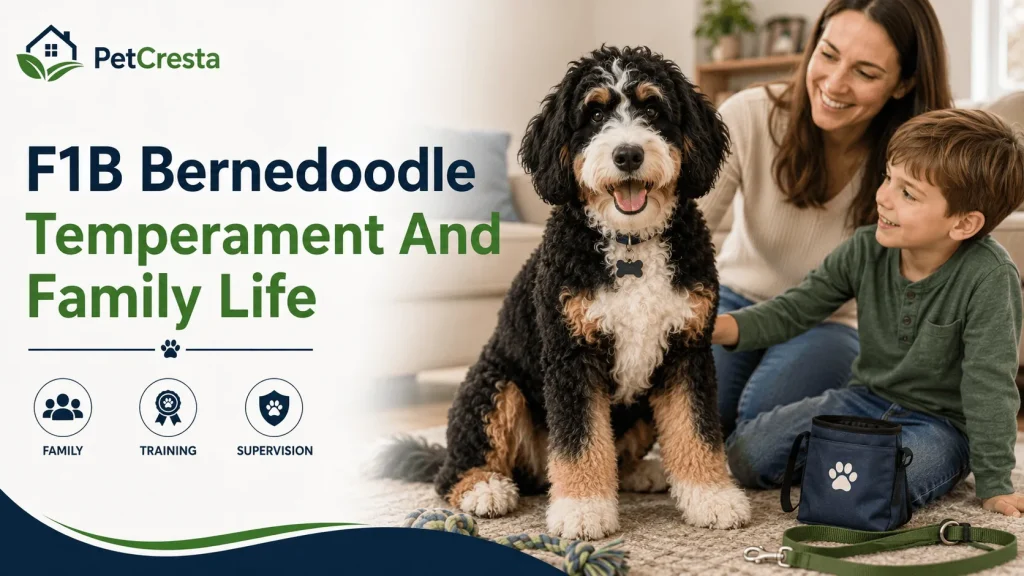
F1B Bernedoodles are many times affectionate, trainable, sensitive, vocal, and overexcited, and some are slow to settle. Percentages aren’t as important as parent temperament, early handling, health and learning.
Are F1B Bernedoodles Good Family Dogs?
They can be adapted to a family that can offer training, supervision, exercise, grooming and rest. All care and mouthing, jumping and child interaction must be managed by adults.
Are They Good With Children?
Compatibility is dependent on the dog, the child and active supervision. Provide a safe place for the dog to retreat; avoid climbing on, hugging, cornering, or disturbing the dog while eating or resting.
Are They Good With Dogs And Cats?
With proper introductions, many pets can live together peacefully. Take into account the interest of the prey, the play style, guarding and the comfort of the resident pet.
Use gates, leashes, separate feeding and slow introduction to contact.
Can F1B Bernedoodles Develop Separation-Related Problems?
They can. Some signs are barking, pacing, destruction, house-soiling, escape attempts or failure to settle.
If the distress is ongoing, punishment is not the answer – veterinary or qualified behavior support is.
Exercise, Training And Mental Stimulation
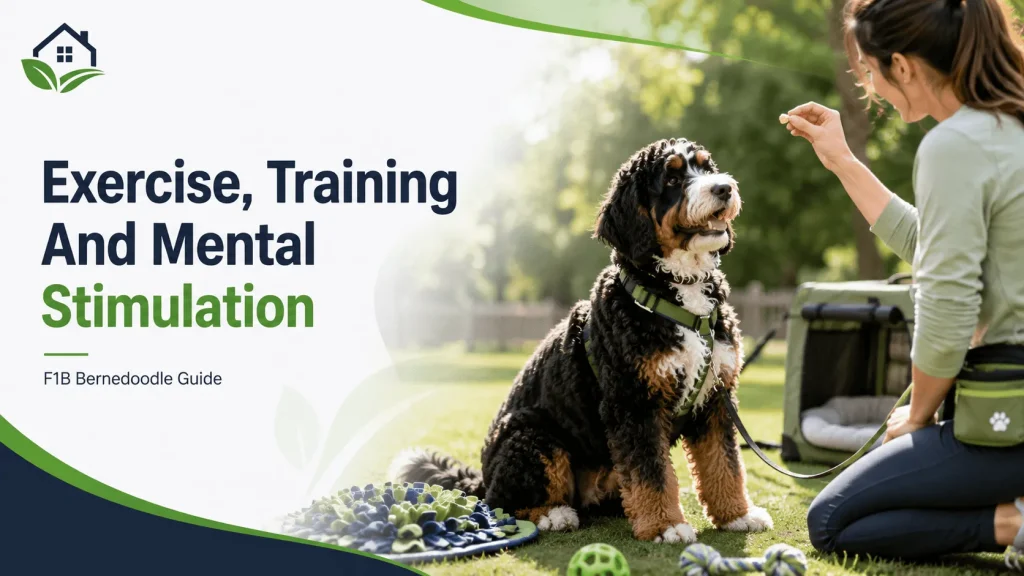
F1B Bernedoodles need exercise, scent work, training, play, socialization and sleep. Just exercise isn’t enough.
How Much Exercise Does An F1B Bernedoodle Need?
Activity requirements vary by age, size, health, conditioning, weather and temperament. A balanced routine of sniff walks, retrieval, training games, puzzles, controlled play and rest can be used. Fresh water should remain available before and after activity, and owners should understand how long a dog can go without water and which dehydration signs require veterinary attention.
Common Training Challenges
Reward 4 paws on the floor, redirect mouthing, work loose-leash walking and don’t pay demand barking. It is easier to prevent overarousal, grooming resistance, poor recall and isolation problems than it is to fix them.
Puppy Socialization Checklist
Socialization is not forced greetings; it is safe, positive exposure. The AVMA suggests that the puppy should have a variety of experiences at a slow pace and should be given time to step back when they are feeling anxious.
- Meet calm people of different appearances.
- Observe healthy, suitable dogs safely.
- Walk on different stable surfaces.
- Hear household and outdoor sounds at a comfortable intensity.
- Practice gentle handling.
- Rest in a crate or safe area.
- Spend short, calm periods alone.
- Ride in a vehicle safely.
- Visit a veterinary clinic for low-pressure handling when possible.
- Learn to disengage and settle.
Lifespan And Health
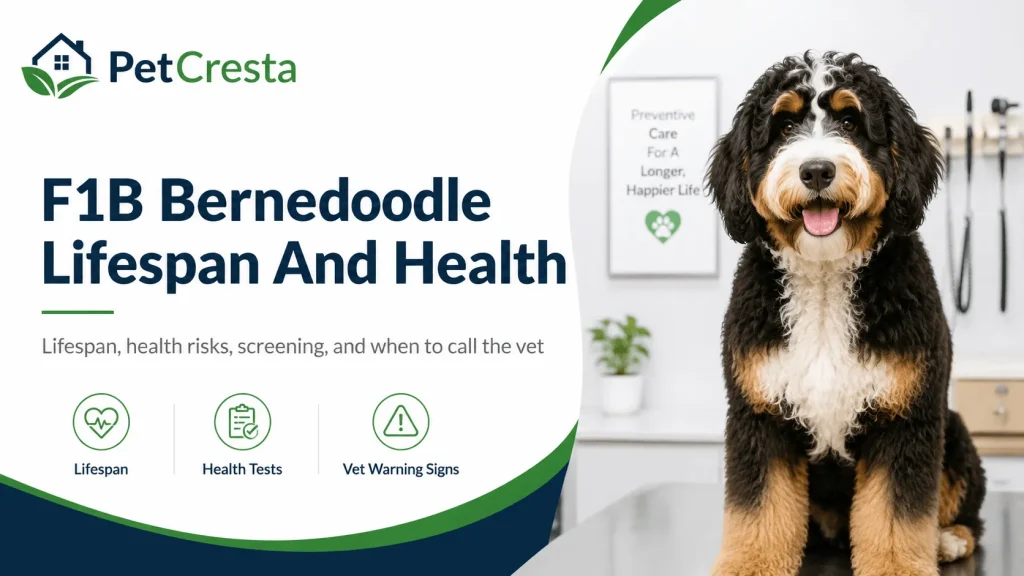
Health cannot be predicted from a generation label. Parent screening, public records, family history, healthy weight and preventive care are more important.
How Long Do F1B Bernedoodles Live?
Veterinary references give a general idea of a Bernedoodle’s lifespan of 12-18 years, though smaller dogs may live longer. There is limited population information for F1B; use with caution.
Longevity is influenced by genetics, size, disease, weight, accidents and care.
Health Concerns To Understand
Some potential issues may be hip dysplasia, elbow dysplasia, eye disease, cardiac disease, skin disease, ear disease, and inherited disease from either parent line.
Symptoms of GDV are dry retching, abdominal bloating, drooling, restlessness, weakness or collapse.
When To Contact A Veterinarian
While the majority of coat, stomach, ear or movement changes are not emergencies, there are some that should not be postponed until a regular appointment.
If your Bernedoodle exhibits any of the following symptoms, please seek veterinary attention immediately:
- Repeated vomiting or diarrhea
- Persistent ear redness, odor, discharge, or pain
- Sudden limping or reluctance to stand
- Eye redness, cloudiness, discharge, or squinting
- Painful skin hidden beneath dense mats
- Reduced appetite with unusual tiredness
- Rapidly worsening itching or skin irritation
Urgent veterinary attention is required when dry retching occurs repeatedly, the abdomen is enlarged, there is weakness, difficulty breathing, pale gums, collapse or severe pain. These signs are not evident in the breed ancestry or by an online checklist.
What “Hybrid Vigor” Does And Does Not Mean
Crossing breeds may increase genetic variation, but not eliminate disease or ensure health. Bernese Mountain Dogs and Poodles are of the same species.
The term “hybrid vigor” is not as important as parents, relatives, structure and combinations of carriers.
Health Tests To Verify For The Bernese Mountain Dog Side
The BMDCA suggests hips, elbows, eyes, heart, degenerative myelopathy and one additional listed test. It also takes sibling information, age at death and cause of death. Look at each result, not proof of testing.
Health Tests To Verify For The Poodle Side
Testing depends on the Poodle variety. Toys need PRA-prcd, eye, and patellar checks; Miniatures add hips; Standards need hips, eyes, thyroid, NEWS, and vWD I, with cardiac and sebaceous adenitis options. Confirm the parent’s variety and actual results.
Parent Health Records To Verify
| Parent side | Records to request | What to confirm |
|---|---|---|
| Bernese Mountain Dog side | Hips, elbows, eyes, cardiac evaluation, degenerative myelopathy, and other current parent-club recommendations | Public results belong to the correct dog and were completed at an appropriate age |
| Toy Poodle side | PRA-prcd, eye evaluation, and patellar evaluation | The breeder used the correct recommendations for a Toy Poodle |
| Miniature Poodle side | PRA-prcd, eye evaluation, patellar evaluation, and hip evaluation | The breeder did not use a generic Poodle testing list |
| Standard Poodle side | Hips, eyes, thyroid, NEwS, vWD I, and other recommended or elective evaluations | The results are public, current where required, and explained clearly |
A screening result reduces uncertainty; it does not guarantee that a puppy will remain free from disease. Family history, adult relatives, structure, temperament, and responsible mate selection still matter.
How To Verify Ofa And Chic Records
Testing is dependent on the poodle variety. Toys require PRA-prcd, eye, and patellar checks; Miniatures require hips; Standards require hips, eye, thyroid, NEwS, vWD I, and cardiac and sebaceous adenitis are optional. Confirm the parent’s variety and actual results.
Parent Health Records To Verify:
- Confirm that the registered name matches the correct parent.
- Review the dog’s breed, sex, date of birth, and identification details.
- Open every individual test result rather than looking only for a CHIC number.
- Check whether hip and elbow results are preliminary or final.
- Review the date and age at which each test was completed.
- Look at available records for parents, siblings, and earlier offspring.
- Ask why any test recommended for that parent breed or Poodle variety is missing.
A CHIC number indicates that the necessary screenings were conducted and shared. This does not imply that all results were normal. A breeder should feel at ease talking about good and bad results.
When A Puppy Is Only “Vet Checked”
Avoid using a screenshot that simply states “A parent was tested.” Request the dog’s registered name and do a self-search on the Orthopedic Foundation for Animals database.
Feeding, Weight Management And Routine Care

Provide a balanced and complete diet for life stage, size and health. Controlled growth food may be necessary for large-breed puppies and adult levels should be based on body condition and activity.
The ideal body condition is when the ribs are easily felt, the waist is visible, and there is an abdominal tuck. Other routine items include dental care, parasite prevention, vaccination planning and timely veterinary care. Owners should check how often dogs need rabies shots using the official certificate, veterinary guidance and local requirements rather than estimating from age alone.
F1B Bernedoodle Cost And Time Commitment

Reduced visible shedding can cause a transfer of effort from vacuuming to grooming. The cost of the purchase is just the start.
| Cost area | What affects it | What owners should ask or plan for |
|---|---|---|
| Purchase or adoption | Source, location, program, included services | What documentation and support are included? |
| Grooming | Size, coat length, condition, location | Obtain local quotes before choosing the dog |
| Food | Adult weight and diet | Estimate monthly quantity |
| Veterinary care | Size, region, health | Plan routine and emergency reserves |
| Training | Puppy needs and owner experience | Budget for classes or professional help |
| Insurance | Age, location, coverage | Compare exclusions and waiting periods |
| Equipment | Crate, car restraint, brushes, beds | Large dogs require larger equipment |
| Time | Brushing, training, exercise, transport | Put the routine on a weekly calendar |
Grooming prices vary by size, coat condition, and location. Get local quotes before committing.
What Owners Commonly Underestimate
Owners tend to underestimate brushing, drying, beard care, training, exercise, appointments, and alone-time practice. Costs include grooming, feeding, weight-based medication, emergency care, classes, and large equipment. Puppies also come with noise, mess and schedule restrictions.
How To Choose An F1B Bernedoodle Responsibly

A responsible source discusses health, temperament, coat, size, and home fit without pressure. Good breeders explain uncertainty and unsuitable matches.
Questions to Ask the Breeder
Ask about public parent records, family longevity, causes of death, adult sizes, temperament, mature offspring, coat testing, grooming, socialization, veterinary care, contracts, and return support.
Good answers include names, dates, records, examples, and limits.
Breeder Red Flags
Red flags include allergy guarantees, exact size promises, hidden parents, missing records, payment pressure, rare-color sales tactics, no return policy, and identical descriptions for every puppy.
Stock photos presented as actual dogs also deserve concern.
How Much Can A Breeder Predict From A Puppy?
Parent size, adult relatives, previous litters, health records, coat testing, and furnishings provide useful evidence. One early weight, color, or photograph predicts far less.
Honest breeders discuss probabilities.
Can Rescue Or Rehoming Be An Option?
Rescues, shelters, rescue groups, and rehoming networks may have Bernedoodle-type dogs, though generation labels can be uncertain.
With adults, size and coat are visible and caregiver notes may help. Appearance alone cannot confirm parentage.
Is An F1B Bernedoodle Right For Your Home?

Daily compatibility matters more than the label. A home that accepts training and coat work may thrive; someone seeking low maintenance may struggle.
Households comparing large, socially attached Poodle mixes may also consider whether a Newfiedoodle is right for them, particularly when adult size, grooming and time alone are major concerns.
| May be a reasonable fit when… | Reconsider when… |
|---|---|
| You can brush and comb the coat consistently | You want a wash-and-wear coat |
| You can budget for professional grooming | Grooming expenses would create strain |
| Someone can provide daily interaction and training | The dog would regularly be alone for long periods |
| You accept variation in size, coat, and temperament | You need an exact guaranteed adult outcome |
| You want an involved, trainable companion | You want an independent dog requiring little input |
| You can manage puppy behavior and adolescent strength | You expect intelligence to eliminate training problems |
| You can verify parent health records | Appearance or color is the primary selection factor |
| Allergy concerns have been discussed with a professional | You require a guaranteed allergy-safe dog |
Final Takeaways
A bernedoodle F1B usually means an F1 Bernedoodle crossed to a Poodle. Ancestry suggests trends but cannot promise size, coat, behavior, health, or allergy compatibility.
Lower shedding often means more grooming. Verified parent records and home fit matter more than the label.
FAQ’s
F1B means a first-generation crossbred back to one parent breed. For Bernedoodles, it usually means an F1 Bernedoodle bred to a Poodle.
An F1 has one Bernese Mountain Dog parent and one Poodle parent. By contrast, an F1B usually has an F1 Bernedoodle parent and a Poodle parent, often shifting coat traits toward the Poodle side.
Many reach much of their adult height during the first year. Larger dogs may continue filling out and maturing physically and behaviorally into the second year.
Neither generation is universally better. F1B may suit someone wanting lower visible shedding, while an F1 may suit a person comfortable with greater coat variation and possibly less intensive grooming.
A reverse F1B is usually an F1 Bernedoodle crossed back to a Bernese Mountain Dog. The coat may be straighter or wavier, with greater shedding potential than a typical Poodle-backcross F1B.
An F1BB is commonly an F1B Bernedoodle bred back to a Poodle. Greater expected Poodle ancestry may influence coat direction, but it does not guarantee no shedding or allergy tolerance.
Furnished dogs have longer facial hair around the brows, muzzle, and beard. Unfurnished dogs usually have smoother facial hair and a less typical doodle-style face.
Loose hair can stay trapped in the coat instead of falling away. Without brushing and combing, that retained hair can tighten into mats near the skin.
Testing should match both parent breeds and the Poodle variety. Ask for public hip, elbow, eye, cardiac, patellar, thyroid, and relevant DNA results as recommended for the actual parents.
Many owners book grooming about every six to eight weeks. A long, dense, curly, wet, or mat-prone coat may need shorter intervals.
Mini ranges are often advertised around 20–45 pounds, but breeder definitions differ. Parent size and previous adult litters provide a better estimate than the label alone.
They can be, provided the owner accepts grooming, training, exercise, and close social involvement. Someone wanting a low-maintenance first dog may find the coat and adolescent behavior demanding.
Most dogs can learn reasonable alone time through gradual practice. Long, frequent absences may be difficult for a socially attached individual, especially without exercise and independence training.
Some are quiet, while others bark from excitement, alerting, frustration, boredom, or distress. Parent temperament, environment, and reinforcement history matter more than the generation label.
Not with certainty. Parent behavior, early rearing, socialization, health, age, and the individual puppy all shape temperament.
Use each parent’s registered name to search the OFA database. Confirm identity, dates, ages, preliminary or final status, and the actual result for every recommended test.
References
These sources support the medical, allergy, genetics, socialization, and screening guidance. Parent-club recommendations should be checked again before publication.
- American Academy of Allergy, Asthma & Immunology. Hypoallergenic Dogs and Dog Allergies: Myths and Facts. Updated guidance on dog allergens, shedding, and allergy claims.
- American Veterinary Medical Association. Socialization of Dogs and Cats. Guidance on positive exposure, sensitive periods, and safe socialization.
- Bernese Mountain Dog Club of America. Recommended Testing. Current parent-club recommendations for hips, elbows, eyes, heart, degenerative myelopathy, and additional screening.
- Cornell University College of Veterinary Medicine. Gastric Dilatation-Volvulus (GDV) or Bloat. Risk factors, signs, emergency care, and prevention.
- Orthopedic Foundation for Animals. How to Interpret OFA Numbers. Guidance for reading public screening records.
- PetMD. Bernedoodle Dog Breed Health and Care. Veterinary-reviewed overview of generation terminology, broad size ranges, grooming, feeding, health, and lifespan estimates.
- Poodle Club of America. Health Statement for the Poodle Club of America. Testing recommendations by Toy, Miniature, and Standard Poodle variety.
- UC Davis Veterinary Genetics Laboratory. Dog Coat-Type Testing Resources. Information on furnishings, curl, coat length, and shedding-related variants.
- World Small Animal Veterinary Association. Body Condition Score for Dogs. Visual criteria for under-ideal, ideal, and over-ideal body condition.