
Training for Adult Dogs: Complete Obedience Tips for Better Behavior

Many dog owners assume that if an adult dog has spent years pulling on the leash, jumping on guests, barking excessively, or ignoring commands, those habits are permanent. But that’s not true.
Adult dogs can learn new behaviors, but successful training often requires changing the routines and rewards surrounding the unwanted behavior and not just repeating commands.
Training for adult dogs should focus on building better everyday decisions, not just collecting obedience commands. And that’s where best no pull dog harness can help in the process.
Why Training an Adult Dog Is Different From Training a Puppy
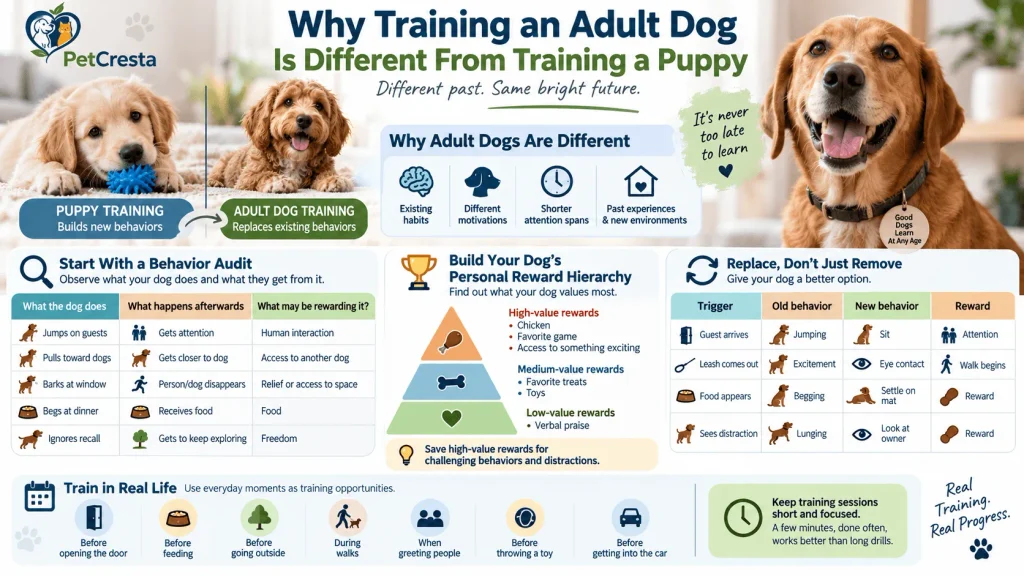
Many dog owners struggle with adult dogs because they have existing habits that may already be deeply established. The dog might have learned that certain unwanted behaviors are rewarding. Adult dogs may have different motivations and attention spans. Previous training experiences can also influence how they respond to training.
Rescue or newly adopted dogs may behave differently once they settle into a home.
Puppy training often starts with teaching behaviors whereas adult training frequently involves replacing behaviors.
For recently adopted dogs, behavior can also change as they adjust to their new environment. So, owners shouldn’t assume that the dog’s first few days reveal its long-term personality.
Begin With a “Behavior Audit” Before Training
Instead of commanding adult dogs to practice “sit” and “stay,” it helps to spend a few days observing the dog.
| What the dog does | What happens immediately afterwards | What may be rewarding it? |
|---|---|---|
| Jumps on guests | Gets attention | Human interaction |
| Pulls toward dogs | Gets closer to dog | Access to another dog |
| Barks at window | Person/dog eventually disappears | Relief/access to space |
| Begs at dinner | Receives food | Food |
| Ignores recall | Gets to keep exploring | Freedom |
So, the question that dog owners want to know is how to make your dog obey you. But the question really should be, “What is my dog getting from doing this?”
Build Your Dog’s Personal Reward Hierarchy
Rewards aren’t universally valuable.
For some dogs:
- Food is strongest
- Others prefer toys
- Some want access to the outdoors
- Some value play
- Others are highly motivated by attention
Positive reinforcement is something that works by making desired behavior more likely through consequences the dog actually values.
There could be a “reward ladder”, and that could include low-value rewards, such as verbal praise. Medium-value rewards can be favorite treats or toys, and high-value rewards can be chicken, favorite game, access to something exciting.
The reward does not always have to be food, although small training treats can make fast reinforcement easier when teaching a new or difficult behavior. What matters is choosing something your dog values enough for the situation.
The “Replace, Don’t Just Remove” Rule
This should be another major differentiator.
Dog owners often focus on eliminating unwanted behaviors:
- Don’t jump
- Don’t bark
- Don’t pull
- Don’t beg
- Don’t chase
But dogs need an alternative behavior.
Instead, focus on:
Trigger → Old behavior → New behavior → Reward
Examples:
Guest arrives → jumping → sit → attention
Leash comes out → excitement → eye contact → walk begins
Food appears → begging → settle on mat → reward
Dog sees distraction → lunging → look at owner → reward
Train in Real Life, Not Just During Training Sessions
Instead of scheduling one 30-minute training session, use ordinary moments to train your dogs:
- Before opening the door
- Before feeding
- Before going outside
- During walks
- When greeting people
- Before throwing a toy
- Before getting into the car
The owner effectively turns daily life into a series of small training opportunities.
Keep formal sessions short, too; guidance from veterinary and training sources commonly emphasizes brief, focused sessions rather than prolonged drills.
Use the 3-D Method to Make Obedience Reliable

Distance
Can your dog perform the behavior when you’re farther away?
Duration
Can the dog maintain it for longer?
Distraction
Can the dog perform it when something exciting is happening?
The dog owners should focus on one variable at a time rather than making the exercise harder in every way simultaneously.
This connects directly to the common problem:
“My dog listens perfectly at home but completely ignores me outside.”
That isn’t necessarily stubbornness. The environment has changed.
Why Your Dog “Forgets” Commands Outside the House

Often, dogs forget the commands that they usually follow in the house and that can get frustrating for dog owners.
And this usually happens in the following environment:
- Different environments
- New smells
- Other dogs
- People
- Traffic
- Wildlife
- Higher emotional arousal
- More valuable competing rewards
That is why it is important to begin in an easy environment and increase difficulty gradually. The same principle applies to training and socialization: calm, controlled exposure usually teaches more than throwing a dog straight into an overwhelming situation.
Progression could be:
Living room → backyard → quiet street → park → busier environment
Don’t jump directly from an easy environment to the hardest one.
Fix Common Adult Dog Behavior Problems

Many common dog behavior problems become easier to address once you identify what triggers and reinforces them. Pulling, jumping, barking, and poor settling may look different, but each needs a clear replacement behavior and consistent practice.
Jumping on People
Teach an incompatible behavior such as sitting or keeping four paws on the floor.
Pulling on the Leash
Reward loose-leash behavior rather than simply correcting pulling. Initially, you can also use easy to put on dog harness to make the whole transition smooth.
Barking at the Door
Teach a predictable alternative routine.
Begging
Create a designated settle location and reinforce calm behavior.
Ignoring Recall
Return to easier environments and make coming back highly rewarding.
Counter Surfing
Manage access while reinforcing an alternative behavior.
Excessive Excitement
Focus on calmness and impulse control rather than expecting the dog to instantly “switch off.”
Common Adult Dog Training Mistakes
Even reward-based training sessions can stall when timing, consistency, or difficulty is off. Some of the most common mistakes dog owners make while training an adult dog include:
- Repeating commands
- Training only when something goes wrong
- Rewarding too late
- Using rewards the dog doesn’t actually value
- Changing household rules
- Making training sessions too long
- Increasing distractions too quickly
- Expecting instant reliability
- Accidentally rewarding unwanted behavior
- Only training indoors
Timing matters because the consequence needs to clearly connect with the behavior being reinforced.
When Obedience Training Isn’t Enough
Dog training and obedience are not always the appropriate solution for every behavior problem.
When it comes to fear, severe anxiety, aggression, sudden behavioral changes, resource guarding, or serious separation-related behavior, basic obedience work may not address the underlying problem. Behavior accompanied by possible medical concerns also warrants professional assessment.
Involve an appropriately qualified veterinarian and/or behavior professional when the problem goes beyond basic obedience.
How Long Does It Take to Train an Adult Dog?
There is no set timeline for training an adult dog. It all depends on the dog’s history, behavior being addressed, reinforcement value, training consistency, environment, frequency of practice, emotional state or owner consistency.
A useful framework can be:
- First goal: understanding
- Second goal: consistency
- Third goal: reliability
- Final goal: maintenance
The Real Goal of Adult Dog Training
The objective isn’t to produce a dog that mechanically responds to commands.
It’s to create a dog that increasingly makes predictable, desirable choices in ordinary situations.
The best-trained adult dog is the one that knows what to do when nobody is actively giving a command.
FAQ’s
No. Adult dogs can continue learning throughout life. Established habits may need more practice to change because the dog has rehearsed them for longer, but age itself does not make training impossible.
Begin with management, attention, name response, recall foundations, loose-leash walking, calm greetings, settling, and simple cues. Keep the environment easy and reward successful behavior frequently before adding distractions.
Yes. A healthy 5-year-old dog can learn new behaviors, routines, and obedience skills. Adjust the training approach to the dog’s health, temperament, experience, and motivation rather than judging training potential by age alone.
Useful skills include recall, wait, leave it, drop it, loose-leash walking, a settle or mat behavior, and reliable attention to the owner. Safety and everyday usefulness matter more than teaching a long list of tricks.
Outdoor environments contain more distractions and competing rewards. Lower the difficulty, increase the value or frequency of reinforcement, and gradually practice in more distracting locations.
Make the requested behavior clear and worthwhile. Practice in easy situations first, reward responses promptly, avoid repeatedly giving cues the dog ignores, and raise difficulty slowly.
Yes. Rescue dogs can learn obedience and household routines. Give a newly adopted dog time to adjust, establish predictable routines, and avoid assuming early behavior represents the dog’s permanent personality.
Short sessions usually work well. Several minutes of focused practice can be enough, especially when combined with training during normal daily activities. Stop before attention and performance begin falling apart.
Reward-based training is the safer approach recommended by veterinary behavior organizations. If a dog is not responding, check whether the behavior is fully learned, whether the environment is too difficult, whether the reward is worthwhile, and whether fear, stress, or a health problem may be interfering.
Reference Box
American Veterinary Society of Animal Behavior (AVSAB): Humane Dog Training Position Statement and guidance on reward-based training.
American Kennel Club (AKC): Guidance on reward-based dog training, training older dogs, reinforcement, and adult-dog behavior.
Editorial note: Training advice should be adjusted for the individual dog’s age, physical health, emotional state, and behavior history. Sudden behavioral changes or serious fear, anxiety, aggression, or guarding should be discussed with an appropriate veterinary or behavior professional.