
Running a Pet Business in Saskatoon? Your Team Needs People-First CPR and AED Skills
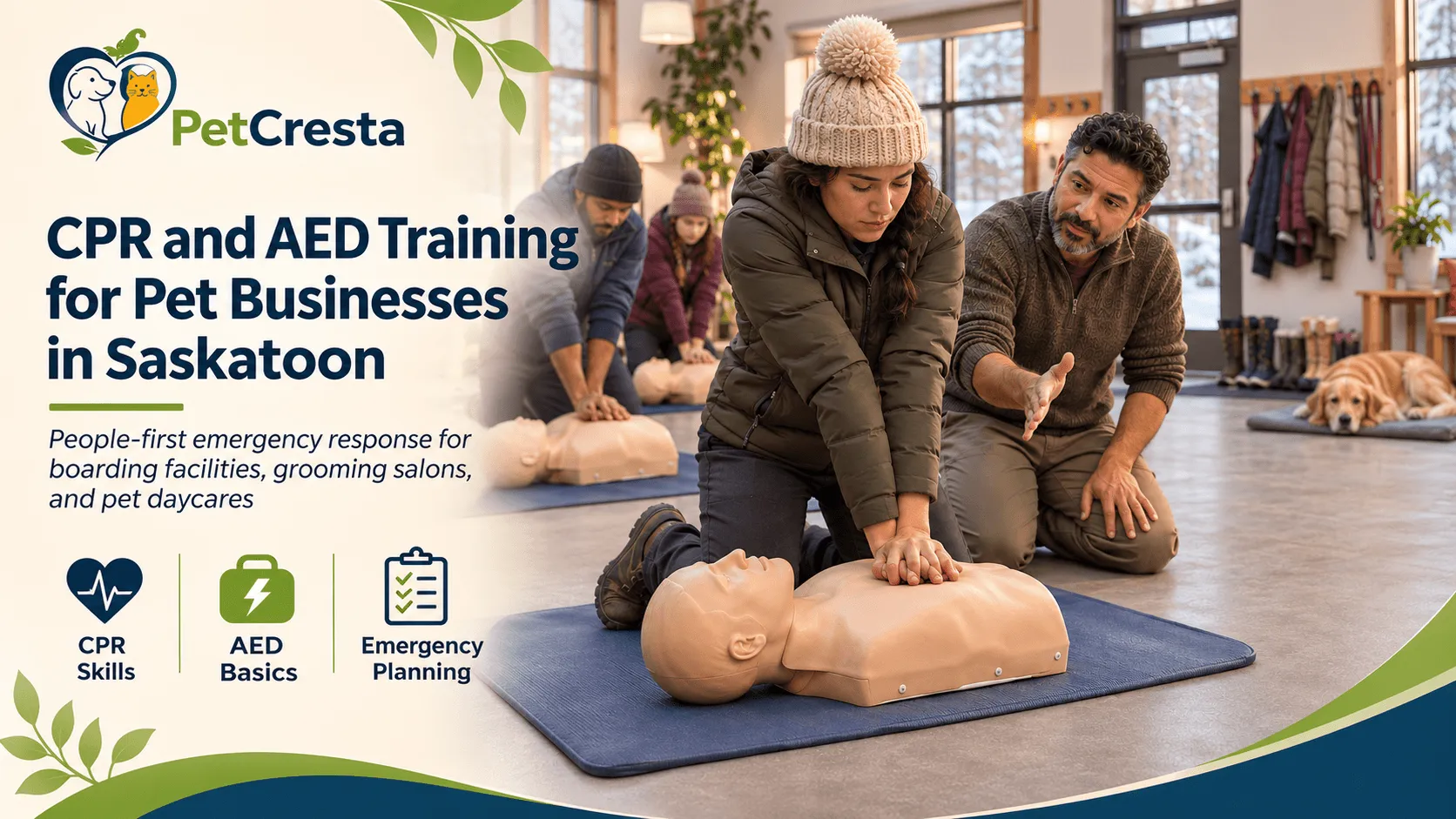
Pet businesses are built around animals, but they’re run by people and visited by people: owners, kids, delivery drivers, and staff on long shifts. When a person collapses on a kennel floor, no amount of pet knowledge helps. That’s the gap CPR C and AED training for pet business fills.
If you run or work at a boarding facility, grooming salon or daycare in Saskatoon, this guide explains what the training covers and how to plan it.
This guide is about human first aid. For your animals’ health, talk to your veterinarian.
Why Do Pet Businesses Need People-First First Aid?
Because the people in your building are the ones who can have a medical emergency.
Think about a typical day. Staff lift heavy dogs, clean wet floors and handle animals that may be stressed. Customers drop off and pick up, sometimes with children in tow. Visitors come and go. Anyone can faint, choke, slip or have a heart emergency.
And pet environments add complications. Dogs bark, cats move, and an owner who collapses may leave a worried animal right beside them. A plan covers both the person and the animals around them.
For businesses involved in running a dog boarding facility, preparing for emergencies also means having clear staff responsibilities, secure animal-handling procedures and reliable communication. These everyday arrangements help maintain a safer environment while employees respond to a human medical emergency.
What Can Go Wrong in a Kennel, Salon or Daycare?
These are the common people-related hazards:
- Bites and scratches. Even gentle animals can nip when they’re scared, hurt or startled.
- Slips and falls. Wet floors, spilled water and dog hair on tile are a classic mix.
- Strains. Lifting large dogs and moving crates can hurt backs and shoulders.
- Allergic reactions. Some people react to animals, cleaning products or grooming supplies.
- Fainting. Heat, long shifts and skipped meals can make anyone dizzy.
- Cardiac arrest. Rare in any one business, but it can happen to staff and customers of any age.
Most of these are minor. A few aren’t. Training helps with both.
Animal behaviour also deserves attention when preventing workplace injuries. Dogs showing fear, growling or defensive reactions may need changes in handling and management rather than punishment. Understanding when a dog needs professional training can help businesses recognize behaviour that deserves further assessment. This does not replace staff first aid training, but it can support a broader workplace safety plan.
What Does CPR C and AED Training Cover?
According to Coast2Coast’s Saskatoon page, the courses include hands-on skills testing with an AED trainer. The page also describes its first aid courses as covering life-saving skills such as bleeding control, CPR, and recognizing heart attacks and strokes. CPR/AED Level C is described as covering adults, children and infants.
A few course facts from the page are worth knowing:
- Formats. Blended learning, with theory online and a skills session in person, or fully in person.
- Certificate. A three-year certificate for First Aid and CPR/AED Level C. BLS, for healthcare providers, is valid for one year.
- Speed. Certificates are issued within 48 hours of completion.
- Standards. A minimum grade of 75% and 100% attendance.
- Retake. A free skills practice retake within 90 days.
- Groups. Private group training for teams of eight or more.
An AED (automated external defibrillator) is a portable device that can shock the heart to help it restart. Heart & Stroke describes it that way, and a course lets you practise with a trainer unit so it doesn’t feel unfamiliar on the day.
Where Should Your AED Go?
If your business has an AED, where it sits matters as much as having it.
Heart & Stroke says every minute without CPR or defibrillation lowers the chance of survival by about 10%. Distance adds up. As a rough estimate, 500 feet is about 152 metres. At a normal walking pace of around 5 km/h, that’s about two minutes each way, so a round trip could take around four minutes before you count doors and stairs.
A few practical ideas:
- Keep it reachable. Place it near reception or a main walkway, not behind a locked door.
- Make sure everyone knows where it is. Show new staff on their first day.
- Check it on a schedule. Follow the manufacturer’s instructions for pads and battery checks.
- Think about the whole building. If your space is large, ask whether one AED can reach everyone quickly.
If you don’t have an AED, note where the nearest one is, such as in a neighbouring building or a community facility.
Who Does What When Something Happens?
Decide before an emergency. A short role plan works well, with one extra role pet businesses need.
- The caller. One person calls 9-1-1, gives the exact address and describes what’s happening.
- The AED runner. Another person fetches the AED, if there is one.
- The first aider. A trained person starts CPR if the person isn’t responding and isn’t breathing normally.
- The door person. Someone meets paramedics at the entrance and brings them in.
- The animal handler. Someone calms and secures nearby animals, so responders can reach the person safely. A frightened or protective dog near a collapsed owner can get in the way.
Heart & Stroke’s three steps for a cardiac arrest are simple: call 9-1-1 and shout for an AED, start CPR right away, and use an AED as soon as one is available. Heart & Stroke stresses that you can’t hurt someone by trying, you can only help.
Say the roles out loud at a staff meeting, and rehearse them once.
How Do You Cover Every Shift?
Plan around your schedule, not your staff list.
- Map your shifts. Include opens, closes, weekends and holidays, and count the staff on each.
- Choose reliable people. Pick staff who work regular hours and are likely to stay.
- Plan backups. Train at least one extra person per shift for sick days and holidays.
- Include closers and early openers. Staffing is often thinnest then.
- Write it down. Keep a one-page list of first aiders by shift, and post it where staff can see it.
- Track expiry dates. Put renewals in your calendar well ahead of time.
What About Pet Emergencies?
That’s a different skill, and a different course. A people-focused CPR and AED course doesn’t teach animal care.
Coast2Coast lists a separate online Pet First Aid course for common pet injuries and emergencies. It’s worth considering for staff who handle animals. But it doesn’t replace a vet. In a pet emergency, contact your veterinarian or an emergency veterinary clinic.
Staff should also know which animal symptoms require urgent veterinary attention. For example, recognizing the signs of bloat in dogs can help employees identify a potentially life-threatening emergency and avoid delaying veterinary care. Animal first aid and human CPR training serve different purposes, and pet businesses need to understand that distinction.
Employer duties in Saskatchewan, including any first aid requirements for your type of business, vary. Check what applies to you with the relevant Saskatchewan authority.
How Do You Train Without Closing the Doors?
Plan it around your quietest times.
- Stagger your people. Don’t send the whole team at once. Train one or two at a time so the business stays open.
- Use a blended format. Staff can finish the theory online, then attend a skills session. That keeps time away from the floor to a minimum.
- Consider group training. If you have eight or more staff, the Saskatoon page lists private group training. Ask about scheduling and minimum group sizes.
Coast2Coast’s Saskatoon classes are still being scheduled, and the page has a waitlist open. Venue details will be shared when classes open. In the meantime, you can see Coast2Coast First Aid options for pet businesses to compare formats.
Why Does It Matter?
Because it takes minutes to matter, not hours. According to Heart & Stroke, about 60,000 cardiac arrests happen outside hospitals in Canada every year, and only one in 10 people survives. Nearly half happen to people under 65, so this isn’t only about older customers. It affects your team, too.
Heart & Stroke also says that doing CPR and using an AED can double a person’s chance of survival. Emergency response times can be six minutes or more in urban centres. The people in your building are the ones who can start.
If you are looking for first aid training near Idylwyld Drive and Circle Drive, downtown Saskatoon, Stonebridge, or surrounding areas, you may reach out to Coast2Coast First Aid & Aquatics in that area.
FAQ’s
No. It teaches you to help people. Coast2Coast lists a separate online Pet First Aid course, and for your animals’ health you should talk to your veterinarian.
Coast2Coast’s Saskatoon page lists three years. BLS certification, for healthcare providers, is valid for one year.
Call 9-1-1 and shout for an AED, start CPR right away, and use an AED as soon as one is available. Heart & Stroke stresses that you can’t hurt someone by trying, you can only help.
The Saskatoon page lists private group training for eight or more. Ask about scheduling and minimum group sizes.
The Saskatoon page currently has a waitlist open and says venue details will be shared when classes open. Check the page for updates.