Cavapoo F1b vs F1& F2: Traits, Shedding, Grooming, Size & Real Costs
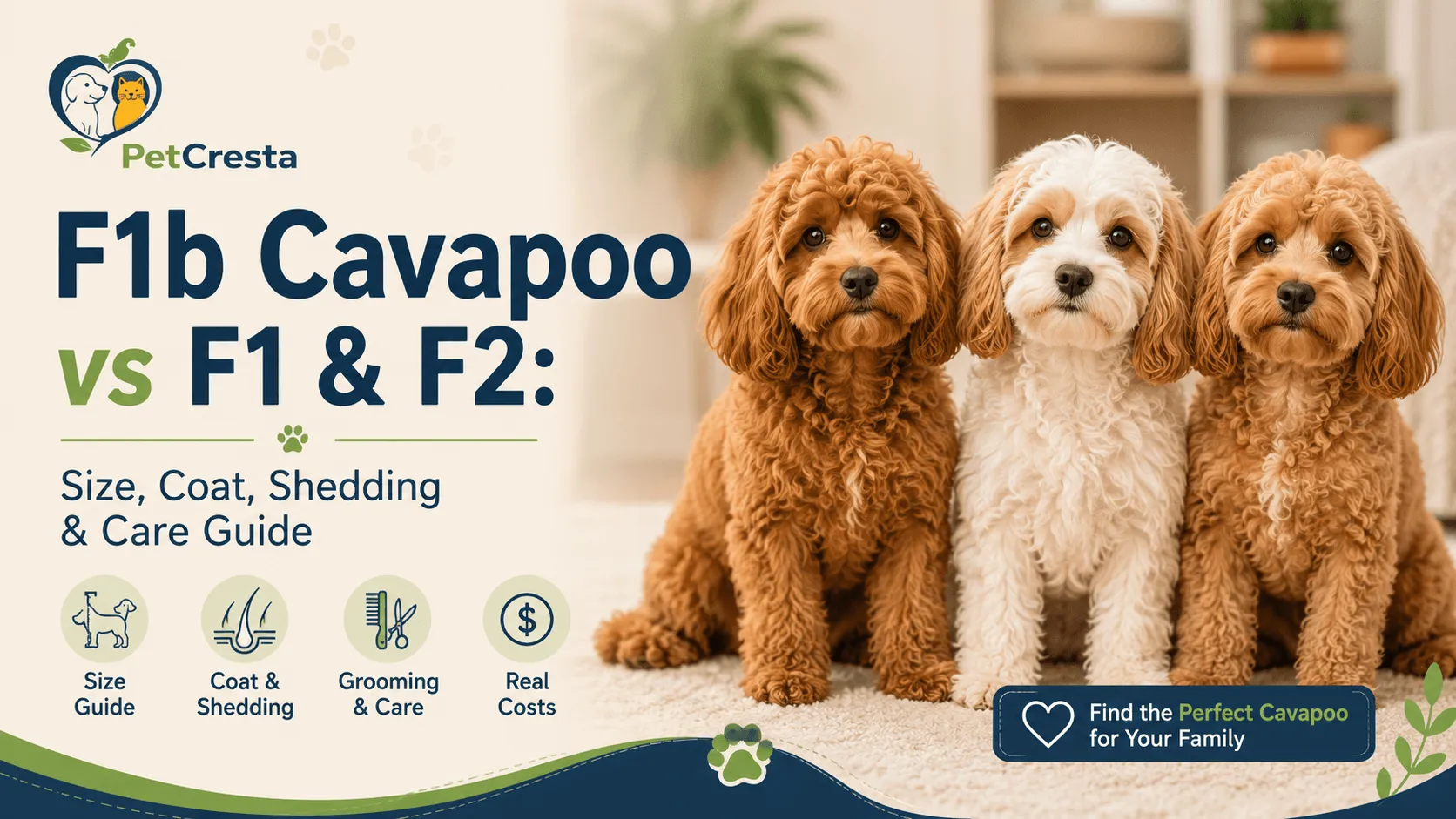
An F1 Cavapoo that is bred back to a Poodle is called an F1b Cavapoo. In real terms, this typically translates into an increased likelihood of having more Poodle in the coat, having less shedding than many Cavapoos, and having to give the coat regular grooming.
This label is important as most households are not only deciding between breeder terms, but also other lifestyle factors. The actual question is whether it is the right texture, whether the loose hair is a problem in the house, whether it is the right adult size, whether it is the right amount of grooming time, whether it is the right daily routine, and whether it fits into the family life.
This guide offers an explanation of what the label indicates, a comparison of the main generations, the appearance of the adult dog, the typical care required, health questions to consider, and determining if the mix will fit the home in which you are considering adopting.
Quick Decision
When looking for a small, loving, and less shedding dog, an F1b Cavapoo may be a good choice. Not suitable for all households, particularly if brushing, grooming, appointments, and companionship are a challenge every day.
| Best Fit | Less Ideal Fit |
|---|---|
| Homes wanting lower shedding | Homes wanting very low grooming |
| Families ready for regular brushing | Buyers expecting a guaranteed hypoallergenic dog |
| Owners who want a trainable companion | Homes with long repeated absences |
| Apartment homes with a steady routine | Buyers choose mainly by color or size label |
Quick Answer: What Does F1b Mean In Dogs?
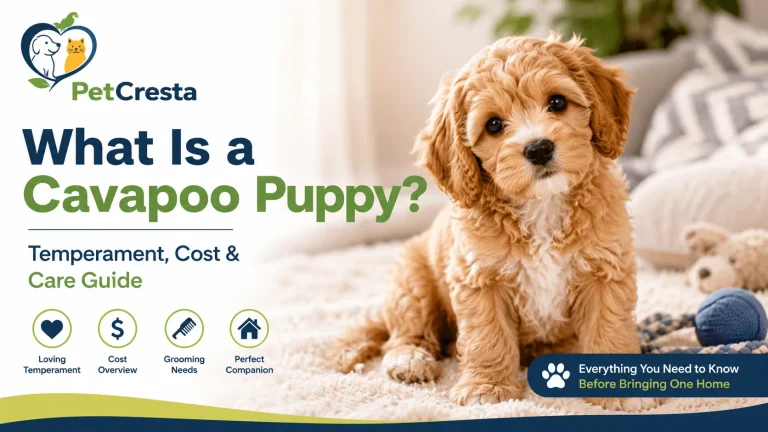
Filial is the term for a way of denoting a generation in a mixed breed, and the F will denote it. 1 is a first-generation cross. b: backcross. F1b (bred back to a poodle) is an F1 Cavapoo that has been bred back to a poodle. If you’re looking at the big picture before you get specific with the generation, it’s best to first look at a cavapoo puppy. This usually results in a curlier coat, less shedding compared to many F1 or F2 Cavapoos, and a more consistent grooming schedule.
F1 meaning dogs is the first generation offspring of two purebred parent breeds. For a Cavapoo, it’s a Cavalier King Charles Spaniel bred directly with a Poodle. This first cross is used to create later generations, such as F1b, F2, and F1bb.
F1 vs F1b Cavapoo vs F2 vs F1bb: Which Cavapoo Generation Fits Your Home Best?
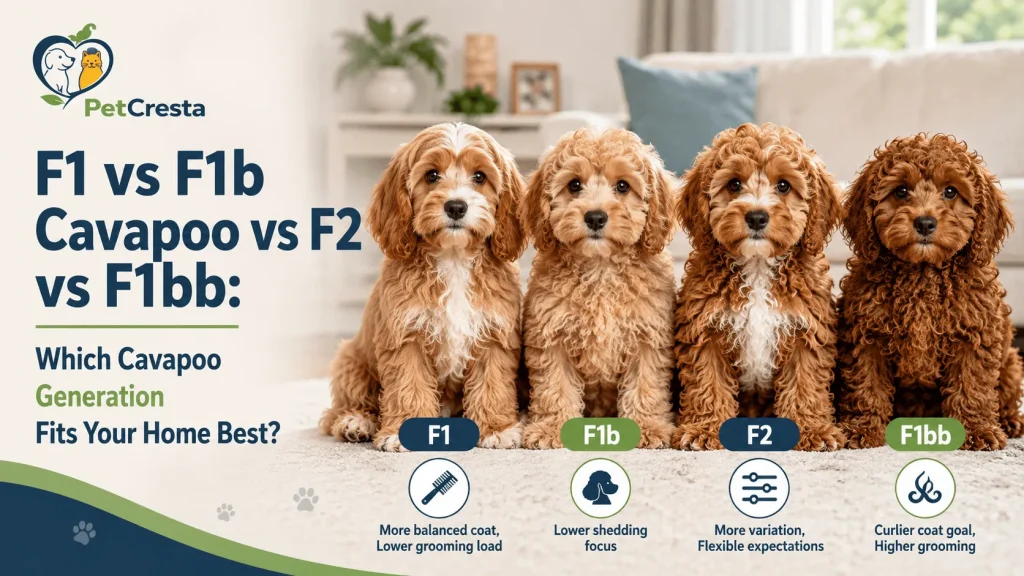
For most households, the generation label matters most for coat direction, loose hair in the home, and grooming commitment. It matters less for an exact promise of size, temperament, or health outcome.
| If the priority is | Usually, the better fit | Why |
|---|---|---|
| Lower shedding focus | F1b or F1bb | These generations usually lean more toward the Poodle side in coat type |
| Lower grooming load | F1 | The coat is often easier to manage than a denser, curlier F1b coat |
| Flexible expectations | F2 | This generation can work well when more variation is acceptable |
| Curlier coat goal | F1b or F1bb | A stronger Poodle influence usually pushes the coat in that direction |
| First-time owner wanting balance | F1 or a well-raised F1b | Routine, training, and breeder quality still matter more than the label alone |
| Smallest adult size | Check parent size first | Toy versus Miniature Poodle lines usually matter more than the generation label |
- Choose F1 when a more balanced coat and lower-maintenance feel matter more than the lowest possible shedding.
- Choose F1b when lower shedding is a high priority and regular brushing and grooming are realistic.
- Choose F2 when the decision is based more on the individual dog than on trying to tightly control coat outcome.
- Choose F1bb when a stronger Poodle-leaning coat is the goal and higher grooming demands are acceptable.
Simple Breeding Diagram
Cavalier King Charles Spaniel + Poodle = F1
F1 Cavapoo + Poodle = F1b
F1 Cavapoo + F1 Cavapoo = F2
F1b Cavapoo + Poodle = F1bb
Cavapoo Dog F1b At A Glance
| Trait | Usual pattern |
|---|---|
| Parent mix | F1 Cavapoo crossed with Poodle |
| Genetic split | Often about 75 percent Poodle and 25 percent Cavalier |
| Coat | Wavy to curly, usually fuller than many F1 coats |
| Shedding | Often low, never guaranteed to be zero |
| Grooming | Moderate to high |
| Size | Small, with parent size shaping the final range |
| Temperament | Affectionate, social, trainable, people-oriented |
| Family fit | Often strong with gentle handling and a steady routine |
| Allergy note | Better for some homes, not risk-free |
| Best match | Households ready for coat care and regular companionship |
Cavalier King Charles Spaniel And Poodle Mix
The Cavalier side may bring along a soft, touchy-feet disposition, and the Poodle side may bring along a more trainable and athletic nature and more dominance over coat texture. If the Cavalier is your favorite breed, another small companion breed to consider is the cockalier. Dogs in the same litter will also have different temperaments, coats, and sizes.
Cavapoo Mixed With Toy Poodle Vs Mini Poodle
Cavadoo (Cavalier King Charles spaniel & Poodle) is generally smaller than Mini Poodle & Cavalier King Charles spaniel. This difference is important because the size of the Poodle, their body build, and even their level of energy can change when it’s a different size in the line. Toy Poodle lines will result in a smaller grown dog, and Mini Poodle lines can produce a slightly sturdier dog.
If you’re aiming to have a significantly smaller companion mix, another handy comparison to make before deciding solely on size is a teacup maltipoo. There are several different types of Cavapoos, and they vary in several ways.
There are two types of Cavapoos, depending on what people are referring to. At times, it is used to denote generation designations (F1, F1b, F2, F1bb). Other times, it means size influence – a Cavapoo that is made from Toy Poodle lines versus one that is made from Mini Poodle lines. Both can impact the appearance and also the foreseeable traits of an adult dog.
Types Of Cavapoos And How They Differ
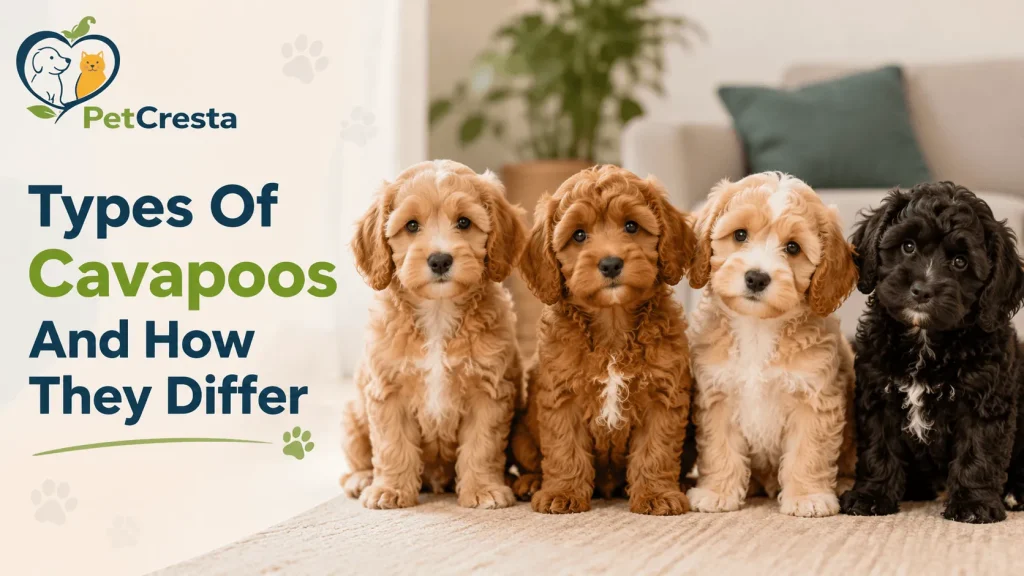
When people talk about types of Cavapoos, they may mean two different things. Sometimes the term refers to generation labels such as F1, F1b, F2, or F1bb. In other cases, it refers to size influence, such as a Cavapoo from Toy Poodle lines versus one from Mini Poodle lines. Both can affect what the dog looks like and how predictable the adult outcome may be.
Cavapoo Generations Explained
Cavapoo generation labels describe how the puppy was bred. They can help estimate coat direction, shedding tendency, and grooming needs, but they do not guarantee size, temperament, health, or allergy outcome.
| Generation | What It Means | Usual Pattern |
|---|---|---|
| F1 | Cavalier King Charles Spaniel crossed with a Poodle | Balanced parent influence, often wavy coat |
| F1b | F1 Cavapoo bred back to a Poodle | More Poodle influence, often curlier and lower shedding |
| F2 | Two F1 Cavapoos bred together | More variation in coat, shedding, and appearance |
| F1bb | F1b bred back again to a Poodle | Stronger Poodle leaning coat, higher grooming needs |
| Reverse F1b | F1 Cavapoo bred back to a Cavalier | Softer, more Cavalier leaning coat with more shedding risk |
| F2b | Often an F1 Cavapoo is bred with an F1b | Mixed outcome depending on parents |
The most useful way to read these labels is simple: more Poodle influence often means a curlier coat and lower shedding tendency, but usually more grooming. More Cavalier influence may mean a softer or looser coat, but shedding can be less predictable.
What Does 2nd Generation Cavapoo Mean?
A cavapoo 2nd gen, also called a cavapoo 2nd generation, usually refers to an F2 Cavapoo. This means the dog comes from two first-generation Cavapoo parents. Second-generation Cavapoos can vary more in coat type, shedding, and overall appearance than F1b, which is why buyers often compare them before choosing.
Cavapoo Generations Explained F1 F1b F1bb
Cavalier + Poodle = F1 Cavapoo
F1 Cavapoo + Poodle = F1b Cavapoo
F1 Cavapoo + F1 Cavapoo = F2 Cavapoo
F1b Cavapoo + Poodle = F1bb Cavapoo
F1 Cavapoo + Cavalier = Reverse F1b Cavapoo
F1b Cavapoo + Poodle = F1bb
Pros And Tradeoffs Of An F1b Dog
Strong points
☑ Often lower shedding than F1 and many F2 Cavapoos
☑ Usually more predictable coat texture than F2
☑ Often affectionate and easy to bond with
☑ Usually bright, trainable, and responsive
☑ Often suits family life well with structure and gentle handling
Tradeoffs
☑ Coat care is usually more demanding
☑ Matting can develop quickly if brushing slips
☑ Some dogs become very attached and dislike long periods of alone time
☑ Size and coat are still not guaranteed
☑ No generation is fully hypoallergenic
What Does A Cavapoo Look Like?
Most Cavapoos F1b are a compact, small dog breed, have dark eyes that are round, and have a fuller coat than many F1s. The face is generally tatted bear but may have different muzzle lengths and a set of ears in different dogs.
One of the primary visual clues is the coat. The Cavapoos F1b tend to have a curly or loose curly coat, although others may be more wavy. The more curls you have, the more brushing and care will be required for your coat.
When the cavapoo black and tan is fully grown, there is typically more contrast around the muzzle, legs, chest, and eyebrows; this may change slightly as the cavapoo reaches maturity. The pattern of the fur can be three different colors throughout the face, ears, body, and legs, though it may differ based on breeding lines and the development of their fur over time.
Common F1b ccavapoo Coat Types
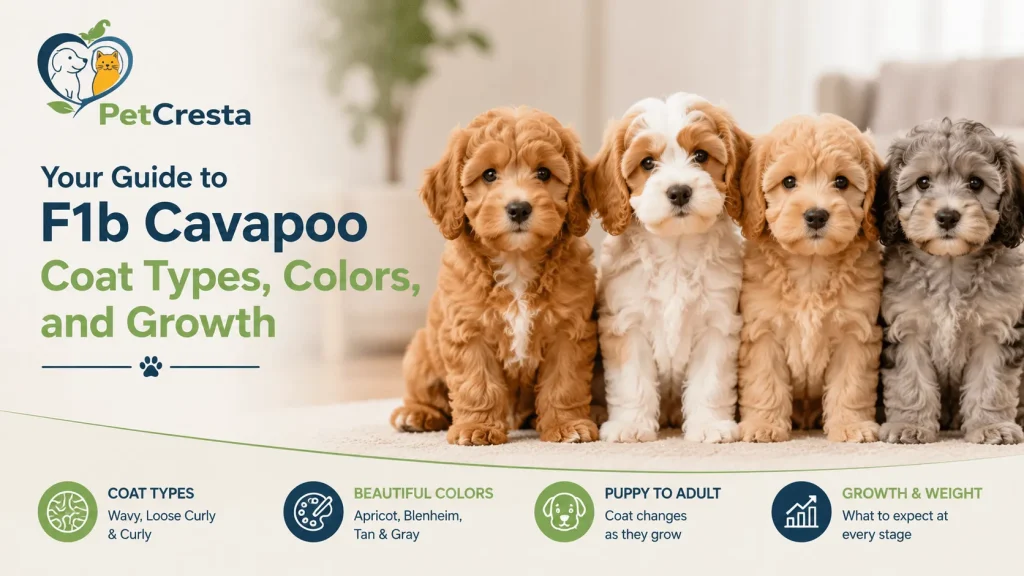
Cavapoo coat types usually fall into three broad patterns: wavy, loose curly, and curly. In an F1b dog, the coat often leans more toward the curly side because of the stronger Poodle influence. Coat type matters because it affects grooming needs, matting risk, and how much loose hair is noticed around the home.
| Coat type | Look | Care level |
|---|---|---|
| Wavy | Soft and fluffy, loose texture | Moderate |
| Loose curly | Fuller and springier | Moderate to high |
| Curly | Denser and tighter | High |
Common Cavapoo Colors And Markings
The F1b Dog can have a variety of coat colors and patterns. These are usually apricot, Blenheim, tan, and grey Cavapoo. Appearance is influenced by color, but not temperament, health, or coat behavior.
F1b Cavapoo Coat Colour Variations: Apricot, Blenheim, Tan, And Gray Cavapoo
Cavapoo apricot coats are one of the most famous as they tend to create the dog appear soft, teddy bear style. Usually, a Blenheim Cavapoo will feature chestnut markings on a white base coat, while tan Cavapoo coats might have a warmer shade and tone. Gray Cavapoo is less prevalent, and may not be seen in early puppyhood — but may be seen in coat fading.
Puppy Coat And Adult Coat
The appearance of a young cavapoo puppy can be entirely different when he’s twelve weeks old and when he is grown. The adult coat emerges, and the texture is clearer. Some puppies that appear wavy in their early stages grow more curled as they mature. Others stay looser in texture.
The reason for this is that early appearance can be of assistance, but not necessarily ideal. With age, it’s often easier to decide what you’re looking for in a puppy’s coat than when the animal is very young.
Cavapoo Weight And Growth Expectations
Cavapoo size at 12 weeks provides a good general indicator of early size development, but isn’t a 100% reliable prediction of adult size. A Cavapoo weight chart can be used to observe trends over time, but should not be used as a definitive indicator. Growth rate may vary depending upon genetics, nutrition, and whether the dog is a Toy or Miniature Poodle breed.
Puppies: What To Expect Early On
Although F1b puppies are most likely to be soft-coated, small, and loving, it’s possible for them to vary from litter to litter in puppyhood. Some Cavapoo F1b develop a wavy coat, while others are naturally more curly. Early appearance does not always predict adult development of coat texture, adult size, or even confidence level.
While a puppy is typically people-oriented, curious, and responsive, some may have different temperaments depending on their genetics, handling, and socialization. Some puppies are placid and affectionate, some are active and frolicsome. The most important consideration is not just appearance, but what the household is providing the puppy, how the parents were screened, and what the household can offer as the dog grows.
F1 Cavapoo Vs F1b: Puppies, Adults, And Full Grown Differences
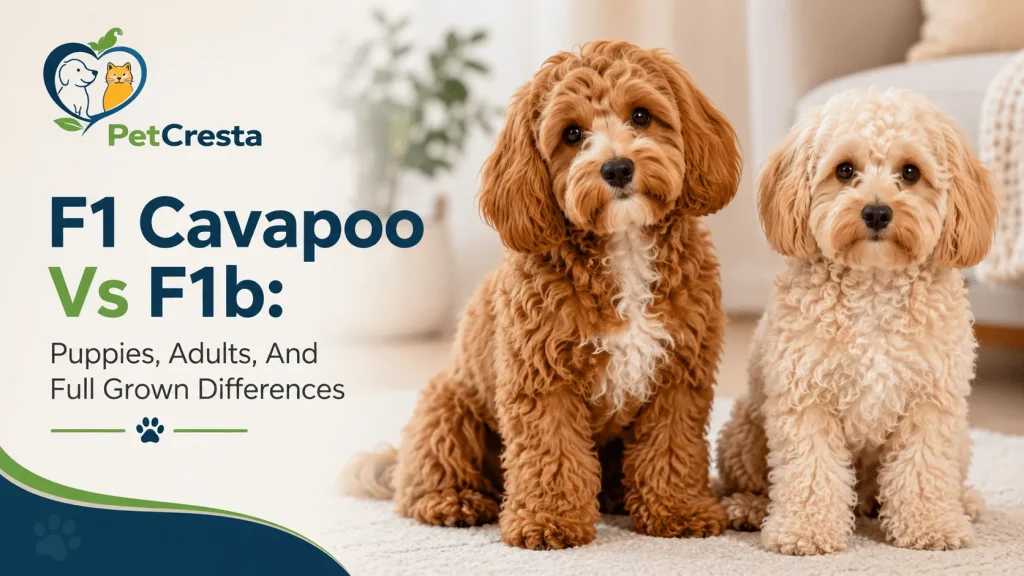
Usually, the difference between an F1 Cavapoo and an F1b becomes more apparent when the coat begins to grow, and the puppy transitions into adulthood. Some readers may think that F1 Cavapoo puppies are the same as F1b puppies due to the initial appearance, as both may have soft, fluffy coats. This contrast is sometimes easier to see as the adult coat comes in.
Other doodle mixes, such as f1 vs f1b Bernedoodle, function in a similar fashion, but coat, size, and care requirements still differ according to each breed mix.
F1 Dog Meaning And F1 Puppy Meaning
F1 dog is the name given to the first generation of outcrossing between two purebred parent dog breeds. With a Cavapoo, this translates to a Cavalier King Charles Spaniel directly bred with a Poodle. The same applies to F1 cavapoo meaning and to F1 puppies meaning, as both of these refer to puppies the first time they are bred together.
F1 Cavapoo Puppies vs F1b Cavapoo Puppies
F1 Cavapoo Puppies are the first-generation hybrid breed, while F1b Puppies are the second-generation hybrid breed. F1 Cavapoo puppies typically possess a softer appearance between their outer coat and their inner coat, which can range from wavy to fluffy or lightly curly. In many litters, an F1b puppy will be closer to the poodle side, meaning that they may have a curlier coat and have even less shedding. Nevertheless, the appearance of the puppy is not an accurate predictor of the adult animal.
F1 Cavapoo Adults, Full Grown Appearance, And Size
Some F1 Cavapoo adults and full-grown F1 Cavapoos may have more unpredictable coats than some of the F1b. Some adults retain a loose wave; others may grow a fluffier or more mixed wave. This is because an F1b will typically be a more consistent adult dog, particularly if they are in the more Poodle direction of the curly type.
F1 Cavapoo size may vary, but the majority of Cavapoo dogs fall into the small dog category. An F1 Toy Cavapoo full-grown can be smaller than an F1 Cavapoo from Miniature Poodle lines, but ultimately depends on the size, body frame, and breeding line of the parents.
F1 Cavapoo vs F1b: Coat, Shedding, and Daily Care
The best way to compare F1 Cavapoo vs F1b is to look at their coats, shedding, and grooming. Often, it is a question of which coat is more balanced in the f1b vs f1 cavapooc comparison, or more Poodle. Depending on the preference of the owner, an F1 coat might be easier to maintain, or an F1b coat may shed less but require more brushing and grooming.
In general, the difference between F1 vs F1b cavoodle is the coat direction, shedding, and grooming requirements. F1b is likely to be more puppy or Poodle-like, and F1 might be less mixed or easier to maintain.
F1 Toy Cavapoo and F1 Mini Cavapoo
Typically, an F1 Toy Cavapoo will have been bred from Toy Poodle lines, and an F1 Mini Cavapoo will have been bred from Miniature Poodle lines. This difference is important because the size of the adult will most often be more dependent upon the size of the Poodle parent rather than upon the F1 label.
F1b Cavapoo Full Grown Size And Weight
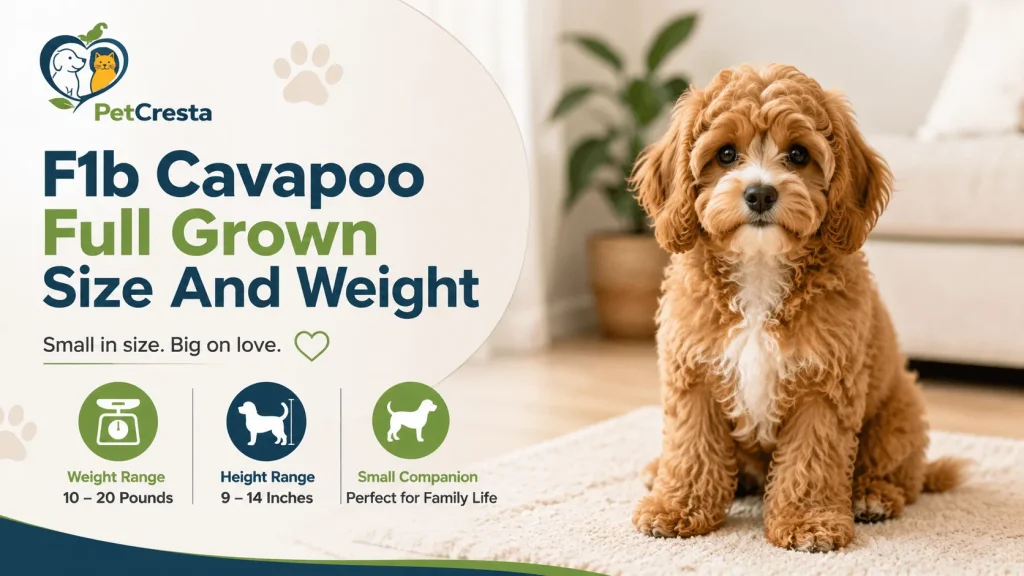
An F1b will typically be a smaller “companion” type dog, but not all F1bs will be one adult size. It’s usually the Poodle parent that has the greatest impact on size, more often than not, and not the F1b designation itself.
Dogs bred in the Toy Poodle line are usually lighter and smaller. Miniature Poodle dogs may grow to be a bit taller and stronger. Parent size usually provides a better estimate than generation wording alone, hence this.
The small-dog range is fairly broad among most adults, typically 10 to 20 pounds, outside of which some may fall in either direction due to breeding lines and body type. There is also a variation in height, but most don’t grow to a large size, so they don’t need to be in a large dog house.
Full Grown Cavapoo Size
The Cavapoo’s full adult size can be thought of as more of a range than an exact number. Adult size can differ even within the same generation, due to the size of the parents, body frame, and inherited growth pattern.
Cavapoo Adult Weight And Average Size
Cavapoo adult size is in the small dog range, but again, there’s an average size that ranges from one line to another. This is why averages are good indicators, but not guarantees for all puppies.
Mini Cavapoo Weight Vs Standard Small Cavapoo Size
The Mini Cavapoo is smaller than its standard small Cavapoo cousin. The Mini Cavapoo is the smaller sibling of the standard-size Cavapoo.
The weight of Mini Cavapoo can sometimes vary based on the breeder’s naming, but generally, the smaller the lines, the lower the weight. Adult size is more important than mini, toy or teacup labels when determining build when considering the size of the parent dogs in practice.
F1b Cavapoo Size And Weight Range
F1b size and weight range can vary, but most remain small companion dogs. Toy Poodle lines often stay smaller, while Miniature Poodle lines may produce a slightly taller or sturdier adult.
| Line influence | Usual adult pattern |
|---|---|
| Toy Poodle line | Often smaller and lighter |
| Miniature Poodle line | Often a bit taller and heavier |
Growth Timeline And What Actually Predicts Adult Size
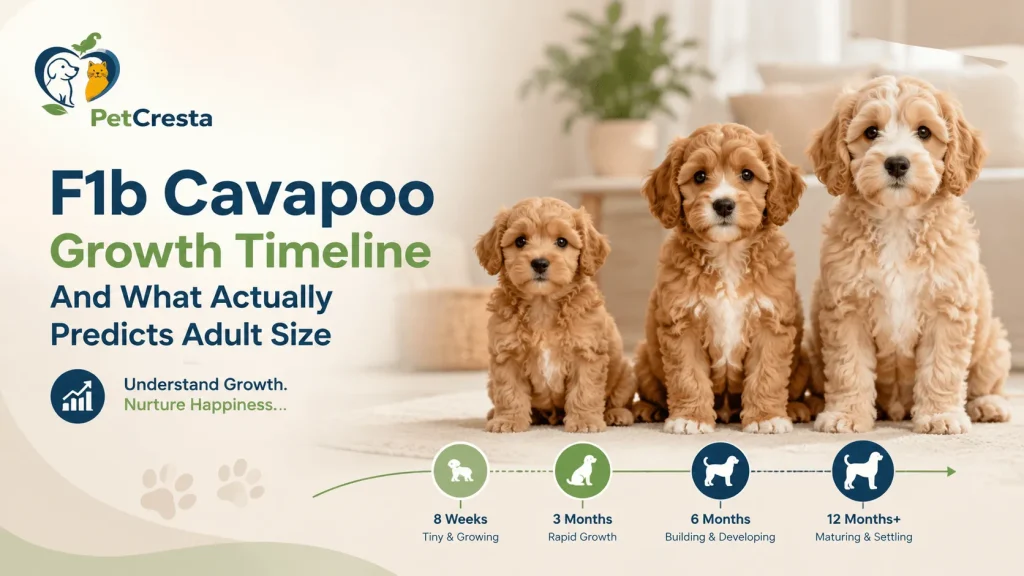
Most F1b grow to a high percentage of their full height in the first year. The body shape, coat, and overall finish might settle further.
The generation label should be more useful in terms of coat expectations than body size exactness. If the parents are not the same size, build, or growth rate, then a smaller F1 may still weigh less than a larger F1b.
Cavapoo Weight And Growth Expectations
The weights and growth rates of Cavapoos are guidelines, not guarantees. The best clues are provided most often by the size of both parents, the size of the Poodle side (Toy or Miniature), the bone structure of the dog, and the pattern in related dogs.
Weight at early stages may provide a general indication of growth, but should not be a constant indicator of adult size. It’s always better to consider ranges and observe the dog’s behavior over time.
Shedding And Allergy Reality
A common reason to consider F1b is for decreased shedding.
That’s a natural expectation. In many instances, the F1b coat will shed less than an F1 coat, and in some allergy-prone homes be easier to deal with. With that being said, however, the description of that should be done carefully.
Do F1b Cavapoos Shed?
Yes, they do shed, but it isn’t always much. Some coats drop very little hair. Others shed visibly, particularly when moving through coat changes, brushing, or when not cared for sufficiently.
Do F1 Cavapoos Shed More Than F1b Cavapoos?
F1 Cavapoos may shed more than F1b, but it does depend on the individual dog. An F1 coat can be more unpredictable, as it lies somewhere between that of the Cavalier and Poodle. The F1b coat tends to be more of a poodle side, and this may result in lower shedding and higher grooming.
Is An F1b Cavapoo A Hypoallergenic Dog?
This is mainly because an F1b typically sheds less than many other generations of Cavapoo. However, there are no 100% hypoallergenic dogs. An F1b canine could be a better choice for some homes that are allergic, but the interaction may vary from individual to individual.
Are Cavapoos Hypoallergenic?
All dogs have some allergens. The F1b Dog might be more allergy-friendly for some households, but not for everyone who is allergic.
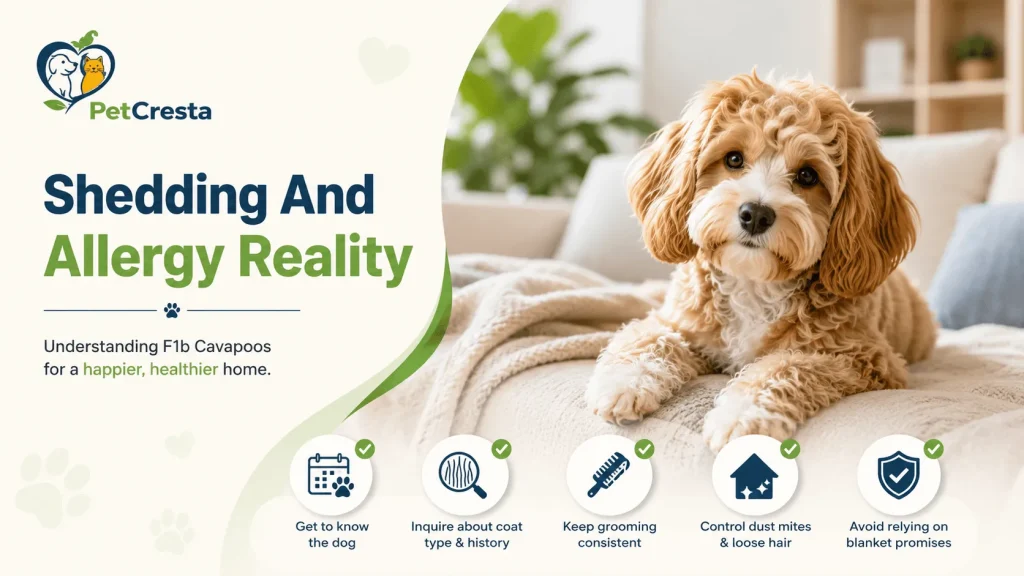
Best approach for allergy-concerned homes
☑ Take time to get to know the dog before deciding on your choice
☑ Inquire about the type of coat and family history
☑ Keep grooming consistent
☑ Control dust mites and loose hair in the house
☑ Avoid relying on blanket promises
Cavapoo Temperament, Personality, And Daily Life
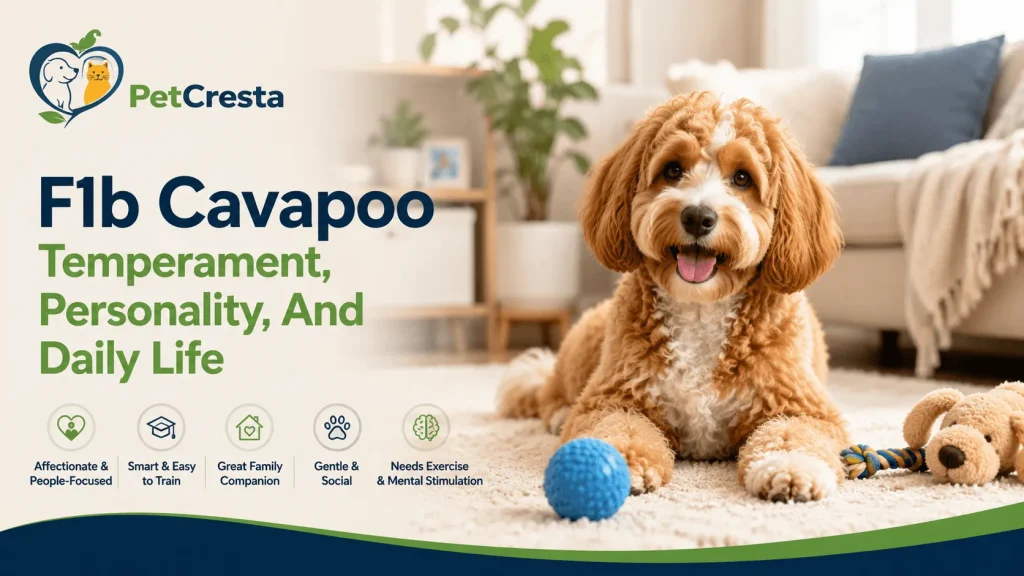
F1b breeds, known as Cavapoos, are generally described as affectionate, social, bright, and good with people. Many are easily trained due to the mix frequently having Poodle intelligence and the companionship of a Cavalier.
Nevertheless, a generation label does not alone determine temperament. The socialization, the routine, the quality of the training, the energy in the house, and the personality of the single dog are as important.
Typical Temperament Pattern
☑ Friendly and people-focused
☑ Responds positively to training
☑ Often gentle in family settings
☑ May be sensitive to harsh handling or chaotic routine
☑ Can become very bonded to one or more people
Common Cavapoo Personality Traits
Cavapoos are known to be affectionate, social, gentle, and eager to be around people. Others are very “people pleasers,” which can make training easier if their routine is calm and consistent. However, personality differences may occur from person to person depending on their genetic make-up, early socialisation, and family environment.
Cavapoo Behavior Traits At Home
Familiar Cavapoo behaviors include keeping close to family members, attention seeking, and sensitivity to tone and routine. They like to play and enjoy brief walks and to participate in training games, but they also prefer company more than independence. They may bark on occasion when excited or when visitors are present, but this usually abates with structure and training.
F1b Cavapoo Traits And Temperament
Sometimes, F1b traits and temperament will show a higher Poodle influence, particularly in training and coat type. F1b dogs are smart, responsive, and loving, making them ideal family pets. Can be very attached to people, and daily interaction and routines are important.
F1b Cavapoo Temperament With Kids
F1b dogs make great family pets, particularly in a well-behaved, non-aggressive setting with children. They are similar to other small dogs in that they need supervision and gentle handling.
With Other Pets
With proper introduction, many get along with other pets, and many will get along with other dogs. Socialization remains important.
Exercise And Mental Work
Not a heavy-duty cross, but a dog that won’t be content on a razor-thin diet either. Daily walks, games, play, and mental tasks are a part of a healthy routine.
Daily Life Fit: Apartment Living, First Time Owner Fit, Barking, Alone Time, And Travel
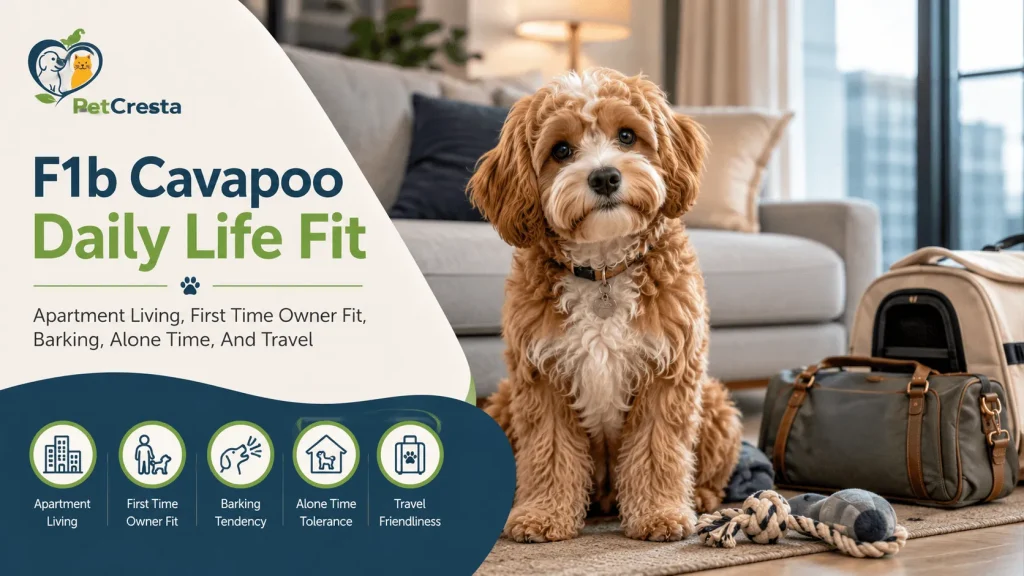
Choosing a dog of this breed does not imply that an F1b will fit perfectly into every home; only the daily routine does. This is typically a small dog that is companion-oriented, and the practical fit depends on time, structure, and coat-care tolerance.
Apartment Living
F1b dogs can live happily in an apartment if they are walked regularly, their needs are met in the bathroom, and they are mentally stimulated on a regular basis. It helps that the dog is small, but it’s still essential for him to have activity and a consistent pace.
First Time Owner Fit
F1b dogs can live happily in an apartment if they are walked regularly, their needs are met in the bathroom, and they are mentally stimulated on a regular basis. It helps that the dog is small, but it’s still essential for him to have activity and a consistent pace. The miniature cockapoo is another breed that you want to consider. A better question would be if the home is prepared to train, groom, and welcome the dog regularly.
Barking Tendency
Some F1b Dogs bark on the arrival of visitors or at house movement. With regularity, training, and some “tough love” in the daily grind, this is usually possible, but don’t think it’s impossible.
Alone Time Tolerance
F1b Dogs are very social. Dogs can form a close bond with the household and prolonged periods of absence can be challenging for them, so in homes that are quite quiet during the day, this should be taken into account.
Travel Friendliness
They are also compact, making travel easier than for larger breeds. Despite this, while it certainly depends on the generation label, comfort in a car ride, in new locations, in crates, and with new noises is dependent on early handling and exposure.
Cavapoo Grooming & Care Tips
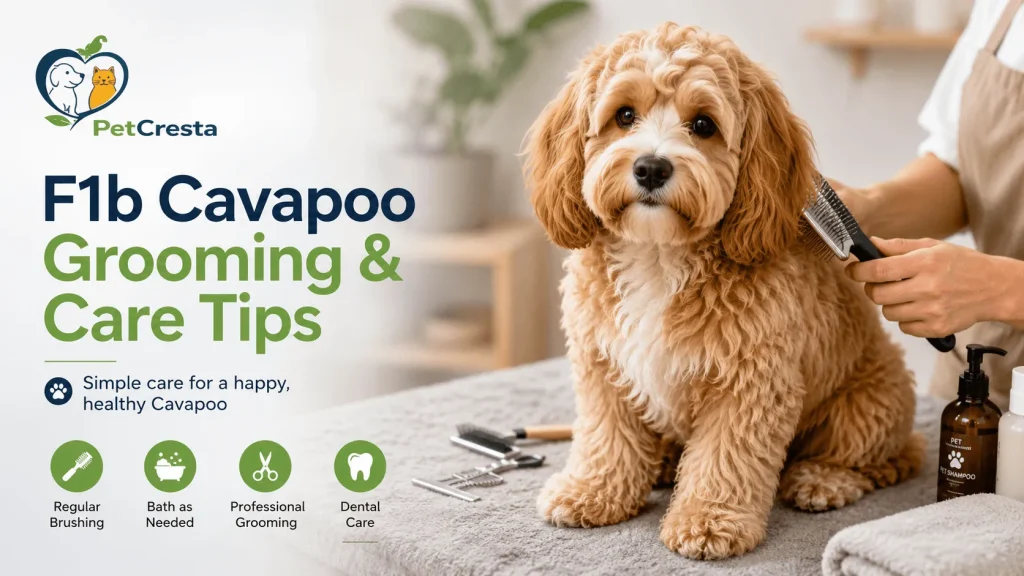
One of the main attractions of an F1b Dog is their coat – and that’s one of the areas where it’s best to keep your expectations realistic.
If the coat is full and has curls, more than a brush is required. Proper grooming will reduce tangling, matting, dampness, and skin irritation.
Home Care Checklist
☑ Brush several times each week
☑ Brush more often if the coat is curly or kept longer
☑ Check ears regularly
☑ Trim nails on schedule
☑ Keep up with tooth brushing
☑ Bathe as needed without overdoing it
☑ Schedule professional grooming regularly
Matting Hotspots
Pay close attention to these areas:
☑ Behind the ears
☑ Under the collar
☑ Armpits
☑ Legs
☑ Tail base
☑ Chest and belly friction points
Coat Length And How It Affects Grooming
Cavapoo coat length plays a big role in daily care. A longer coat often looks fuller and softer, but it also tangles faster and needs more brushing. A shorter trim is usually easier to maintain, especially in an F1b Dog with a dense or curly coat.
F1b Cavapoo Grooming Schedule
| Care task | Usual pattern |
|---|---|
| Brushing | Several times weekly, sometimes more |
| Bathing | As needed based on coat and lifestyle |
| Ear care | Regular checks and cleaning guidance from a veterinarian or groomer |
| Nail care | Routine trimming |
| Dental care | Frequent brushing and dental support |
| Professional grooming | Regular appointments based on coat length and texture |
F1b Cavapoo Health Issues & Lifespan And Breeder Screening
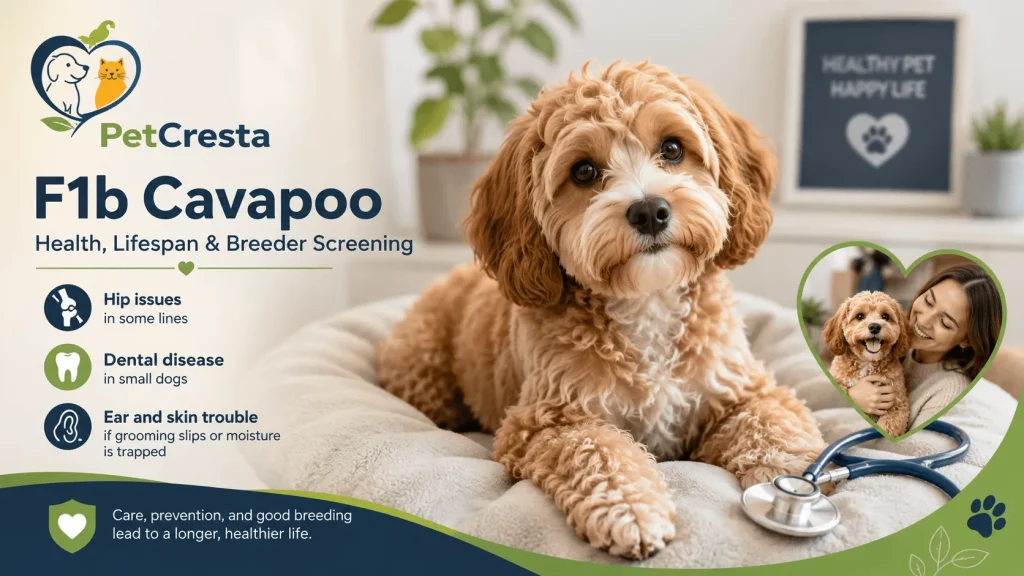
Common Health issues inluclude:
☑ Hip issues in some lines
☑ Dental disease in small dogs
☑ Ear and skin trouble if grooming slips or moisture is trapped
Hybrid Vigor In Context
Mixed breeding can reduce some inherited risk patterns in some cases, but it does not replace careful health testing. A strong breeding program still matters.
What Breeders May Not Explain Clearly
Generation labeling can be good, but it can also be too much. It doesn’t mean the puppy will be tiny; it doesn’t mean that the puppy will be fully hypoallergenic; it doesn’t mean that the puppy will be perfectly curly; it doesn’t mean that the puppy will be healthier than all the other Cavapoo’s in the F2 or F1’s.
A good breeder will tell you what you can expect, what you might not manage to, and what may be different from pup to pup. Don’t be misled into thinking that the health of the F1b Dog is not an issue because this is a long-lived small dog breed.
Lifespan
The general age range for many Cavapoo’s is roughly 10 to 15 years, but will vary based on genetics, body condition, preventive care, dental care, and general management.
Common Health Themes To Watch
No issue is guaranteed, but the parent breeds can carry concerns that deserve attention.
☑ Age is a risk factor in Cavalier dogs
☑ Eye issues
☑ Patellar concerns
These should be discussed as realistic ranges, not promises.
Good questions to ask include:
☑ What size are both parents?
☑ What coat types appeared in past litters?
☑ What health testing has been completed?
☑ How are puppies socialized before going home?
☑ What grooming routine is expected for this coat?
☑ Can allergy sensitive families spend time around the dog first?
How To Choose An F1b Cavapoo Breeder And Spot Red Flags
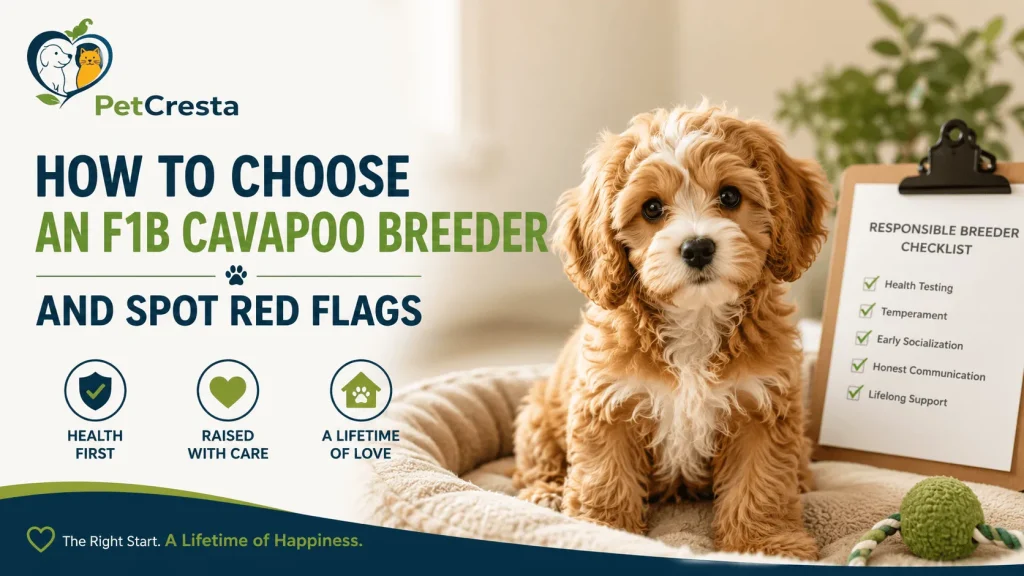
When picking a Cavapoo F1b Breeder, there are a few red flags to look out for. There are several red flags to watch out for when choosing a Cavapoo F1b Breeder.
A reputable breeder should be able to discuss health testing, parent temperament, handling at an early age and realistic coat expectations without pressure. It’s not just their puppy’s location, it’s the puppy’s breeding and upbringing.
What to ask for
☑ Cardiac screening, especially on the Cavalier side
☑ Eye testing
☑ Patella evaluation
☑ Hip discussion or evaluation where relevant
☑ Poodle-side DNA testing where appropriate, including PRA-related screening
☑ Clear information about parent temperament
☑ Honest discussion of coat care, shedding, and daily needs
☑ A clear explanation of how puppies are raised and socialized
Red Flags To Take Seriously
☑ Guaranteed hypoallergenic language
☑ Pressure to place a deposit quickly
☑ No proof of health testing
☑ Heavy focus on color or tiny size over health and temperament
☑ Always-available puppies without much discussion of fit
☑ Vague answers about the parents or the raising environment
☑ No interest in how the puppy will fit in the home
A strong breeder usually talks as much about long-term fit as about appearance. That is often a better sign than polished marketing language or a higher price tag.
Cavapoo Price Range And What Affects Cost

The cost of Cavapoos depends on the parents’ health testing, their popularity and demand for the coat, the standards of the breeders, and the level of early care they provide. The price range for a realistic Cavapoo puppy is typically wider than most people think so it’s not just how much do Cavapoos cost, but what is included in that.
Average Price Of A Cavapoo
The breed’s price will vary depending on location, reputation of the breeder, size expectations, and the proper health screening. The low price end may be an indication that there are fewer records or lower breeding standards, and the high price end may be an indication that there are more thorough health tests, socialization early and careful placements.
Toy, Mini, And Teacup Cavapoo Price
The toy Cavapoo and mini Cavapoo price may vary according to the size of the Poodle’s parent and the breeder’s naming of its litter. The price is often advertised as premium for the Teacup Cavapoo, but this should be taken with a grain of salt.
Although small size claims may prompt additional questions regarding breeding and health and may also indicate possible long-term soundness issues, it is important to remember that parent size and overall quality are the most important considerations when assessing the label of “very small size.
Red Cavapoo Price And Black Cavapoo Price
The price of red Cavapoo and black Cavapoo can be different if one’s favorite color is in higher demand but should not be the primary determining factor of value for the coat color. It is more important that the animal is healthy, has a good temperament, is well constructed, and has received good early care than whether the coat is red, black, or another color.
King Cavalier Poodle Cost And Cavalier Poodle Price
The terms ” King Cavalier Poodle cost and Cavalier Poodle price are often used for the same general mix. The most important aspect of the cost is the breeding program’s transparency regarding health screening, parent dogs, puppy care and realistic expectations, regardless of the actual wording used.
F1b Cavapoo Cost And Ongoing Expenses
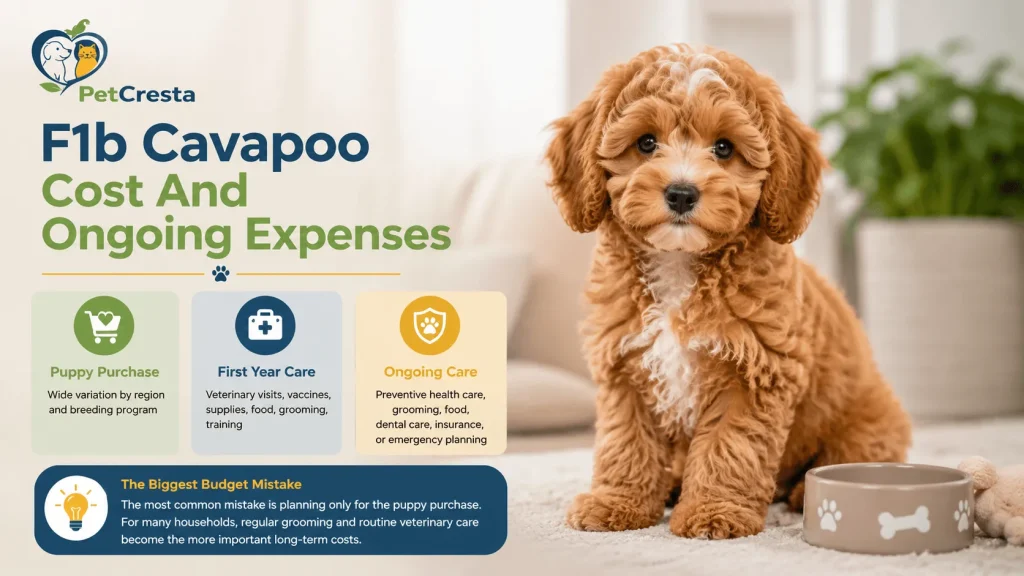
The purchase price of an F1b Dog can vary widely by location, demand, parent size, breeder reputation, and the level of health testing and early care involved.
Price alone does not prove quality. A higher price tag without strong documentation is not automatically a better sign.
Cost view
| Cost area | What to expect |
|---|---|
| Puppy purchase | Wide variation by region and breeding program |
| First year care | Veterinary visits, vaccines, supplies, food, grooming, training |
| Ongoing care | Preventive health care, grooming, food, dental care, insurance, or emergency planning |
The Biggest Budget Mistake
The most common mistake is planning only for the puppy purchase. For many households, regular grooming and routine veterinary care become the more important long-term costs.
Is An F1b Cavapoo Right For Your Home?
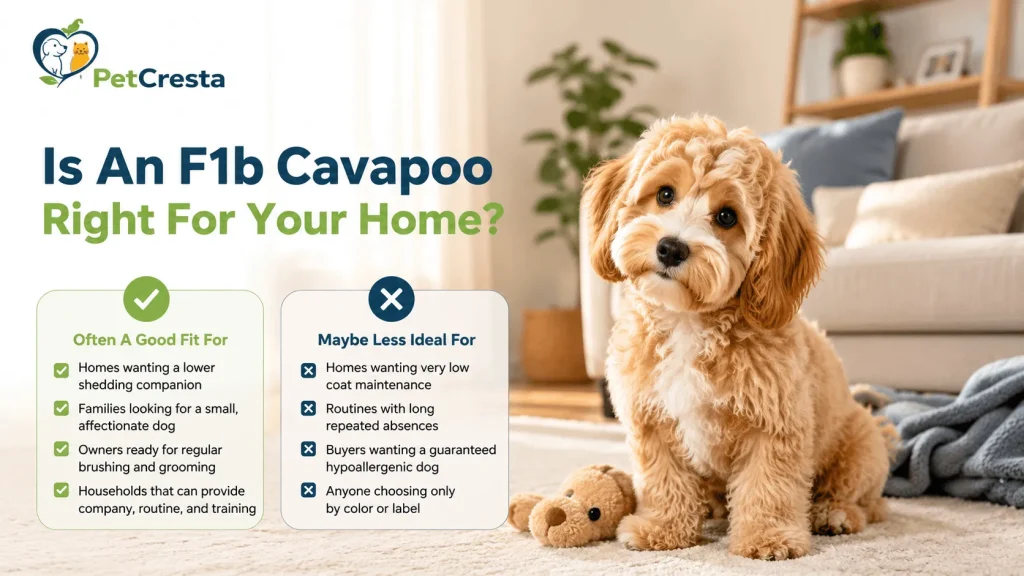
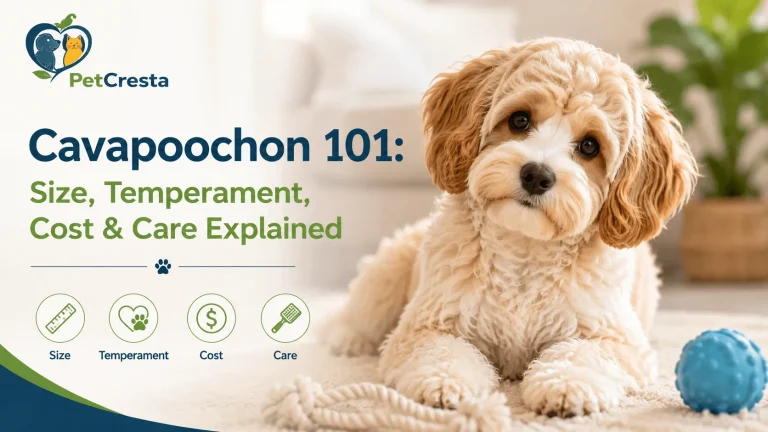
While an F1b may be a great fit, it will be the basic routine of the day that makes the difference, not the trend. If you’re on the fence about which low shedding companion mix would be the best for you, you should compare the cavapoochon before making a final choice.
Often a good fit for
☑ Homes wanting a lower shedding companion
☑ Families looking for a small, affectionate dog
☑ Owners ready for regular brushing and grooming
☑ Households that can provide company, routine, and training
Maybe less ideal for
☑ Homes wanting very low coat maintenance
☑ Routines with long repeated absences
☑ Buyers wanting a guaranteed hypoallergenic dog
☑ Anyone choosing only by color or label
Conclusion
The main reason to select an F1b Dog is that their coat tends to shed less and is more towards the Poodle side. That’s an excellent benefit for several homes, however it requires greater seriousness in grooming.
The generation label is helpful, but not an indicator of size, coat, or temperament, nor is it an indicator of allergy outcome. The ideal is to find the dog that fits the household’s lifestyle, coat maintenance and commitment to the dog’s care.
To make a good decision one must have realistic expectations, a careful screening of breeders and a clear understanding of what daily life with this mix looks like.
FAQ’s
Yes, in most cases, FB1 and F1b refer to the same generation. FB1 is usually just a different way the term is written in searches, listings, or casual use. The more standard and widely accepted form is F1b, especially when describing Cavapoo generations in a clear breeding context.
An F1 Cavapoo is the direct first-generation cross between a Cavalier King Charles Spaniel and a Poodle. An F1b Dog comes from breeding that F1 Cavapoo back to a Poodle, so it often has a stronger Poodle influence. That may lead to a curlier coat, less shedding, and higher grooming demands than an F1.
An F1b Dog is created by crossing an F1 Cavapoo with a Poodle, while an F2 Cavapoo usually comes from breeding two Cavapoos together. Because of that, F1b puppies often show a more predictable lean toward Poodle coat traits. F2 Cavapoos can vary more in coat type, appearance, and shedding pattern from one litter to another.
The yearly cost of keeping a Cavapoo can vary quite a bit depending on grooming, diet, veterinary care, and where the dog lives. Routine expenses often include food, parasite prevention, checkups, vaccinations, grooming, and occasional training or boarding. For many homes, grooming and preventive healthcare are the two areas that add up faster than expected.
The purchase price of this puppy can differ based on breeder practices, health testing, location, and parent size. A lower price does not always mean better value if health screening and early care have been overlooked. It is also important to remember that the first year usually includes extra costs for vaccinations, supplies, food, training, and grooming.
A full-grown F1b Dog usually has a small, balanced frame with a soft facial expression and a coat that ranges from wavy to quite curly. Many adults keep a teddy bear style appearance, though coat density and texture can differ by bloodline. The final adult coat often becomes more obvious after the puppy coat begins to change.
Many F1b Dog are affectionate, social, and gentle, which can make them a good fit for families with children. That said, temperament is shaped by early socialization, training, and the way the dog is handled at home. Calm supervision and respectful interaction are still important, especially around younger children.
Most F1b Dogs need regular coat care because their hair can mat easily if it is not maintained. Home brushing is usually needed several times each week, while professional grooming is often required on a routine schedule, depending on coat length and curl. Dogs with curlier coats generally need more frequent upkeep than those with a looser wave.
F1b Dogs are usually small companion dogs, but their final size is not identical in every case. Dogs from Toy Poodle lines are often smaller, while those from Miniature Poodle lines may grow a bit taller and heavier. Generation labels help describe breeding, but parent size remains the better guide for adult size expectations.
A full grown Cavapoo generally falls within the lighter companion dog range, but exact adult weight can differ from one dog to another. Dogs with a finer frame may stay lighter, while those from sturdier lines may carry more body mass. The most useful clues usually come from the parent dogs rather than from the generation label alone.
An F1b Dog can develop inherited or acquired health problems seen in either the Cavalier or Poodle side of the family. Potential concerns may include heart disease, joint issues, eye problems, skin or ear trouble, and dental disease, depending on the individual dog and breeding background. Careful parent health screening, routine veterinary visits, and good preventive care remain more meaningful than the generation label by itself.
Reference
- American Kennel Club — Hypoallergenic Dogs
- Cavalier King Charles Spaniel Club, USA — Health Testing Guidelines
- Poodle Club of America — Poodle Information Online
- American Kennel Club — Cavalier King Charles Spaniel Dog Breed Information
- Poodle Club of America — Health Concerns
- Poodle Club of America — Sizes of Poodles