Newfypoo Dog: Size, Shedding, Drool, Temperament & Care Guide
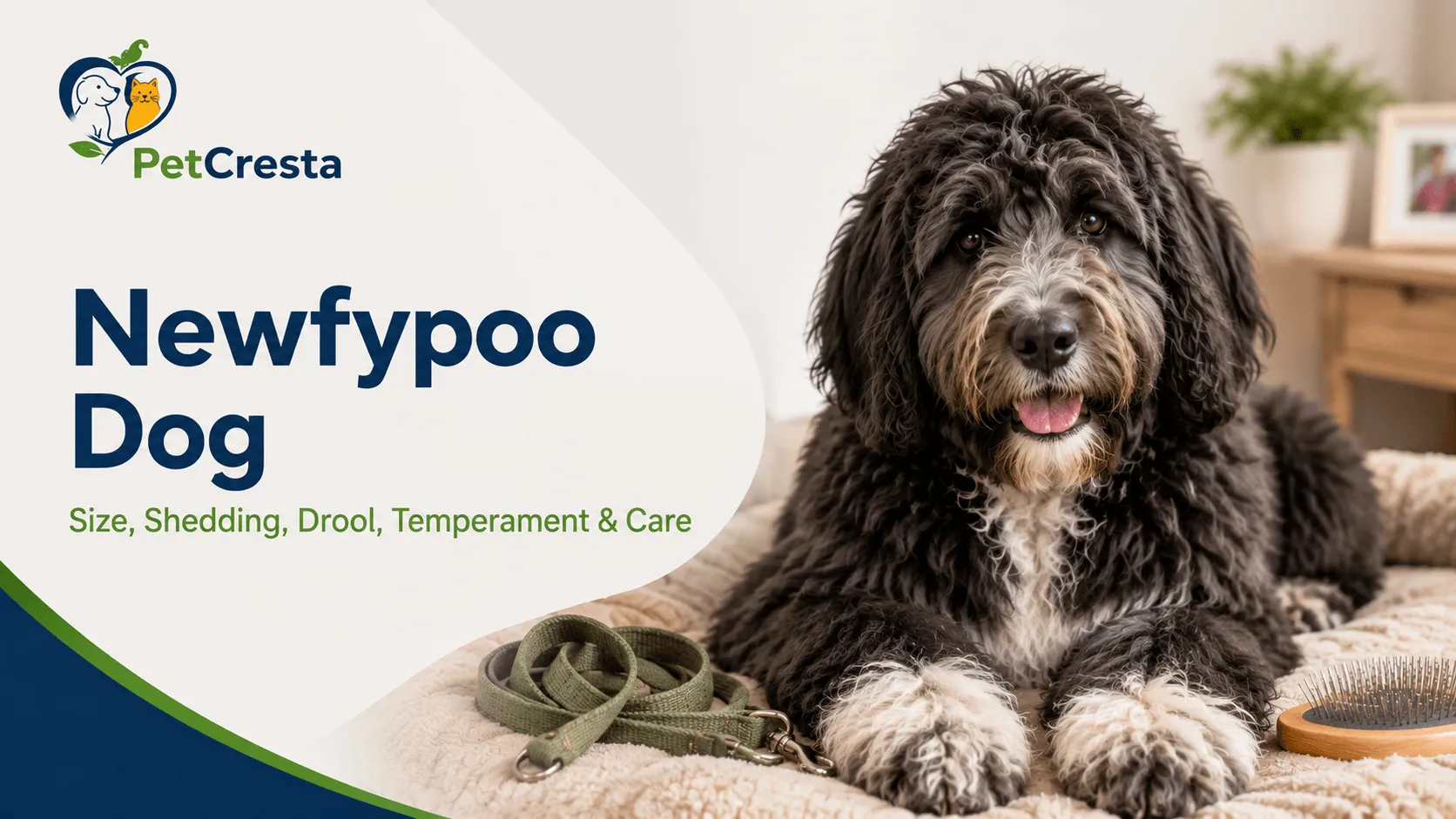
A Newfypoo is a Newfoundland and Poodle mix, typically a Standard Poodle, when breeders are looking for a large dog. You’ll also hear the names Newfiedoodle, Newfie Doodle and Newfoundland Poodle mix. They’re different labels for the same general type of cross.
Yes, these dogs are irresistible. Puppy photos can be a danger to your decision making abilities with a shaggy face, big paws and that soft expression.
However, the puppy picture is not as important as adult life. You could be getting a dog that will shed a lot, have a big body, have a lot of hair to groom, have a tendency to drool, and might cost more as it grows.
But there’s another twist: the Newfypoo is not a breed that is standard. Puppies with the same Newfypoo label can grow up very differently in terms of coat, body, shedding and behavior as their parents and their inherited traits are not the same.
So it’s not just a matter of “Do I like Newfypoos?”. It’s about whether the dog you’re thinking of is a good match for your lifestyle.
Veterinary review note: Health, growth, feeding and emergency-care passages should receive final veterinary review before publication.
Quick Answer: What Is A Newfiedoodle?
It is a Newfoundland–Poodle mix, which is also known as a Newfypoo. While most are of the standard size, breeding programs differ.
The cross does not have one breed standard so you cannot predict the adult size, coat or temperament of every puppy with the Newfypoo name. The size of the parents and family history and the size of the individual puppy are much more important.
Don’t think of “Newfypoo” as a blueprint for a “how-to” dog, but rather a description of parentage.
Quick Verdict: Is A Newfypoo Right For You?
The Newfypoo isn’t really a good choice for a person just wanting a teddy-bear-looking Doodle; it’s a good choice for a person who really wants a large, hands-on companion. No one can make brushing, training or fitting a giant crate in the car go away if it’s the sweetest temperament in the room.
Good fit if:
- A large or giant companion is desired.
- Professional grooming is within your budget.
- You’re ready to start training your puppy to be on leash and to greet properly.
- You have frequent contact with your dog.
- Muddy paws, wet beards and some slobber don’t bother you that much.
- You’re not afraid of variation in adult coats and size.
Think twice if:
- You want a coat that’s truly low maintenance.
- An easy-to-travel dog is required.
- Regular grooming sessions would be a strain on the finances.
- Extended periods of time away from home are common.
- A dog is required for the household that is guaranteed to be allergy safe.
- It’s mostly the fluffy look that’s convincing.
Both lists do not determine the goodness or badness of the Newfypoo. It just places the work next to the appeal, where it belongs.
Newfypoo Dogs At A Glance
There’s a bit of a problem with quick reference numbers for crosses. One Newfypoo breeder says that the standard adult size is 90-150 lbs and 22-30 inches, but that is from their breeding program and not the official Newfypoo standard.
As a general guide, refer to the table, and then ask about the real parents of any puppy you’re interested in.
| Trait | What owners can expect |
|---|---|
| Parent breeds | Newfoundland × Poodle |
| Common names | Newfypoo, Newfiedoodle |
| Typical size | Large to giant, depending on parents |
| Adult height | Commonly reported around 22–30 inches in standard lines |
| Adult weight | Commonly reported around 70–150 pounds across published sources and breeding lines |
| Lifespan | Often estimated around 8–12 years; no standardized crossbreed dataset |
| Coat | Wavy, curly, shaggy or mixed |
| Shedding | Variable; some dogs shed considerably less than a Newfoundland |
| Grooming | High |
| Drooling | Variable |
| Temperament | Often affectionate and trainable, with individual differences |
| Exercise | Regular daily exercise plus mental activity |
| Climate | Thick-coated individuals need extra care in hot weather |
| First-time owner | Possible with preparation |
| Apartment fit | Depends on space, routine and the individual dog |
The wide ranges are not a drawback in the table. They’re a reminder that this is not a standardised pure breed.
Newfypoo Pros And Cons
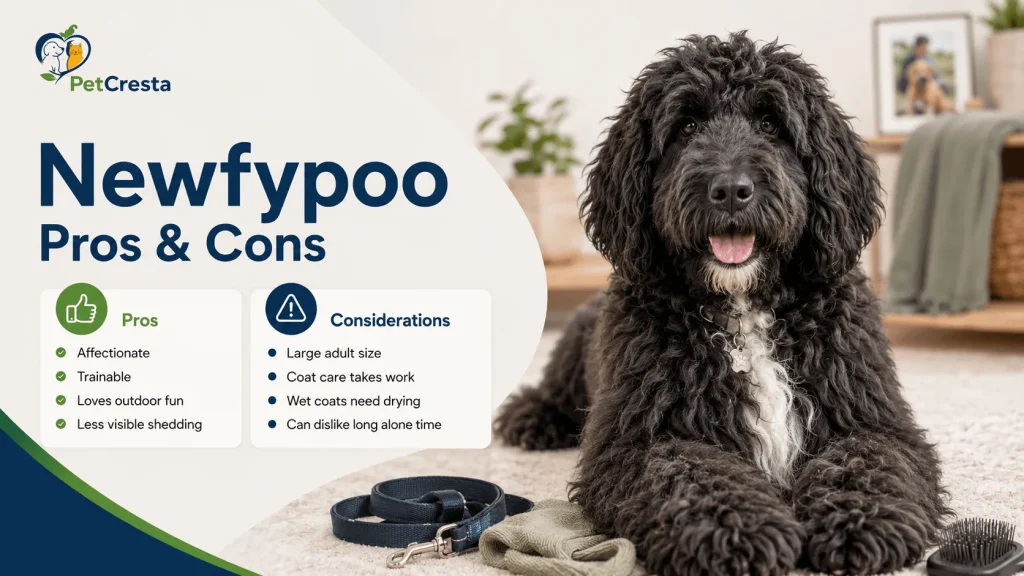
Living with a large Poodle cross comes with some lovely advantages. It also comes with chores that are difficult to appreciate when the dog still weighs twenty pounds and sleeps half the afternoon.
Here’s the practical balance.
| Pros | Considerations |
|---|---|
| Can be highly affectionate | Adult size can be physically demanding |
| Often responsive to training | Early leash and greeting manners matter |
| Some have less visible shedding | Lower shedding can mean more coat maintenance |
| May enjoy swimming and outdoor activities | Wet coats take time to rinse and dry |
| Can enjoy close family involvement | Some dogs dislike being alone for long periods |
| Striking appearance | Grooming, food and equipment can cost more at this size |
What matters most is whether the drawbacks look manageable rather than merely tolerable during the puppy honeymoon.
What Is A Newfiedoodle Dog?
The complete response is more complex than parent names. It is not a breed that is consistently reproduced, as it is a cross breed and does not have one set standard for size, coat, structure or behavior.
This has real-world implications. One puppy may be born with a loose, shaggy coat and a substantial Newfoundland-type build, while the other may be born lighter-framed and much curlier.
Genes don’t divide themselves according to a puppy sales brochure. Because when you’re looking at the real parents and relatives, that’s more telling than just the word “Newfypoo.
Newfiedoodle Vs Newfypoo: Is There A Difference?
No, both generally refer to the same Newfoundland–Poodle mix. Other names for the Newfoundland Doodle are “Newfie Doodle” and “Newfoundland Doodle.
A breeder might choose to use one name for branding, but the name does not make a new breed or a predictable sub-type. Do not assume that two dogs with different names are two different breeds; ask about parentage.
History And Parent Breed Background
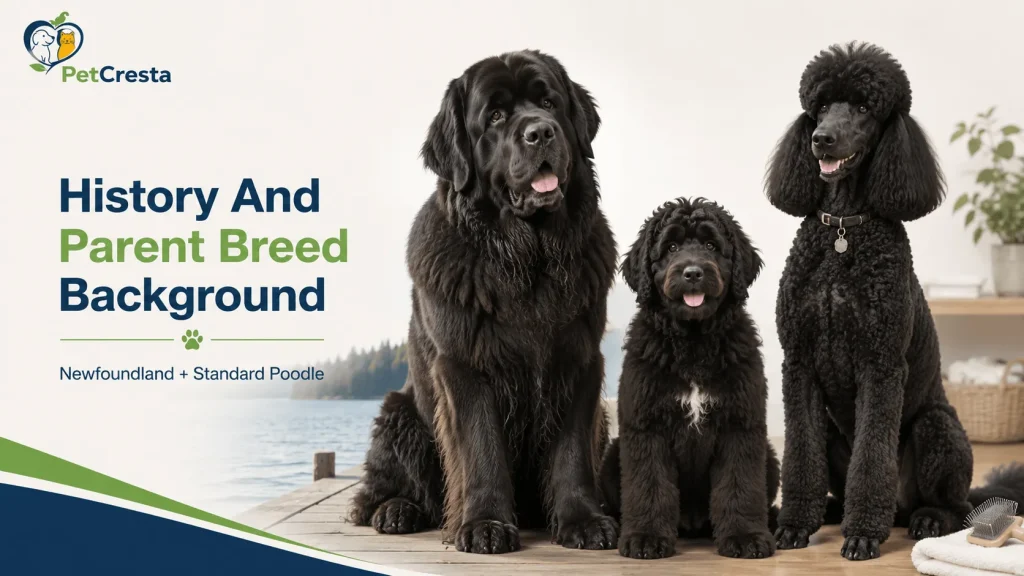
It is unclear who created the Newfypoo, or even when. It’s better to say it’s a modern Poodle cross than to come up with a nice story that the facts don’t fit.
Its parents are more easily documented. The Newfoundland and Poodle breed standards are quite different from one another with respect to their coat and body structure, which is why their mixed children can range from one extreme to the other.
What Traits Come From Newfoundland?
The Newfoundland parent can provide a lot of bone, body size, a thick coat of fur and a strong bond with water work. According to the AKC standard, an adult male will be approximately 28 inches tall and weigh 130-150 pounds, while an adult female will be approximately 26 inches tall and weigh 100-120 pounds.
This family can also provide information on how some Newfypoos are more likely to be heavier boned, have a fuller coat or slobber more. None of these characteristics are guaranteed in a cross.
What Characteristics Are Characteristic Of The Poodle?
Poodle ancestry may give a more athletic frame, a curly coat, intelligence and great responsiveness to training. The official Standard Poodle definition begins at 15 inches at the shoulder and up, which means there is a lot of size variation in the Standard.
A curlier Poodle-like coat may shed less loose hair in the room. It can also keep that hair close to the skin where someone still needs to pick it up with a brush and comb.
Newfydoodle Size, Weight, And Full-Grown Growth
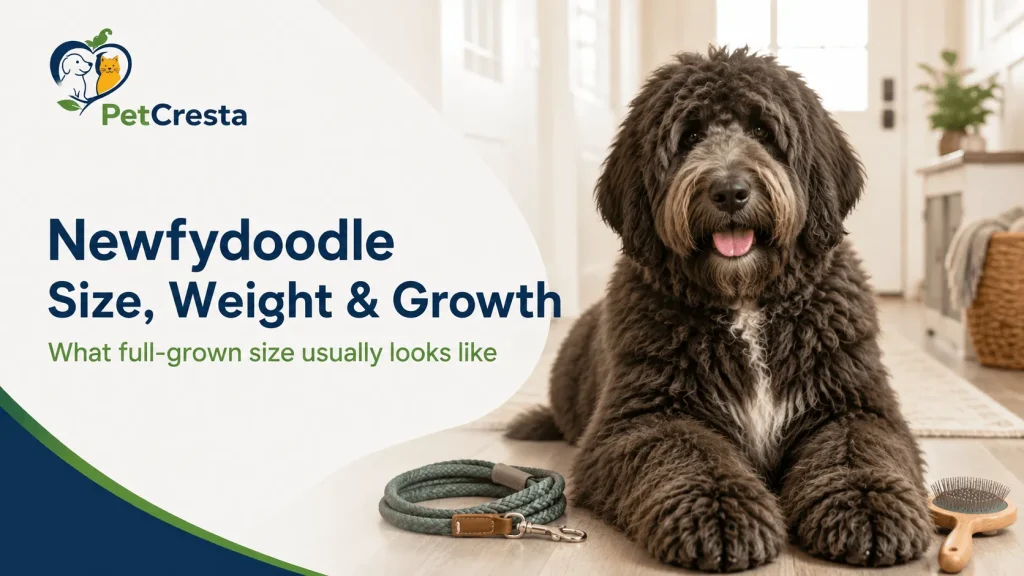
One of the most difficult predictions to make in this cross is the adult size. Very large Newfoundland and a good sized Standard Poodle may yield different results from a breeding program that utilizes smaller lines of Poodles. The Standard Goldendoodle is another larger Poodle cross, but its Golden Retriever ancestry creates a different size, coat and temperament picture from the Newfoundland-based Newfypoo
Some dogs will keep growing until about two years of age, and one breeder says that their standard Newfypoos weigh 90-150 pounds. Use those numbers as an illustration, not a rule.
If you’re thinking about adopting a puppy, request the size and weight of the parents and other puppies from similar litters.
Full Grown Newfypoo Dog: What Adult Life Usually Feels Like
Numbers don’t really describe the size of home. A dog that is lying on its side in a hallway, weighing 90 pounds, can make a normal door into a negotiation.
Adult size is a factor in how to handle the leash, crate selection, vehicle space, boarding, grooming, and if the dog is injured, how to get it into a vehicle.
Another factor is young children and physically frail adults. A friendly dog does not necessarily mean a dog that knocks somebody out of balance.
Newfypoo Adult-Size Card
The take-home message is “plan large unless the actual breeding history provides good reason to think otherwise. A verbal guarantee that a puppy will be medium sized isn’t sufficient.
| Adult-size point | Practical meaning |
|---|---|
| General category | Usually large; some standard lines reach giant-dog weights |
| Reported height | Roughly 22–30 inches in some standard breeding lines |
| Reported weight | Wide variation; published estimates commonly extend well past 100 pounds |
| Better predictor | Actual parent sizes and mature relatives |
| Official Newfypoo standard | None |
Don’t let adult size be the deciding factor on whether or not the dog will be allowed in your home, or it becomes a criterion and not a wish.
Male Vs Female Newfypoo Size
The size difference can be significant in some individual breeding programs, but size may trend larger in males. The average difference between the height and weight of the female and male in one line of breeders is 1-3 inches and 10-15 pounds.
Please do not make this a promise for one puppy. A female from a very large line will easily outgrow a male from a smaller line.
Mini Newfypoo And Miniature Mini Newfypoo Size
There is no standard size for “Mini Newfypoo. Typically it refers to an effort to produce smaller puppies via Poodle size, multi-generation breeding or another breeder’s program. Similar caution applies to size labels used elsewhere in the Doodle market, including terms such as Micro Bernedoodle, because these labels do not create an official breed size standard.
Inquire specifically about how that smaller size is being made. Then ask the parents for their measured height and weight and mature sizes of related dogs.
Those numbers tell you a lot more than a label like “mini”.
Newfypoo Size Chart By Age
A development chart is more helpful than assuming that all Newfypoo puppies will reach a specific weight at a specific age. The growth rate may vary widely due to the parent dogs’ differences in growth rate.
| Development stage | What changes | What owners should focus on |
|---|---|---|
| Young puppy | Rapid physical growth and coordination changes | Handling, socialization and appropriate activity |
| Older puppy | More strength and independence | Leash skills and grooming cooperation |
| Adolescent | Near-adult dimensions may arrive before mature behavior | Impulse control and calm routines |
| Young adult | Body may continue filling out | Conditioning and healthy body weight |
| Mature adult | Growth stabilizes | Long-term mobility and fitness |
Your veterinarian will be able to determine if a specific puppy is growing at the right rate, rather than a chart on the internet.
Newfiedoodle Weight Chart
Beware of any chart that says that every three-month Newfypoo should weigh X pounds. There is no official Newfypoo growth standard to check those numbers.
| Age | Weight guidance |
|---|---|
| 2–3 months | Use the individual puppy’s growth curve rather than a fixed breed target |
| 4–6 months | Monitor steady growth and body condition with your veterinarian |
| 7–12 months | Expect substantial strength even if physical development isn’t finished |
| Full grown | Use parent size and mature family history for the best estimate |
That’s less satisfying than a tidy prediction. It’s also less likely to give you false confidence.
How Big Does Newfoundland Get?
Newfoundland is a helpful reference because it does have a breed standard. Adult males are approximately 28 inches and weigh about 130-150 pounds, while females are approximately 26 inches and weigh about 100-120 pounds.
A Newfypoo is not automatically born within those ranges as the Poodle parent alters the genetic picture. However, Newfoundland size is a factor to keep in mind when assessing the realistic expectations of even “smaller” Newfypoos.
Bernedoodle vs Newfypoo: What’s The Difference?
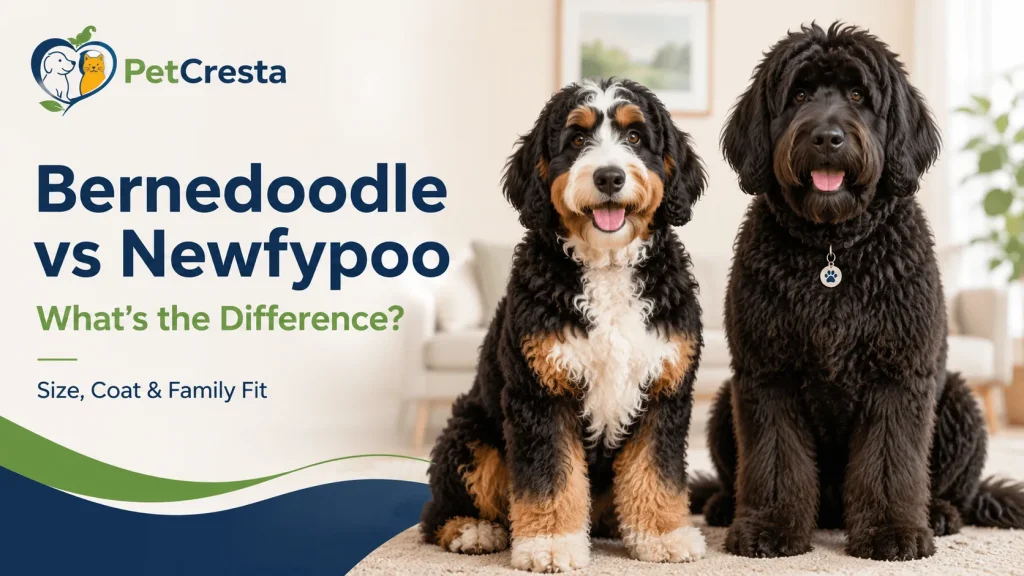
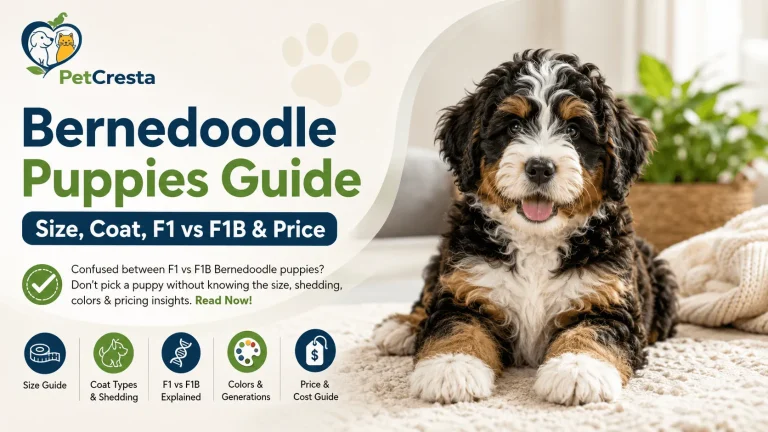
These two breeds are frequently combined in one home: a person who sees a large Poodle with a fluffy coat and social family-dog temperament. It’s the day-to-day ownership of their likely parent influence that’s the useful comparison, not the beauty contest. These two breeds are frequently compared by families considering a large, fluffy Poodle cross, especially those also researching whether a Bernedoodle would suit their household.
| Feature | Bernedoodle | Newfypoo |
|---|---|---|
| Parent breeds | Bernese Mountain Dog × Poodle | Newfoundland × Poodle |
| Typical size | Medium to large depending on breeding | Commonly large; some reach giant-dog weights |
| Coat | Wavy to curly | Wavy, shaggy or curly |
| Drool potential | Variable | Newfoundland ancestry can increase it |
| Exercise | Depends strongly on age and individual | Regular activity without assuming endless endurance |
| Grooming | Usually substantial | Usually substantial |
| Water interest | Individual | Newfoundland heritage may make it more common |
| Best fit | Owner prepared for a large coated cross | Owner prepared for size, coat care and possible water/slobber mess |
There is a lot of commonality. Do not make a decision based on stereotypes about cross or individual dogs; rather, consider each breeding program and each individual dog.
Newfydoodles: Coat Type, Colors, And Appearance
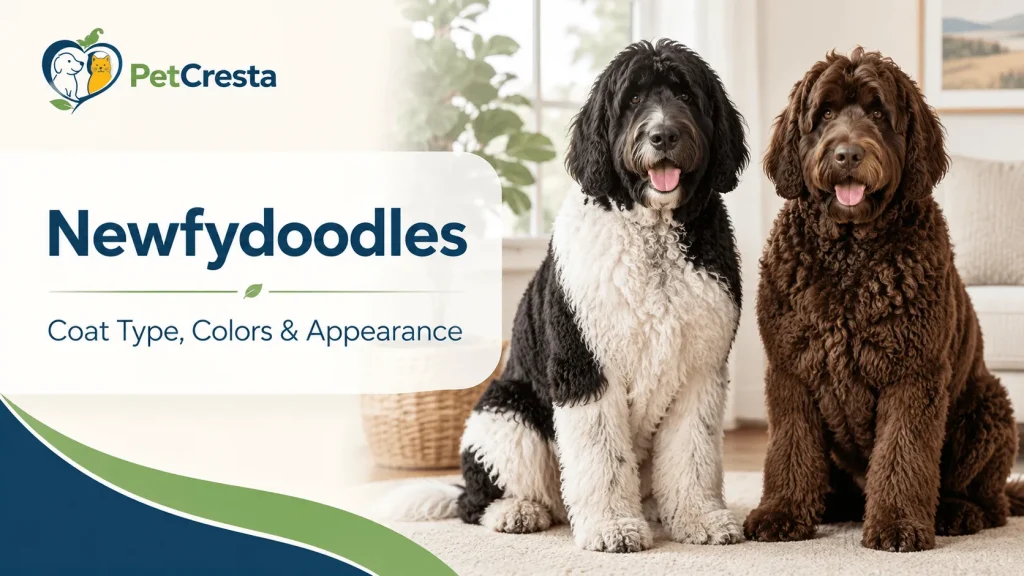
There is no “right” or “wrong” Newfypoo outline. Some resemble oversized curly Doodles; others have a wider head, a heavier frame and a looser coat, making it much more apparent that they are Newfoundlanders.
Ignore the hair and you will find a fairly large body, drop ears and a well-equipped muzzle. It is not a Newfypoo breed standard, but is a combination which depends upon inheritance.
What Does A Newfoundland Dog Look Like?
The Newfoundland standard calls it a large, heavily boned, muscular dog with a broad, massive head, relatively small, triangular ears and a thick coat. The standard includes the following colors: black, brown, gray and white-and-black.
A Newfypoo can steal elements of that appearance without copying it. A curlier face, lighter frame or a different coat pattern will easily alter the impression.
Common Coat Styles
Yes, in some cases, the puppy’s coat may lighten as he grows up. A single Newfypoo breeder mentions that black or brown puppies in fading-gene Poodle lines are turning silver or silver-beige.
Having pictures of older family members can provide perspective. They can’t even guarantee what color one puppy will be at age three.
Typical looks include:
- loose and shaggy
- soft waves
- denser curls
- mixed textures across the body, ears and furnishings
A puppy coat can also mislead you. Adult texture may become clearer only as the mature coat replaces it.
Common Newfypoo Colors
Black and brown are common in Newfypoo breeding programs, with combinations involving white, gray and apricot also reported. One breeder describes solid black and brown, black-and-white, brown-and-white, gray-and-white and apricot-and-white dogs in its lines.
| Color or pattern | What you may see |
|---|---|
| Black Newfypoo | Solid black or black with white markings |
| Brown Newfypoo | Brown ranging in depth, sometimes with white |
| Gray or silver | May appear or become more obvious with maturity |
| Cream or apricot | Lighter Poodle-influenced shades in some lines |
| Parti | White combined with another color |
| Golden Newfypoo | Informal marketing term that needs clarification from the breeder |
Color should sit very low on your priority list compared with health testing, temperament and structural soundness.
Does A Newfypoo Puppy’s Color Change As It Grows?
Yes, some coats can lighten as the puppy matures. One Newfypoo breeder specifically reports black or brown puppies in fading-gene Poodle lines developing toward silver or silver-beige shades.
Photos of mature relatives can give you context. They still can’t guarantee exactly what shade one puppy will wear at age three.
Newfypoo Shedding: What Owners Should Realistically Expect
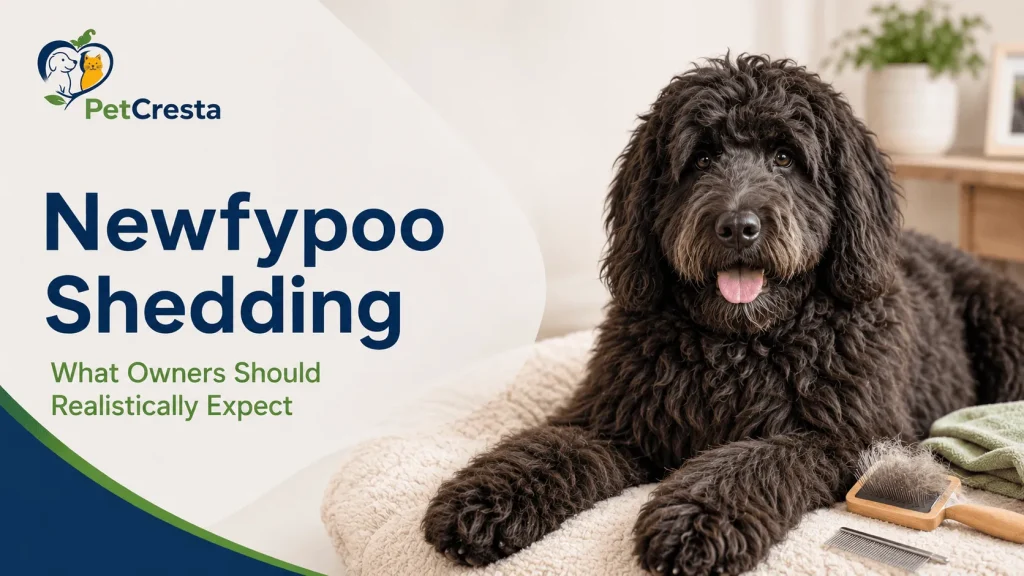
A Newfypoo may shed less than a Newfoundland, particularly if it has a more curly coat. The thing you don’t want to take for granted is that less hair on the sofa equals less maintenance.
Some hair that would otherwise fall does not fall away, but remains trapped in the coat. With enough friction and moisture, you have the conditions for tangles and mats.
Hair Is Less On The Floor
A shedder may leave less visible shedding on clothing, upholstery and floors. This is one of the reasons why people like Poodle crosses.
But coat behavior varies. It is impossible to predict the amount of loose hair from an F1 or F1B label.
Further Work To Finish The Coat
Curl and density changes may alter the vacuuming to brushing. The dog still sheds, wets, collects debris, and rubs up against moving joints and behind the ears.
Someone has to brush the coat, dry it off correctly and keep the length in check. This is why it is not the same thing to say “lower shedding” as to say “easy coat.
Are Newfypoos Hypoallergenic?
No dog can be guaranteed hypoallergenic. Dog allergens occur in sources such as saliva, dander and urine, and major allergy organizations specifically caution that lower shedding doesn’t make a dog allergen-free.
That matters with Newfypoos because Poodle ancestry is sometimes marketed much more confidently than the evidence allows. If somebody in your household has a significant dog allergy, talk with an allergist before committing rather than relying on coat labels.
Do Newfypoos Shed?
Yes, Newfypoos can shed. How noticeable that shedding becomes depends partly on coat type and the traits an individual dog inherits.
A loose, Newfoundland-leaning coat may drop more visible hair. A curlier coat may hold more of it until brushing, bathing or grooming removes it.
Why Lower Shedding Often Means More Grooming
Think about a curly coat like a net. Loose hairs don’t always make it to your floor because surrounding hair catches them first.
That’s convenient for the sofa, but not necessarily for the dog. Those trapped hairs need regular brushing and combing before they help create tight tangles close to the skin.
Do Newfypoos Drool?
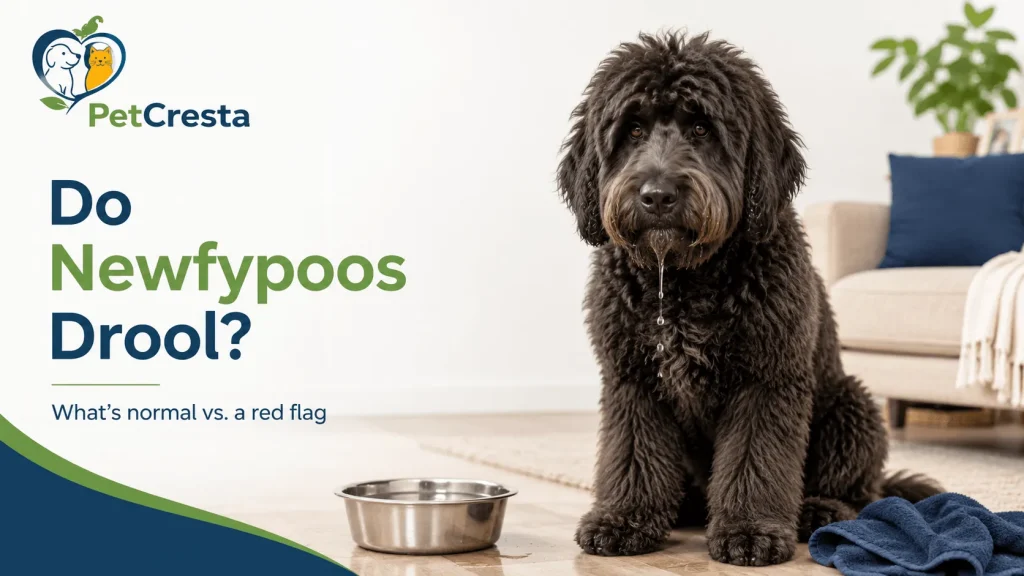
Some Newfypoos drool, and the amount can vary quite a bit. The Newfoundland parent is well known for substantial drooling, so assuming a Newfypoo will have a perfectly dry mouth isn’t sensible.
Even modest saliva can look like a lot once it’s living in a long beard. Add a freshly emptied water bowl and you’ll understand why owners keep towels nearby.
How Much Drool Should Owners Expect?
There’s no scientific Newfypoo drool scale, but a household scale is useful. Judge it by cleanup rather than trying to attach percentages to slobber.
- Low: damp beard and a few drips after drinking.
- Moderate: visible saliva after meals, drinking or excitement.
- High: routine cleanup around floors, furniture and the dog’s face.
Ask to meet adult relatives if drooling is a deal-breaker. It’s much more informative than asking whether a puppy “looks drooly.”
When Drool Is Normal Vs When It Is A Red Flag
Drooling after water, food or excitement can be ordinary. A sudden major change combined with distress deserves much more attention.
Nonproductive retching, heavy salivation, restlessness, abdominal enlargement, weakness or breathing difficulty can occur with gastric dilatation-volvulus, a life-threatening emergency that needs immediate veterinary care. Standard Poodles are among the breeds identified as being at increased GDV risk.
Don’t wait at home trying to decide whether the stomach “looks bloated enough.” If those signs appear together, call an emergency veterinarian.
Newfypoo Temperament: What Are They Usually Like?
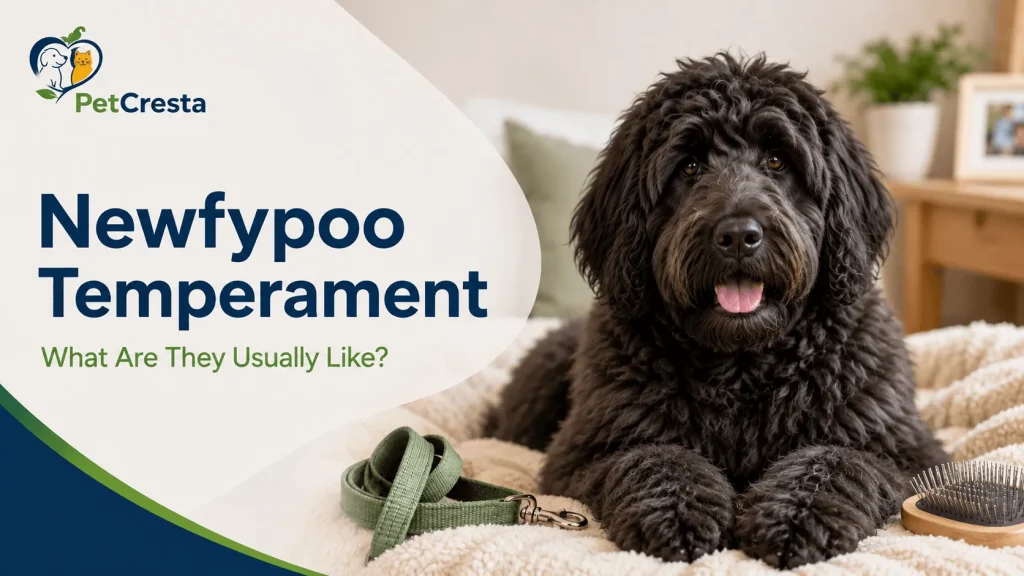
The Newfypoo is a popular breed because both the parent breeds have experience in working with humans. Temperament is not the same as two ingredient jars, in equal spoonfuls.
Genetics matter. Early handling, socialization and reinforcement history are also important, as is the dog’s personality.
A well-bred, well-raised Newfypoo may be affectionate, socially interested and quick to learn. An ill-fitting or inadequately trained one can be as intimidating as any other large dog.
Are Newfypoos Good Family Dogs?
They can be. The question is, is a specific dog and family a good fit?
A 100-pound teenager who’s a big fan of everyone can still fling a toddler over his head with one enthusiastic twist. Supervision, calm greetings and a dog’s resting place where children do not act are a great help in family life.
Children require rules, too. Never put your dog to the test by hugging, climbing on or disturbing them while they are eating or sleeping.
Are They Good With Other Dogs And Pets?
Many Newfypoos can live harmoniously with other animals, but size differences do not diminish the need for friendliness. A playful interaction that is not noticed by a large dog may be terrifying or even perilous for a small senior dog.
Introduce slowly and carefully. Elevated spots for cats to hide from a large, inquisitive dog and escape routes should be provided.
Do Newfypoos Bark A Lot?
Barking is more individual and dependent on the situation than on the breed, Newfypoo. Vocal habits can be formed from alerting at the door, excitement, frustration, and boredom.
Teach a quiet settlement before the dog is physically mature. Working with a calm puppy at the door is much simpler than a big adolescent puppy jumping on the windowsill.
Are Newfypoos Good Watchdogs?
A large Newfypoo can be a good look to make an unfamiliar visitor hesitate. Some will also bark if something unusual occurs.
This is not a reliable protection dog. Do not expect this cross to provide genetically predictable guarding behavior and do not create suspicion in a naturally social dog.
Are Newfypoos Calm Or High Energy?
You can obtain a fairly calm adult temperament dog, but not “calm” in the sense of “doesn’t need much to do. Poodles are active, intelligent dogs and Newfoundlands were bred to be working dogs.
Age also has an impact on the picture. A four-year-old and a ten-month-old Newfypoo can be completely different projects.
Do They Get Separation Anxiety?
Some socially attached dogs struggle when left alone, but you can’t diagnose separation anxiety from breed type. Destructive behavior can also come from boredom, incomplete house training or simple adolescent curiosity.
Teach comfortable alone time early in small doses. A puppy that learns the house doesn’t stop functioning when you leave the room has a much better foundation than one given constant company for six months and sudden solitude afterward.
Exercise Needs, Swimming, And Space Requirements
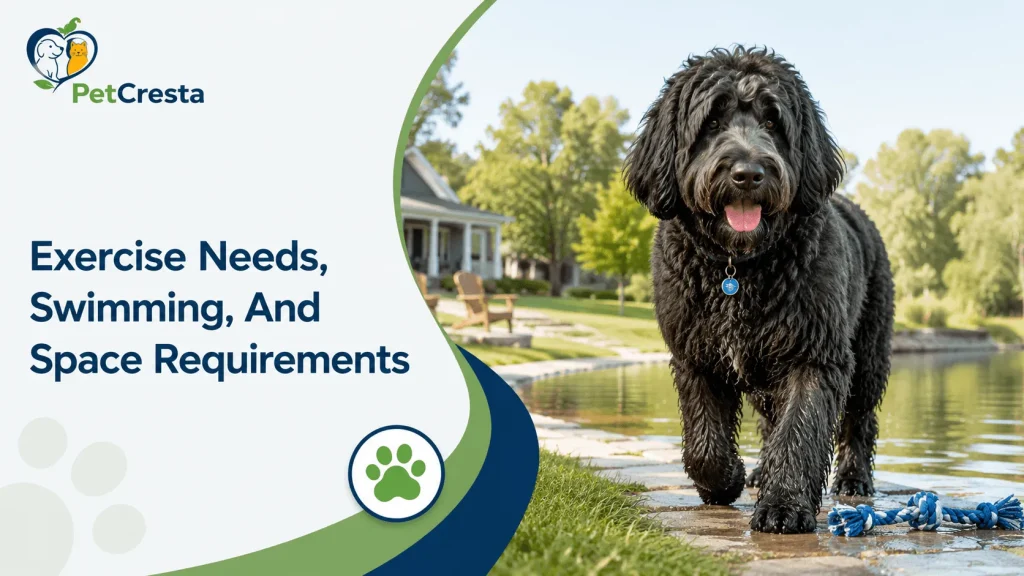
A Newfypoo isn’t required to run a marathon to lead a happy life. It does require some movement, some interesting activities, and a certain amount of structure so that all that body and brain have a place to go.
The routine should vary as per age. Fast growing puppies are not miniature adults with large feet.
How Much Exercise Does A Newfypoo Need?
Don’t try to find one specific number of minutes; match activity to the dog’s age, conditioning, health and weather. Walking, free movement in safe areas, training and play are all examples of adult routines.
When puppies are developing, they require extra care with repetitive high impact work. If growth, joints or body condition are a concern, your veterinarian can help adjust activity level.
Also monitor the dog following exercise. A stopwatch isn’t the only indicator of comfortable recovery.
Mental Stimulation For A Newfypoo
You can tire a clever dog without adding another mile. Sniffing games, food puzzles, retrieve work and short training sessions ask the brain to participate rather than turning every outing into cardio.
Try rotating activities:
- scatter part of a meal through grass for scent work
- practice five-minute skill sessions
- hide a toy for the dog to find
- use controlled retrieving
- teach calm mat or settle work
Mental work is particularly handy on foul-weather days when a large wet coat is the last thing anyone wants dripping across the house.
Do Newfypoos Like Water And Swimming?
There’s a good reason for the association with water. Newfoundlands were developed for work in and around water, and Poodles also have water-retrieving ancestry.
That doesn’t make every Newfypoo a swimmer. Introduce water gradually, supervise closely and never assume a dog is safe simply because its parents come from water-working breeds.
Afterward, rinse dirty or chlorinated coats when needed and dry dense areas thoroughly.
Hot Weather And Heat Sensitivity
A large dog wearing a dense coat deserves conservative management in hot, humid weather. Move harder exercise toward cooler parts of the day and make shade and water easy to reach.
Panting alone isn’t a useful reason to panic, but marked weakness, confusion, collapse, vomiting or trouble breathing needs prompt veterinary attention. Don’t make vigorous summer exercise a test of toughness.
How Much Space Does A Newfoundland Doodle Dog Need?
A huge yard isn’t a substitute for a daily routine, and a smaller house doesn’t automatically make ownership impossible. Floor plan matters, though.
Picture the adult dog turning around beside your dining table, drying after rain and getting through doorways while somebody carries groceries. Then consider stairs, slippery flooring, elevators and vehicle space.
That’s a much better housing test than measuring the backyard alone.
Newfypoo Grooming Styles And Coat Management
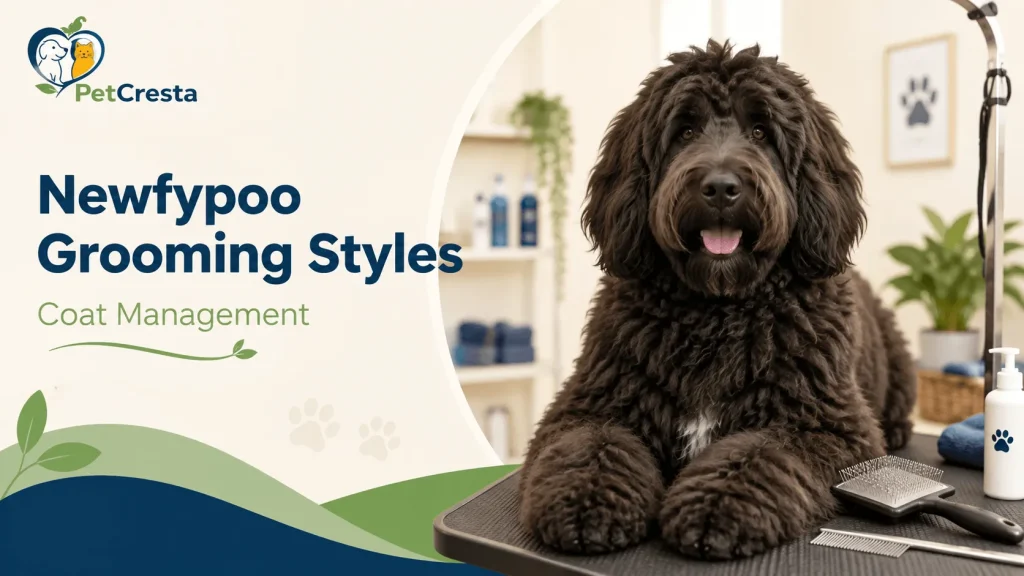
Do not take the coat very seriously if you have one of the Newfypoo’s commitments. While a long coat might seem like a dream come true, hair doesn’t seem to care how busy your week gets.
The amount of work you will actually have to do will depend on length, curl and density. The dog must also be comfortable with having their legs, ears, beard, feet and body handled.
How Often Should A Newfypoo Be Groomed?
Brushing is a requirement for many Newfypoos several times a week, particularly for a longer coat. A slicker brush will not be enough if the tangles are still under the skin, use a brush that will reach towards the skin.
The frequency of professional appointments varies according to coat length and the trim that is being maintained. It’s better to keep a shorter pet clip than a full teddy-bear coat.
Start grooming practice during puppyhood. It is certainly more difficult for everyone if the dog is so big that she does not like having her feet touched.
Simple Newfypoo Grooming Routine
There is no need to have 20 products in a row on a shelf. You need a repeatable procedure that will prevent small issues from being packed against the skin.
- Brush the coat. Skate in small areas rather than skating over the top.
- Follow with a comb. Be aware of areas where the comb gets stuck.
- Check friction zones. Check under collar, harness, ears and legs.
- Dry wet furnishings. The dampness in the beard, chest, ears and feet can last a surprisingly long time.
- Maintain nail appointments and professional appointments. Nails that are overgrown and an out-of-date coat make regular care more difficult.
Two 10 minute calm sessions can be much easier than dealing with a month of unkempt fur.
Best Newfypoo Grooming Styles For Manageability
For families that want to brush their pets less and dry them off quicker, a shorter pet cut is likely the practical winner. You still need to take care of your coat regularly, but there’s less length to tangle.
A fuller teddy-style trim maintains the round and fluffy appearance that many prefer. The price is more brushing, greater moisture retention and less room for skipped maintenance.
Select the longest style that you can pull off on a regular basis, not on grooming day.
Common Matting Zones And Skin Trouble Spots
Friction and moisture create predictable trouble areas. Behind the ears, beneath collars and harnesses, inside the armpits, around the feet, through the beard and across a damp chest deserve extra attention.
Run your fingers through those spots before brushing. If you can feel clumps or tight webbing underneath, a fluffy surface can hide more coat trouble than it reveals.
Never attack a tight mat by pulling hard at the skin. Ask a professional groomer for help when removal becomes uncomfortable or risky.
Weekly Grooming Checklist
A checklist keeps little jobs from quietly becoming big ones. Put it somewhere you’ll actually see it rather than relying on memory.
- Brush the main body coat.
- Comb through to the skin.
- Check behind both ears.
- Inspect collar and harness areas.
- Dry and clean the beard.
- Check the chest for lingering dampness.
- Look between and around the feet.
- Check nail length.
- Deal with small tangles early.
The goal isn’t a show-ring finish. It’s a comfortable coat and a dog who’s easy to handle.
Training A Newfypoo
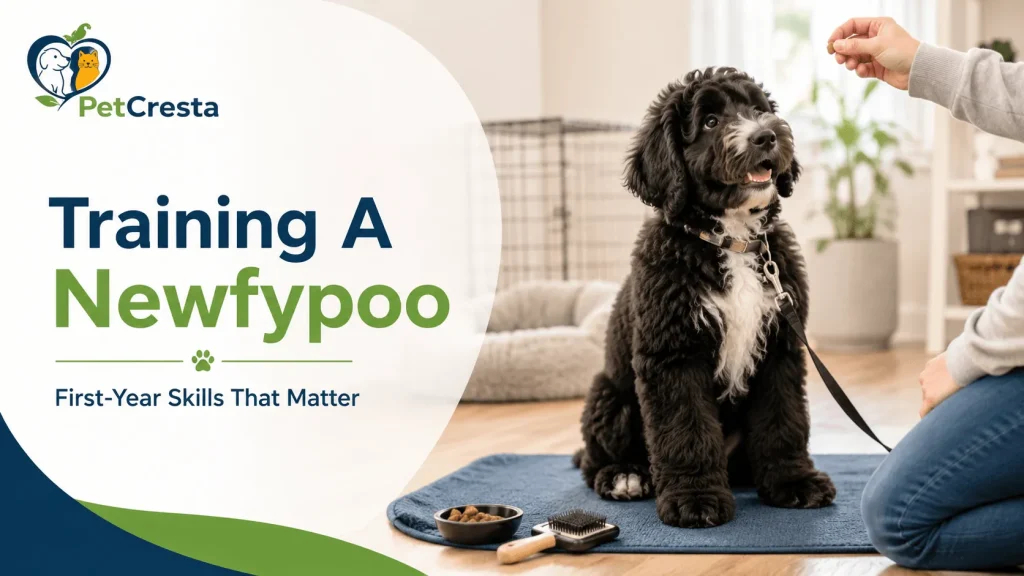
Training feels optional when a twelve-week puppy follows you around like a shadow. Add six months of growth and suddenly “he’s friendly” isn’t much comfort while you’re being towed toward another dog.
Start the boring skills early. They’re the ones you’ll appreciate most later.
Are Newfypoos Easy To Train?
Poodles are described in their standard as intelligent and active, while Newfoundlands have long histories as cooperative working dogs. Those parent traits can give a Newfypoo plenty of learning ability, though one crossbred dog’s temperament can’t be guaranteed from breed ancestry alone.
Use reward-based training and short sessions. Clear repetition beats turning every lesson into a battle of wills.
The clever dog who learns to “sit” in three minutes can also learn that dragging you toward the park works. Be consistent about both.
Must-Teach Skills In The First Year
Think of these as adult-dog insurance. Each behavior becomes more valuable as the puppy gains strength.
- loose-leash walking
- recall foundations
- four paws on the floor for greetings
- settle on a mat
- comfortable crate or rest-area use
- calm doorway behavior
- leave it and drop it
- paw, ear and mouth handling
- grooming-table tolerance
- relaxed car entry and exit
Practice them where life happens, not only in the living room with treats in your hand.
Can A Newfypoo Be A Therapy Or Service Dog?
Some Newfypoos can be temperamentally and trainable for therapy or disability related service tasks. Just because a dog is a parent of a working dog doesn’t mean that the dog has the health, environmental stability and behaviour required for that role.
Consider the size as well. A very large service prospect must navigate through public areas, vehicles and medical settings and be under excellent handler control.
Friendliness is not sufficient for therapy work either. The dog must be calm when encountering new people, strange movements, new equipment, sounds, and handling.
Common Training Mistakes With Giant Doodle Puppies
The most common error is to wait until the puppy is harmless. Jumping, pulling and body-slamming play becomes a lot less cute when you scale up.
Another mistake is not training grooming. Reach out to paws, check ears, hold the beard gently and reward calm standing well before a groomer needs to have the cooperation.
Don’t mistake a tired puppy with a taught puppy. Fatigue cannot be used as a substitute for impulse control.
Newfiedoodle Lifespan And Health Problems
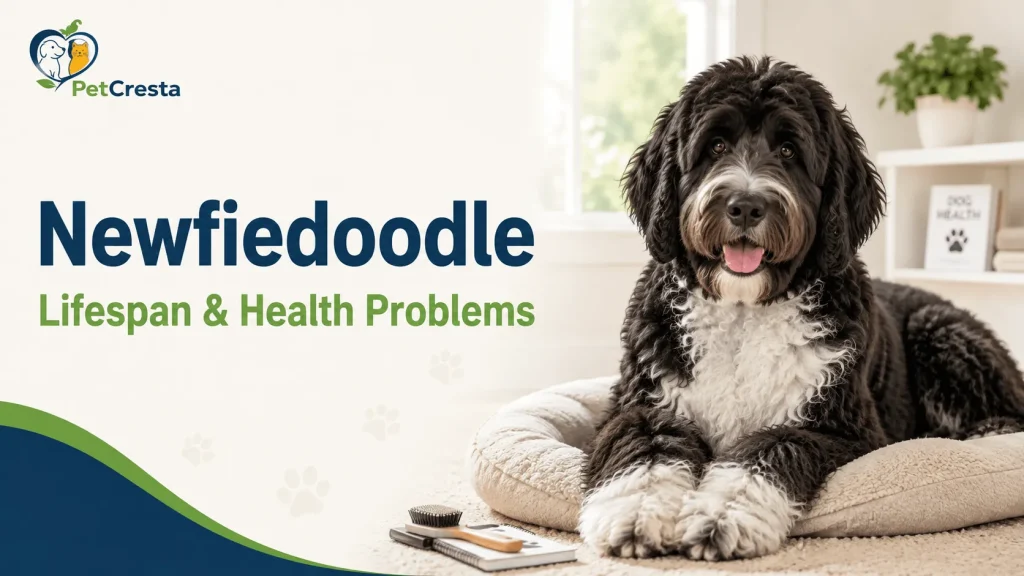
Unlike other pure breeds, there is no formal Newfypoo longevity database to collect data. The average published Newfypoo life expectancy is around 8-12 years, and the AKC puts Newfoundland at 9-10 years.
Don’t use the lifespan as a countdown clock. The life that a dog actually lives is influenced by health inheritance, adult size, body condition and individual disease.
Newfypoo Life Expectancy And Lifespan
For many Newfypoos, a reasonable estimate is 8–12 years, but it is important to note that there is limited cross-specific data.
When a breeder guarantees a very long life, ask him what the long-term records are. Optimism is not as helpful as mature relatives and documented health history.
Common Newfoundland Doodles Health Concerns
Responsible breeding involves crossing two apparently healthy dogs; however, a Newfypoo can inherit health risks from either parent line.
Hip and elbow evaluation, cardiac screening and DNA testing for cystinuria are recommended by Newfoundland parent clubs; eye, patella and thyroid checks are also recommended. The Poodle Club of America statement for Standard Poodles recommends hip evaluation, an ACVO eye exam, thyroid testing, NEWS and von Willebrand testing, and cardiac and sebaceous adenitis testing, to name a few.
Not all Newfypoos will get one of those diseases. It means that the parents must be intelligently screened before anyone speaks of “hybrid vigor” as an alternative to testing.
Giant-Breed Puppy Growth And Joint Protection
Heavy puppies that grow quickly should be carefully managed for weight and exercise. Maintaining a lean puppy with just enough padding to feel the ribs is more helpful than to make the puppy “big for its age.
Select food and amount in consultation with your veterinarian, especially during the growth phase. Avoid adding calcium or other growth supplements just because someone online reported that giant puppies require additional building material.
Also, make sure to use sensible footing. The floor is always slippery and it’s not the best training for a gangly puppy who is still learning how to use four long legs.
What Health Testing Should Buyers Ask About?
The terms “vet checked” and “health tested” are not synonymous. A clinical examination will give you a snapshot of a dog’s health that day, while screening for inherited health questions will help you understand the breed-specific questions.
OFA keeps public records of many submitted screening results and provides recognition to CHIC for dogs that have met their parent club’s required screening with published results.
| Parent | Screening/test | Ask breeder for | Why it matters |
|---|---|---|---|
| Newfoundland | Hip evaluation | OFA/PennHIP documentation where applicable | Screens breeding stock for hip dysplasia risk |
| Newfoundland | Elbow evaluation | OFA documentation | Screens elbow structure |
| Newfoundland | Cardiac evaluation | Documented cardiac result | Newfoundland parent-club recommendation |
| Newfoundland | Cystinuria | DNA result | Screens for an inherited Newfoundland condition |
| Poodle | Hip evaluation | OFA or PennHIP documentation | Standard Poodle recommendation |
| Poodle | Eye examination | Current ACVO/OFA eye result | Screens for inherited eye disease |
| Poodle | Thyroid evaluation | OFA thyroid documentation | Current PCA recommendation |
| Poodle | NEwS | DNA result or documented clear-by-parentage status | Current PCA recommendation |
| Poodle | von Willebrand disease I | DNA result or documented clear-by-parentage status | Current PCA recommendation |
| Poodle | Cardiac/SA testing | Relevant documentation when performed | Additional PCA-recommended screening |
The Newfoundland recommendations are based on the national parent club health statement and the Poodle entries are based on the current health statement of the Poodle Club of America.
Request registered names or OFA identifiers where records are supposed to be searchable. A screenshot saying “clear” is much less useful than a result you can verify.
Newfypoo Cost, Feeding, And Daily Ownership Reality
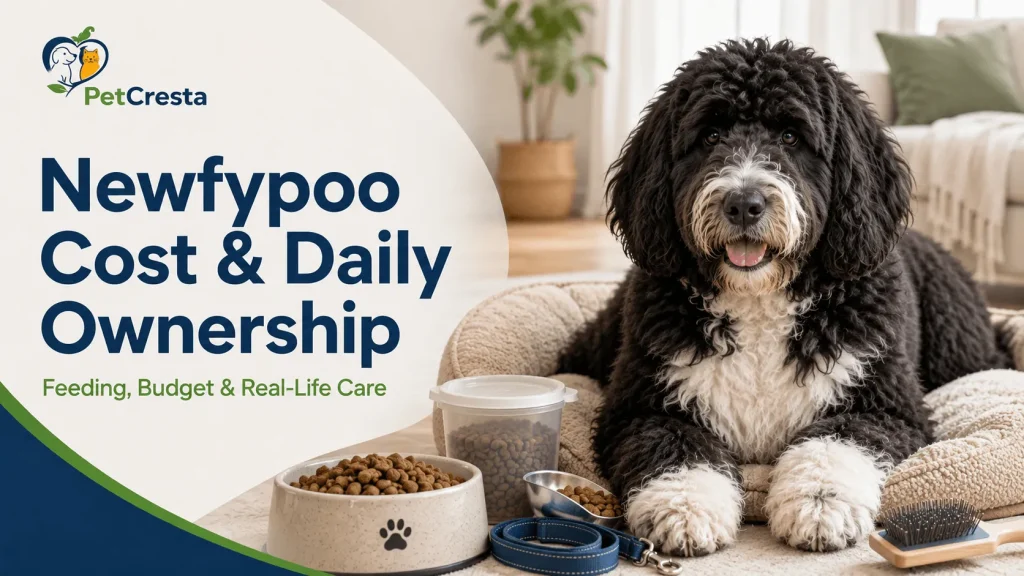
The puppy price is the one that gets attention as it is paid at one painful moment. The cost of ownership is concealed in scores of small transactions.
Some of the ongoing costs of a large dog are higher food, bigger preventives, larger equipment, grooming and boarding. Emergency treatment may also be more complex, with all equipment and all doses having to fit a much larger patient.
What Does It Cost To Own A Newfoundland Doodle Dog?
Unfortunately, there is no truthful single number that fits all applications. Grooming rates in Atlanta will not be the same as in LA, and a dog on a calorie-rich food won’t eat as many cups as a dog on a lower-calorie food.
Budget for categories instead:
- puppy purchase or adoption
- veterinary care
- food
- professional grooming
- training
- insurance or emergency savings
- crate, bed and restraint equipment
- boarding or pet care
- travel equipment
Check the local prices before you adopt a puppy. Just the grooming quote can be enough to give a dog that is supposed to grow to over a hundred pounds a startling shock.
First-Year Cost Buckets
Puppyhood adds up costs, as you have to buy equipment, pay vet bills, and train and groom your puppy before you get into your regular monthly routine.
| Cost bucket | What may fall inside it |
|---|---|
| Acquisition | Puppy price or adoption fee |
| Veterinary | Exams, vaccines, parasite prevention and other recommended care |
| Food | Puppy diet, treats and feeding equipment |
| Grooming | Tools, bathing supplies and professional appointments |
| Training | Puppy class, private help if needed, training equipment |
| Home setup | Large crate, gates, bed and cleanup supplies |
| Travel | Vehicle restraint, boarding or pet sitter |
| Emergency planning | Insurance, savings or both |
It is almost a rite of passage for puppies to grow out of their first bed and have to be replaced. Careful planning of adult sized equipment can help to avoid some of that pain.
Daily Workload Owners Underestimate
The time cost can come as a shock to people more than the money. A 5-minute towel job is a different experience when you’re drying four large paws, a beard, chest furnishings and half the kitchen floor.
The same thinking should be applied to vehicle logistics. Imagine the dog is sick or injured and cannot jump; how could you move the dog?
These are not excuses for not getting one of these dogs. They’re the ordinary aspects of having a puppy that puppy listings don’t often show you pictures of.
Feeding And Meal Routine
Don’t copy a cup measure from another owner’s post, but feed the dog in front of you instead. There are differences in calorie content between foods and differences in energy requirements between individual dogs based on age, body condition and activity.
Use measuring tools, track training treats and monitor body condition on a regular basis. As your puppy grows into adulthood, your veterinarian can help you adjust intake.
Standard Poodles are one of the breeds that are known to be at risk for GDV, so it is important that large Newfypoo owners discuss bloat risk and prevention with their veterinarian, not just one feeding trick.
Is This Mix Good For First-Time Owners?
Yes, but not necessarily something easy, as “first-time owner” doesn’t imply “I want something easy. It’s more important to be organized than to have a dog’s résumé.
A well-trained and prepared novice who plans for grooming and takes early handling seriously can excel. A large adolescent may not be so easy to handle if the person is inexperienced with dogs but not interested in brushing, training or managing a large dog.
Access to help counts. A good trainer, groomer and veterinary clinic make the learning curve much kinder.
Newfiedoodle Puppies: What To Know Before Bringing One Home
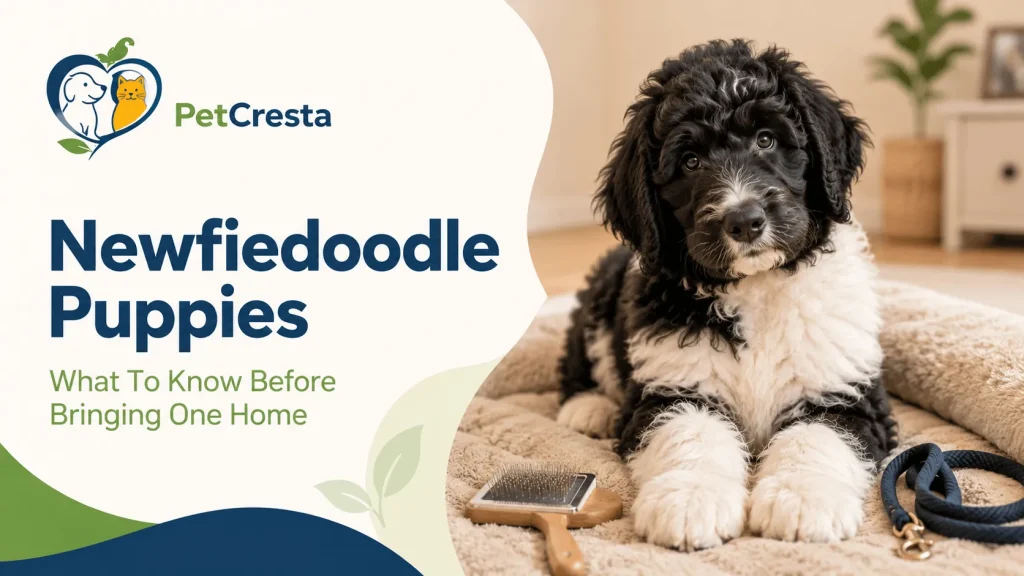
The first few weeks at home can be deceptive as a Newfiedoodle puppy. Then the legs extend, the body fills out and yesterday’s adorable behaviors begin to show up at full adult size.
Establish behaviors during puppyhood that you want to have when the dog is hard to handle physically.
What To Expect From A Newfypoo Puppy
Expect rapid change, awkward coordination, mouthing, sleep, curiosity and plenty of repetition. House training and socialization happen while you’re also teaching the puppy that brushes, combs, nail handling and car rides are ordinary events.
A simple developmental view is more useful than obsessing over exact pounds:
- 8–16 weeks: household routines, handling and careful social exposure.
- 4–8 months: leash work, grooming cooperation and growing independence.
- 8–18 months: stronger adolescent behavior and impulse-control practice.
- Young adulthood: physical filling out and a more settled routine.
Some standard Newfypoo breeding lines report continued physical growth toward roughly two years.
Questions To Ask Before Committing To A Puppy
Good questions require answers that can be checked. “Are the parents healthy?” is too easy.
Ask instead:
- What are both parents’ registered names?
- Can I verify their health-test results?
- What do the parents weigh and measure?
- How large are mature dogs from comparable previous litters?
- What are parents like around unfamiliar people and dogs?
- How are puppies introduced to grooming?
- What social experiences happen before they leave?
- What happens if an owner can no longer keep the dog?
- What health provisions appear in the contract?
Notice how few of those questions involve coat color. That’s intentional.
Buying Or Adopting A Newfypoo Safely
A responsible breeder should be willing to discuss the less glamorous possibilities: adult size, coat workload, health history and temperament variation. They should also be able to produce documentation rather than turning health testing into a verbal promise.
OFA allows prospective owners to look up public health results, which makes registered names useful before money changes hands.
Adoption can be a very good route too. With an adult dog, you may have far more information about final size, coat texture, shedding and behavior than you’d ever get from an eight-week-old puppy.
Red Flags Buyers Should Not Ignore
Beware of the sales pitch that seems more definitive than the genes are. Any guarantees of shedding, allergies, adult size or temperament should prompt further questions.
Watch for:
- “100% hypoallergenic” promises
- guaranteed zero shedding
- No family data was provided to guarantee tiny adult size
- No health testing of parents has been found.
- Heavily emphasized unusual color(s)
- Avoidance of talking to older adult dogs from previous litters
- The urge to make an up-front payment.
- No meaningful return policy
- A seller who asks little to nothing about your home.
It’s a two-way street when it comes to responsible placement. If someone is breeding giant companion dogs, they should have a clue as to where those dogs are going.
F1b Newfypoo: What Changes In Coat And Care?
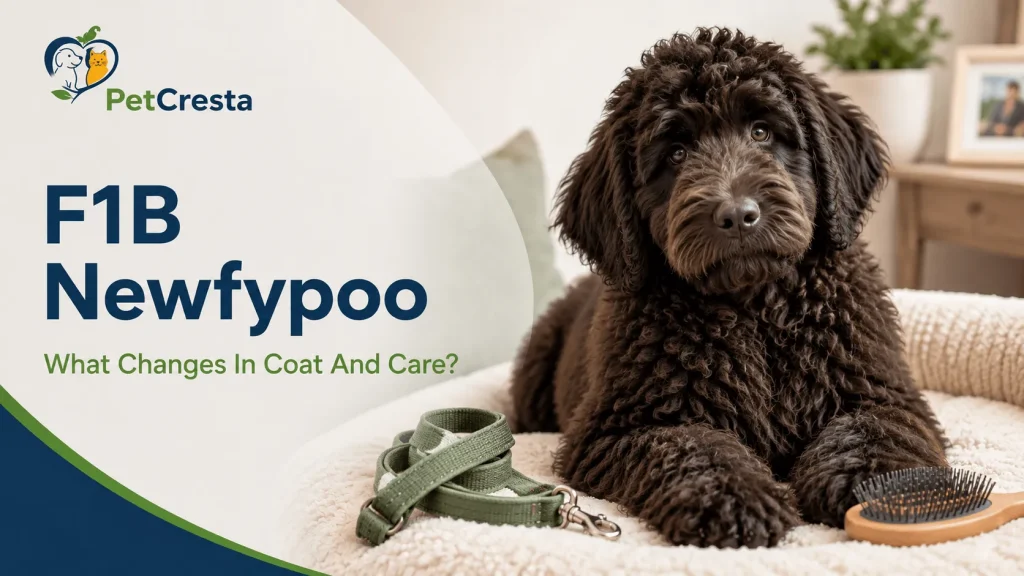
The F1B Newfypoo is typically an F1 Newfypoo bred back to a Poodle. Breeders may breed that cross when they desire more Poodle coats. The same backcross terminology is also used with other Doodle mixes, such as an F1B Bernedoodle, although the generation label still does not guarantee a particular coat or shedding level.
It is possible that the coat will curl up more or that the shedding will be less visible, but “more likely” is not “guaranteed. The allergy response, adult size and temperament cannot be determined by the generation label alone.
F1 vs F1B Newfypoo
Parentage is revealed by generation language. It does not guarantee the outcome of all the inherited traits.
| Factor | F1 | F1B |
|---|---|---|
| Common parentage | Newfoundland × Poodle | Newfypoo × Poodle |
| Coat tendency | Broader variability | May trend curlier |
| Shedding | Variable | May trend lower |
| Grooming | High | Can be equally or more demanding |
| Guarantees? | None | None |
Ask what previous adult dogs from that breeder’s comparable crosses actually look like and how their coats behave.
Newfypoo vs Newfypoo Mastidoodle
A Newfypoo and a Mastidoodle don’t represent two iterations of the same cross. The Newfypoo is a cross between Newfoundland and Poodle, and the Mastidoodle is typically a Mastiff–Poodle mix.
Both can grow to be very large dogs, but they are very different in terms of their non-Poodle ancestry. That alters the health inquiries, anticipated structure and temperament attributes that the buyer should look into.
If you see the term “Newfypoo Mastidoodle” in a listing, inquire about the actual parent breeds, not the marketing name.
Newfypoo Generations And Coat Expectations
The generation and size labels are different questions. F1 and F1B refer to ancestry; standard, medium and mini refer to intended or marketed size.
Generation
| Type | Common parent mix | What it may tell you |
|---|---|---|
| F1 Newfypoo | Newfoundland × Poodle | First-generation cross with broad trait variation |
| F1B Newfypoo | Newfypoo × Poodle | Greater Poodle ancestry; coat may trend curlier |
Size terminology
| Label | What it means |
|---|---|
| Standard | Usually the larger form, often involving a Standard Poodle |
| Medium | Breeder-defined smaller target; no universal Newfypoo standard |
| Mini | Breeder-defined smaller target; verify how size is being produced |
The two are kept separate so that you don’t get the Doodle confusion that F1B does not imply mini, and mini does not imply F1B.
Is A Newfie Doodle Right For Your Home?
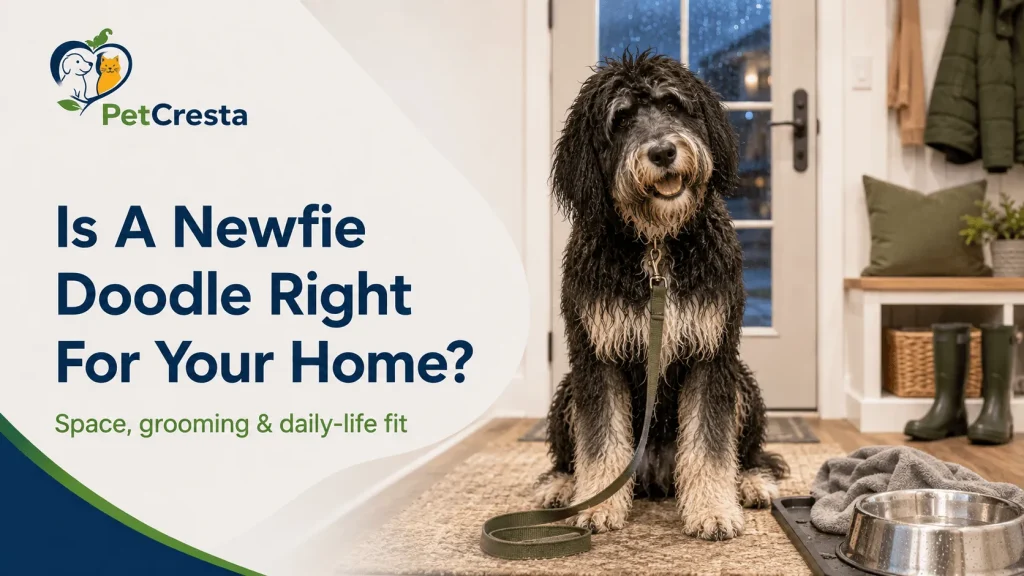
Ignore the breed description and think of Tuesday evening. The dog has come in wet, it’s raining, you’re tired, grooming is next week and the dog is an adolescent Newfypoo who wants interaction.
If that picture sounds like a manageable, not a miserable situation, then you’re thinking about it the right way.
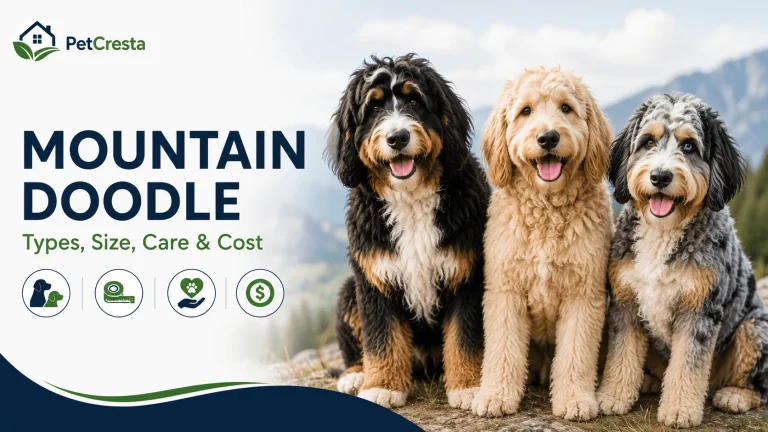
A better match is likely to have enough room for a large body, some financial resources to cover ongoing care, a desire to learn and a family that enjoys having a social dog in the house. If you like large Poodle mixes but are still comparing options, a Mountain Doodle has a different parentage and ownership profile worth comparing before you decide
The fit loosens up when portability or low coat maintenance or guaranteed allergy compatibility are key factors.
Home Fit Checklist
You don’t need a score. One serious “no” in the wrong place may matter more than eight easy yeses.
Ask yourself:
- Am I able to control a big dog on a leash?
- If a dog is injured, can I assist him/her to get into the car?
- Is professional grooming for a big coated dog cost effective?
- Will I brush between appointments?
- Is there sufficient usable space in my vehicle?
- Are household stairs and floors manageable?
- Does someone provide regular interaction and exercise?
- Do I have the ability to clean up wet beard and water bowl?
- Is it okay if I don’t know what the final size and shape will be for my adult coat?
- Have I seen actual health-test documentation for parents?
Answer based on the life you have now. Don’t build the decision around a future version of your schedule that may never arrive.
Key Takeaways
Some facts are more important than a bunch of cuddly photos. If you’re considering purchasing one, keep these points in mind.
- Newfiedoodle, Newfypoo and Newfoundland Poodle mix are all used to refer to the same type of cross.
- Parent measurements are more important than marketing labels as adult size can vary significantly.
- Brushing more can lead to less visible shedding.
- There is no guarantee that all Newfypoo dogs will be hypoallergenic.
- Drooling is a trait that some dogs inherit from the Newfoundland side.
- Puppy training is important because little puppy behaviours turn into big dog behaviours.
- Parent-breed health testing should be recorded and traceable.
- A good home wants more than just the look of a big coated dog, it wants the reality.
Even with those facts still making you want to adopt the dog, you’re doing so with a much better idea of what to expect.
FAQ’s
Newfypoo guides place life expectancy around 8–12 years, though there isn’t a standardized lifespan database for the cross. Health history, adult size, inherited disease and individual care can all change the outcome for one dog..
They can suit a committed first-time owner who’s prepared for grooming, training, size and recurring costs. They aren’t a great introduction to dog ownership for someone specifically wanting low effort. Getting professional training help early can make a big dog much easier to live with later.
Thick-coated, large-bodied Newfypoos may be more comfortable exercising in cooler conditions than during hot, humid weather. Their exact heat tolerance still varies with coat, fitness, health and acclimation. Move strenuous activity to cooler hours during hot weather and watch the individual dog rather than relying on breed assumptions.
Some live very comfortably with cats and smaller animals. Success depends on the dog’s behavior, careful introductions and whether the smaller pet has space to disengage. Size alone deserves respect. Friendly play from a very large adolescent can still overwhelm a tiny companion.
Loose hair in a curly or dense coat may stay trapped instead of falling onto the floor. That trapped material needs brushing and combing before it contributes to tangling. So you may vacuum less while spending more time maintaining the dog itself.
Some standard Newfypoo breeding lines report dogs reaching full size from about 18 months onward, with certain individuals continuing to develop toward age two. Behavioral maturity may follow its own timeline, so a dog can look fully grown while still behaving very much like an adolescent.
An F1B Newfypoo usually comes from breeding a first-generation Newfypoo back to a Poodle. That can increase the likelihood of a curlier, more Poodle-influenced coat. It still doesn’t guarantee shedding level, allergy compatibility, adult size or temperament.
There isn’t one useful universal price because puppy prices and ongoing expenses vary by breeder, location and dog. The larger financial question includes professional grooming, food, veterinary care, training, equipment and boarding. Ask local groomers and veterinary clinics for current prices before buying. That gives you a far more realistic ownership budget than the puppy price alone.
References
The sources below support the parent-breed, health, allergy and emergency-care claims used in this guide. Crossbreed-specific estimates are treated separately because they don’t carry the same status as an official breed standard.
- Newfoundland Club of America — Health Statement: hip and elbow evaluation, cardiac screening, cystinuria DNA testing and additional recommended screening. (AKC)
- American Kennel Club — Official Standard of the Newfoundland: parent-breed structure, adult height, adult weight, coat and recognized colors. (AKC Images)
- Poodle Club of America — 2024 Health Statement: current testing recommendations for Standard Poodles, including hips, eyes, thyroid, NEwS and von Willebrand disease type I. (The Poodle Club of America)
- American Kennel Club — Official Standard of the Poodle: Standard Poodle size, coat and breed characteristics. (AKC Images)
- Orthopedic Foundation for Animals: health-test databases, public results and CHIC information. (OFA)
- American Academy of Allergy, Asthma & Immunology: guidance explaining why no dog can be considered completely allergen-free. (AAAAI)
- American College of Allergy, Asthma & Immunology: dog-allergen information covering dander, saliva, fur and urine. (ACAAI Patient)
- MSD Veterinary Manual — Gastric Dilatation and Volvulus: risk factors and emergency warning signs including nonproductive retching, hypersalivation, restlessness and abdominal enlargement. (MSD Veterinary Manual)
- The Doodle Tribe — Newfypoo Guide: breeder-specific examples used only for reported Newfypoo size, maturity and coat variation rather than as official breed standards. (The Doodle Tribe)