Dog Training Challenges: Why Progress Stalls

You can buy the right leash, memorize cue words, and practice every day, yet still feel as though your dog has forgotten everything you taught them.
Dog training challenges are rarely caused by stubbornness alone. Inconsistent rewards, distractions, unclear timing, stress, and unrealistic expectations can all affect how a dog responds.
For owners in a busy city such as Los Angeles, crowded sidewalks, traffic noise, apartment living, and encounters with unfamiliar dogs can make training even more difficult.
Quick Answer: When dog training progress stalls, check whether your dog understands the behavior, whether the environment is too distracting, whether rewards are motivating, and whether stress or discomfort is interfering. Returning to easier exercises, reinforcing desired responses, and increasing difficulty gradually can help rebuild progress.
Understanding what affects your dog’s behavior can make training more consistent, manageable, and rewarding for both of you.
Your Dog Is Learning All the Time, Not Just During Training Sessions

Many owners think of training as a dedicated 10-minute session with treats and commands. Dogs, however, learn from everyday interactions as well.
Walks, mealtimes, greetings, doorways, and opportunities to receive attention all help shape behavior.
This means inconsistent responses can make certain habits harder to change.
If jumping earns attention from visitors occasionally, a dog may continue trying because the behavior has worked before. Similarly, allowing pulling on some walks while discouraging it on others can make leash training less predictable.
Make Everyday Routines Part of Training
The solution is to reinforce desirable behavior during normal activities.
You can:
- Reward calm behavior before preparing a meal.
- Encourage a relaxed response when attaching the leash.
- Practice waiting at doorways.
- Reward four paws on the floor when visitors arrive.
- Reinforce voluntary attention during walks.
These short repetitions help establish predictable expectations without requiring lengthy training sessions.
Consistency matters across the household, too. Everyone who interacts with the dog should understand which behaviors are encouraged and how to respond when unwanted habits appear.
When Progress Stalls, a Professional Perspective Can Help
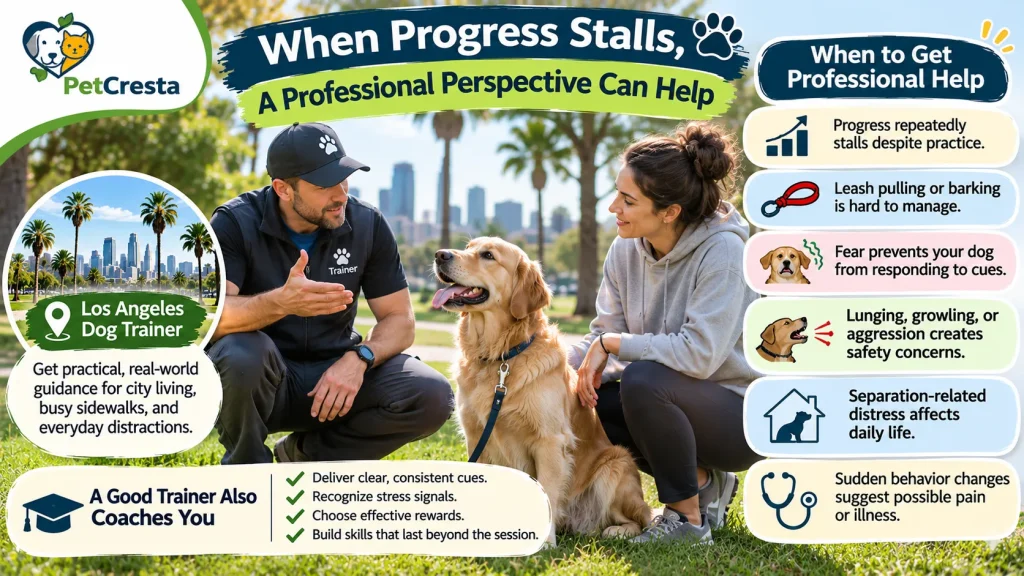
Sometimes owners become so familiar with their dog’s behavior that they overlook the small details contributing to the problem.
An outside perspective can help identify inconsistent cues, accidental reinforcement, leash-handling issues, or training expectations that increase too quickly.
For owners navigating busy urban environments, a Los Angeles dog trainer can offer guidance on practical obedience, behavior challenges, and building skills that work beyond the home.
Training should account for the dog’s everyday surroundings and the situations in which the owner needs reliable responses.
A useful professional approach should also involve coaching the owner.
Learning how to deliver cues, recognize stress signals, choose appropriate rewards, and respond consistently matters because those habits continue long after an individual training session ends.
When Should You Get Professional Dog Training Help?
Not every setback requires professional intervention. However, repeated difficulties may indicate that the training plan needs an experienced assessment.
PetCresta’s guide explaining when a dog needs professional training can help owners distinguish routine obedience difficulties from behaviors that deserve specialist support.
Consider professional assistance when:
- Training progress repeatedly stalls despite consistent practice.
- Leash pulling or barking becomes difficult to manage.
- Fear prevents your dog from responding to familiar cues.
- Lunging, growling, or aggressive behavior creates safety concerns.
- Separation-related distress affects everyday life.
- Sudden behavior changes suggest possible pain or illness.
For severe fear, aggression, or anxiety, a veterinarian and appropriately qualified behavior professional may need to work together.
Choose trainers who use reward-based methods and explain how they will adapt training to your dog’s needs.
The Environment Can Change How Well Your Dog Responds

A dog that responds reliably to a command at home may struggle to follow the same cue outside.
This does not necessarily mean the training has failed. The surroundings may simply make the task more difficult.
Dogs need opportunities to practice learned behaviors in different environments.
A quiet living room offers fewer distractions than a busy sidewalk, park, or outdoor café. New smells, moving vehicles, unfamiliar dogs, and passing strangers can compete for attention.
Why Does My Dog Listen at Home but Not Outside?
A dog may understand a cue in one setting but need additional practice before responding reliably elsewhere.
This is often described as generalization: learning that the same cue applies in different places and situations.
Start practicing in a familiar, quiet environment. Then introduce manageable distractions one at a time.
If your dog struggles, increase the distance from the distraction or return to an easier setting before trying again.
The American Kennel Club explains this process in its guidance on why dogs may behave differently outside the home.
The goal is to build confidence and reliability through gradual practice rather than expecting immediate performance in every situation.
Timing Makes a Bigger Difference Than Many Owners Realize
Even when you use the right cue and reward, delayed timing can make a lesson confusing.
Dogs are more likely to connect reinforcement with the behavior happening immediately before it.
For example, if your dog stops barking, turns away, and then receives a treat, the reward may reinforce turning away rather than the specific response you intended to encourage.
The distinction can be difficult to notice, particularly when several things happen within a few seconds.
How Marker Training Can Improve Communication
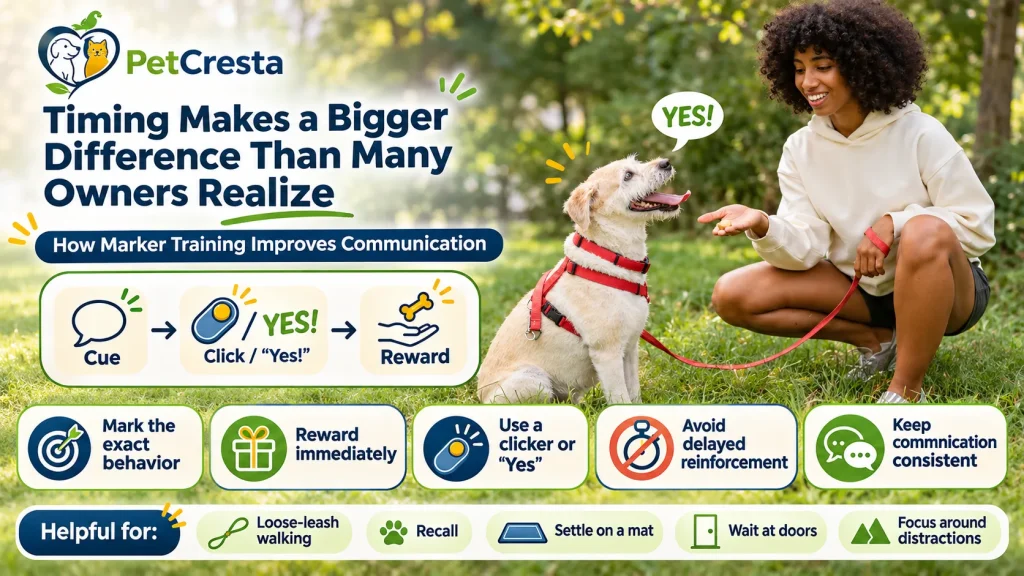
Marker training uses a consistent signal to identify the behavior that earned a reward.
A clicker or a short verbal marker such as “yes” can tell your dog which action you want to reinforce.
You can then follow the marker with a treat, toy, praise, or another appropriate reward.
This approach can help with:
- Loose-leash walking.
- Recall.
- Settling on a mat.
- Waiting calmly near doors.
- Responding around manageable distractions.
Your timing doesn’t need to be flawless, but consistent communication makes it easier for your dog to understand what you’re asking.
Stress Can Affect Behavior Before the Signs Become Obvious
Owners often recognize stress only after a dog starts barking, lunging, or pulling frantically.
However, less obvious signals may appear first.
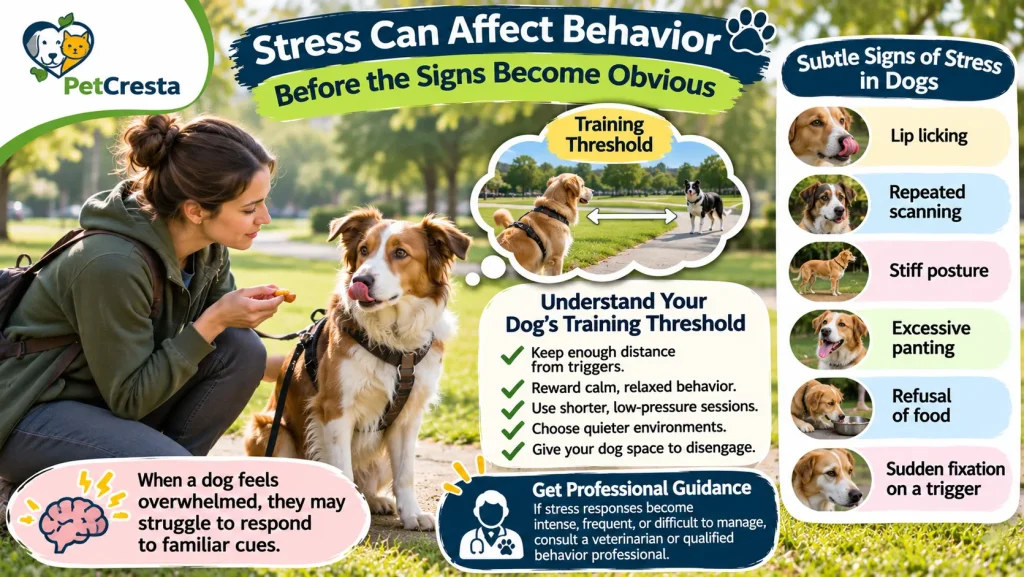
Lip licking, repeated scanning, a stiff posture, excessive panting, refusal of food, or sudden fixation on a particular trigger can indicate discomfort or rising arousal.
These signals should be interpreted in context because they can also occur for other reasons.
A dog that feels overwhelmed may struggle to respond to familiar cues.
Continuing to increase training demands in that situation can make learning less productive.
Understand Your Dog’s Training Threshold
A training threshold is the point at which a distraction or trigger becomes difficult for your dog to manage calmly.
For example, a dog may remain relaxed and accept treats while watching another dog across the street but become tense when that dog approaches.
The greater distance may provide a better opportunity to reward calm observation and build confidence.
Give your dog room to disengage when necessary.
Shorter sessions, greater distance from triggers, and quieter surroundings can help create conditions where learning is more likely to succeed.
If stress responses become intense or frequent, ask a veterinarian or qualified behavior professional for guidance.
The Wrong Reward Can Make Effective Training Feel Unsuccessful
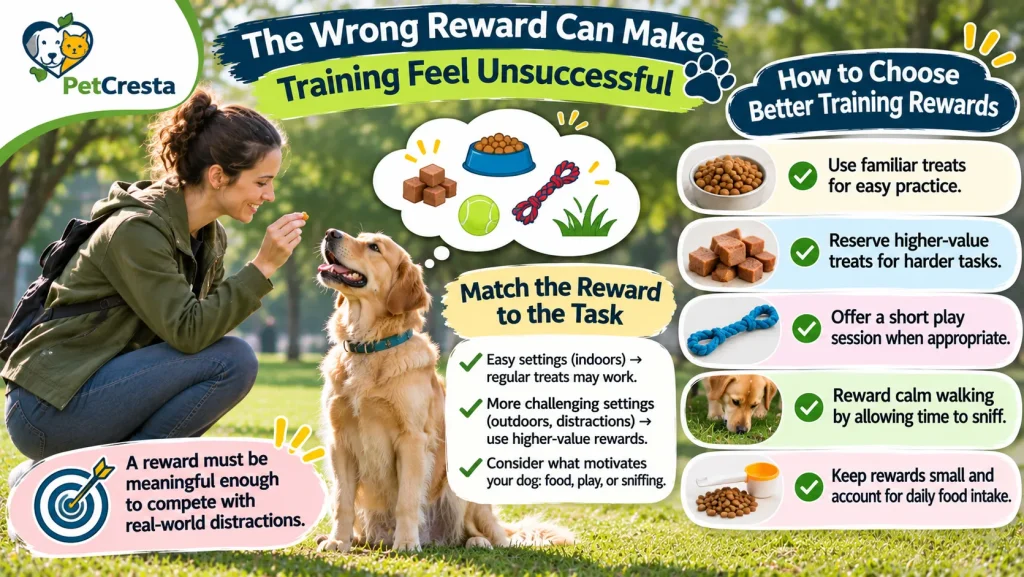
Not every reward has the same value to every dog.
Ordinary kibble may be enough to maintain attention indoors but may not compete with squirrels, unfamiliar dogs, or outdoor smells.
The reward should match the difficulty of the task.
More challenging environments may call for higher-value treats, a favorite toy, a short game, or access to something the dog enjoys, such as an opportunity to sniff.
How to Choose Better Training Rewards
Start by observing what motivates your individual dog.
Some dogs respond enthusiastically to food, while others prefer play, movement, or social interaction.
Experiment with different options and observe which rewards help maintain attention.
For example:
- Use familiar treats for easy indoor practice.
- Reserve especially appealing treats for harder tasks.
- Offer a short play session as a reward when appropriate.
- Reward calm walking by allowing time to sniff.
- Keep rewards small and account for treats within the dog’s daily food intake.
Avoid assuming that your dog is being difficult simply because it ignores a low-value reward in a highly distracting environment.
The reward may not be meaningful enough, or the situation may be too challenging.
Adjusting reinforcement and reducing difficulty can make training more productive.
Progress Is Rarely Linear, Even When Training Is Working
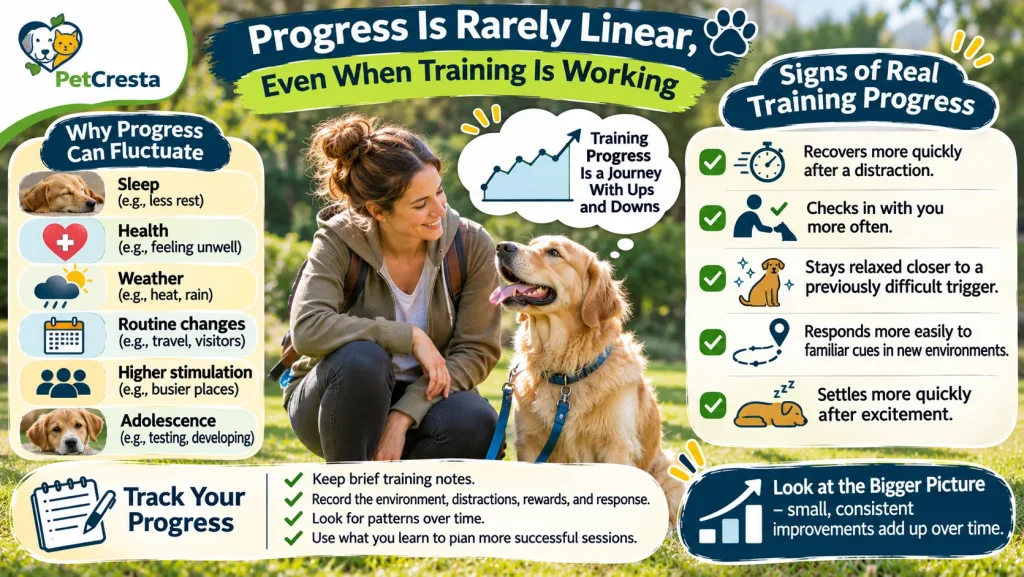
One difficult walk or unsuccessful session does not necessarily mean that previous training has been lost.
Dogs can respond differently depending on sleep, health, weather, changes in routine, visitors, and the level of stimulation around them.
Adolescence can introduce additional challenges as dogs develop and their responses to familiar situations change.
Owners may find that a behavior that seemed reliable a few weeks earlier needs more practice.
How to Recognize Real Training Progress
Instead of judging progress through individual sessions, look for broader patterns.
Ask yourself:
- Does your dog recover more quickly after becoming distracted?
- Does your dog voluntarily check in with you more often?
- Can your dog remain relaxed closer to a previously difficult trigger?
- Are familiar cues becoming easier in new environments?
- Can your dog settle more quickly after excitement?
These changes can indicate meaningful improvement, even when occasional setbacks continue.
Keeping brief training notes can make patterns easier to recognize.
Record the environment, distractions, rewards used, and your dog’s response.
Over time, this information can help you identify what supports successful sessions and what makes them more difficult.
Better Training Starts With Observation, Not More Commands
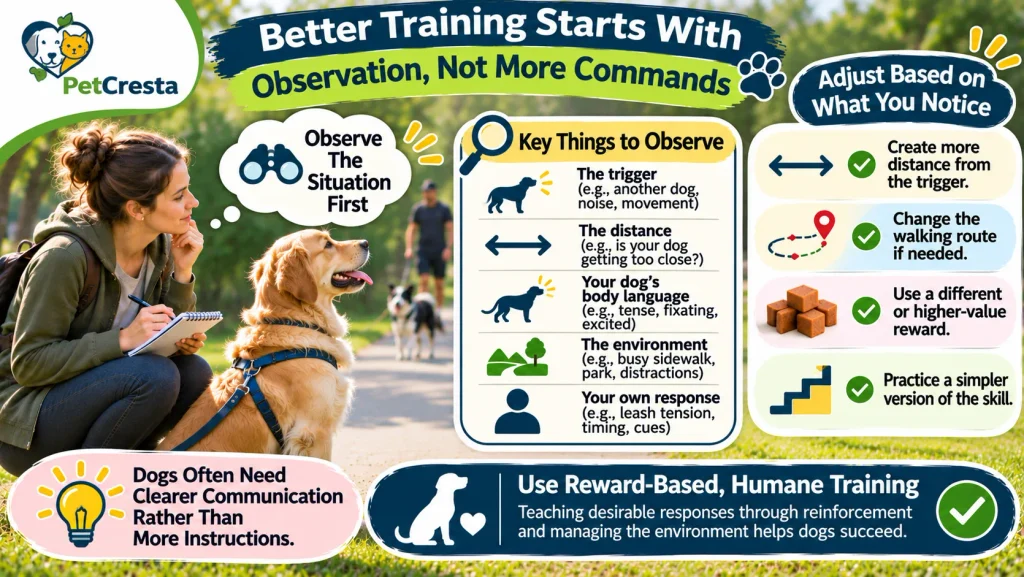
When owners feel frustrated, they may repeat commands, increase their volume, or tighten control.
However, dogs often need clearer communication rather than additional instructions.
Start by observing what happens immediately before an unwanted behavior.
Consider the trigger, distance, body language, environment, and your own response.
If your dog repeatedly pulls toward other dogs, notice whether the behavior begins when another dog appears, when the distance decreases, or when the leash becomes tight.
Understanding these patterns allows you to make adjustments before the behavior escalates.
You may need to create more distance, change the walking route, use a different reward, or practice a simpler version of the skill.
The American Veterinary Society of Animal Behavior emphasizes reward-based methods in its position statement on humane dog training..
Its guidance supports teaching desirable responses through reinforcement and managing the environment to help dogs succeed.
Build a Training Routine That Supports Long-Term Progress
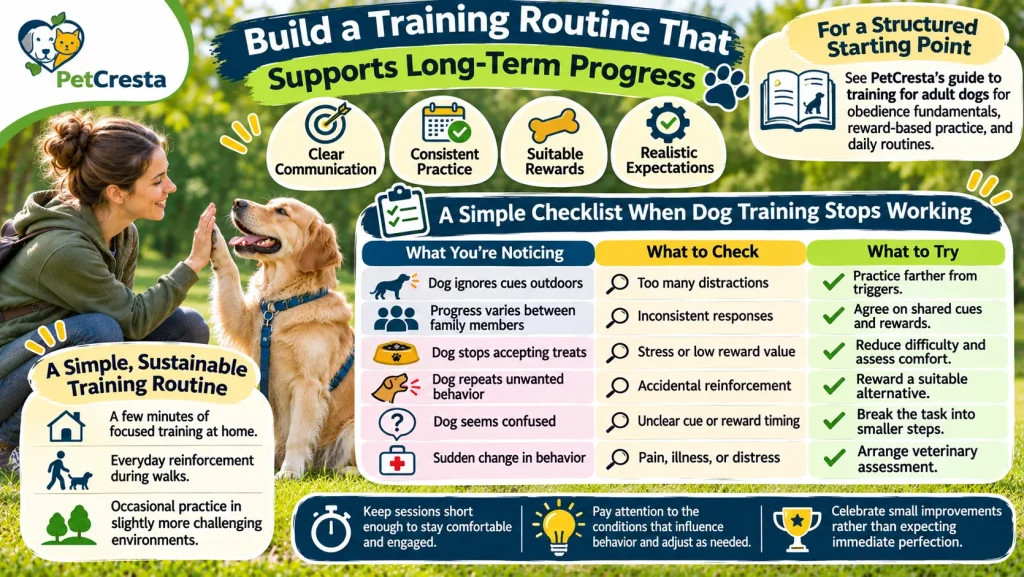
Successful training is not about getting every response right on the first attempt.
It comes from clear communication, realistic expectations, suitable rewards, and consistent practice in different situations.
A manageable routine might include a few minutes of focused training at home, everyday reinforcement during walks, and occasional practice in slightly more challenging environments.
For owners who want a structured starting point, PetCresta’s guide to training for adult dogs covers obedience fundamentals, reward-based practice, and ways to build reliable behavior through daily routines.
A Simple Checklist When Dog Training Stops Working
| What You’re Noticing | What to Check | What to Try |
|---|---|---|
| Dog ignores cues outdoors | Too many distractions | Practice farther from triggers |
| Progress varies between family members | Inconsistent responses | Agree on shared cues and rewards |
| Dog stops accepting treats | Stress or low reward value | Reduce difficulty and assess comfort |
| Dog repeats unwanted behavior | Accidental reinforcement | Reward a suitable alternative |
| Dog seems confused | Unclear cue or reward timing | Break the task into smaller steps |
| Sudden change in behavior | Pain, illness, or distress | Arrange veterinary assessment |
Keep sessions short enough that your dog can remain comfortable and engaged.
Pay attention to the conditions that influence behavior, and adjust the difficulty when necessary.
Celebrate small improvements rather than expecting immediate perfection.
Final Takeaway
Dog training progress rarely follows a perfectly straight line.
When your dog stops responding as expected, more commands or stricter corrections are not necessarily the answer.
Look at the environment, reward value, timing, consistency, stress levels, and whether the behavior has been practiced in enough different situations.
Make training easier when your dog becomes overwhelmed, reinforce successful responses, and increase difficulty gradually.
When problems persist, a qualified reward-based trainer or veterinary behavior professional can help identify factors that are difficult to recognize on your own.
Better training begins with understanding what your dog is experiencing, not assuming every setback is disobedience.
FAQ’s
Progress may stall because of inconsistent cues, distractions, poor reward timing, stress, or expectations that increase too quickly. Health problems can also affect behavior. Review the training conditions and return to simpler exercises when necessary.
Outdoor environments contain more distractions and competing rewards. Your dog may need gradual practice in different settings before a familiar cue becomes reliable outside the home.
Common mistakes include repeating cues excessively, rewarding the wrong behavior, increasing difficulty too quickly, using inconsistent household rules, and overlooking signs of stress.
Begin in a quiet environment, use meaningful rewards, keep sessions manageable, and gradually introduce distractions. Reward voluntary attention and avoid expecting sustained focus when your dog is overwhelmed.
Repeatedly saying the same cue may make communication less clear. Check whether your dog understands the behavior, whether the environment is too difficult, and whether you need to return to an easier exercise.
Yes. Fear, anxiety, overstimulation, and discomfort can interfere with attention and learning. Look for changes in posture, behavior, and willingness to engage, and adjust the training environment accordingly.
The best reward is something your individual dog finds motivating in that situation. Food, toys, play, praise, or opportunities to sniff can all work depending on the dog and the task.
Short, focused sessions often work well. Several minutes of successful practice can be more productive than a long session where attention declines or frustration increases.
Consider professional help when consistent home practice isn’t producing progress, unwanted behaviors create safety concerns, or your dog shows persistent fear, reactivity, or severe distress. Sudden behavior changes also warrant veterinary assessment.
Yes. Adult dogs can learn new skills and improve established behaviors through clear communication, reward-based teaching, repetition, and appropriate management. Progress depends on the dog’s health, history, and individual circumstances.