
Why Professional Dog Training Matters For Emotional Support Animals

For the purpose of providing emotional support, an emotional support animal does not require specialized task training. The animal’s presence and bond with its owner provide comfort.
That does not negate the significance of training.
Regular behaviors like pulling on the leash, barking at guests, hurrying through doors, jumping on people, or finding it difficult to settle can make daily routines more difficult for people who live with an emotional support dog. Without altering the dog’s legal role, professional dog training for emotional support animals can help solve those practical issues.
Teaching an emotional support dog how to show affection is not the goal of training. The goal is to create routines that are predictable, safer, and easier for both the owner and the dog to follow on a daily basis.
Quick Answer: Why Does Training Matter for an Emotional Support Dog?
An emotional support dog that receives professional training can acquire practical daily skills like:
- Walking calmly on a leash
- dependable recall
- Choosing a mat or bed
- Kindly greetings
- Awaiting doors
- Reacting to distractions
- Staying more composed around guests
- Managing communal areas more comfortably
- Adhering to regular household practices
Obedience training does not convert an ESA into a service dog, and training is not a legal requirement that automatically qualifies a dog as an emotional support animal.
Its usefulness is more straightforward: a dog that is simpler to comprehend and control can develop into a more trustworthy daily companion.
Emotional Support And Dog Training Are Different Things

Through presence and companionship, an emotional support animal offers emotional support related to disabilities.
Under the Americans with Disabilities Act, that is not the same as a service dog. A service dog is specially trained to carry out jobs or particular duties that are directly associated with a person’s disability.
For the purpose of providing emotional support, an emotional support dog does not require task training related to disabilities.
In housing matters, the U.S. Department of Housing and Urban Development explains that assistance animals can include animals that provide emotional support related to a person’s disability. HUD’s assistance animal guidance focuses on the disability-related need for the animal and the accommodation being requested rather than requiring a particular obedience certificate.
That distinction is important because owners may encounter websites or businesses suggesting that a training certificate, online registration, vest, or identification card automatically establishes an animal’s legal status.
Training and legal classification should be treated as separate questions.
An emotional support dog may be extremely well trained and still remain an ESA. A poorly trained dog may still provide meaningful emotional support, although difficult behavior can make everyday life considerably harder.
Readers who are unsure how ESAs differ from task-trained service dogs may also find PetCresta’s guide to what conditions qualify for a service dog helpful.
Good Everyday Behavior Can Make an ESA Easier to Live With
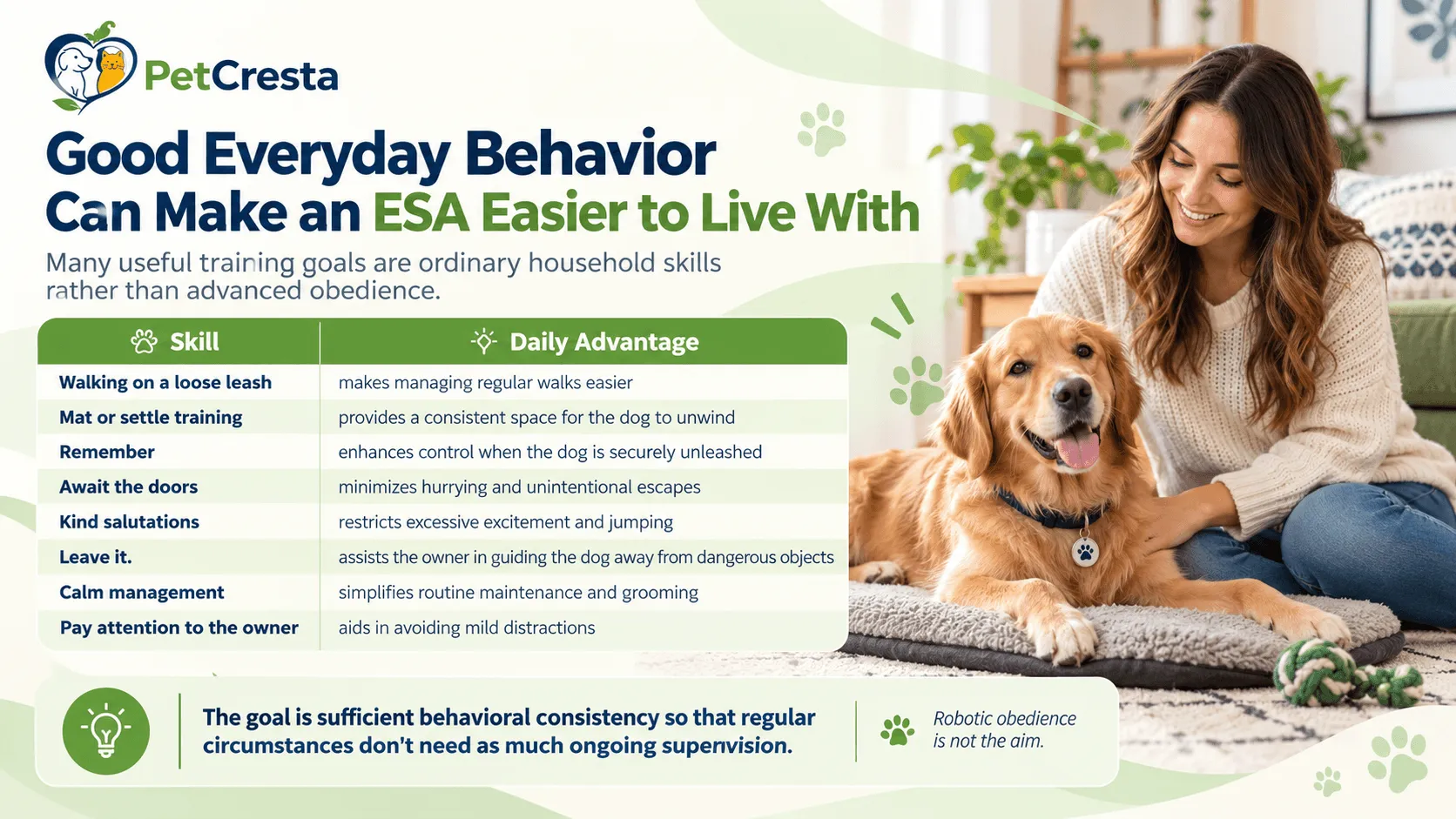
Many useful training goals are ordinary household skills rather than advanced obedience.
Consider a dog that becomes highly excited whenever somebody approaches the front door. Barking, jumping, circling, or rushing toward the entrance may increase tension in a situation that is already stressful for the owner.
A trainer may instead teach the dog to move to a mat or designated resting place when the doorbell rings.
The same principle applies to walking.
A dog that can pass another person or dog without pulling, lunging, or trying to escape is easier to handle than one whose behavior becomes unpredictable whenever the environment changes.
Useful everyday skills can include:
| Skill | Daily Advantage |
|---|---|
| Loose-leash walking | Makes routine walks easier to manage |
| Settle or mat training | Gives the dog a consistent place to relax |
| Recall | Improves control when the dog is safely off leash |
| Wait at doors | Reduces rushing and accidental escapes |
| Polite greetings | Limits jumping and overexcitement |
| Leave it | Helps the owner redirect the dog from unsafe items |
| Calm handling | Makes grooming and routine care easier |
| Attention to owner | Helps around moderate distractions |
The goal is sufficient behavioral consistency so that regular circumstances don’t need as much ongoing supervision.
Professional Training Can Reduce Avoidable Stress

When everyone knows what is expected of them, living with a dog becomes more predictable.
Clear patterns are beneficial to dogs. The dog has a clear behavior to repeat if it regularly receives attention, praise, food, play, or another appropriate reward for settling peacefully close to the owner.
The same predictability is advantageous to owners.
Rather than responding differently each time an issue arises, they can employ well-known cues and routines in typical circumstances like:
- responding to the door
- strolling through the hallways of apartments
- Getting into elevators
- greeting guests
- Getting into a vehicle
- Going to the veterinarian
- Settling while the proprietor is at work
- Walking dogs passing by
Additionally, professional training can assist owners in distinguishing between a dog that is overwhelmed, confused, fearful, frustrated, or excited.
It is possible for two dogs to bark at strangers while feeling quite different emotions.
Because one wants to get close, one could become irritated.
Someone else might be scared and attempting to get farther away.
It might not be possible to address the underlying cause of the behavior if you respond to both dogs in exactly the same way.
Owners who are struggling with repeated pulling, fear, reactivity, unreliable recall, overexcitement, or similar problems may benefit from a professional dog training facility where the dog’s behavior and environment can be evaluated more individually.
PetCresta’s guide explaining when a dog needs professional training also covers the point at which home practice may no longer be enough.
What Should an Emotional Support Dog Be Trained to Do?

Every emotional support dog is not required to fulfill a universal obedience checklist.
The owner’s actual everyday struggles should serve as the basis for training objectives.
Dogs that live in busy apartment buildings may require different skills than those that live in quiet detached homes.
Some beneficial objectives could be teaching the dog to:
Settle Calmly
A settle or mat behavior can help when the owner is working, eating, talking with visitors, or completing household tasks.
Walk Without Constant Pulling
Loose-leash skills make walks easier and reduce the need for continuous physical restraint.
Respond Around Everyday Distractions
A dog may understand “sit” in the kitchen but struggle to respond in a hallway, parking lot, or busy outdoor area.
Training should gradually transfer known skills into the environments where they are actually needed.
Greet People Politely
Jumping may seem harmless with familiar people but becomes difficult around children, older adults, visitors, or people who are uncomfortable around dogs.
Wait at Doors
Door rushing creates an escape risk and can make arrivals and departures chaotic.
Come When Called
A strong recall provides an important layer of safety, although dogs should still be appropriately confined or leashed where required.
Relax During Routine Handling
Comfort with brushing, paw handling, harnesses, collars, and routine veterinary handling can make everyday care less stressful.
Owners working with an older dog can also use PetCresta’s guide to training an adult dog for practical advice on reinforcement, distractions, and replacing established habits.
Professional Guidance Is More Important for Serious Behavior Problems

Some training concerns are ordinary manners.
Others deserve more specialized attention.
Fear, aggression, resource guarding, severe separation-related distress, panic, and intense reactivity are not simply failures to teach basic commands.
Behavior can be influenced by:
- learning history
- genetics
- previous experiences
- environmental triggers
- fear or frustration
- inadequate social exposure
- pain
- illness
- neurological changes
- other medical factors
A sudden behavior change deserves particular attention because discomfort or illness can sometimes alter how a dog reacts.
Professional dog training for emotional support animals should therefore be matched to the actual problem.
A basic obedience instructor may be appropriate for leash skills or household manners.
More serious fear, aggression, or anxiety-related behavior may call for a veterinarian, veterinary behaviorist, or appropriately qualified behavior professional.
Training should not be used as a substitute for veterinary assessment when a health problem could be contributing.
Use Reward-Based Training Methods

Training method matters as much as the skill being taught.
The American Veterinary Society of Animal Behavior recommends reward-based methods for dog training and behavior modification.
In practice, this means reinforcing behaviors the owner wants to see more often instead of relying on fear, intimidation, pain, or physical punishment.
Rewards may include:
- food
- toys
- play
- praise
- access to something the dog wants
- permission to move forward
- environmental opportunities such as sniffing
The reward should be meaningful to the individual dog.
A dog that loves food may work eagerly for a small treat, while another may respond more strongly to a toy or the opportunity to continue walking.
Clear timing also matters. The dog needs to understand which behavior produced the reward.
What Professional Dog Training Cannot Do
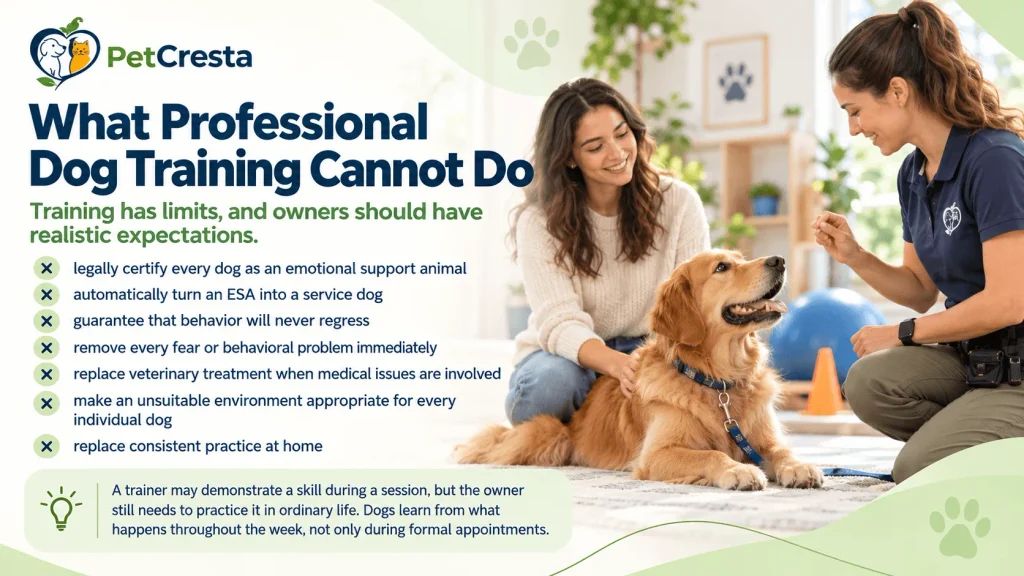
Training has limits, and owners should have realistic expectations.
Professional training cannot:
- legally certify every dog as an emotional support animal
- automatically turn an ESA into a service dog
- guarantee that behavior will never regress
- remove every fear or behavioral problem immediately
- replace veterinary treatment when medical issues are involved
- make an unsuitable environment appropriate for every individual dog
- replace consistent practice at home
A trainer may demonstrate a skill during a session, but the owner still needs to practice it in ordinary life.
Dogs learn from what happens throughout the week, not only during formal appointments.
Training an ESA Does Not Turn It Into a Service Dog
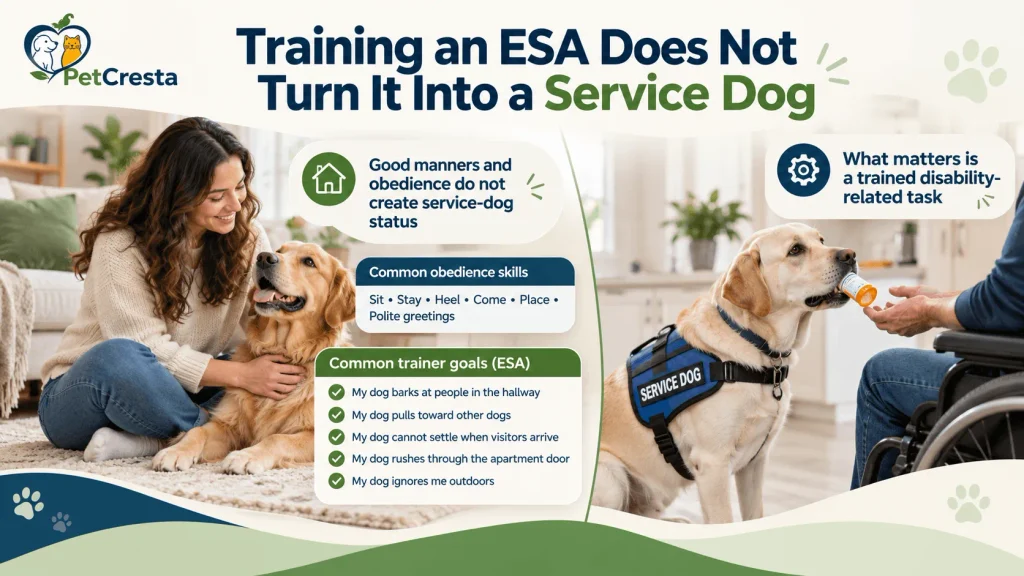
This distinction deserves special attention.
An emotional support dog can have excellent manners and still remain an emotional support animal.
Under the ADA, a service dog is trained to perform specific work or tasks directly related to an individual’s disability. Emotional comfort from the dog’s presence alone is treated differently.
General obedience skills such as:
- sit
- stay
- heel
- come
- place
- polite greetings
do not themselves establish service-dog status.
The difference is the disability-related task.
That means owners should describe their goals clearly when contacting a trainer.
Instead of saying:
“My ESA needs training.”
A more useful description would be:
“My dog barks at people in the hallway.”
“My dog pulls toward other dogs.”
“My dog cannot settle when visitors arrive.”
“My dog rushes through the apartment door.”
“My dog ignores me outdoors.”
Specific problems give the trainer something measurable to assess and improve.
How to Choose a Trainer for an Emotional Support Dog
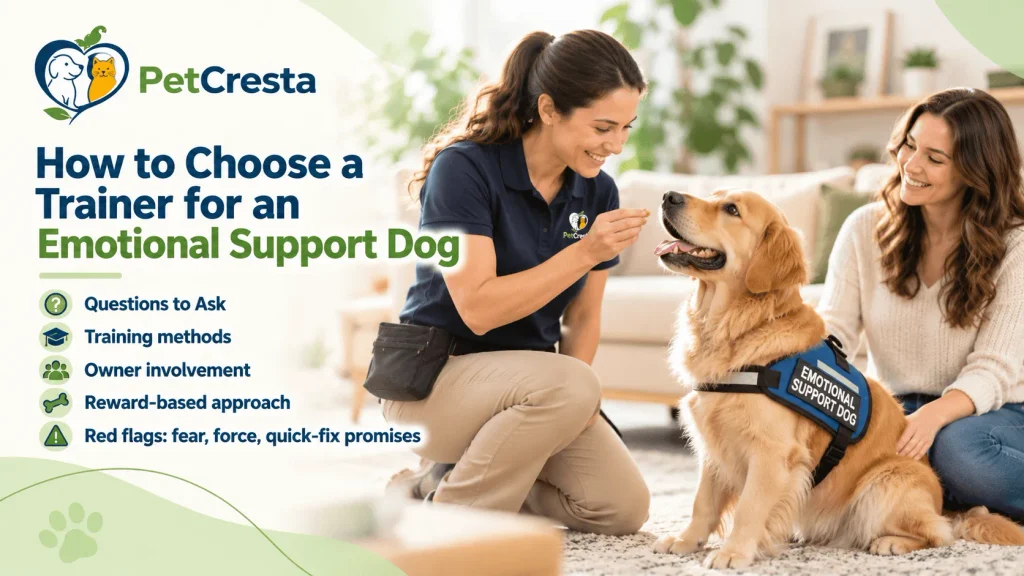
Not everyone in the dog training industry employs the same techniques, training, or professional standards.
Inquire about the trainer’s methods before signing up.
Examples of good questions are:
- Which training techniques do you employ?
- How do you deal with acts of fear?
- Will I take part in the course?
- How will we put the behavior into practice at home?
- What would happen if the dog started to feel anxious during a session?
- Do you employ strategies based on rewards?
- What experience do you have with my dog’s current behavior?
- When would you send a case to a behaviorist or veterinarian?
When someone uses a lot of physical force, intimidation, pain, or fear, or promises to solve every behavioral issue right away, be wary.
A competent trainer should instruct both the dog and the owner.
The owner has not yet received a fully functional system if the dog only behaves well when the trainer is holding the leash.
Build Training Goals Around Everyday Life

When professional training focuses on issues that truly impact the household, it is most beneficial.
Start by figuring out what issues keep coming up.
Examples include:
- Barking at sounds in the hallway
- Leaping on visitors
- Pulling on walks
- Having trouble settling
- Getting too excited before leaving the house
- Disregarding recall
- Hurrying through doors
- Strong reactions to dogs that are unfamiliar
- Inability to endure routine handling
Next, turn the issue into a training objective.
Rather than:
“Stop barking.”
Utilize:
“Go to the mat when someone approaches the door.”
Rather than:
“Stop pulling.”
Utilize:
“Walk beside me on a loose leash for short distances.”
Rather than:
“Calm down.”
Utilize:
“Lie on the mat for five minutes while I work.”
It is simpler to teach, practice, and assess clear behavior goals.
A Well-Trained ESA Can Be a More Dependable Companion
For the purpose of providing comfort, an emotional support dog does not require advanced obedience.
Because daily behavior influences how manageable the relationship feels, professional dog training is important for emotional support animals.
A dog may need less constant supervision from its owner if it can settle, walk calmly, react to familiar cues, and handle everyday situations better.
Perfection is not the goal.
In this relationship, both the dog and the owner are able to navigate everyday life with more defined expectations; the dog is able to comprehend common routines, and the owner is able to guide behavior.
When a problem goes beyond simple obedience, training should continue to be tailored to each dog, employ humane reward-based techniques, and involve behavioral or veterinary specialists.
FAQs
No federal rule requires every emotional support dog to complete professional obedience training simply to provide emotional support. Professional training may still be useful when behavior problems or weak everyday manners make the dog difficult to manage.
An obedience certificate is not what determines whether an animal provides disability-related emotional support. Housing accommodation questions should be evaluated under applicable housing law and current HUD guidance rather than commercial certification claims.
Not by itself. General obedience does not make a dog a service dog under the ADA. A service dog must be individually trained to perform work or tasks directly related to a person’s disability.
A universal command list is not required. Recall, walking on a loose leash, waiting, leaving it, settling on a mat, courteous greetings, and reacting to the owner in the face of common distractions are all examples of useful skills.