Brown Ragdoll Cats Explained: Seal, Chocolate and Cinnamon Compared
Search for a “brown Ragdoll cat” online and you will quickly discover that the term can mean several different things.
One person may be describing a dark seal Ragdoll. Another may mean chocolate. Someone else may have seen the lighter reddish-brown coloring of cinnamon and simply called it brown.
That creates understandable confusion for families trying to identify kittens or compare breeders.
The problem is that brown is a visual description, not a precise Ragdoll color identification. Seal, chocolate and cinnamon can all look brown to the human eye, yet they represent different pigmentation and can develop quite differently as the cat matures.
Understanding those differences makes it easier to read breeder descriptions, compare photographs and recognize why genetics often tells us more than a color label alone.
Quick Answer: What Is a Brown Ragdoll Cat?
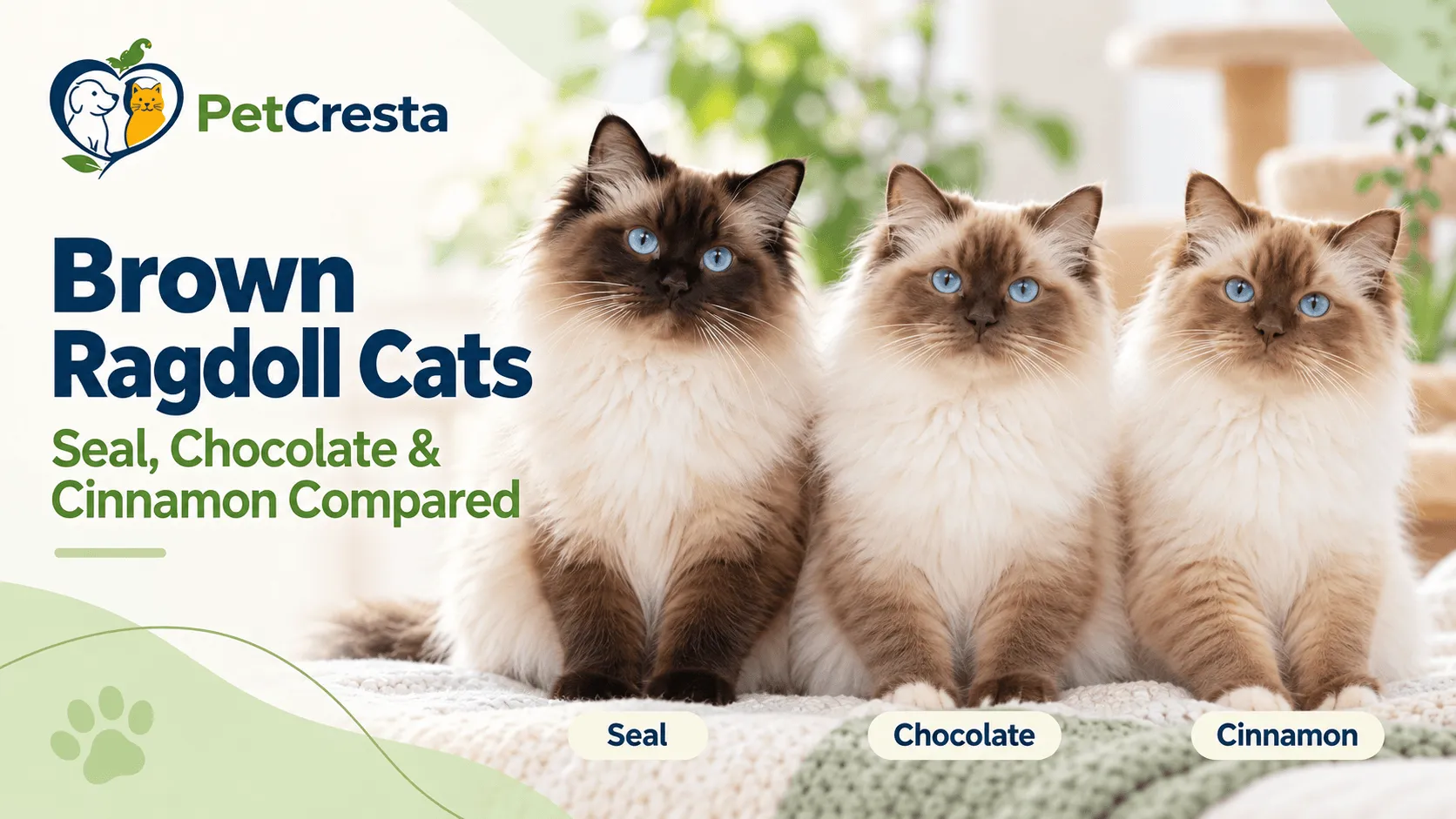
A “brown Ragdoll cat” is not one specific genetic color. The term usually describes a Ragdoll that visually appears brown, most often seal, chocolate, or, under standards that recognize it, cinnamon. Seal is typically darkest, chocolate is warmer and lighter, and cinnamon has a lighter reddish-brown appearance. Age, pattern, lighting, and genetics all affect how these colors look.
What Does “Brown Ragdoll” Actually Mean?
“Brown Ragdoll” is useful when someone is describing what a cat looks like.
However, it is not specific enough to tell us the cat’s genetic color.
Several Ragdoll colors can produce a brown appearance, particularly:
- seal
- chocolate
- cinnamon
Even within one color, the exact appearance can vary because of age, pattern, body shading, lighting and individual genetics.
A mature seal Ragdoll may have very dark brown points. Chocolate is generally warmer and lighter. Cinnamon moves further toward a softer reddish-brown tone.
Yet photographs can blur those distinctions.
That is why a responsible breeder should be able to explain more than:
“This kitten is brown.”
The useful question is:
What color is producing that brown appearance?
Why Several Ragdoll Colors Can Look Brown
Cat coat color begins with pigment.
One of the main pigments involved is eumelanin, which normally produces dark coloration.
Different genetic variants can change how that pigment appears.
As a result, colors that are genetically distinct may still fall somewhere within what an ordinary observer would call “brown.”
Ragdolls add another complication because they are pointed cats.
Their pigment is concentrated more strongly on cooler parts of the body, particularly the:
- ears
- face
- tail
- legs
- feet
The body remains lighter.
Therefore, when people describe a Ragdoll as brown, they are usually talking primarily about its points, not an evenly brown coat from nose to tail.
Seal Ragdolls
Seal is one of the colors most often described casually as brown.
A mature seal Ragdoll usually develops deep, rich brown points. Depending on lighting, the darkest areas can look almost black.
The body is much lighter, although adult cats can develop additional shading with age.
Seal therefore produces strong contrast between the point color and the lighter body.
This is important because people sometimes assume the word “seal” refers to a completely different color family.
In reality, if you see a Ragdoll with very dark brown facial, ear and tail pigmentation, seal is often the color being described.
CFA’s current Ragdoll standard describes seal points as deep seal brown, which helps explain why consumers frequently use “brown” when talking about them.
Chocolate Ragdolls
Chocolate produces a softer and warmer brown appearance than seal.
Instead of deep dark-brown points, chocolate typically gives the impression of:
- milk chocolate
- warm medium brown
- softer brown pigmentation
The body also tends to appear lighter.
Chocolate can be difficult for inexperienced buyers to identify because photographs vary so much.
Under certain lighting, a chocolate Ragdoll may look surprisingly dark. Under brighter natural light, the same cat can appear much softer and warmer.
Age matters too.
A young chocolate kitten may have only lightly developed points, making comparisons with a mature adult unreliable.
Therefore, identifying chocolate is easier when several clues agree:
- point color
- age
- parent colors
- nose leather
- paw pads
- pedigree
- genetics when available
Cinnamon Ragdolls
Cinnamon sits at the warmer and lighter end of this brown-color comparison.
Rather than deep seal brown or milk-chocolate brown, cinnamon typically produces a lighter reddish-brown appearance.
Depending on the cat and lighting, people may describe it as:
- cinnamon brown
- reddish-brown
- warm caramel
- light warm brown
- softly copper-toned
However, cinnamon is not just a marketing name for an unusually warm chocolate cat.
It has its own genetic basis.
That distinction becomes important when a family is researching a cinnamon Ragdoll cat for sale.
A kitten should not be advertised as cinnamon merely because a photograph looks unusually warm.
Parent genetics, pedigree and DNA testing can provide much stronger evidence.
The Genetics Behind Chocolate and Cinnamon
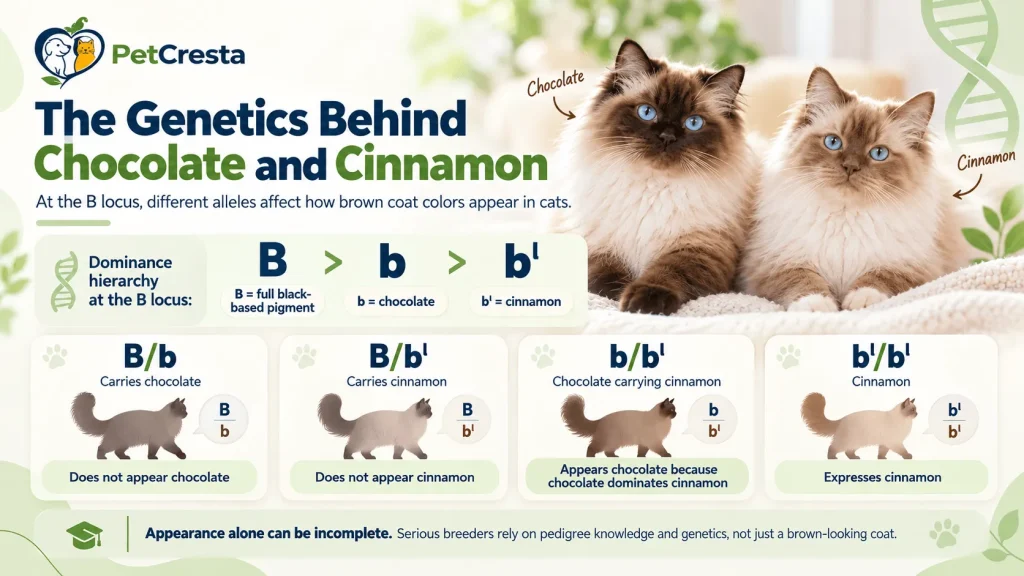
The difference becomes much clearer when we look at the B locus.
According to feline coat-color genetics, three important alleles in this system are:
- B — full black-based pigment
- b — chocolate
- bˡ — cinnamon
Their dominance order is:
B > b > bˡ
This matters because a recessive color can be hidden.
A cat carrying chocolate
A cat with:
B/b
can carry chocolate without appearing chocolate.
A cat carrying cinnamon
A cat with:
B/bˡ
can carry cinnamon without looking cinnamon.
Chocolate carrying cinnamon
A cat with:
b/bˡ
appears chocolate because chocolate dominates cinnamon, yet the cat still carries the cinnamon allele.
Cinnamon
A cinnamon cat has:
bˡ/bˡ
and therefore expresses cinnamon rather than having it masked by a more dominant allele.
This is why appearance alone can be incomplete.
A breeder working seriously with cinnamon should understand how the color travels through a pedigree rather than simply selecting cats that look brown.
Seal vs Chocolate vs Cinnamon at a Glance
Here is a simple comparison:
| Color | General visual impression | Relative appearance |
|---|---|---|
| Seal | Deep, rich brown points | Darkest |
| Chocolate | Warm milk-chocolate brown | Softer and lighter than seal |
| Cinnamon | Warm reddish-brown or light cinnamon tone | Generally warmest and lighter |
This table is useful, but it should not be treated as a perfect identification test.
Real cats are more complicated than three paint swatches.
Their appearance also depends on:
- age
- coat development
- pattern
- white spotting
- lynx markings
- body shading
- lighting
- photography
- seasonal changes
That is why genetic information becomes especially valuable with rarer colors.
Why Kittens Are Harder to Identify Than Adults
Ragdoll kittens begin life very pale.
Because pointed coloration is temperature-sensitive, the characteristic darker areas gradually develop after birth.
As the kitten grows, pigment becomes increasingly noticeable around the:
- ears
- nose and face
- tail
- feet
- legs
This development continues for much longer than many first-time Ragdoll families expect.
TICA notes that Ragdolls mature slowly and may take around three years to reach their full color.
Therefore, comparing an eight-week-old cinnamon kitten with a three-year-old chocolate Ragdoll can create the wrong impression.
The adult has had years to develop pigment and body shading.
The kitten has barely started.
When evaluating brown Ragdoll kittens, families should therefore ask how old each kitten is before making color comparisons.
How Lighting Changes Brown Coat Colors
Lighting is one of the biggest sources of confusion in online cat photographs.
Warm colors are especially sensitive to changes in white balance and surrounding light.
Warm indoor bulbs
Yellow household lighting can make brown pigmentation appear warmer and more reddish.
A chocolate Ragdoll may consequently look much closer to cinnamon.
Cool LED lighting
Cool light can remove some of the warmth from the coat.
Cinnamon may look duller or slightly gray compared with its appearance in daylight.
Direct sunlight
Strong sunlight can exaggerate golden, reddish and copper undertones.
It may also create bright highlights that make point color difficult to judge.
Indirect daylight
Soft natural light usually provides one of the best conditions for comparing similar coat colors.
For this reason, a breeder working with rare colors should ideally provide more than one photograph.
A short video in natural light can sometimes be more useful than ten heavily edited portraits.
Pattern Changes the Overall Appearance Too
A Ragdoll’s color and pattern are separate characteristics.
The same base color can therefore look very different depending on how white spotting and pattern genes affect the coat.
Colorpoint
Colorpoint Ragdolls display their point color without the extensive white areas seen in mitted and bicolor cats.
That can make the underlying brown shade easier to evaluate.
Mitted
Mitted Ragdolls have white feet and other white areas.
Consequently, less of the point pigment may be visible on certain parts of the legs.
Bicolor
Bicolor Ragdolls have substantially more white, including the familiar inverted white “V” on the face.
This creates greater visual contrast and may make the colored areas seem stronger.
Lynx
Lynx introduces striping.
Instead of a smooth area of seal, chocolate or cinnamon, the points contain lighter and darker markings.
Therefore, two cats with the same underlying genetic color may look quite different at first glance.
Can Nose Leather and Paw Pads Help?
Yes, but they should be treated as supporting evidence rather than a stand-alone test.
Official breed standards use nose-leather and paw-pad pigmentation when describing different Ragdoll colors.
For example, seal pigmentation tends to be deeper, while chocolate is associated with warmer and lighter pigmentation.
Cinnamon also produces a lighter warm pigment.
However, pattern complicates the picture.
White spotting can create pink areas on the nose or paw pads, particularly in mitted and bicolor cats.
Therefore, breeders do not identify unusual colors from one paw pad alone.
A better assessment looks at the complete picture:
coat + nose + paw pads + parents + pedigree + genetic testing when useful
Why “Brown” Can Still Be a Useful Search Term
If “brown Ragdoll” is not a precise genetic color, should people stop using the term?
Not necessarily.
It describes what many families are actually looking for.
Someone may know that they prefer a warm brown Ragdoll but have no idea whether the cat they saw was seal, chocolate or cinnamon.
That is completely reasonable.
The job of good educational content is not to criticize the search term.
It is to help the reader move from:
“I want that beautiful brown Ragdoll.”
to:
“I think I prefer cinnamon because I like the warmer, lighter pigmentation.”
Or perhaps:
“Actually, the cat I liked was chocolate.”
That information helps people communicate more clearly with breeders and reduces misunderstandings when choosing a kitten.
What Prospective Families Should Ask
Rare colors often attract additional attention, and unfortunately that can also encourage inaccurate advertising.
A family does not need to become a feline geneticist before adopting a Ragdoll.
However, a few sensible questions can reveal a great deal.
What color are the parents?
The breeder should know.
The answer also needs to make genetic sense for the kitten being offered.
Do the parents carry cinnamon?
When cinnamon is involved, understanding carrier status can help explain the expected litter.
Has coat-color DNA testing been performed?
Not every identification requires a new DNA test on every kitten.
However, DNA testing can be extremely useful when breeders are establishing or confirming color genetics within their lines.
Can I see the kitten in natural light?
This is a simple request and can prevent a surprising amount of confusion.
Can I see older cats from the same lines?
Mature relatives help families understand how point color and body shading may develop.
How old is the kitten in these photographs?
A very young kitten should not be judged as though its adult coloring is complete.
Registry Terminology Matters
Another source of confusion is that cat registries do not always use exactly the same accepted color lists.
TICA’s current Ragdoll information includes:
- seal
- blue
- chocolate
- lilac
- red
- cream
- cinnamon
- fawn
CFA’s current Ragdoll standard lists six point colors:
- seal
- blue
- chocolate
- lilac
- red
- cream
Therefore, people can encounter apparently conflicting information online even when two sources are discussing legitimate registry standards.
The important question is not simply:
“Is this color recognized?”
Instead ask:
Recognized by which registry and under which current standard?
That produces a much more accurate answer.
Why Accurate Color Identification Matters
For a family seeking a companion animal, incorrect color terminology may seem relatively minor.
However, accurate identification still matters.
It improves:
- pedigree records
- breeding records
- genetic planning
- registration information
- communication between breeders
- expectations for adopters
It also discourages sellers from attaching rare-color labels to kittens simply because those labels sound more valuable.
Rarity should be documented, not invented.
That principle protects both serious breeders and prospective families.
Color Should Never Override Health and Temperament
There is another important point.
People naturally notice unusual colors first.
A cinnamon kitten may catch someone’s attention before they know anything else about the cat.
That is fine.
However, coat color tells us very little about whether that kitten will be a good companion.
Families should also evaluate:
- health testing
- veterinary care
- socialization
- personality
- breeder transparency
- living conditions
- pedigree
- household compatibility
Prospective owners should also know the everyday warning signs that deserve attention after bringing a kitten home. Changes in eating can be especially important in cats, so understanding cat appetite and health warning signs can help families recognize when a problem deserves veterinary attention.
Rare color should be an additional characteristic of a thoughtfully bred Ragdoll, not the entire breeding goal.
Final Thoughts
“Brown Ragdoll” can describe several very different-looking cats.
Seal produces deep brown points. Chocolate creates a warmer, softer milk-chocolate tone. Cinnamon is lighter and tends toward a warmer reddish-brown appearance.
Those visual differences have a genetic basis, but age, lighting, pattern and coat development can make identification difficult from photographs alone.
That is especially true with kittens because Ragdolls begin life pale and develop their point color gradually.
For prospective families, the best approach is to look beyond a single photograph or color label.
Ask about the parents. Consider the kitten’s age. Look at natural-light photos. Learn how the breeder determined the color. Use genetic information when it is relevant.
Once those pieces come together, terms like seal, chocolate and cinnamon become much more useful than simply calling every warm-colored Ragdoll “brown.”
FAQ’s
“Brown” is generally a visual description rather than a specific Ragdoll color name. A cat described as brown may actually be seal, chocolate, or another warm-looking color. Accepted terminology also depends on the registry standard being used.
Many Ragdolls that appear brown are seal or chocolate. Seal typically produces deep dark-brown points, while chocolate is softer and warmer. Cinnamon can create a lighter reddish-brown appearance under standards and breeding programs where that color is recognized.
Seal Ragdolls generally develop darker, deeper brown points. Chocolate Ragdolls usually have lighter, warmer brown pigmentation. Age, lighting and pattern can make visual identification difficult, so pedigree and genetic information may provide stronger evidence.
Chocolate generally produces a milk-chocolate or warm brown appearance, while cinnamon tends toward a lighter reddish-brown tone. They also have different genetic bases, so cinnamon is not simply a lighter-looking chocolate coat.
Cinnamon is encountered much less often than familiar Ragdoll colors such as seal and blue. Buyers should be cautious about rarity claims and ask how the breeder established the kitten’s color through parentage, pedigree and, where useful, genetic testing.
Ragdoll kittens are born pale and their pointed coloration develops as they mature. Point color and body shading can continue changing over time, which is why a young kitten should not be judged by the same visual standard as a mature Ragdoll.
A photograph can provide clues, but it is not always enough for reliable identification. Lighting, camera white balance, age, pattern and editing can alter how brown pigmentation appears. Natural-light images, pedigree information and genetics may help resolve uncertain cases.
Paw-pad and nose-leather pigmentation can support color identification, but neither should be used alone. White spotting can also produce pink areas, particularly in mitted and bicolor cats.
No. Accepted colors and terminology can differ between registries and can change as standards are revised. Check the current standard of the specific registry being referenced rather than assuming that one registry’s recognition applies universally.
Coat color alone should not be used to predict a Ragdoll’s personality. When selecting a kitten, health, socialization, temperament, breeder practices and suitability for the household matter more than obtaining a particular shade of brown.