Retiring a Working Dog: 6 Common Mistakes and What to Do
A working dog spends years with a clear purpose. Police K9s search buildings, guide dogs help their handlers navigate everyday life, and therapy dogs visit hospitals, schools, and care facilities. Their routines are built around training, teamwork, and regular responsibilities.
When that work comes to an end, the change can be significant for both the dog and the handler. A sudden loss of structure, reduced exercise, overlooked health problems, and unfamiliar living arrangements can make the transition harder than necessary.
Retiring a working dog requires planning for physical health, daily routines, mental enrichment, home safety, and the emotional significance of ending a working partnership. The goal isn’t to keep the dog working forever. It’s to create a comfortable, meaningful next chapter.
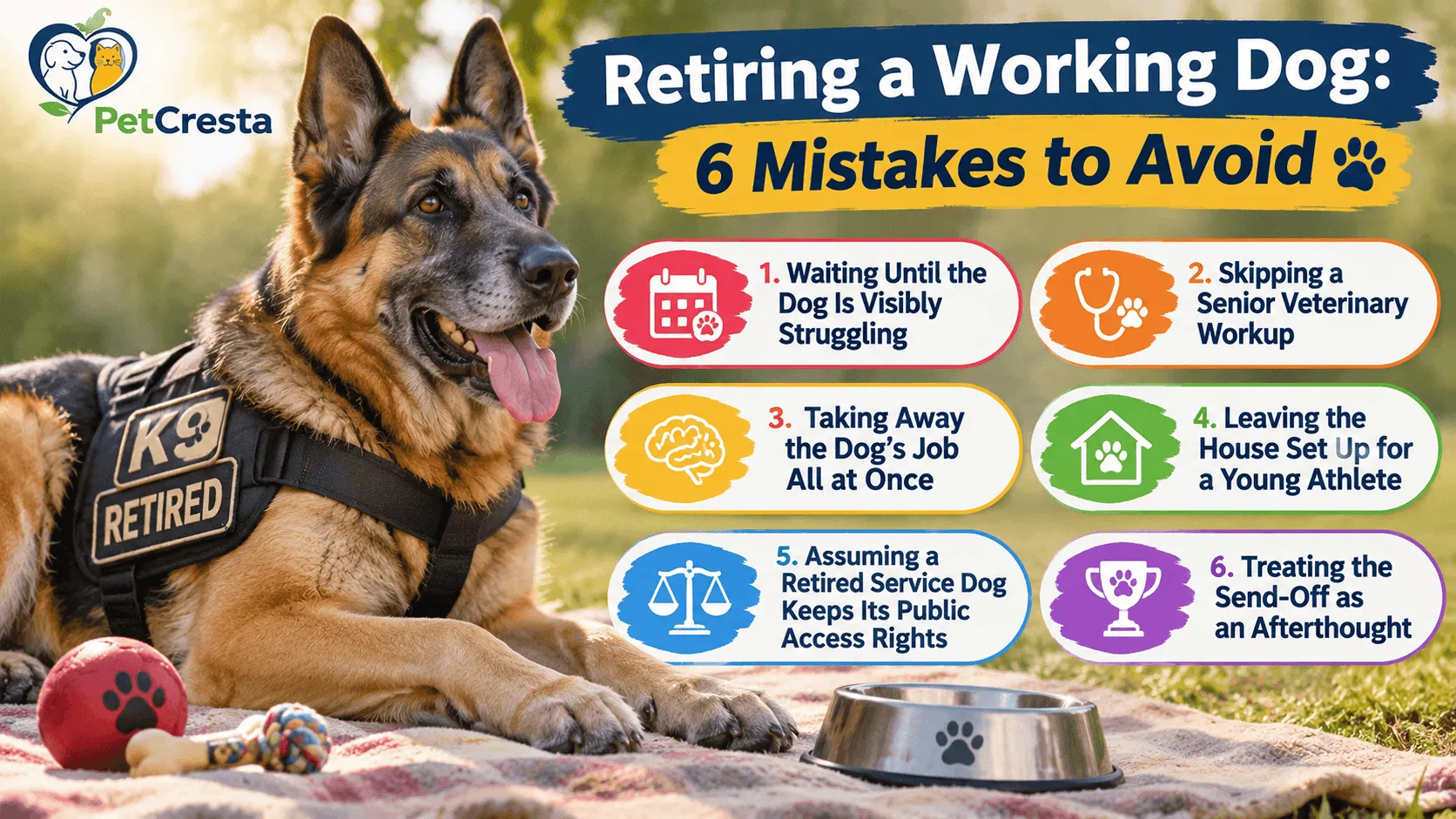
Here are six common working dog retirement mistakes, why they matter, and what owners and handlers can do instead.
For medical decisions and individualized activity recommendations, consult your veterinarian.
Why Retirement Is a Transition, Not an Off Switch
A working dog’s day often follows a predictable schedule: wake-up times, travel, training, assignments, exercise, and frequent interaction with a handler.
That routine can become deeply familiar.
When it disappears overnight, some dogs may become restless, vocal, or less settled at home. Others adjust readily but need changes to their exercise and feeding routines.
The transition also differs between working roles. A retired police dog may need help adjusting to a quieter environment, while a guide dog may need a carefully managed transition involving the handler, training organization, and possibly a new home.
Retirement should therefore be planned around the individual dog’s health, behavior, working history, and future living arrangements.
A gradual transition, when feasible, makes it easier to identify what the dog still enjoys and which activities need to change.
Mistake 1: Waiting Until the Dog Is Visibly Struggling
It’s tempting to keep a capable working dog on duty for as long as possible.
After years of successful service, handlers may be reluctant to reduce responsibilities, especially when the dog still appears enthusiastic.
However, willingness to work doesn’t necessarily mean a dog is physically comfortable.
Some working dogs continue performing familiar tasks despite developing stiffness, fatigue, reduced stamina, or other health problems.
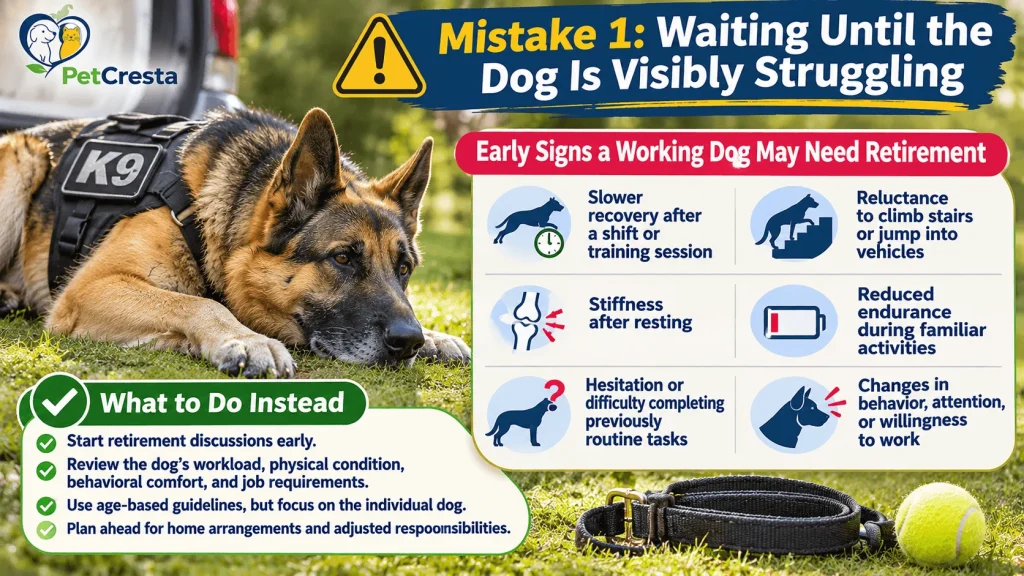
Early Signs a Working Dog May Need Retirement
Watch for changes such as:
- Slower recovery after a shift or training session.
- Reluctance to climb stairs or jump into vehicles.
- Stiffness after resting.
- Reduced endurance during familiar activities.
- Hesitation or difficulty completing previously routine tasks.
- Changes in behavior, attention, or willingness to work.
These signs don’t automatically mean retirement is necessary. Pain, illness, sensory changes, and other treatable problems may also affect performance.
A veterinary assessment can help identify the cause.
What to Do Instead
Start retirement discussions before performance significantly declines.
Review the dog’s workload, physical condition, behavioral comfort, and the requirements of its job.
Programs may use age-based planning guidelines, but the individual dog’s condition should remain central to the decision.
Early planning also gives handlers time to prepare suitable home arrangements and adjust responsibilities without rushing.
Mistake 2: Skipping a Senior Veterinary Workup
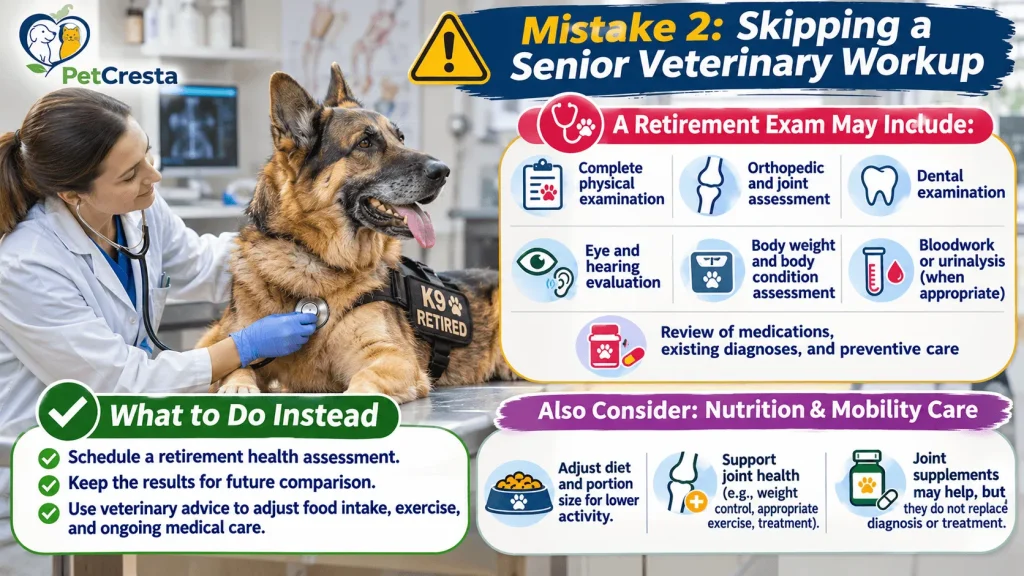
A retirement health assessment helps establish what a working dog needs after leaving active service.
Dogs that spent years running on hard surfaces, jumping from vehicles, carrying equipment, or performing physically demanding tasks may need particular attention to musculoskeletal health.
Older dogs can also experience dental disease, vision changes, hearing loss, and conditions that affect their activity tolerance.
What Should a Working Dog Retirement Exam Include?
Depending on the dog’s age, medical history, and symptoms, your veterinarian may recommend:
- A complete physical examination.
- Orthopedic and joint assessment.
- Dental examination.
- Eye and hearing evaluation.
- Body weight and body condition assessment.
- Bloodwork or urinalysis when clinically appropriate.
- A review of medications, existing diagnoses, and preventive care.
Not every dog requires every test. Your veterinarian should tailor the assessment to the animal’s history and clinical findings.
Adjust Nutrition and Mobility Care
A dog that no longer performs demanding daily work may require fewer calories.
Continuing the same portions after activity drops can contribute to unwanted weight gain, placing additional stress on the joints.
Ask your veterinarian whether the dog’s diet, meal portions, and exercise plan need adjustment.
Some retired dogs may benefit from a broader joint-management program that includes weight control, appropriate exercise, pain treatment, and other veterinary recommendations.
Owners considering joint supplements for dogs should understand that evidence varies between ingredients and that supplements do not replace diagnosis or treatment for painful joint disease.
What to do instead: Schedule a retirement health assessment, keep the results for future comparison, and use veterinary advice to adjust food intake, exercise, and ongoing medical care.
Mistake 3: Taking Away the Dog’s Job All at Once
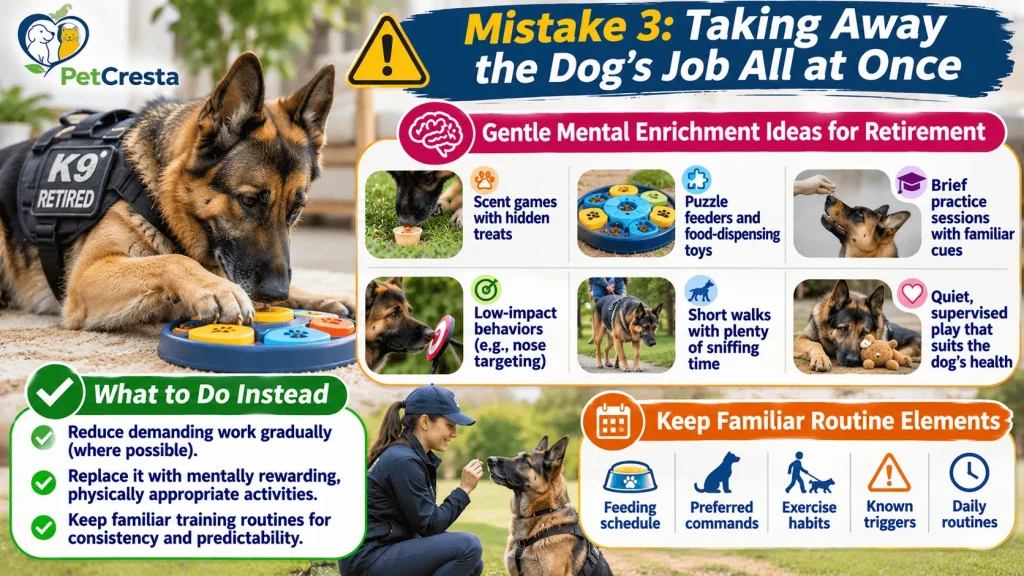
Working dogs often receive much more than exercise from their daily responsibilities.
They also experience problem-solving, structured interactions, familiar cues, and regular mental challenges.
Removing all those activities at once may leave some dogs without the stimulation they have become accustomed to.
Retirement doesn’t have to mean complete inactivity.
Replace Demanding Work With Gentle Mental Enrichment
Depending on the dog’s physical abilities and interests, suitable activities may include:
- Scent games using hidden treats.
- Puzzle feeders and food-dispensing toys.
- Brief practice sessions involving familiar cues.
- New, low-impact behaviors such as nose targeting.
- Short walks with plenty of opportunities to sniff.
- Quiet, supervised play that suits the dog’s health.
The goal is to preserve enjoyable activity while reducing physical strain and work-related demands.
Avoid exercises that involve repeated jumping, sharp turns, or strenuous exertion when a dog has joint discomfort or mobility limitations.
Keep Familiar Training Routines
Many older dogs still enjoy learning and responding to familiar cues.
PetCresta’s guide to training for adult dogs explains how reward-based practice, consistency, and manageable sessions can support continued learning.
For retired working dogs, familiar cues can also provide a sense of predictability during the transition.
If the dog is moving to a new household, ask the previous handler or organization about its feeding schedule, preferred commands, exercise habits, triggers, and daily routines.
Maintaining familiar patterns initially can help the dog settle into its new surroundings.
What to do instead: Reduce demanding work gradually where possible, and replace it with mentally rewarding, physically appropriate activities.
Mistake 4: Leaving the House Set Up for a Young Athlete
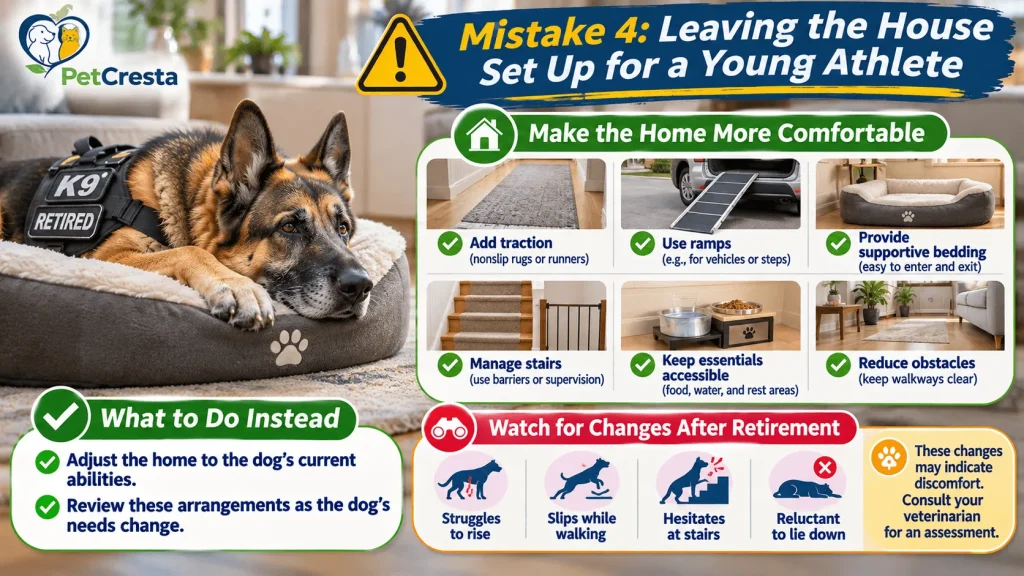
A home that suited a fit four-year-old may not be comfortable for a retired working dog with stiff joints or reduced mobility.
Slippery floors, steep stairs, high vehicle entrances, and poorly positioned sleeping areas can make everyday movement more difficult.
Retirement planning should include an assessment of the dog’s living environment.
Make the Home More Comfortable for a Senior Working Dog
Consider these practical changes:
- Add traction: Place secure, nonslip rugs or runners on slippery flooring.
- Use ramps when appropriate: A stable ramp can reduce the need to jump into vehicles or climb certain steps.
- Provide supportive bedding: Choose a bed that is easy to enter and exit, with enough cushioning for comfortable rest.
- Manage stairs: Use suitable barriers or supervision if the dog struggles with steps.
- Keep essentials accessible: Position water, food, and resting areas where the dog can reach them without unnecessary effort.
- Reduce obstacles: Keep walkways clear of loose items that could create tripping hazards.
Raised food bowls are sometimes suggested for larger dogs, but they are not universally recommended for comfort or health. Discuss feeding arrangements with your veterinarian if your dog has neck problems, swallowing difficulties, or a risk of gastric dilatation-volvulus.
Watch for Changes After Retirement
Mobility can change over time.
Pay attention to whether the dog struggles to rise, slips while walking, hesitates at stairs, or becomes reluctant to lie down.
These changes may indicate discomfort that deserves veterinary assessment rather than simply being accepted as normal aging.
What to do instead: Adjust the home to the dog’s current abilities, and review those arrangements as its needs change.
Mistake 5: Assuming a Retired Service Dog Keeps Its Public Access Rights
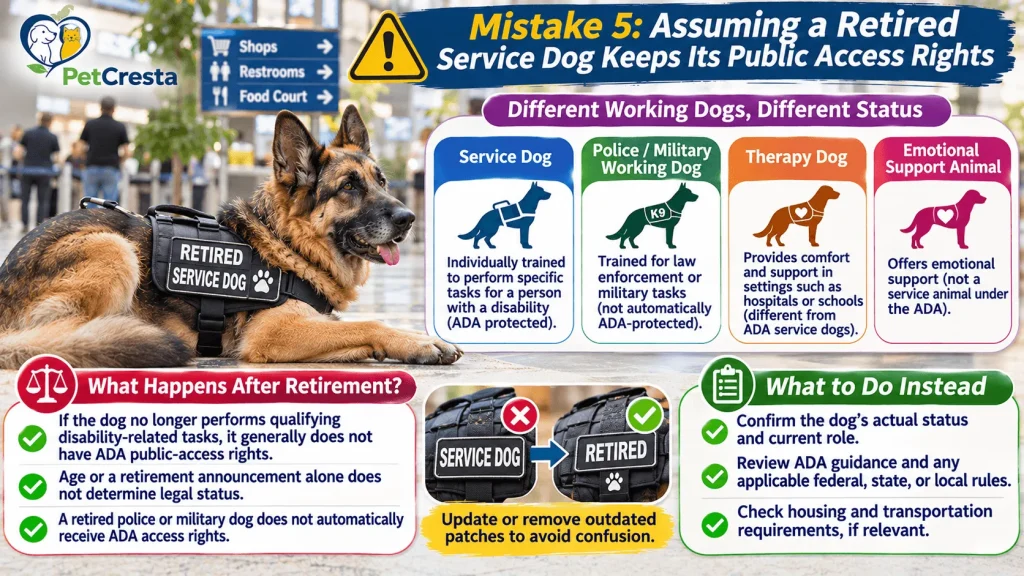
Service dogs, police K9s, military working dogs, therapy dogs, and emotional support animals do not all have the same legal status.
Confusion about these distinctions can create problems when a working dog retires.
Under the Americans with Disabilities Act (ADA), a service animal is a dog individually trained to perform work or tasks for a person with a disability, according to the U.S. Department of Justice’s guidance on service animals.
Those tasks must be directly related to the person’s disability.
What Happens to Public Access After Retirement?
If a dog has fully retired and no longer performs the disability-related work or tasks required to qualify as a service animal, it generally cannot rely on the ADA’s service-animal public-access protections.
However, age or an informal retirement announcement alone does not determine a dog’s legal status.
The relevant question is whether the animal still meets the applicable legal definition and is being used to perform qualifying disability-related work or tasks.
A retired police or military dog does not automatically receive ADA public-access rights because of its previous service.
Therapy dogs and emotional support animals are also different from ADA-qualified service animals, although other laws may provide protections in particular circumstances.
Review Identification and Access Rules
When a dog has fully retired from service work, remove outdated patches or identification that could misleadingly suggest it is still acting in that role.
The ADA does not require qualified service animals to wear vests or special identification, so the absence or presence of a vest alone does not determine status.
Handlers should review applicable federal, state, and local rules, along with housing and transportation requirements when relevant.
PetCresta’s guide to what conditions qualify for a service dog explains the distinction between disability-related task training and ordinary companionship.
What to do instead: Confirm the dog’s actual status, understand which rules apply, and avoid assuming that previous working credentials automatically establish continuing public-access rights.
Mistake 6: Treating the Send-Off as an Afterthought
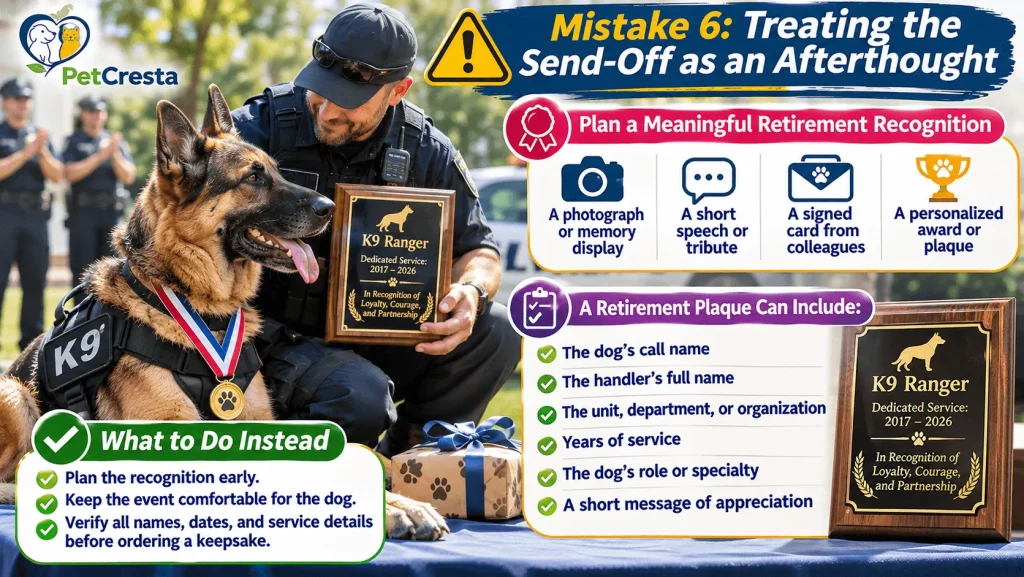
When a working dog’s career ends, the transition affects both the animal and the people who served alongside it.
Police departments may recognize a retiring K9 at a shift briefing. Service dog programs may organize a farewell gathering, while therapy dog teams sometimes mark the end of their visits with colleagues and staff.
These events recognize years of teamwork, training, and service.
For handlers, a retirement ceremony can also provide an opportunity to acknowledge the significance of the partnership.
Plan a Meaningful Retirement Recognition
A ceremony doesn’t need to be elaborate.
A photograph, a short speech, a signed card from colleagues, or a personalized award can make the occasion memorable.
The dog’s comfort should come first. An older dog with pain, anxiety, or fatigue may be happier with a brief gathering than a long public event.
For keepsakes, accuracy matters.
Engravers who handle retirement and service recognition, including Martin Awards, which has made engraved plaques and recognition awards since 1993, offer examples of the personalized items that can mark a working career.
Before approving an inscription, verify all names, dates, and service details with the handler or organization.
What Should a Working Dog Retirement Plaque Say?
A clear inscription may include:
- The dog’s call name.
- The handler’s full name.
- The unit, department, or organization.
- Years of service.
- The dog’s role or specialty.
- A short message of appreciation.
An example inscription might read:
K9 Ranger
Dedicated Service: 2017–2026
In Recognition of Loyalty, Courage, and Partnership
Use only confirmed details for an actual award.
What to do instead: Plan the recognition early, make it comfortable for the dog, and proofread the keepsake before ordering.
A Simple Working Dog Retirement Checklist
Retirement planning becomes easier when the main responsibilities are organized before the dog’s last working day.
| Retirement Task | What to Check |
|---|---|
| Plan the transition | Discuss retirement before the dog begins struggling |
| Schedule a veterinary assessment | Review health, mobility, weight, and ongoing treatment |
| Adjust daily activity | Replace demanding tasks with low-impact enrichment |
| Update the feeding plan | Match portions to reduced activity and body condition |
| Prepare the home | Add traction, accessible bedding, and suitable ramps |
| Review legal status | Confirm whether service-animal protections still apply |
| Organize records | Keep medical history, medications, and previous routines |
| Plan the recognition | Confirm names, service dates, and appropriate keepsakes |
For dogs entering a new home, include a written handover covering health concerns, training cues, feeding habits, veterinary contacts, and any behavior-management requirements.
A well-organized handover is especially helpful when the new family has not previously cared for a retired working dog.
Final Takeaway
Retiring a working dog should not mean suddenly removing every familiar part of its life.
The most successful transition is one that respects the dog’s working history while adapting to its current physical and emotional needs.
Plan retirement before serious problems develop, arrange a veterinary workup, preserve familiar routines, provide appropriate mental enrichment, and prepare the home for changing mobility.
For service dogs, confirm the legal implications of retirement rather than assuming past working status determines future public-access rights.
And when it’s time to recognize the dog’s career, make sure the celebration reflects the years of partnership without compromising its comfort.
A working dog that spent years serving people deserves thoughtful care in retirement, and the handler deserves a meaningful opportunity to recognize what they accomplished together.
FAQ’s
There is no universal retirement age. The right time depends on the dog’s health, workload, performance, comfort, and job requirements. Veterinary assessments and early retirement planning help guide the decision.
Retired police dogs may remain with their handlers or move to an approved home, depending on department policies. They generally transition from operational duties to family life with appropriate veterinary care, exercise, and enrichment.
Some dogs may show restlessness, reduced engagement, or behavior changes when familiar routines disappear. These signs can also indicate pain, illness, or stress, so persistent changes should be assessed by a veterinarian.
Suitable activities include scent games, puzzle feeders, familiar training cues, short reward-based lessons, and gentle sniff walks. Choose activities that match the dog’s physical abilities.
Possibly. Reduced physical activity often lowers calorie requirements. A veterinarian can help adjust portions and recommend an appropriate diet based on weight, age, body condition, and health.
A dog that has fully stopped performing qualifying disability-related tasks generally does not retain ADA service-animal access solely because it previously worked. Age alone does not determine status, and other laws may apply.
Many retired working dogs can adapt to family life, but individual suitability depends on their training, temperament, medical needs, and history. Some may require an experienced household and a structured transition.
Older working dogs may experience arthritis, orthopedic injuries, dental disease, sensory changes, or other age-related conditions. Individual risks depend on the dog’s work history, breed, and overall health.
Adjustment varies by dog. Some settle into a new routine quickly, while others need several weeks or longer. Familiar schedules, gradual changes, and appropriate enrichment can support the transition.
Personalized plaques, framed photographs, service-history displays, and commemorative awards can recognize years of partnership. Confirm the dog’s call name, handler details, unit, and service dates before ordering.