Luxury Vinyl Tile Flooring: Types, Costs And Buying Guide
LVT flooring is a multi-layer resilient flooring that is designed to look like stone, ceramic, concrete or wood. It may be glued down, clicked together, laid loosely or built around a rigid core, depending upon the product.
Choosing LVT involves more than finding a colour that works with the cabinets. The performance of the floor will be influenced by wear, subfloor condition, moisture, installation method and warranty terms.
Brand and collection variations in product specifications are possible. Always follow the installation instructions and warranty for the specific flooring type, rather than general category recommendations.
What Is LVT Flooring? Luxury Vinyl Tile At A Glance
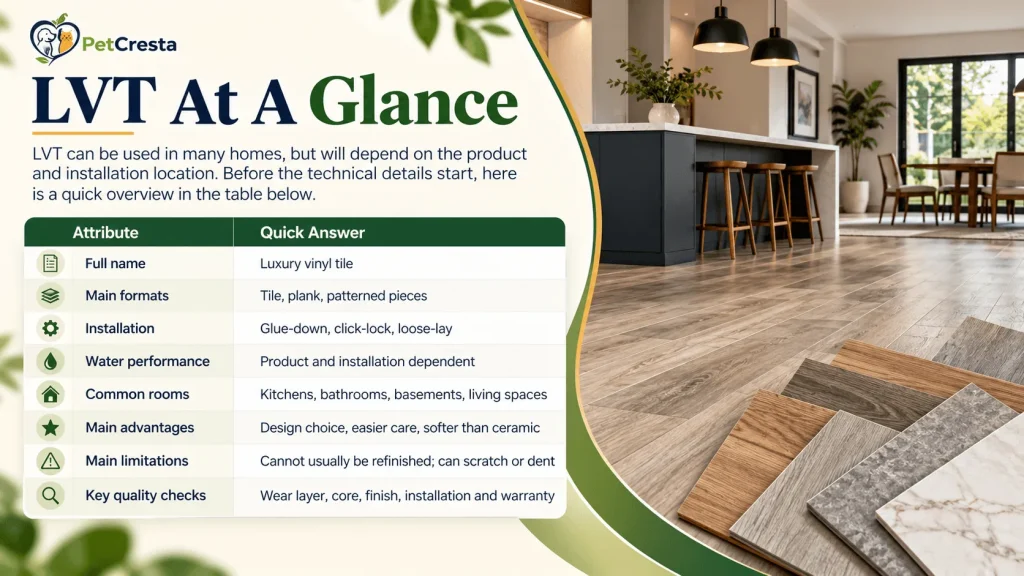
LVT can be used in many homes, but will depend on the product and installation location. Before the technical details start, here is a quick overview in the table below.
| Attribute | Quick Answer |
|---|---|
| Full name | Luxury vinyl tile |
| Main formats | Tile, plank, patterned pieces |
| Installation | Glue-down, click-lock, loose-lay |
| Water performance | Product and installation dependent |
| Common rooms | Kitchens, bathrooms, basements, living spaces |
| Main advantages | Design choice, easier care, softer than ceramic |
| Main limitations | Cannot usually be refinished; can scratch or dent |
| Key quality checks | Wear layer, core, finish, installation and warranty |
What Is Luxury Vinyl Tile Flooring?
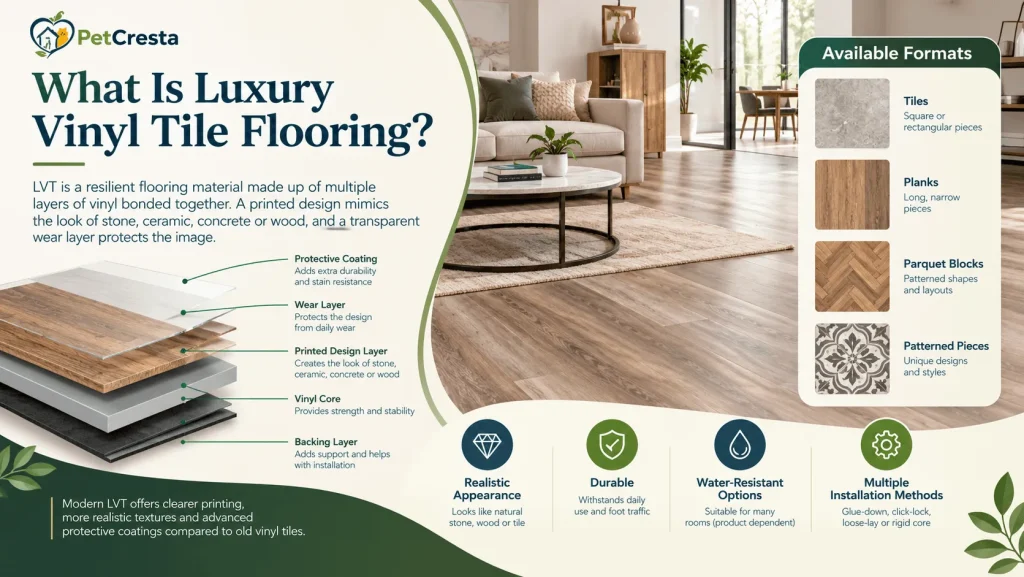
It is a resilient flooring material that is made up of multiple layers of vinyl bonded together. A printed design is used to simulate the appearance of stone, ceramic, concrete or wood, and a transparent wear layer is used to protect the image.
The term “tile” typically refers to the format or visual style. LVT can be available in square tiles, rectangular pieces, parquet blocks or other patterned shapes.
Unlike the basic vinyl floor tiles from the past, modern vinyl flooring is not the same. Printing is clearer, the surface texture is more realistic and the protective coatings are generally more sophisticated.
PVC is commonly used in the product’s construction, sometimes with mineral fillers, stabilisers or composite materials. The exact formula is different for each product, and two products with the same LVT label may differ significantly in feel and performance.
Is LVT The Same As Vinyl Flooring?
LVT is a type of vinyl flooring, but not all vinyl flooring is LVT. There are also sheet vinyl, standard vinyl tiles, peel-and-stick vinyl and luxury vinyl planks.
Luxury vinyl plank (LVP) is typically sold in long wood look planks. Sheet vinyl is available in huge rolls and requires fewer seams in a room.
| Flooring Term | Description | Common Format |
|---|---|---|
| LVT | Layered Lvt | Tile or patterned formats |
| LVP | Luxury vinyl plank | Wood-look planks |
| Sheet vinyl | Continuous roll flooring | Large sheets |
| Standard vinyl tile | Basic vinyl tile | Square tiles |
| SPC | Rigid mineral-composite core | Click planks or tiles |
| WPC | Expanded composite core | Click planks or tiles |
These labels are sometimes used in an uninformative manner by retailers. The construction of a product and its size and instructions for installation are more accurate than the name on a display board.
How Does Luxury Vinyl Tile Work?
LVT is a single product that offers decorative, protective and structural benefits. The printed film gives the illusion, and the clear wear layer shields it from the daily use of foot traffic.
The shape of the tile is provided by a flexible or rigid base. The edges are then adhesive or locked together or the backing is loose, which secures the floor.
The overall performance is derived from the total product. A thick tile with a weak locking profile can be less effective than a thinner commercial glue-down tile with a durable vinyl flooring finish.
How Is LVT Made?
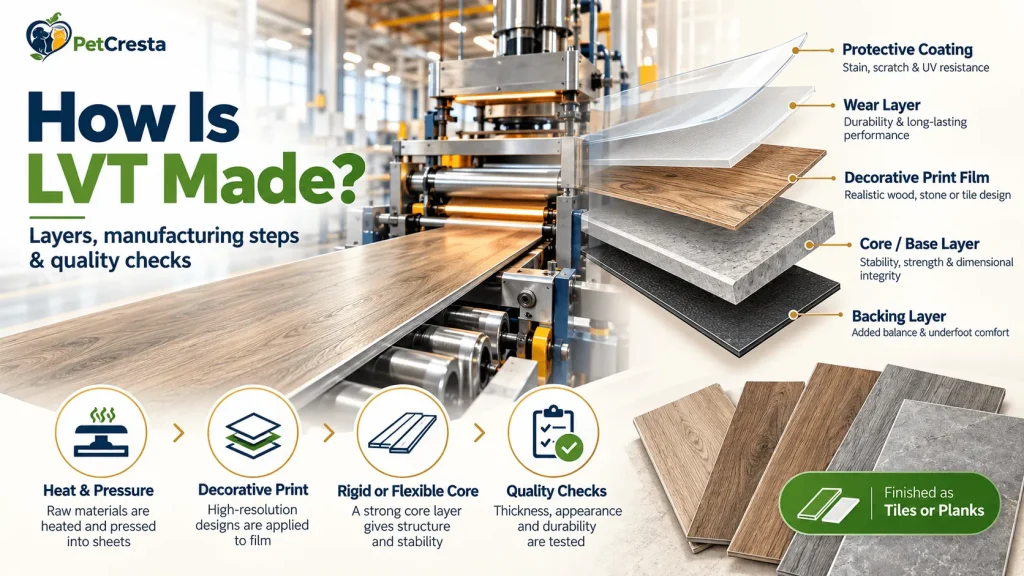
Typically, manufacturers make LVT by fusing multiple layers together under heat and pressure. How it’s done varies from flexible dryback flooring to a rigid-core system.
A decorative picture is placed on top of the base. A transparent wear layer and protective coating are placed on top of this and sometimes the texture is pressed into the surface.
The finished material is produced in the form of tiles or planks. Thickness, colour consistency, dimensions, locking strength and surface appearance can be evaluated by quality checks prior to packaging.
Rigid core products need extra steps since the hard or expanded core needs to be created independently. Flexible glue down tiles place more emphasis on the prepared subfloor.
What Are The Layers In LVT?
Most LVT products consist of a protective finish, wear layer, printed design, core or base and backing. There are also some click products that have an attached acoustic pad.
The protective coating resists stains, scuffs and regular marks. It does not scratch the surface, making it impossible to scratch.
A clear wear layer is beneath the finish. It is used primarily to protect the print image from wear due to foot traffic.
The wood grain, stone pattern, concrete texture or decorative print is carried by the design film. The sharper the images and the more pattern variations, the better the product will be.
The core gives stability. Flexible dryback products have a thinner vinyl base, and SPC and WPC floors have a thicker rigid base.
Backing can enhance stability, grip or sound control. Moisture and underlayment do not get removed automatically by an attached pad. .
| Specification | Example | What It Means |
|---|---|---|
| Total thickness | 5 mm | Complete product depth |
| Wear layer | 20 mil | Thickness of the protective clear layer |
| Installation | Click-lock | Floating locking-edge system |
| Attached pad | Yes | Integrated backing; extra pad may be restricted |
| Residential warranty | 25 years | Coverage subject to exclusions |
| Commercial warranty | 10 years | Approved commercial conditions only |
| Wet-area approval | Bathroom use | Does not automatically include shower floors |
These are just a sample of the possible appearance of a product label. They should not be considered as generic targets.
LVT, LVP, SPC And WPC: What Is The Difference?
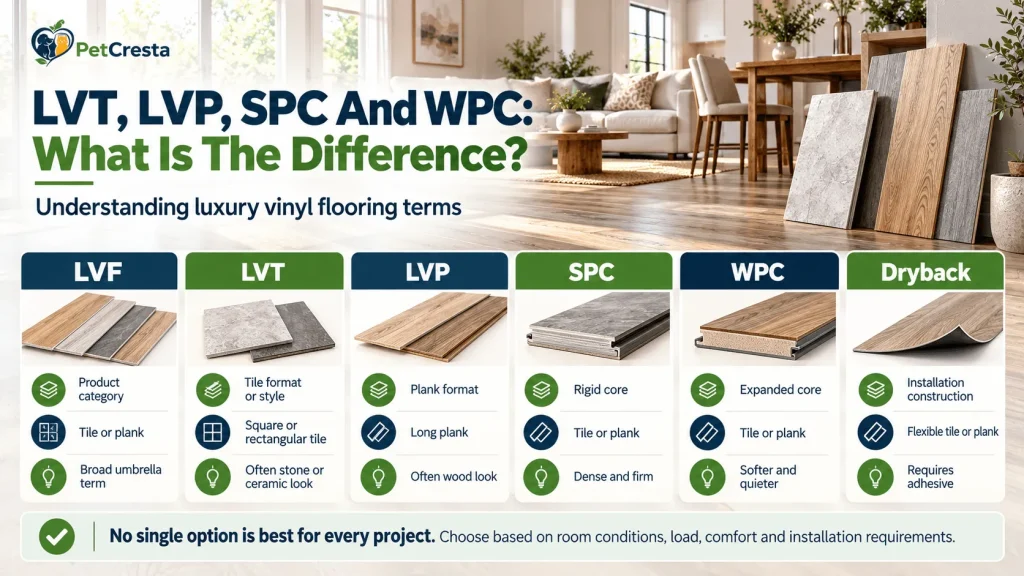
LVT, LVP, SPC and WPC are all terms that can be used to describe luxury vinyl flooring. A few talk about form, others about the essence.
Luxury vinyl flooring, also known as LVF, is the general term. LVT is typically tile shaped or tile style, and LVP is normally planks.
Rigid-core constructions are covered by SPC and WPC. Core may be in tiles or planks.
| Term | What It Describes | Typical Format | Main Consideration |
|---|---|---|---|
| LVF | Product category | Tile or plank | Broad umbrella term |
| LVT | Tile format or style | Square or rectangular tile | Often stone or ceramic look |
| LVP | Plank format | Long plank | Often wood look |
| SPC | Rigid core | Tile or plank | Dense and firm |
| WPC | Expanded core | Tile or plank | Softer and quieter |
| Dryback | Installation construction | Flexible tile or plank | Requires adhesive |
The mineral content in the core of the SPC makes it feel firm. WPC may feel a bit softer because of its increased structure.
Neither is necessarily better. The choice should be based on the room conditions, load, comfort and installation requirements.
What Are The Main Types Of LVT Flooring?
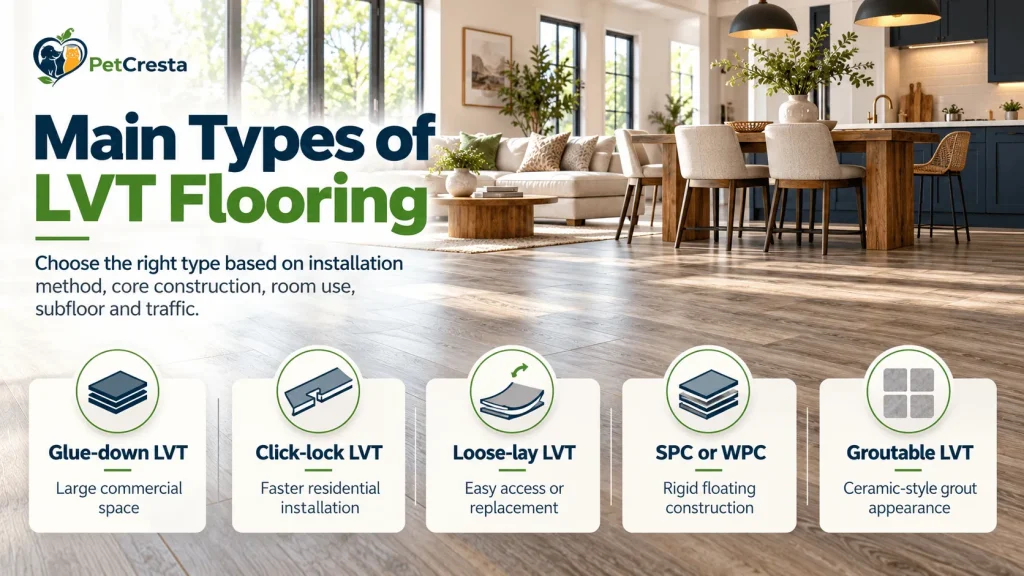
Luxury vinyl flooring can be categorized according to how it is installed and by its core construction. It will depend on the room, subfloor and traffic.
A quiet bedroom versus a retail entrance, which is busy. Different demands are placed on a floor: a quiet bedroom versus a busy retail entrance. Product type should be based on the job and not the latest showroom fad.
| Need | Likely Starting Point |
|---|---|
| Large commercial space | Glue-down LVT |
| Faster residential installation | Click-lock LVT |
| Easy tile access or replacement | Loose-lay LVT |
| Rigid floating construction | SPC or WPC |
| Ceramic-style grout appearance | Groutable LVT |
Glue Down LVT
Glue-down vinyl tile is installed with an approved adhesive directly to the subfloor. It forms a flat surface on the floor and is frequently used in the commercial environment.
Each piece is permanently attached to the floor, allowing it to withstand repeated traffic and rolling loads if the correct specifications are used. In a floating system, individual damaged tiles are more easily replaced than boards.
The preparation needs to be comprehensive. Sometimes thin flooring can show through grout lines, ridges, cracks and panel seams, which is called telegraphing.
The type of adhesive used will vary according to the type of flooring, substrate, moisture and site conditions. There’s no pretty way to use any bucket that comes to hand.
Once installed, curing times need to be observed. Wet cleaning, heavy furniture and rolling traffic may require waiting until the adhesive has reached a proper level of strength.
Click-Lock Vinyl Tile And Floating LVT
Click-lock LVT is made of shaped edges that join adjacent pieces. The completed floor is not bonded to the subfloor, but rather is floating.
Installation may be faster than glue down work. There are some systems that can be used for confident do-it-yourselfers, particularly in relatively simple rectangular rooms.
Perimeter expansion space is required for floating floors. Large areas or between rooms may also need a transition.
Fixed cabinetry should not trap the floor (unless otherwise permitted by the manufacturer). Heavy islands and pre-made units can limit mobility and cause stress on locking joints.
The term “floating” only refers to the installation method. It does not imply that it is waterproof.
Loose-Lay LVT
Loose lay LVT is held down by weight, friction backing or a combination of both. Perimeter adhesive or removable tackifier may also be needed for some projects.
Access and replacement is usually easy. This can be helpful in offices, shops or areas where services operate under the floor.
The amount of fixing required can vary depending on the size of the room, the rolling loads and traffic. Even with a loose-lay product, a clean, flat and stable base is necessary.
Heavy flooring does not automatically make uneven subfloors OK. Unfortunately, gravity doesn’t go on forever.
Rigid-Core LVT
Rigid-core LVT is also available in SPC and WPC. Such floors are typically installed floating as a click system.
SPC has a compact core that is firm underfoot. It is very rigid, which can offer good dimensional stability, but the degree of rigidity will vary according to the quality of the product.
WPC has a wider organizational structure. May be softer and quieter, but can be more susceptible to concentrated loads.
Light surface texture is better concealed by rigid core than by thin dryback material. It is not able to span large holes, joints or movement.
Thickness is also added to doors, stairs and transitions. Please verify the height of the finished floor before ordering.
Groutable LVT
Groutable LVT is designed to recreate the look of ceramic tile. There is space between the pieces and a compatible flexible grout is used to fill the space.
The finished floor can be convincing in kitchens, entrance halls and other decorative areas. It also has a softer feel to it than ceramic on the bottom.
The grout to be used must be the one recommended for the system. Not all vinyl tile products can use traditional cement grout.
Glue-Down Vs Click-Lock LVT
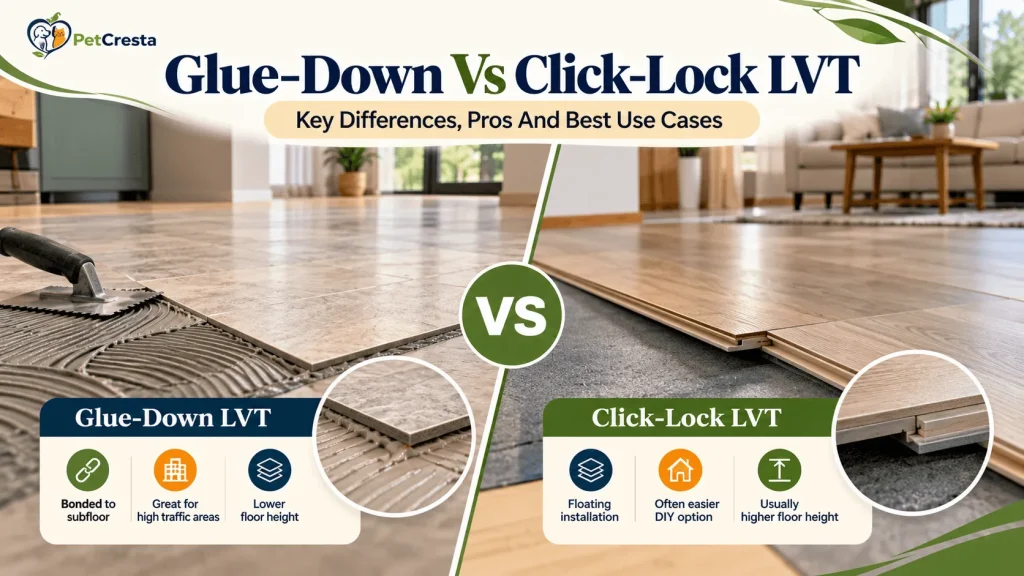
Glue down LVT may be appropriate for areas with high traffic or commercial use, or when the area is large. For residential vinyl flooring projects, where quicker floating installation is desired, click-lock flooring might be appropriate.
Both are still concerned with subfloor condition. Glue down floors require an extreme level of smoothness and click systems require a flat and stable surface.
| Factor | Glue-Down LVT | Click-Lock LVT |
|---|---|---|
| Installation | Bonded to subfloor | Floating |
| Subfloor preparation | Very demanding | Must be flat and stable |
| Tile replacement | Usually localized | May require partial disassembly |
| Large spaces | Often suitable | Transition rules may apply |
| Rolling loads | Often better suited | Product-specific restrictions |
| DIY suitability | Moderate to difficult | Often easier |
| Added floor height | Usually lower | Usually higher |
Select glue-down for low height, stability and rolling-load requirements. Click-lock becomes more important when removal, floating installation or a simpler residential installation is more important.
How Do You Judge LVT Quality?
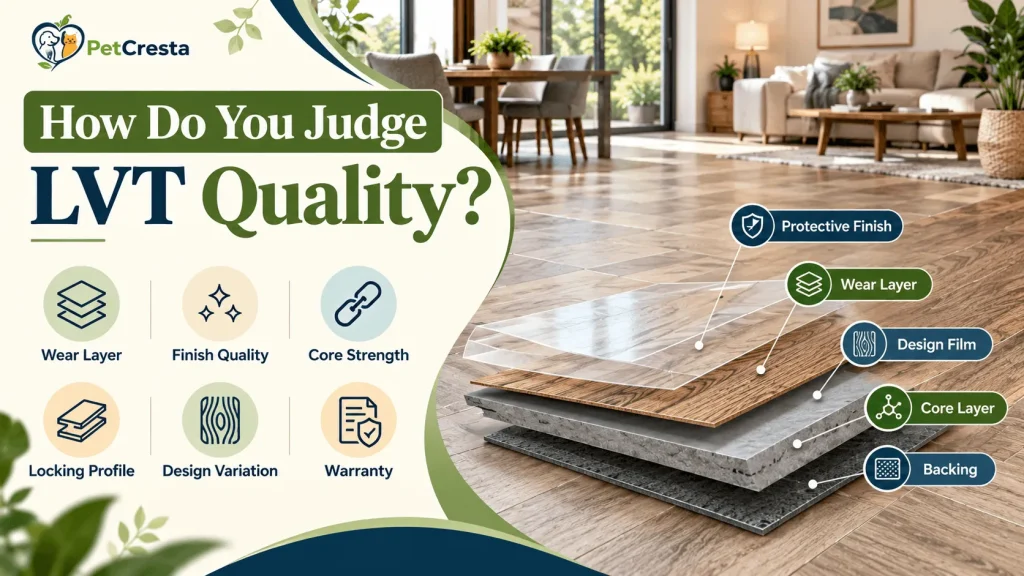
Colour, thickness and brand name are not enough to assess LVT quality. There are multiple specifications that contribute.
Wear layer, finish, core strength, locking profile, design variation and warranty are all factors. Another good indicator is documentation that is clear.
Any product that obfuscates the fundamental information with ambiguous terms should be taken with a grain of salt. Premium protection is not a measure.
| Common Claim | More Accurate Interpretation |
|---|---|
| All LVT is waterproof | Material and installed-floor performance differ |
| Thicker LVT is always better | Wear layer, core, finish and installation also matter |
| Rigid core fixes uneven floors | It still needs a flat, stable base |
| Attached pad solves underlayment needs | Moisture and acoustic requirements still apply |
| LVT never scratches | It resists routine wear but can still be damaged |
What Is The Difference Between Wear Layer And Total Thickness?
Total thickness is the thickness of the entire product. Wear-layer thickness refers to the clear protective layer over the print.
One mill is equal to 1/1000 inch. A 20-mil wear layer is, in fact, only 0.50 millimetres thick, not 20 millimetres.
Some common approximations are:
- 6 mil: 0.15 mm
- 12 mil: 0.30 mm
- 20 mil: 0.50 mm
- 28 mil: 0.70 mm
The total thickness will impact the final height and can potentially impact comfort or locking construction. The relationship between wear-layer thickness and surface wear is more similar.
These figures should not be interpreted independently.
What Wear Layer Is Best For LVT?
There are a number of different types of wear layer depending on traffic, surface finish and product rating. A bedroom isn’t as worn as a busy entrance.
| Intended Use | Common Wear-Layer Range |
|---|---|
| Light residential | Approximately 6–12 mil |
| General residential | Approximately 12–20 mil |
| Busy residential | Approximately 20 mil or above |
| Commercial | Product-specific commercial rating |
These are market ranges and not rules. There should be a proper rating and warranty for commercial products in the space they are used for.
Surface coating is also important. Sometimes a good finish is more important than a slight variation in the thickness of the wear-layer.
Does Thicker LVT Mean Better Quality?
No. Thicker does not necessarily mean stronger, quieter or longer lasting.
A thin commercial dryback tile can outperform a thicker low quality floating floor. Performance is affected by core strength, finish, locking design and dimensional stability.
Thickness can also pose functional issues at doors, stairs and appliances. More material is needed when the entire product is appropriate to the project.
How Do Texture, Bevels And Pattern Repeat Affect Quality?
Surface texture has an impact on realism and grip. Embossed-in-register flooring matches the texture to the wood grain or stone pattern.
Square edges make a flatter look. Micro-bevels create a bit of separation, and deeper painted bevels make each tile stand out.
The repeat pattern is visible on large floors. If the same marks are used on the product every few pieces, the product may look artificial.
Use multiple cartons of tiles when installing. Seeing several samples is also a more true representation than one carefully selected display piece.
Formats are affected by room size. Large tiles can help to soothe an open space, and smaller tiles can help to add rhythm in smaller rooms.
Side lighting can show up joints and texture. Test samples in the vicinity of windows before deciding.
How Do Acoustic And Slip Ratings Affect Selection?
Acoustic performance is important in apartments, upper floors, offices and shared buildings. The impact sound may be lower with attached pads and approved underlayments.
The ratings for impact sound are called IIC ratings and relate to floor and ceiling assemblies. ΔIIC is the floor covering’s contribution to the rating of a test assembly.
Thicker is not necessarily quieter. There are many factors that have an influence on the sound, such as core, backing, subfloor and building construction.
Slip performance is important in bathrooms, kitchens, entrances and commercial spaces. Product testing is more accurate than feeling the safety of a product.
Residue left by the cleaning can cause a textured floor to become slippery. In most cases, adding more detergent does not help anything other than the size of the rinse job.
How Durable Is Luxury Vinyl Tile?
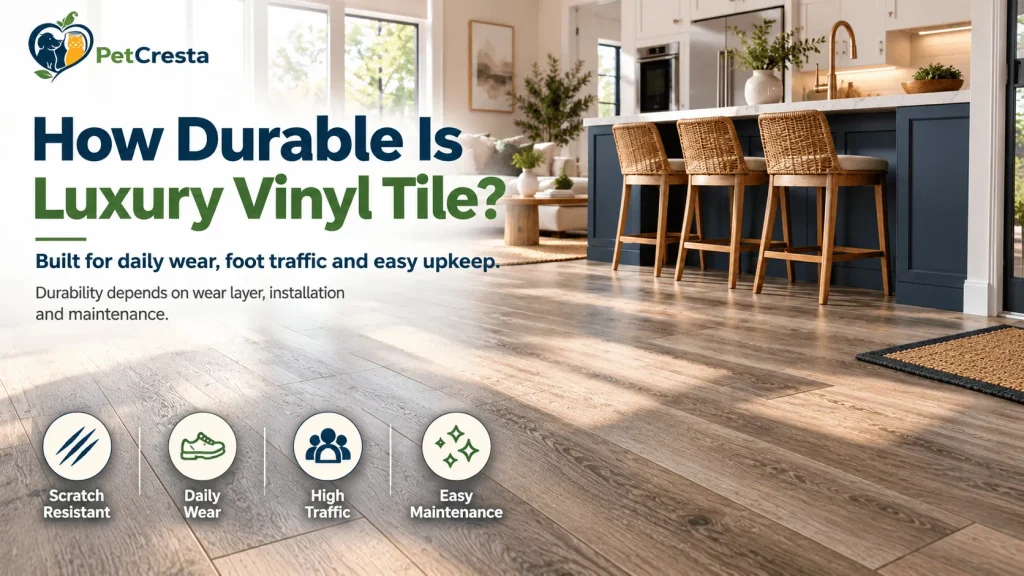
When properly installed and selected, Quality LVT can be used over time in the home or office. Durability is influenced by wear, finish, traffic, sunlight, heat and maintenance.
Most products are resistant to normal wear and tear, but may scratch, dent or gouge. Locking joints can also become damaged if the subfloor moves or if the floor is trapped.
Entry grit can wear more than normal foot traffic. Regular cleaning and good mats can prolong the appearance of the floor.
Does LVT Scratch Easily?
LVT is not scratch-proof, but is scratch resistant vinyl flooring. The surface can be marked with sand, pet claws, furniture legs and sharp objects.
Use entrance mats to collect grit. Felt pads minimize damage caused by chairs and tables.
Casters or protective mats may be required on office chairs. Heavy furniture can still be a risk to drag, even if the box promises to be super durable.
Luxury Vinyl Tile For Pets
LVT can be used in homes with pets, as it is easily cleaned and can be made water-resistant.
Textured flooring might provide more traction for dogs than smooth, shiny floors. Even with no dirt, claws can leave marks.
Trim nails and put appropriate mats at the door and water bowls. Seams and edges should be cleaned immediately after the accident.
Luxury Vinyl Tile For High Traffic Areas: Is It Suitable
LVT can be used in hallways, shops, offices and other high traffic areas and can perform well if the product is rated for the use.
Rolling chairs, wheelchairs, mobility aids and carts should be considered for commercial areas. Transition profiles should also provide for safe movement between surfaces.
In situations where repeated traffic is a concern, glued down systems are typically selected. Spare tiles should be stored for future repairs.
Is Luxury Vinyl Tile Waterproof?
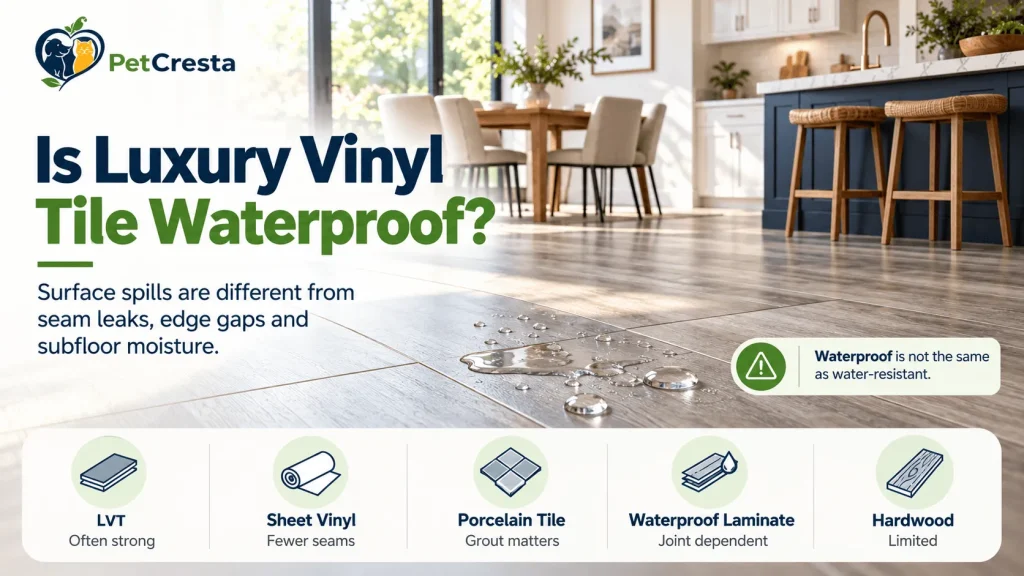
A lot of LVT products are composed of non-absorbent materials. Water may still penetrate seams, edges and penetrations in the completed installation.
Surface spills are not flooding, or moisture rising through a slab. All adhesive, underlayment, subfloor and warranty considerations have an impact.
| Flooring | Surface Water Performance | Seam Risk | Subfloor Moisture Concern |
|---|---|---|---|
| LVT | Often strong | Product and installation dependent | Yes |
| Sheet vinyl | Strong with fewer seams | Lower when installed correctly | Yes |
| Porcelain tile | Strong | Grout and waterproofing system matter | Yes |
| Waterproof laminate | Product dependent | Joint integrity matters | Yes |
| Hardwood | Limited | Board gaps can admit water | Yes |
Waterproofing is not synonymous with water-resistant flooring. There are still leaks to be mended.
Can Water Get Under LVT?
Water can seep around thresholds, broken joints, room edges, appliances and pipes. It can also be pumped through concrete.
Moisture can cause problems with adhesive, timber subfloors and surrounding materials. Moisture against organic debris or wood can cause odour or mould.
LVT does not produce mold. The conditions are provided by moisture and appropriate material under the floor.
Is LVT Suitable For Bathrooms And Wet Rooms?
Bathroom-approved LVT can withstand normal splashes around sinks, toilets and baths. There is still work to be done on slip rating and perimeter information.
The bathroom floor is not a shower base. Numerous products are not designed for use in showers, steam rooms or areas where the product is constantly wet.
Special care must be taken with pipe penetrations, toilet bases and doorways. If there is any doubt, it should be resolved by written product approval.
Where Can LVT Flooring Be Used?
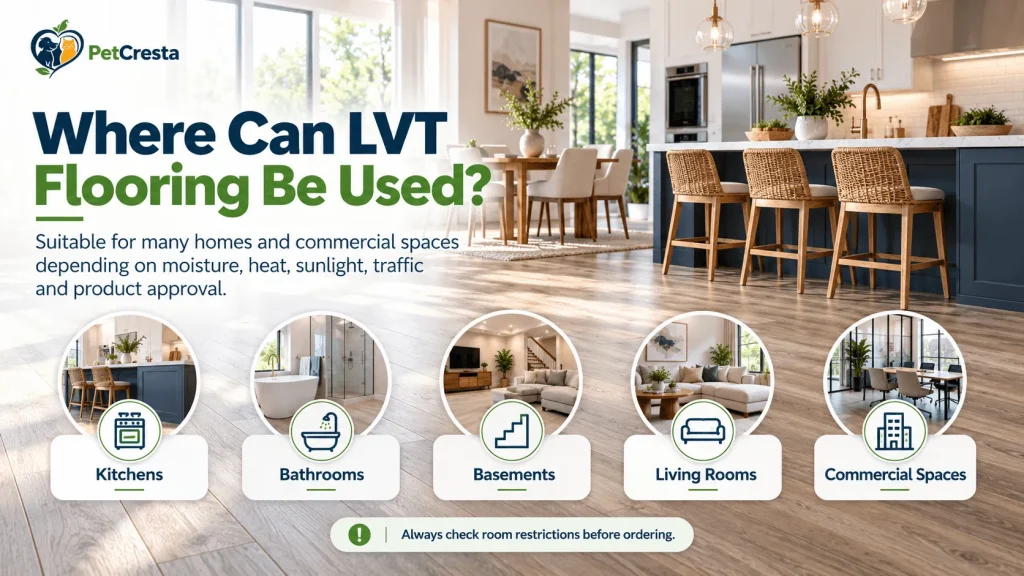
There are numerous examples of LVT that can be installed in homes and commercial buildings. Applicability is related to moisture, heat, sunlight, traffic and product approval.
The same collection can work great in the kitchen, but not in an unconditioned sunroom. Please consult the room restrictions prior to ordering.
Kitchens And Dining Areas
The kitchen vinyl flooring will have to withstand dropped objects, chair movement, and spills and frequent cleaning.
LVT is frequently more warm and soft than ceramic tile. Good water tolerance can be achieved around normal kitchen spills with approved products.
Floating vinyl flooring should not be trapped under fixed cabinets or islands, unless there is a specific reason to do so. Appliance and cabinet specifications are dependent on the system.
Consider slip resistance at sinks and cooking surfaces. It’s still a good idea to clean up promptly.
Bathrooms And Laundry Rooms
Bathroom vinyl flooring must be rated for use in residential wet areas. Detailing of toilet bases, appliance hoses and floor edges is important.
Washing machines are also a risk of leakage in laundry rooms. Not all parts of the structure below are protected by surface water performance.
Some LVT systems may not be appropriate for floor drains and slopes. Check the product for approval prior to installation.
Basements And Concrete Floors
Luxury vinyl tile for bathrooms is commonly installed with concrete slabs. Moisture testing is thus an important aspect of preparation.
Concrete may be dry but be emitting vapour. That moisture can impact the adhesive, backing or material that is positioned under a floating floor.
Cracks, uneven areas and flood history should be evaluated. Understanding the slab is not eliminated by a waterproof vinyl tile flooring.
Living Rooms And Bedrooms
LVT is an option to ceramic in living rooms and bedrooms that can offer a comfortable alternative.
The core, backing and subfloor are responsible for sound and warmth. Rugs can help make things more comfortable, but some rugs will have a rubber or latex backing, which can discolour some products.
Strong sunlight may heat or fade the surface. Samples should be looked at close to the windows of the room.
Hallways, Entryways And Commercial Spaces
Grit, rainwater and frequent foot traffic accumulate in hallways and entrances. Appropriate walk-off mats can minimize wear.
Commercial vinyl flooring should have suitable traffic, rolling-load, slip and acoustic ratings. Access to level changes should also be maintained.
Having replacement stock from the same batch facilitates future repairs. Collections do end, and sometimes rather quickly.
Where Should LVT Not Be Installed?
Most LVT is not recommended for outdoor use because of temperature fluctuation and rain outside of the normal product limits.
Other materials are typically used in shower pans, saunas, and steam rooms and in continuously wet areas.
Other factors that could be excluded include unconditioned rooms, high-heat locations and persistently damp subfloors. Any floors that are structurally weak should be repaired prior to the addition of a finish.
What Does LVT Installation Require?
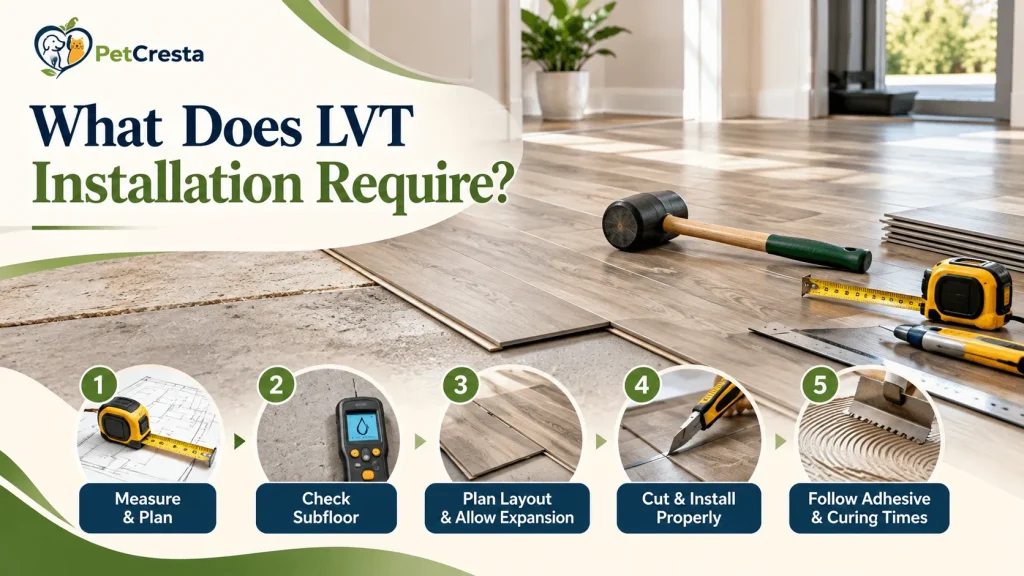
The first step in LVT installation is to measure, plan the product, and evaluate the subfloor. The actual laying will be later.
The base should be clean, dry, stable and within the allowable flatness. Concrete and certain timber systems might need moisture testing.
Narrow cuts and odd pattern placement should be avoided in layout. Expansion, transitions, adhesive and curing times must be in accordance with the product instructions.
Flexible LVT can be scored and snapped with a utility knife as permitted. Rigid core vinyl flooring products might need a cutter or saw.
Dark mastics may contain hazardous materials, as may old resilient flooring. Avoid sanding or disturbing suspect surfaces until a professional evaluation is conducted.
Can Luxury Vinyl Tile Be Installed Over Concrete?
When the slab is properly cured, clean, stable and within moisture limits, LVT can often be installed over concrete.
Cracks, contamination and leveling must be addressed. The glue-down installation needs an appropriate adhesive as well.
A slab can be sloped but flat. Click systems are more concerned with local humps and dips than with the overall flatness of the floor.
Can You Install Luxury Vinyl Tile Over Existing Tile?
LVT can be installed over secure, flat existing tile if the manufacturer allows.
Tiled walls with holes, cracks or loose tiles must be repaired or removed. To avoid telegraphing, deep grout lines may require filling.
Doors, appliances and transitions may be impacted by added floor height. Review those details prior to work.
Can LVT Be Installed Over Wood Subfloors?
Numerous LVT products can be installed over an appropriate plywood or approved wood-based panel.
Squeaks, movement, panel seams and deflection should be addressed. Some glue-down products may not be suitable for use under particleboard.
The base must be either adhesive or floating-floor. A good finish is not enough to make a bad structure sound.
Does LVT Need Underlayment?
Some LVT products require underlayment and others do not allow underlayment.
Click floors can have an attached pad. If it conforms to the product specification, then acoustic underlayment can be used separately.
Typically, glue-down LVT requires a smooth approved surface and not soft underlayment. Moisture barriers are other requirements.
Excessive cushioning can lead to damage to locking joints. Read and follow written instructions.
Does LVT Need To Acclimate?
There are product-specific acclimation requirements.
A certain number of dryback tiles must be left in the room for an advertised time. Some rigid-core products are less sensitive to acclimation, but room temperature and storage conditions do still play a role.
The heating and cooling should be in the range of installation. Don’t assume that if it is rigid, it is not prepared.
Can LVT Be Used With Underfloor Heating?
There are a number of LVT products that are compatible with approved underfloor heating systems.
Verify the highest surface temperature, adhesion and heating process. The temperature should gradually change unless it is extremely hot or cold.
Area rugs have the capacity to retain heat above the floor. That risk should be addressed in product guidance.
Can Beginners Install LVT?
Click-lock LVT can be installed in a simple room on a flat subfloor by some beginners.
Glue-down flooring requires more expertise in the areas of leveling, adhesive timing and layout. There is also less margin for error in patterned designs.
The flexible tiles can be cut with a sharp utility knife, if so authorized. Rigid-core pieces might call for a saw or expert saw cutter.
Large areas, moisture problems and complex patterns are better handled by an experienced installer.
How Much Extra LVT Should You Buy?
For many projects, a general allowance of 5-10% over the measured area will suffice.
Less may be sufficient for simple square rooms. Generally, herringbone, diagonal patterns and layout, and pattern matching will need more.
Any extra parts should be stored for future use. Keep the product code, batch number and receipt with them.
Luxury Vinyl Tile Flooring Pros And Cons
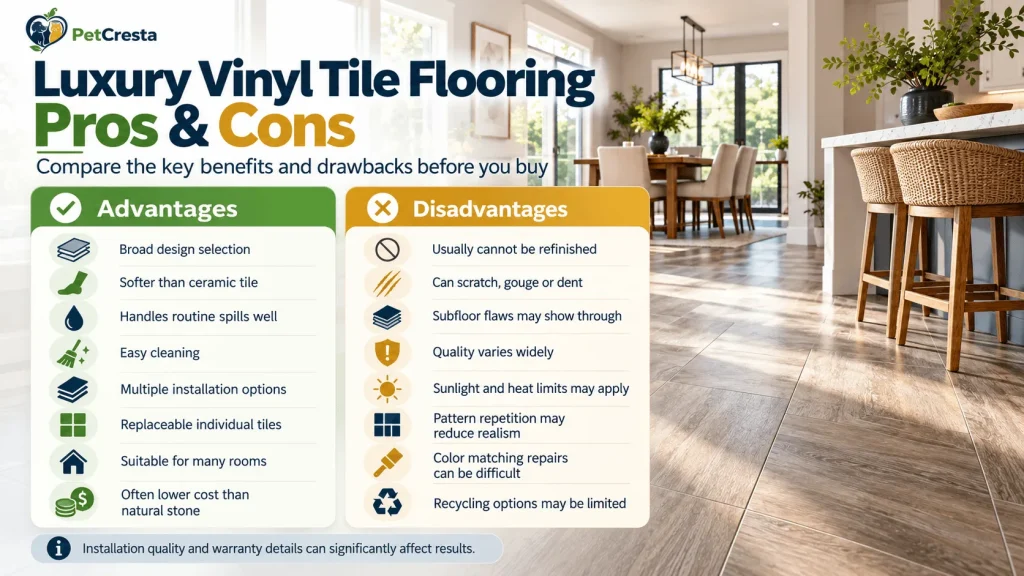
LVT provides a handy combination of design, comfort and practical care. It also comes with its drawbacks that need to be known before buying.
| Advantages of luxury vinyl tile flooring | Disadvantages of luxury vinyl tile flooring |
|---|---|
| Broad design selection | Cannot usually be refinished |
| Softer than ceramic tile | Can scratch, gouge or dent |
| Often handles routine spills well | Subfloor flaws may show through |
| Easier cleaning than porous materials | Quality varies widely |
| Multiple installation options | Sunlight and heat restrictions may apply |
| Individual tiles may be replaceable | Pattern repetition can reduce realism |
| Suitable for many rooms | Repair color matching may become difficult |
| Often lower cost than natural stone | Recycling options may be limited |
Installation quality has a major effect on results. Warranty exclusions may also limit coverage for moisture, heat or incorrect preparation.
How Much Does Luxury Vinyl Tile Flooring Cost?
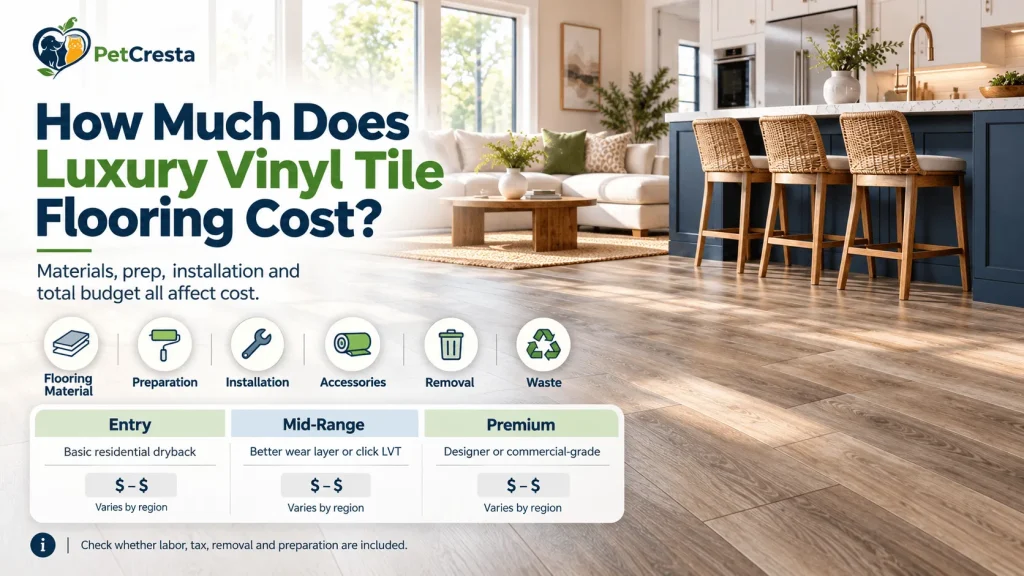
The cost of LVT depends on the country, product grade, installation technique, and subfloor.
The cost of materials is just one component of the budget. It may be significantly more if you have to prepare, remove, apply adhesive, install underlayment, add trims and labour.
| Cost Component | What Affects It |
|---|---|
| Flooring material | Brand, wear layer, core and design |
| Preparation | Moisture, cracks, unevenness and old flooring |
| Installation | Glue-down, click-lock, pattern and room shape |
| Accessories | Adhesive, underlayment, trim and transitions |
| Removal | Existing material and disposal requirements |
| Waste | Layout, tile size and cutting complexity |
Current regional prices should be checked before publication. The table below must use one currency and state whether labour, tax, removal and preparation are included.
| Cost Level | Material Only | Installed | Typical Product |
|---|---|---|---|
| Entry | [Regional range] | [Regional range] | Basic residential dryback |
| Mid-range | [Regional range] | [Regional range] | Better wear layer or click LVT |
| Premium | [Regional range] | [Regional range] | Designer or commercial-grade product |
Complex patterns usually cost more because layout and cutting take longer. A cheap product over a difficult slab can become an expensive floor.
How Does LVT Compare With Other Flooring?
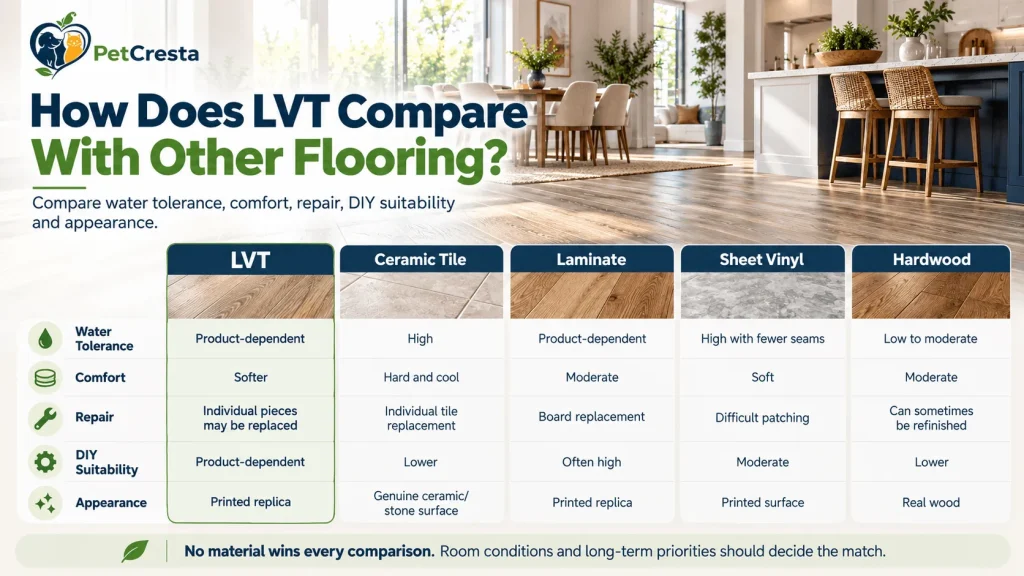
LVT is positioned between some of the more common types of flooring. In general, it’s softer than ceramic, more water-resistant than many wood products and easier to repair than sheet vinyl in certain instances.
| Feature | LVT | Ceramic tile | Laminate | Sheet vinyl | Hardwood |
|---|---|---|---|---|---|
| Water tolerance | Product-dependent | High | Product-dependent | High with fewer seams | Low to moderate |
| Comfort | Softer | Hard and cool | Moderate | Soft | Moderate |
| Repair | Individual pieces may be replaced | Individual tile replacement | Board replacement | Difficult patching | Can sometimes be refinished |
| DIY suitability | Product-dependent | Lower | Often high | Moderate | Lower |
| Appearance | Printed replica | Genuine ceramic/stone surface | Printed replica | Printed surface | Real wood |
No material wins every comparison. Room conditions and long-term priorities should decide the match.
LVT Vs Laminate
The vinyl or composite material in the main structure of an LVT is generally more resistant to moisture. Laminate is usually made with a wood fibre core, but there are water resistant laminates.
Laminate might also provide excellent scratch resistance and firmness. LVT may sound softer and quieter, depending on the backing.
Both use print visuals. Do not compare labels of the categories only.
LVT Vs Hardwood
Hardwood – uses real wood and can sometimes be sanded and refinished. LVT is a printed surface, which is usually not possible to repair the same way.
Household moisture is more tolerated in vinyl. Hardwood is natural, and may have a better resale appeal.
The price and suitability vary from room to room. The basement and the formal reception room might suggest different materials.
Luxury Vinyl Vs Ceramic Tile And Porcelain Tile
Mineral surfaces offer good water performance and long service life with ceramic and porcelain.
They are harder and cooler to walk on. It is more labour-intensive to install and grout needs to be taken care of.
LVT is softer, lighter and sometimes easier to fit. Many showers, outdoor spaces and areas with high heat exposure are still more suitable for porcelain.
LVT Vs Sheet Vinyl
A room is covered with sheet vinyl with fewer seams. This can enhance surface water performance.
LVT provides individual pieces, greater design variation and local replacement. Sheet vinyl may be more difficult to repair neatly.
Both need a good preparation of the subfloor. Thin products may show defects below the surface.
How Do You Clean And Maintain LVT?
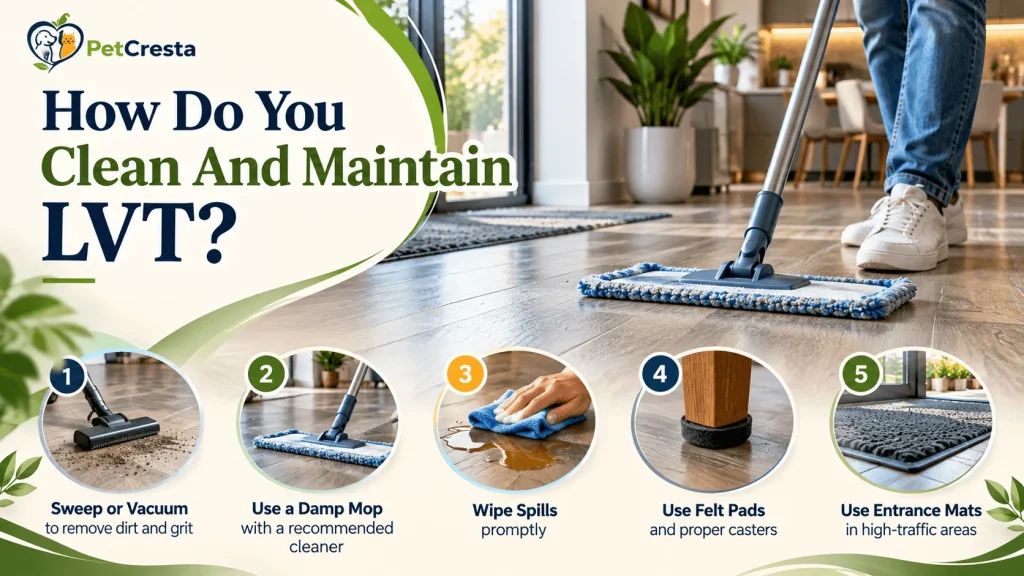
Regularly sweep or vacuum LVT to collect grit. Use a damp mop with a cleaner recommended by the manufacturer.
Wipe spills promptly. Utilize felt pads, appropriate casters and compatible entrance mats.
Do not use abrasive brushes, harsh solvents or wax unless specified in the care guide. During wet or dusty weather, commercial entrances might require seasonal cleaning adjustments.
Can You Steam-Clean LVT?
There are many manufacturers that do not recommend steam cleaning LVT.
Hot and humid conditions can cause the joints, adhesive or surface finish to be compromised. Even a waterproof material may have restrictions for steam cleaning.
Please read the steam appliance care guide prior to use.
How Do You Remove Stains From LVT?
Start with a soft cloth and mild, approved cleaner. Handle the treated marks promptly and don’t scrub too hard. The finish may become damaged or change in appearance by strong solvents.
Test any cleaner in an out-of-the-way place first. A quiet test is preferable to a permanent bright patch.
How Do You Repair Damaged LVT?
Repair will be based on the damage and installation.
Scuffs can be treated with cleaning if they are light. If there are deep gouges, they most likely need to be replaced with tile.
Glue down pieces can be removed one at a time. Partial disassembly from the nearest wall may be required for Click floors.
| Damage | Likely Response |
|---|---|
| Light scuff | Approved cleaner or manufacturer method |
| Surface scratch | Product-specific repair treatment |
| Deep gouge | Replace the affected tile |
| Loose glue-down tile | Lift, clean and re-bond if approved |
| Broken click joint | Partial disassembly may be required |
| Widespread moisture damage | Identify the moisture source first |
Flooring should be stored flat and dry. Installed pieces can fade in color over time or from exposure to sunlight.
How Long Does Luxury Vinyl Tile Last?
The luxury vinyl tile lifespan depends on the quality of the product, traffic, installation, moisture, sunlight and maintenance.
Many years of use can be expected from a well-specified floor. Even if the surface material is strong, failure can occur early if it is not prepared properly.
The warranty period is useful to compare products but not indicative of service life. The same standard cannot be applied to residential bedrooms and commercial entrances.
Is It Safe And Environmentally Responsible?
Not all products are created equal when it comes to safety and environmental performance.
Products with FloorScore and GREENGUARD Gold certifications can be identified as those that have been tested for specific indoor-air emissions. Certification does not guarantee a floor to be entirely free of chemical and environmental effects.
Emissions of adhesives are also important. During installation and curing, good ventilation should be ensured.
LVT can contain recycled content, mineral fillers, stabilisers and PVC flooring. In many areas, there are no recycling facilities available.
An environmental product declaration can give more detail regarding manufacturing and material impacts. Claims should be verified by the official certification databases.
How Should You Choose This Flooring?
The best LVT is the one that is matched to the room, subfloor and intended use. Price and appearance are important but should come after basic suitability.
The following ten steps transform product specifications into a real choice.
Step 1: Define The Room Conditions
List the Moisture, Traffic, sunlight, and Temperature conditions.
Other factors such as pets, rolling loads, acoustic requirements and slip performance could also play a role in the selection.
A quiet room requires different performance than a noisy shop entrance.
Step 2: Inspect The Subfloor
Identify whether the base is concrete, plywood, existing tile or another approved material.
Check moisture, flatness, cracks, movement and finished height. A floor may slope while still being flat.
Doors, appliances and transitions should be measured before ordering.
Step 3: Choose The Installation System
Glue Down flooring has low height and good stability.
Click-lock products can be floated in place. Depending on the type of core, loose-lay systems can offer easier access, whereas rigid cores offer structural thickness.
Do not use a convenient choice of system for the room, but rather match the system to the room.
Step 4: Compare Product Specifications
Review wear layer, total thickness, core, finish and locking profile.
Acoustic and slip ratings may be required. Commercial areas need an appropriate use classification.
Do not treat one number as the full quality score.
Step 5: Assess The Visual Quality
Compare clarity and pattern repeat, texture, bevels and colour variation.
View several pieces together. Inspect them during the day and under artificial lighting.
Think about how the floor should be used as a focal point or as a subdued background. Room scale is influenced by the layout direction and the size of the tiles.
Step 6: Read The Warranty
Look for moisture, flooding, heat, sun and improper underlayment.
Restrictions may also apply to commercial use, rolling loads, labour and transferability.
A long warranty is only beneficial if the project falls within the parameters of the warranty.
Step 7: Order And Compare Samples
Store samples near cabinets, paint, furniture and existing floors.
Observe them in the morning, afternoon and evening. To see how easily dust, footprints and marks show.
Compare a number of pieces to see that pattern repeat appears.
Step 8: Calculate The Complete Cost
Add accessories and spare stock, flooring, waste, preparation, removal and labour.
Patterns may require additional materials. A wet work job can really affect your budget. The box price is just the first price.
Step 9: Confirm Installation Requirements
Check adhesive, underlayment, moisture tests, acclimation and heating limits.
Inquire who does the subfloor prep. Experience by the installer with the system being installed is important.
Maintain installation instructions for the project.
Step 10: Keep Spare Tiles And Product Records
Keep extra parts from the same batch.
Ensure product code, colour, receipt, warranty and installation guide are kept together.
Those records can make a repair in the future a small job.
What LVT Colors, Styles And Patterns Are Available?
LVT is available in stone, marble, concrete, ceramic, terrazzo and wood effects.
There are luxury vinyl flooring pattern options like herringbone, checkerboard, geometric and encaustic-inspired patterns. Open rooms will feel calmer with large format tiles and bring more visual movement with smaller format.
Light hues can help open up a space. Dark floors provide contrast and tend to reveal dust more readily.
Side lighting can emphasise seams and surface texture. Test samples close to windows before making a selection.
A bold floor could be the focal point of the space. When cabinets, furniture or artwork should lead, the quiet design is better.
In commercial and open-plan spaces, zoning and borders can be used to delineate spaces. More cutting, labour and waste are needed for complex layouts.
Is Luxury Vinyl Tile Worth It?
LVT is a viable option for design flexibility, maintenance ease and the softer surface than ceramic.
Approved products are appropriate for many kitchen vinyl floorings, bathrooms, basements and commercial applications. The quality of installation is still a big contributor to the outcome.
If natural character, refinishing, or use in the outdoors or shower installation is desired, another material might be more suitable.
The value of a property for resale will depend on the market and the individual property. While LVT is not typically as materialistic as hardwood or natural stone, it can still transform a fatigued room
LVT May Suit You If…
LVT is ideal for those who prefer a variety of colors and patterns.
It also works well when the standard cleaning jobs must not be too cumbersome. Normal household spills can be cleaned with approved products.
The category is flexible in terms of glue-down, click-lock and loose lay.
Consider Another Floor If…
Select another material if you wish to have a natural finish which can be refinished.
Typically, a different product is needed in outdoor areas, shower floors and extreme heat.
A wet or unstable subfloor will need to be addressed before a new floor is ever added.
Common LVT Buying And Installation Mistakes
Most LVT problems begin before the first tile is laid. A short planning check can prevent expensive repairs.
| Mistake | Better Approach |
|---|---|
| Choosing by colour alone | Compare construction, warranty and room approval |
| Confusing wear layer and total thickness | Check both measurements separately |
| Assuming all LVT is floodproof | Review seams, edges, subfloor and warranty |
| Ignoring slab moisture | Test concrete before installation |
| Installing over deep grout lines | Fill and smooth the surface |
| Adding unapproved underlayment | Follow the flooring specification |
| Trapping a floating floor | Check cabinet and island requirements |
| Ignoring direct sunlight | Confirm temperature and sunlight limits |
| Failing to mix cartons | Blend tiles before installation |
| Ordering too little | Add suitable waste and repair stock |
| Using a residential product commercially | Confirm traffic and warranty, class |
| Using the wrong cleaner | Follow the product care guide |
| Discarding spare tiles | Retain matching pieces and records |
| Disturbing old resilient flooring | Test suspect materials before removal |
Is LVT The Right Flooring For Your Project?
If you are looking for realistic design, easier care and more comfort than ceramic tile, LVT might be the better option.
Start with room conditions and subfloor quality. Then compare installation method, wear layer, water expectations, warranty and full project cost.
View several samples in the actual room. Check the technical documents and ensure installation requirements before purchasing.
A good match will last for years in a house or business. The best is to choose for the space and not just from the display.
FAQ’s
Most floating LVT requires a perimeter expansion gap so the floor can move with temperature changes. Glue-down systems follow different requirements because the tiles are bonded directly to the subfloor.
Floating LVT should not usually be trapped beneath fixed cabinets unless the manufacturer allows it. Glue-down flooring may follow different rules, so cabinet and island plans should be checked before installation.
Mould can grow beneath LVT when moisture reaches wood, dust, paper backing or other organic material. The vinyl itself is not the sole cause; persistent moisture creates the conditions.
A damaged glue-down tile can often be replaced individually. Click-lock floors may need partial disassembly from the nearest wall, depending on the product and location of the damage.
A 20-mil wear layer generally provides more protective material, but it is not automatically the better choice. Traffic, surface coating, warranty and product construction should guide the decision.
Some rubber or latex rug backings may react with vinyl and cause discolouration. Use mats approved by the flooring manufacturer and avoid trapping moisture underneath them.
LVT can suit wheelchairs and office chairs when the product is approved for rolling loads. Suitable casters, level transitions and a stable installation system are also required.
Prolonged sunlight and heat can fade or affect some LVT products. Window coverings, UV films and product-specific sunlight warranties should be considered in bright rooms.
LVT can improve the appearance and practicality of a worn room. Its effect on value depends on installation quality, design, local preferences and how it compares with expected materials in the property.
Heavy furniture can sit on suitable LVT when point loads are managed with approved pads or protectors. Newly glued floors may also need time to cure before furniture is returned.
LVT over concrete may feel cooler than flooring over timber. Core construction, backing, approved underlayment and underfloor heating can change how the surface feels.
LVT recycling options vary by location and product composition. Some manufacturers operate take-back schemes, but many local recycling systems do not accept mixed vinyl flooring.
References
- RFCI — Flexible Luxury Vinyl Tile and Plank Flooring
https://rfci.com/flexible-lvp-lvt/ - RFCI — Resilient Flooring Industry Resources
https://rfci.com/ - ASTM International — ASTM F3261: Rigid Polymeric Core Resilient Flooring Standard
https://www.astm.org/f3261-20.html - SCS Global Services — FloorScore Indoor Air Quality Certification
https://www.scsglobalservices.com/services/floorscore - UL Solutions — GREENGUARD Certification
https://www.ul.com/services/ul-greenguard-certification - U.S. Environmental Protection Agency — Asbestos Floor Tiles and Mastic Guidance
https://www.epa.gov/large-scale-residential-demolition/how-epas-asbestos-regulations-apply-floor-tiles-and-mastic - Mannington Commercial — LVT Specifications, Installation, Warranty and Maintenance Resources
https://www.manningtoncommercial.com/en/resources/lvt/ - Shaw Floors — Luxury Vinyl Flooring Installation Guidance
https://shawfloors.com/en-us/plan-and-install/vinyl - Karndean — LVT Installation Guides for Glue-Down, Loose-Lay and Rigid-Core Flooring
https://www.karndean.com/en-au/floors/services/installation-guides/ - Mannington Commercial — Technical Flooring Resources
https://www.manningtoncommercial.com/en/resources/