Fun Ways to Show Off Your Pet’s Personality
Every pet has its own personality. Some dogs greet everyone with a full-body wiggle, while others prefer quietly watching the world. Some cats investigate every new object, while others take their time before approaching anything unfamiliar.
If you want to show off your pet’s personality, start by noticing the habits, expressions, and activities that make your companion different. You can capture those qualities through photographs, personalized accessories, simple tricks, enrichment games, and creative spaces at home.
The best ideas are the ones your pet genuinely enjoys. A relaxed photograph of a shy cat or a playful video of an energetic dog often reveals more character than a carefully staged scene.
Start by Reading Your Pet’s Temperament
Before planning photos, choosing accessories, or teaching tricks, spend a few days observing your pet’s natural behavior. Notice what excites them, how they respond to unfamiliar situations, and when they seem most relaxed.
A simple observation record can help you recognize patterns rather than judging personality from one unusual moment.
Look for four characteristics:
- Energy level: Is your pet usually energetic, moderately active, or relaxed?
- Social style: Do they approach visitors confidently, prefer familiar people, or avoid interaction?
- Motivation: Are they most interested in food, toys, scents, exploration, or attention?
- Stress signals: Do they show signs such as lip licking, flattened ears, hiding, a tucked tail, or attempts to move away?
These observations can guide the activities you choose. A scent-driven dog may enjoy a searching game, while a shy cat may be more comfortable exploring a new toy in a quiet room.
Remember that behavior changes with context. A normally outgoing pet may become cautious around unfamiliar people, loud noises, or new surroundings.
Dress Your Pet With Purpose
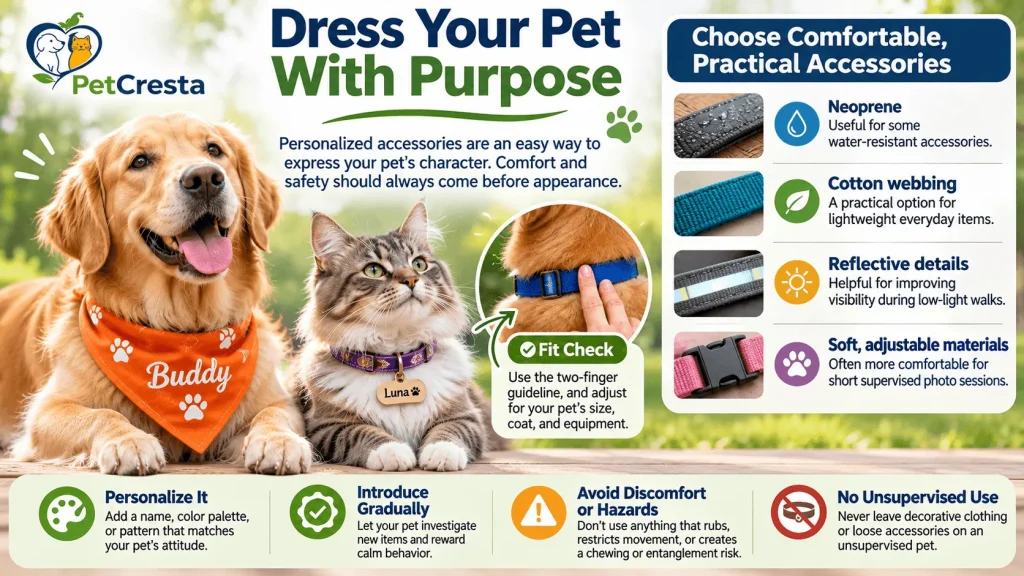
Personalized accessories are an easy way to express your pet’s character without requiring an elaborate photo session. A bright bandana might suit an enthusiastic retriever, while a simple embroidered collar may complement a quieter companion.
Comfort and safety should always come before appearance.
Choose Comfortable, Practical Accessories
Check that collars and harnesses fit securely without rubbing, restricting movement, or interfering with breathing. The common two-finger collar-fit guideline is a starting point, but fit should also be assessed according to the animal’s size, coat, and equipment design.
Choose materials according to their intended use:
- Neoprene: Useful for some water-resistant accessories.
- Cotton webbing: A practical option for lightweight everyday items.
- Reflective details: Helpful for improving visibility during low-light walks.
- Soft, adjustable materials: Often more comfortable for short supervised photo sessions.
Custom pet products let you add a name, a color palette, or a pattern that matches your pet’s attitude. A bold orange bandana suits a goofy retriever. A muted embroidered tag suits a dignified senior cat.
Introduce unfamiliar accessories gradually. Let your pet investigate the item, reward calm interaction, and begin with brief supervised sessions.
Avoid anything that causes discomfort, restricts natural movement, or creates a chewing or entanglement hazard. Never leave decorative clothing or loose accessories on an unsupervised pet.
Capture Real Expression With a Photo Routine
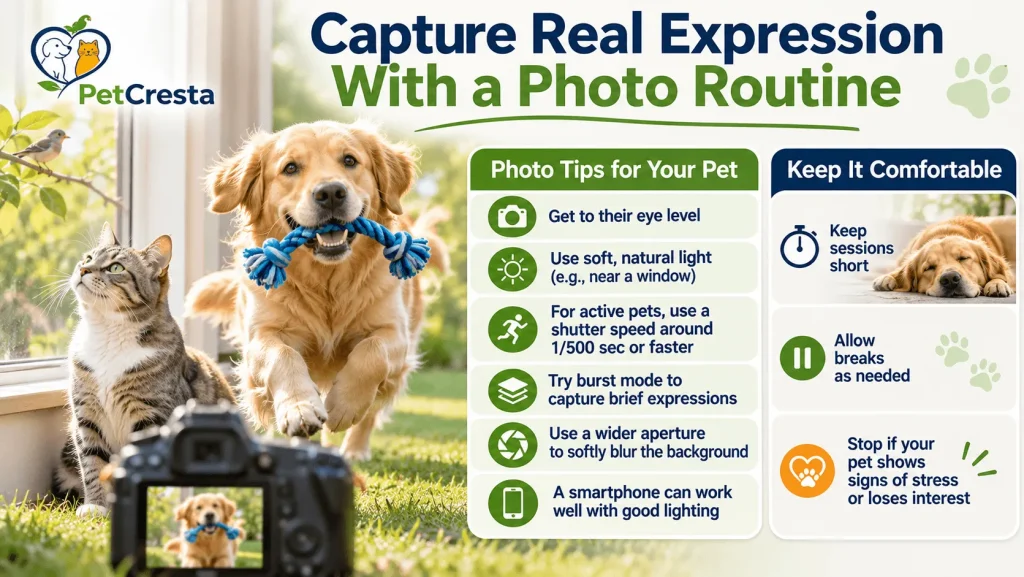
Photographs are one of the simplest ways to share your pet’s individuality. Instead of trying to force a particular pose, photograph the behaviors your pet already enjoys.
A curious cat watching birds or a dog carrying a favorite toy can communicate personality without elaborate props.
Use Lighting and Camera Settings That Suit Your Pet
Photograph your pet at eye level whenever possible. Soft natural light, such as light from a nearby window, can reveal coat texture and facial expressions without the harsh appearance of direct flash.
For active pets, a shutter speed around 1/500 second or faster may help reduce motion blur. Burst mode can capture brief expressions, while a wider aperture can soften a distracting background.
These settings are useful starting points rather than requirements. Smartphone cameras can also produce appealing results when lighting is good and the subject is comfortable.
Keep sessions short and allow breaks. If your pet becomes restless, turns away repeatedly, or shows signs of stress, stop and try another time.
Turn Daily Behaviors Into Signature Tricks
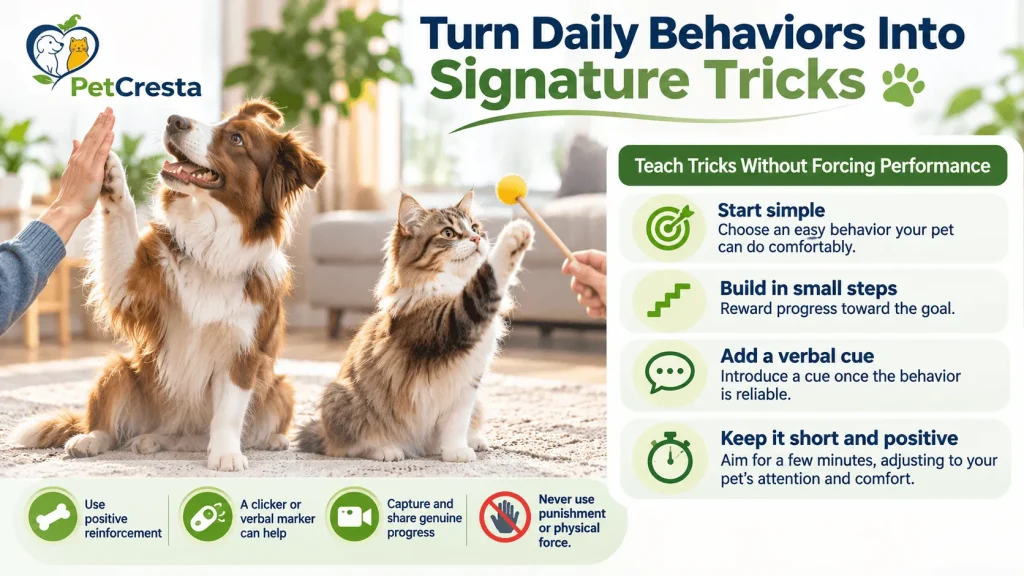
Training can turn your pet’s natural habits into memorable moments. A dog that enjoys spinning or a cat that frequently touches objects with its paw may already offer the beginnings of a simple trick.
Use positive reinforcement to reward the behavior you want. A clicker or a consistent verbal marker can help identify the successful action, followed promptly by a suitable reward.
Teach Tricks Without Forcing Performance
Start with an easy behavior your pet can perform comfortably. Reward small steps toward the goal and introduce a verbal cue once the behavior becomes predictable.
For dogs, the same reward-based principles used in training for adult dogs can help owners teach new behaviors while maintaining positive interactions.
For cats, short targeting exercises or voluntary paw touches may work better than expecting prolonged obedience-style sessions.
Aim for a few minutes at a time, adjusting the duration to your pet’s attention and comfort. A brief video showing genuine progress can be more enjoyable than a polished performance that requires repeated attempts.
Never use punishment or physical force to obtain a trick.
Match Enrichment to Your Pet’s Drive
Enrichment gives pets opportunities to explore, solve problems, move, and engage in natural behaviors. It is also an excellent way to discover which activities bring out their individual character.
The ASPCA identifies positive social interaction, food-based activities, sensory experiences, and opportunities for movement as useful enrichment approaches. Its canine enrichment guidance also includes practical ideas for engaging dogs.
Easy Ways to Match Activities to Personality
| Pet Personality | Activity Idea | What It May Reveal |
|---|---|---|
| Playful chaser | Supervised fetch or appropriate chase toys | Energy and enthusiasm |
| Curious sniffer | Scent games or treat-search activities | Persistence and exploration |
| Problem solver | Food puzzles and interactive feeders | Curiosity and learning style |
| Confident climber | Secure cat trees and elevated perches | Agility and environmental confidence |
| Quiet observer | Window perches and calm observation areas | Patience and preferred resting habits |
| Social companion | Gentle interactive games | Interest in people and shared activities |
Choose activities suited to your pet’s species, age, health, and physical abilities. Avoid unsafe toys, excessive exertion, and food puzzles that encourage frustration.
If your pet gives up repeatedly, simplify the activity rather than increasing the challenge.
Build a Space That Reflects Your Pet’s Personality
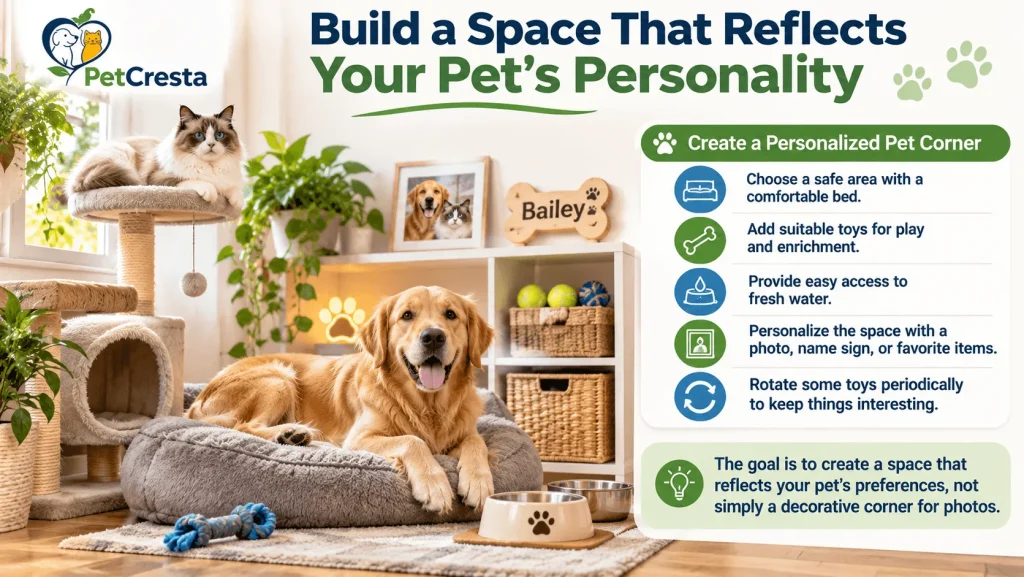
Your pet’s favorite resting and play areas can reveal as much about their personality as photographs or tricks.
Some cats prefer elevated perches with a view of the room, while others seek enclosed hiding spots. Dogs may choose a quiet bed, a sunny floor, or a comfortable area near family members.
Observe where your pet naturally settles before rearranging their environment.
Create a Personalized Pet Corner
Choose a safe area with a comfortable bed, suitable toys, and easy access to water.
You can personalize the space with a framed photograph, a name sign, or a small display of favorite accessories. Keep decorations, cords, and loose objects out of reach if they could be chewed or swallowed.
Rotate some toys periodically to maintain interest, while leaving familiar comfort items available. Not every pet enjoys frequent changes, so use their behavior to decide how much novelty is appropriate.
The goal is to create a space that reflects your pet’s preferences, not simply a decorative corner for photographs.
Share Your Pet’s Personality Safely and Consistently
A dedicated photo album, family group, or social media account can help you collect memorable moments over time.
Focus on captions that explain behavior rather than appearance alone. A sentence describing how your dog waits patiently for a favorite toy can tell readers more than a generic caption about being cute.
Protect Your Pet’s Comfort and Privacy
Avoid sharing information that reveals your home address, regular walking routes, or travel schedule. Check photographs for visible identification details and consider delaying posts made while you are away.
Most importantly, never prioritize content over your pet’s comfort.
Stop photographing or filming when your pet shows signs of distress, attempts to escape, or repeatedly avoids interaction. Some animals enjoy attention and activities; others prefer quiet observation.
Both personalities are worth celebrating.
Final Takeaway
The most enjoyable ways to show off your pet’s personality begin with understanding what makes them comfortable, curious, playful, or relaxed.
Personalized accessories, natural photographs, reward-based tricks, enrichment games, and thoughtfully arranged spaces can all highlight those qualities.
You do not need expensive equipment or elaborate performances. A familiar habit, a favorite activity, or a candid moment can communicate more about your pet than a carefully staged photograph.
Observe first, choose activities that fit, and let your pet’s natural character lead.
FAQ’s
You can highlight your pet’s personality through candid photographs, personalized accessories, short training videos, enrichment games, and descriptions of their everyday habits. Choose activities your pet enjoys rather than forcing unfamiliar situations.
Try photographing your dog during play, teaching simple reward-based tricks, creating scent games, or choosing comfortable accessories that suit their character. Natural behavior often makes the most memorable content.
Photograph your cat during familiar activities such as exploring, playing, resting, or watching birds. Use soft natural light, avoid direct flash, and allow your cat to approach or leave the camera freely.
Yes. Individual pets vary in sociability, activity level, confidence, curiosity, and responses to unfamiliar situations. Genetics, early experiences, learning, health, and environment can all influence behavior.
Some accessories are safe when appropriately fitted and supervised, but others can restrict movement, cause discomfort, or create choking and entanglement hazards. Introduce new items gradually and remove them if your pet appears uncomfortable.
Scent games, interactive toys, food puzzles, gentle training, and species-appropriate play can encourage natural behaviors. The best activity depends on your pet’s interests, physical abilities, and comfort level.
Yes. Reward-based training can encourage pets to demonstrate behaviors they already enjoy, such as spinning, targeting, retrieving, or exploring. Sessions should remain short, positive, and appropriate for the individual animal.
Avoid posting your address, location tags, identifying documents, or predictable travel routines. Review image backgrounds and make sure your pet is comfortable during every photography or filming session.