Pros And Cons Of Getting Two Kittens At The Same Time
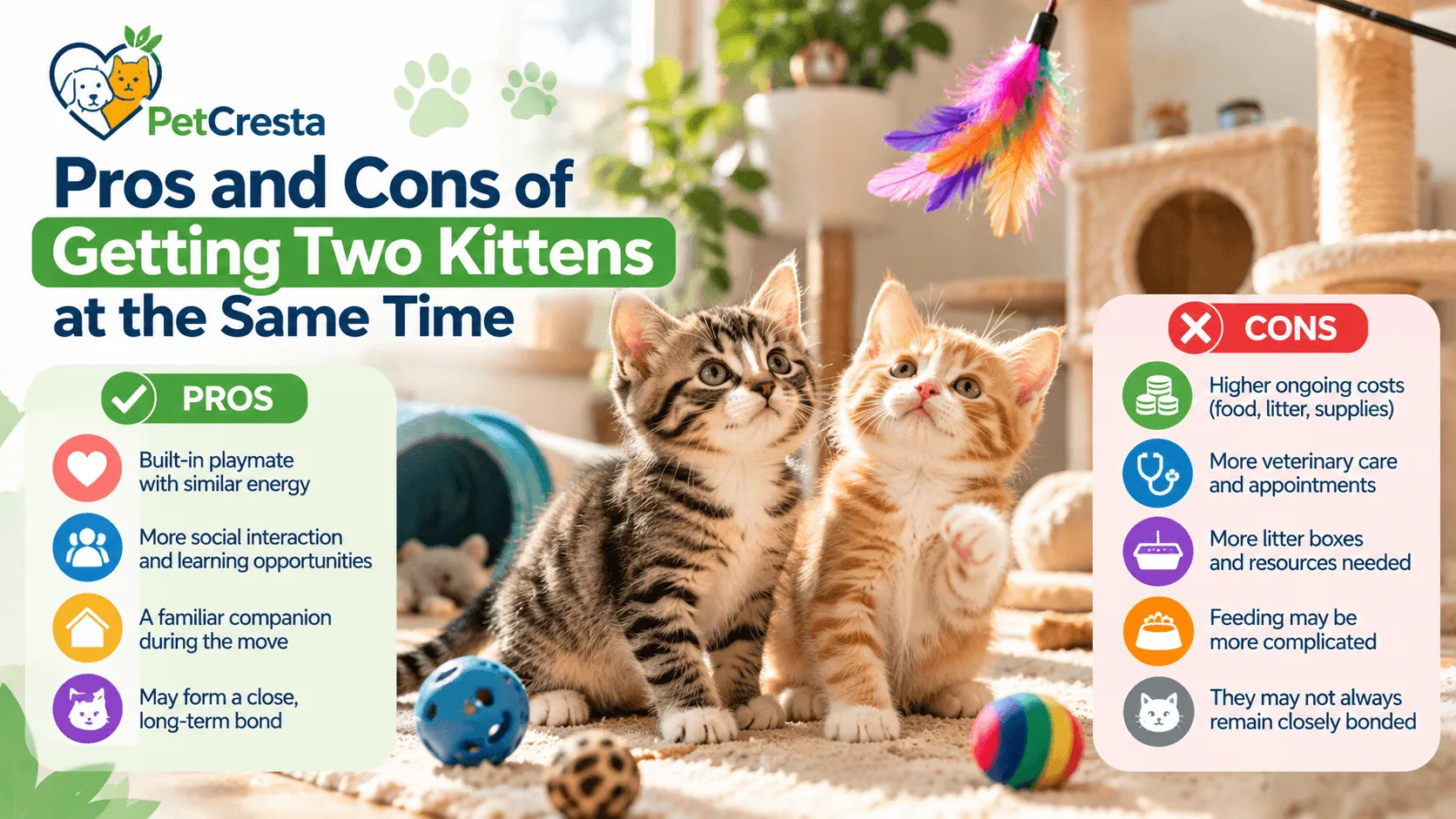
Bringing home one kitten is a big commitment. Bringing home two can mean twice the food bowls, veterinary appointments, litter, and midnight zoomies—but it may also give each kitten a compatible playmate during an energetic stage of life.
So, is getting two kittens better than getting one?
The main pros of getting two kittens are companionship, shared play, opportunities for social interaction, and having another kitten with a similar energy level. The main cons are higher costs, more veterinary care, additional litter and feeding resources, and the possibility that the kittens may not remain closely bonded.
The right choice depends less on the number of kittens and more on whether you have the time, space, budget, and home setup to meet each kitten’s individual needs.
The American Association of Feline Practitioners’ Intercat Tension Guidelines, 2024 also emphasize that relationships between cats depend on familiarity, individual preferences, resources, and social compatibility.
What Are the Pros and Cons of Getting Two Kittens?
Here is the basic trade-off.
| Factor | One Kitten | Two Kittens |
|---|---|---|
| Play opportunities | Relies more on human play | Can play with each other |
| Social interaction | Mainly people or resident pets | Regular kitten-to-kitten interaction |
| Expenses | Lower | Higher |
| Veterinary care | One kitten | Two kittens |
| Litter boxes | Fewer required | More resources required |
| Feeding | Simpler | Separate feeding may be useful |
| Settling in | Depends on individual kitten | Familiar pairs may settle together |
| Intercat tension | Not applicable unless other cats are present | Possible even in apparently friendly pairs |
| Human attention | Goes to one kitten | Must be shared while still giving individual attention |
Two kittens are therefore not automatically easier or harder. They simply create a different set of responsibilities.
Benefits Of Getting Two Kittens
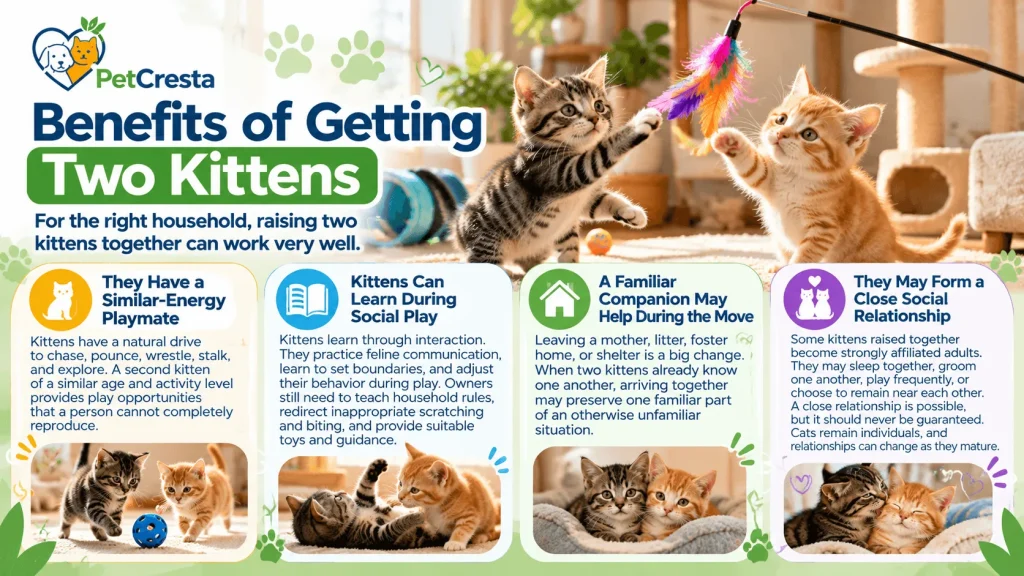
For the right household, raising two kittens together can work very well.
They Have a Similar-Energy Playmate
Young kittens have a considerable drive to chase, pounce, wrestle, stalk, and explore.
A second kitten of a similar age and activity level can provide opportunities for interactive play that a person cannot completely reproduce.
This does not mean owners can stop playing with them. Interactive play with people remains important for enrichment, exercise, training, and your relationship with each kitten.
Kittens Can Learn During Social Play
Kittens learn through interaction.
During play, one kitten may stop participating when the other becomes too rough. These exchanges give kittens opportunities to practice feline communication and adjust their behavior.
That does not mean two kittens will train each other for you. Owners still need to teach household rules, redirect inappropriate scratching and biting, provide suitable toys, and reward desirable behavior.
A Familiar Companion May Help During the Move
Leaving a mother, litter, foster home, shelter, or breeder and entering an unfamiliar house is a major change.
When two kittens already know one another, arriving together may preserve one familiar part of an otherwise unfamiliar situation.
This benefit is most relevant to kittens that already have a comfortable relationship. Simply adopting two unfamiliar kittens does not guarantee the same effect.
They May Form a Close Social Relationship
Some kittens raised together become strongly affiliated adults.
They may sleep together, groom one another, play frequently, or choose to remain near each other.
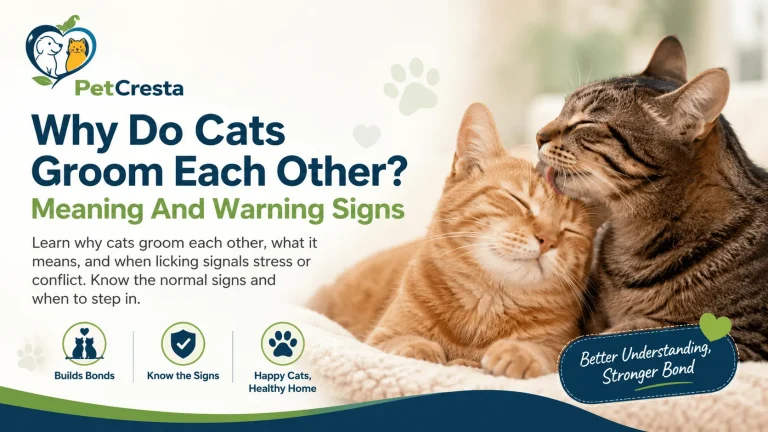
If you want to understand what social grooming can tell you about a feline relationship, PetCresta’s guide to why cats groom each other explains normal grooming, bonding behavior, and signs that an interaction may be becoming uncomfortable.
A close relationship is possible, but it should never be guaranteed. Cats remain individuals, and relationships can change as they mature.
What Are the Downsides of Getting Two Kittens?
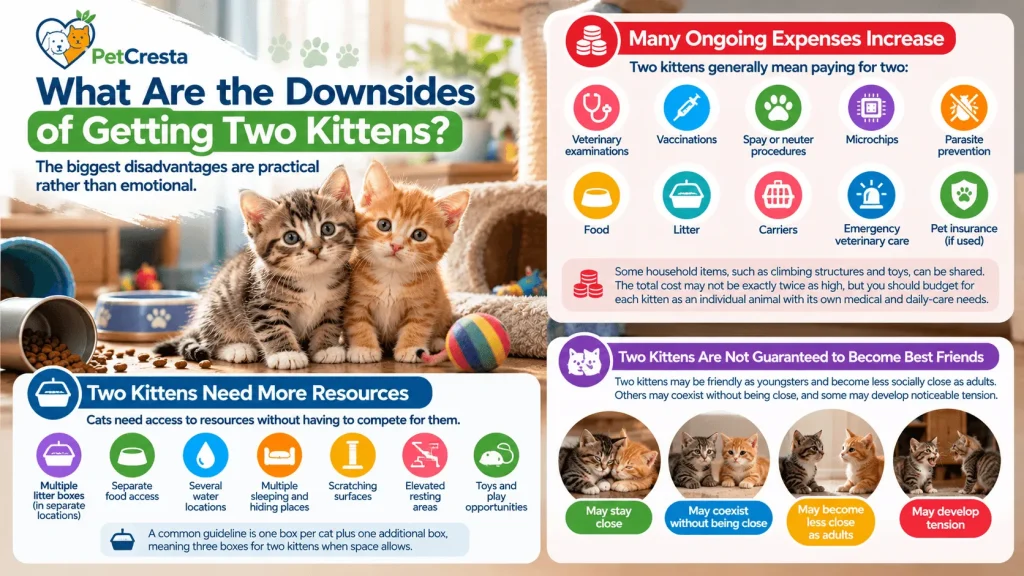
The biggest disadvantages are practical rather than emotional.
Many Ongoing Expenses Increase
Two kittens generally mean paying for two:
- Veterinary examinations
- Vaccination schedules
- Spay or neuter procedures
- Microchips
- Parasite prevention
- Food
- Litter
- Carriers
- Emergency veterinary care
- Pet insurance, if used
Some household items, such as climbing structures and toys, can be shared.
That does not mean the total cost will be exactly twice as high. It does mean you should budget for each kitten as an individual animal with its own medical and daily-care needs.
Two Kittens Need More Resources
One of the biggest mistakes in a multi-cat home is assuming everything can simply be shared.
Cats need access to resources without having to compete for them.
Plan for:
- Multiple litter boxes in separate locations
- Separate food access
- Several water locations
- Multiple sleeping and hiding places
- Scratching surfaces
- Elevated resting areas
- Toys and play opportunities
A common starting guideline for litter boxes is one box per cat plus one additional box, meaning three boxes for two kittens when space allows.
The placement matters too. Three boxes side by side function less like separate resources than boxes placed in different accessible locations.
Two Kittens Are Not Guaranteed to Become Best Friends
Two kittens may be friendly as youngsters and become less socially close as adults.
Others may happily coexist without sleeping or grooming together.
A smaller number may develop noticeable tension.
Watch the relationship instead of assuming that absence of fighting means everything is perfect. Blocking access to resources, prolonged staring, repeated chasing, hiding, avoidance, and one cat consistently yielding space can all deserve attention.
Is It Better to Get Two Kittens From the Same Litter?
Littermates can be a good choice because they already know each other’s scent, play style, and behavior.
That existing familiarity can simplify the transition to a new home.
It does not, however, guarantee a lifelong bond.
Individual personality still matters. One kitten may be much more energetic, bold, demanding, or socially motivated than its sibling.
When choosing littermates, look at how the kittens actually interact rather than relying only on their biological relationship.
Whether you are considering a Devon Rex Kitten, a Sphynx Kitten, or another type of kitten, health, temperament, responsible breeding practices, and compatibility should matter more than assuming breed or litter status guarantees a particular relationship.
Can You Get Two Kittens From Different Litters?
Yes. Two unrelated kittens can live very successfully together.
Age and energy level can help when evaluating a potential pairing, but personality and behavior matter as well.
Do not put two unfamiliar kittens together and assume they will sort things out themselves.
How to Introduce Two Unfamiliar Kittens
Start gradually.
- Give each kitten a secure area with food, water, litter, resting areas, and hiding places.
- Allow them to become familiar with each other’s scent before prolonged face-to-face contact.
- Associate the other kitten’s presence with positive experiences such as food or play.
- Begin short, controlled visual or physical interactions when both appear comfortable.
- Increase access gradually while monitoring body language.
- Slow down or separate them temporarily if either kitten shows persistent fear, avoidance, or tension.
There is no universal three-day, seven-day, or two-week deadline.
Some pairs progress quickly. Others need considerably more time. Let their behavior determine the pace.
Should Two Kittens Be the Same Sex?
They do not have to be.
Sex alone does not tell you whether two kittens will become compatible adults. Individual temperament, early experiences, resource availability, neuter status, and the way introductions are handled can matter more.
What does matter is preventing accidental breeding.
Ask your veterinarian when spaying or neutering is appropriate for each kitten rather than relying on the assumption that young kittens cannot reproduce.
How Much Does It Cost to Raise Two Kittens?
There is no reliable universal figure.
Veterinary prices, food costs, insurance premiums, adoption fees, and routine-care expenses vary greatly by location and individual kitten.
A more useful approach is to build a two-kitten budget before adopting.
| Expense | One-Time or Initial | Recurring |
|---|---|---|
| Adoption or purchase fee | ✓ | |
| Veterinary examination | ✓ | ✓ |
| Vaccinations | ✓ | Sometimes |
| Spay/neuter | ✓ | |
| Microchip | ✓ | |
| Carriers | ✓ | |
| Litter boxes | ✓ | |
| Cat tree/scratching surfaces | ✓ | Replacement |
| Food | ✓ | |
| Litter | ✓ | |
| Parasite prevention | ✓ | |
| Insurance | ✓ | |
| Emergency veterinary care | Possible | Possible |
Do not build the budget around routine expenses alone.
An emergency affecting both kittens within the same year can quickly change the financial picture.
How Should You Set Up Your Home For Two Kittens?
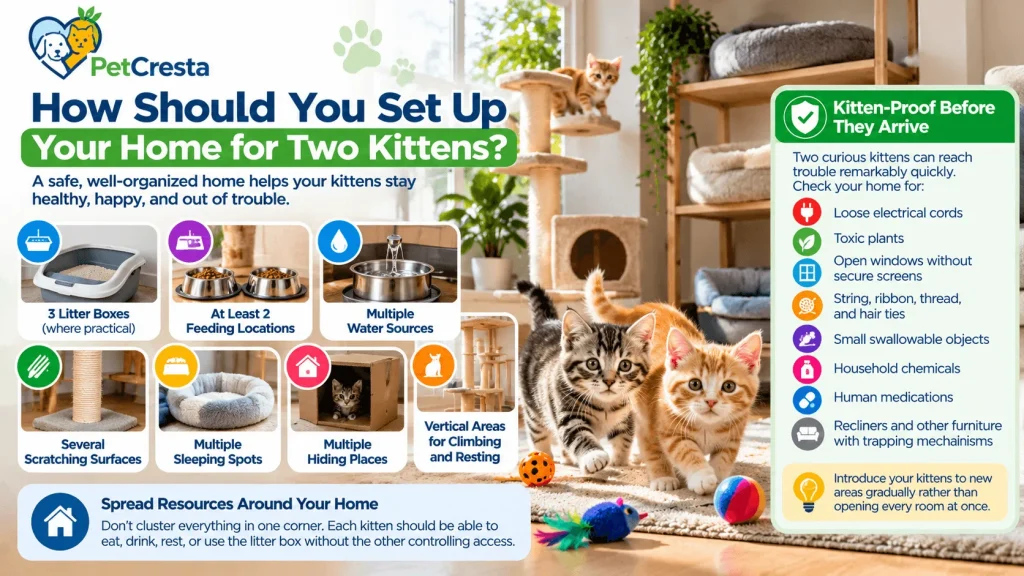
Good resource placement can prevent problems before they start.
Provide Separate Access To Important Resources
For two kittens, aim to provide:
- Three litter boxes where practical
- At least two suitable feeding locations
- More than one water source
- Several scratching surfaces
- Multiple sleeping spots
- Multiple hiding places
- Vertical areas for climbing and resting
Resources should not all be clustered into one corner.
A kitten should be able to eat, drink, rest, or use the litter box without another kitten controlling access.
Kitten-Proof Before They Arrive
Two curious kittens can reach trouble remarkably quickly.
Check the home for:
- Loose electrical cords
- Toxic plants
- Open windows without secure screens
- String, ribbon, thread, and hair ties
- Small swallowable objects
- Household chemicals
- Human medications
- Recliners and other furniture with trapping mechanisms
Give the kittens access to the home gradually rather than opening every room immediately.
How Can You Tell Kitten Play From Fighting?
Kittens can wrestle dramatically without actually fighting.
Look at the entire interaction.
Normal Play May Include
- Chasing in both directions
- Wrestling
- Pouncing
- Brief biting
- Pauses
- Loose body movement
- Taking turns
- Returning voluntarily to play
Signs One Kitten May Be Uncomfortable
Watch more closely if you notice:
- One kitten always chasing the other
- Repeated hissing or growling
- Flattened ears with tense posture
- One kitten repeatedly attempting to escape
- Blocking food, water, or litter boxes
- Hiding after encounters
- Reduced appetite
- Injuries
- Persistent avoidance
The question is not simply whether the kittens wrestle.
Ask whether both kittens continue choosing the interaction and whether each can disengage freely.
What If You Already Have an Older Cat?
Getting two kittens does not automatically make the transition easier for a resident cat.
The kittens may entertain one another, but two unfamiliar young cats also represent a larger environmental and social change.
Give your resident cat:
- Its own food and water
- Separate litter resources
- Established resting areas
- High places the kittens cannot easily monopolize
- Quiet areas
- Individual attention
Introduce newcomers gradually rather than allowing them immediate access to the resident cat.
If the older cat begins hiding, stops eating normally, avoids important areas, eliminates outside the litter box, or shows persistent aggression or fear, speak with your veterinarian.
Should You Get One Kitten or Two?
Two kittens may suit your household if:
- You can comfortably afford lifelong care for both
- You have enough room for separated resources
- You want two cats rather than choosing a second solely to entertain the first
- You can provide individual attention
- You are prepared for veterinary expenses for two animals
- The kittens appear socially compatible
One kitten may make more sense if:
- Your budget would be stretched by two cats
- Housing limits pet numbers
- You already have animals requiring careful introductions
- You cannot provide enough litter, feeding, and resting resources
- You only want one adult cat long term
Do not adopt two kittens because you have been told that owning one kitten is automatically harmful.
The better question is whether you can meet the behavioral, environmental, medical, and financial needs of the number of cats you choose.
Final Takeaway
The pros and cons of getting two kittens come down to companionship and play versus greater responsibility.
A compatible pair may spend hours playing, resting, exploring, and learning alongside each other. Raising two kittens can be a rewarding experience, particularly when they already share a comfortable relationship.
But two kittens also mean two individual cats.
Each needs veterinary care, appropriate nutrition, safe resources, human interaction, and enough space to retreat when desired. Littermates are not guaranteed to remain inseparable, and unrelated kittens are not destined to fight.
Choose based on compatibility, your household, and what you can realistically provide for both cats throughout their lives.
Frequently Asked Questions
Neither option is universally better. Two compatible kittens can play and interact with each other, while one kitten costs less and may be a better fit for some households. Your available time, budget, space, resident pets, and ability to provide appropriate enrichment should guide the choice.
Two kittens can sometimes make play and enrichment easier because they interact with each other. They are not necessarily easier overall because you will have two cats to feed, supervise, train, insure, and take for veterinary care.
Some kittens benefit from living with a compatible kitten, particularly when they enjoy social play. That does not mean every kitten requires another kitten or that every pair will form a close bond.