
What Conditions Qualify For A Service Dog? Complete Legal & Clinical Guide
Under the Americans with Disabilities Act (ADA), a service dog is individually trained to perform specific tasks or work directly related to a person’s disability. Qualifying conditions span physical, sensory, psychiatric, and neurological health categories. Federal law defines service animal eligibility functionally rather than through an exhaustive list of specific medical diagnoses. Eligibility depends on whether a condition substantially limits one or more major life activities and whether a dog can be trained to perform concrete tasks that directly mitigate those limitations.
Key Takeaways
- Functional Definition: Eligibility is determined by functional limitations and task performance, not by diagnosis names alone, government registries, or specific breeds.
- Qualifying Categories: Mobility impairments, sensory loss (blindness, deafness), neurological disorders (epilepsy, autism), medical alerts (diabetes, cardiac conditions), and psychiatric conditions (PTSD, panic disorder, severe depression) can all qualify.
- ADA Public Access Rules: Public entities and businesses are legally permitted to ask only two specific questions when a dog’s task is not obvious. They cannot demand medical records, task demonstrations, or official certification.
- Training Standard: Service dogs must undergo extensive task and public access training to remain calm, housebroken, and controlled in public settings.
How U.S. Law Defines Service Dog Eligibility (ADA Basics)
The main federal law governing service animals in public places is Title II and Title III of the Americans with Disabilities Act (ADA). The ADA defines a disability as a physical or mental impairment that substantially limits one or more major life activities, such as walking, seeing, hearing, breathing, learning, working, or performing manual tasks.
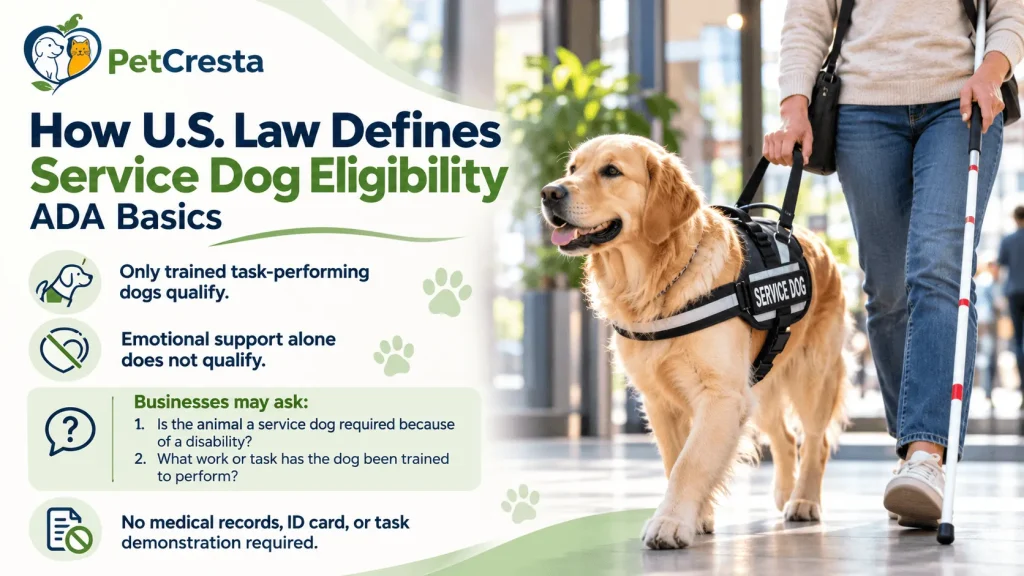
Under federal regulations, only dogs (and, in specific instances, miniature horses) qualify as service animals. Animals that provide comfort, emotional support, or companionship without being trained to execute concrete tasks do not meet the legal definition of a service dog under the ADA.
“Under federal law, service dog eligibility is never determined by a specific medical label alone. What legally transforms a dog into a service animal is individual task training directly tied to mitigating the handler’s functional limitations.” — Sarah Jenkins, Disability Rights Attorney
When an individual enters a public space where pets are normally prohibited, business personnel may ask only two specific questions if the dog’s service function is not immediately obvious:
- Is the animal a service dog required because of a disability?
- What work or task has the dog been trained to perform?
Staff cannot mandate medical documentation, demand a physical demonstration of the task, or require a special identification card, vest, or harness.
Qualifying Health Conditions and Trained Service Tasks
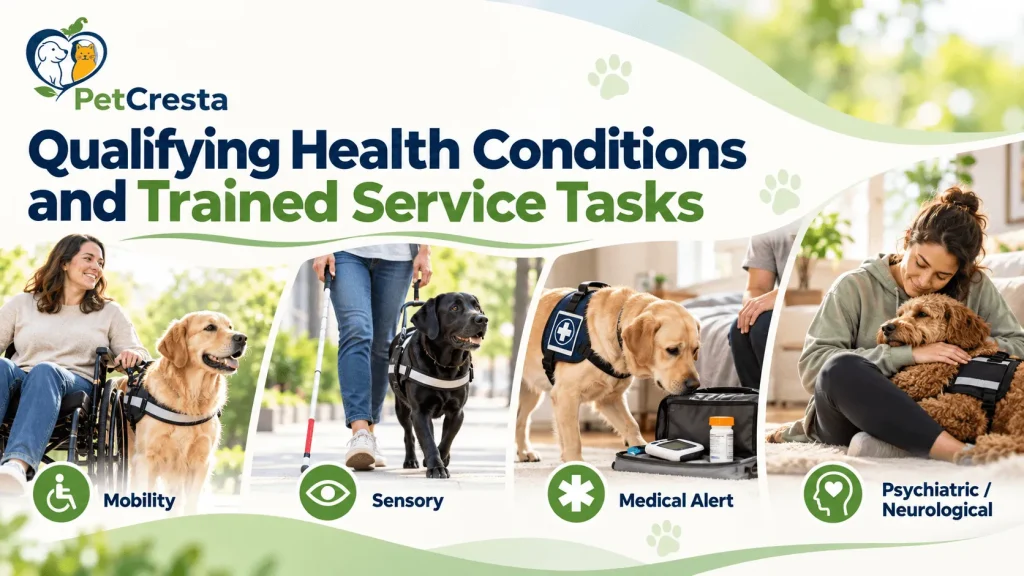
A diagnosis qualifies an individual for a service dog when it creates functional barriers that a dog can actively help overcome through trained behaviors.
Physical and Mobility Impairments
Physical disabilities affect motor control, strength, balance, or endurance. Severe mobility limitations can stem from spinal cord injuries, cerebral palsy, muscular dystrophy, multiple sclerosis, spina bifida, or severe arthritis.
- Balance and Brace Work: Providing counter-balance and stability for handlers with gait instability.
- Item Retrieval: Picking up dropped items such as keys, phones, or medical supplies.
- Environmental Management: Opening heavy doors, pushing automatic door buttons, and operating light switches.
- Wheelchair Assistance: Assisting with manual wheelchair propulsion over short distances or helping with positioning transfers.
Sensory Disabilities
Sensory disabilities include legal blindness, visual impairment, profound deafness, and severe hearing loss.
- Guide Dogs: Navigating complex pedestrian environments, avoiding obstacles, detecting drop-offs or curbs, and finding door handles or elevators.
- Hearing Dogs: Alerting handlers to environmental sounds—such as doorbells, smoke alarms, ringing phones, or crying babies—by making physical contact and leading the handler to the sound source.
Medical Alert and Chronic Conditions
Medical alert service dogs support individuals with chronic physiological conditions through specialized scent detection and behavioral interventions.
- Seizure Response & Alert Dogs: Detecting subtle physiological cues prior to a seizure, warning the handler to sit safely, activating emergency alert buttons, or positioning themselves to prevent injury during a seizure.
- Diabetic Alert Dogs: Detecting chemical shifts in breath or sweat caused by rapid blood glucose fluctuations (hypoglycemia or hyperglycemia) and alerting the handler to test blood sugar levels.
- Cardiac & Autonomic Impairments: Assisting individuals with Postural Orthostatic Tachycardia Syndrome (POTS), severe syncope, or cardiac arrhythmias by alerting to sudden heart rate spikes, fetching medication, or providing deep pressure therapy to stabilize blood pressure.
Psychiatric and Neurological Conditions
Psychiatric Service Dogs (PSDs) assist individuals with mental health disorders or neurodevelopmental conditions. They hold equal legal status under the ADA as dogs assisting physical disabilities.
“For individuals with severe PTSD or panic disorders, a psychiatric service dog provides active physiological and environmental intervention. The dog isn’t just offering comfort; it is executing structured sensory feedback to interrupt panic spirals and ground the handler.” — Dr. Marcus Vance, Licensed Clinical Psychologist
- Post-Traumatic Stress Disorder (PTSD): Interrupting flashbacks or night terrors, conducting room searches to confirm safety, providing tactile grounding during dissociation, and creating physical space buffers in crowded areas.
- Anxiety Disorders and Panic Attacks: Recognizing early physiological signs of panic, guiding the handler to a quiet area, fetching emergency medication, and applying Deep Pressure Therapy (DPT).
- Autism Spectrum Disorder (ASD): Preventing bolting or wandering, interrupting repetitive self-injurious behaviors, and offering calming sensory feedback during sensory overload.
Summary Of Qualifying Conditions Vs Trained Tasks
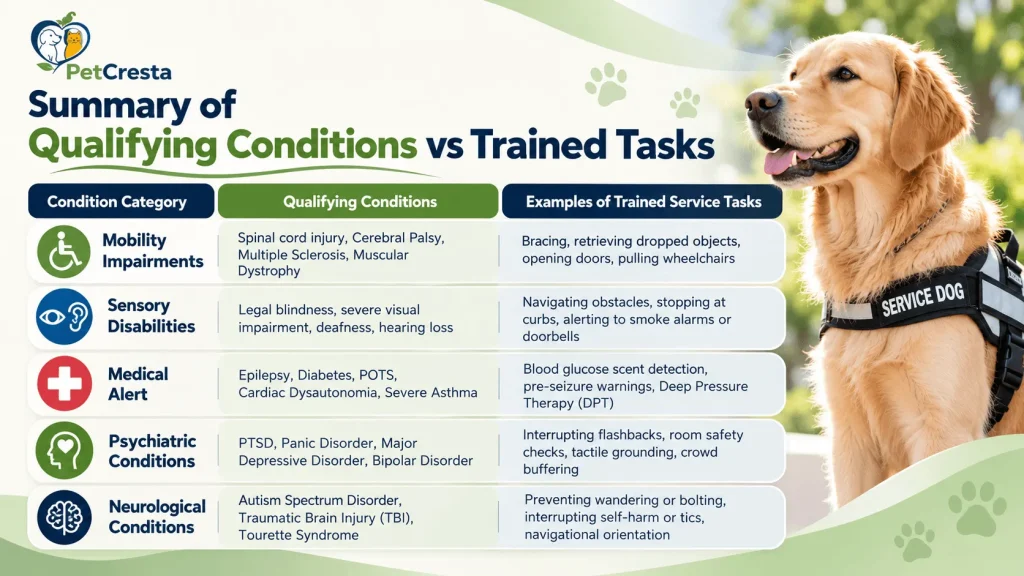
| Condition Category | Qualifying Conditions | Examples of Trained Service Tasks |
|---|---|---|
| Mobility Impairments | Spinal cord injury, Cerebral Palsy, Multiple Sclerosis, Muscular Dystrophy | Bracing, retrieving dropped objects, opening doors, pulling wheelchairs |
| Sensory Disabilities | Legal blindness, severe visual impairment, deafness, hearing loss | Navigating obstacles, stopping at curbs, alerting to smoke alarms or doorbells |
| Medical Alert | Epilepsy, Diabetes, POTS, Cardiac Dysautonomia, Severe Asthma | Blood glucose scent detection, pre-seizure warnings, Deep Pressure Therapy (DPT) |
| Psychiatric Conditions | PTSD, Panic Disorder, Major Depressive Disorder, Bipolar Disorder | Interrupting flashbacks, room safety checks, tactile grounding, crowd buffering |
| Neurological Conditions | Autism Spectrum Disorder, Traumatic Brain Injury (TBI), Tourette Syndrome | Preventing wandering/bolting, interrupting self-harm or tics, navigational orientation |
Legal Frameworks Across Environments: ADA, Housing (FHA), and Air Travel (ACAA)
Service animal rights are protected under three federal laws, each governing distinct environments:
| Federal Law | Governing Entity | Key Rights & Documentation Rules |
|---|---|---|
| Americans with Disabilities Act (ADA) | U.S. Department of Justice | Grants public access rights. No documentation, certification, or vest required. Staff may ask only the two standard questions. |
| Fair Housing Act (FHA) | U.S. Department of Housing and Urban Development (HUD) | Applies to residential housing. Landlords must grant reasonable accommodations without pet fees. Housing providers may request a documentation letter from a licensed healthcare provider if the disability is not obvious. |
| Air Carrier Access Act (ACAA) | U.S. Department of Transportation (DOT) | Applies to commercial airlines. Allows service dogs in the cabin free of charge. Airlines require handlers to submit the official DOT Service Animal Air Transportation Form prior to travel. |
How to Obtain and Train a Qualified Service Dog
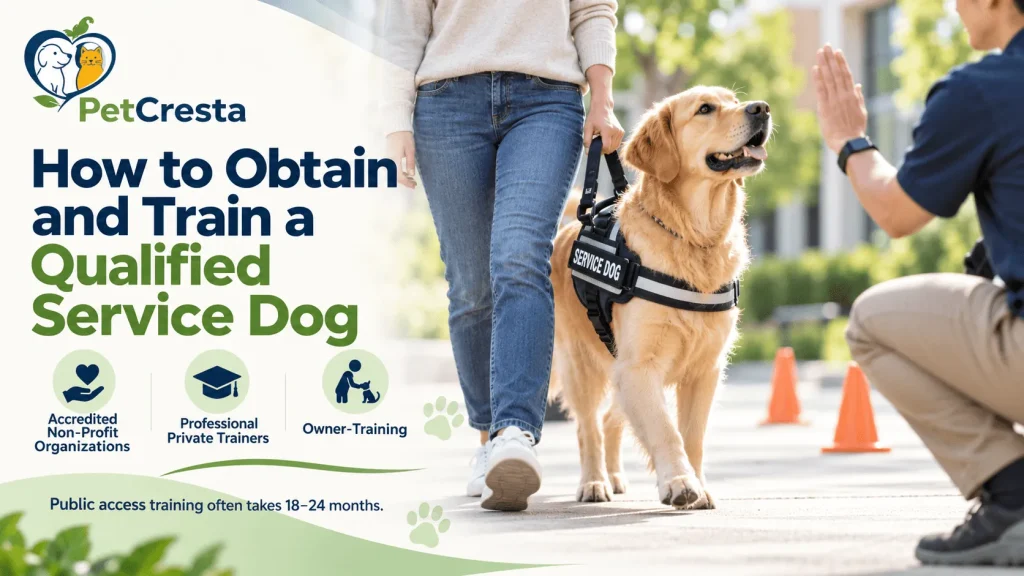
Acquiring a service dog involves three main pathways:
- Accredited Non-Profit Organizations: Applying through organizations accredited by bodies like Assistance Dogs International (ADI). These programs fully train and place purpose-bred dogs, though waitlists can range from one to three years.
- Professional Private Trainers: Hiring a professional canine behaviorist or trainer experienced in public access testing and disability task training to train a candidate puppy or adult dog.
- Owner-Training: The ADA allows people with disabilities to train their own service dogs. Owner-training requires consistent work on disability-related tasks, everyday obedience, leash manners, impulse control, and calm behavior around distractions. PetCresta’s adult dog training guide explains foundational obedience and behavior-training principles that can support this process, although basic obedience alone does not make a dog a service animal.
“Proper public access training takes 18 to 24 months of consistent work. A qualified service dog must demonstrate complete environmental neutrality, zero aggression, and flawless task execution under high distraction.” — Elena Rostova, Master Canine Behaviorist.
Handler Responsibilities and Public Access Standards
Readers working on everyday obedience and behavior can also browse PetCresta’s dog training and care guides for related guidance.
- Control Requirements: The dog must be harnessed, leashed, or tethered unless these devices interfere with the dog’s task performance, in which case voice, signal, or control commands must be maintained.
- Public Behavior Standards: A service dog must be housebroken and completely non-aggressive. A public business may legally ask a handler to remove a service dog if the animal is out of control, barking uncontrollably, or posing a direct safety threat.
- Fraudulent Representation: Fraudulently representing a non-service pet as a service dog is illegal in over 25 U.S. states, carrying penalties that include substantial civil fines and misdemeanor charges.
FAQ
No. There is no official government service dog registry, certification program, or mandatory registration under federal U.S. law. The ADA does not require handlers to register their dogs with any agency. Public access rights depend entirely on having a qualifying disability and a dog trained to perform specific disability-related tasks. However, for personal convenience, some handlers choose to complete a voluntary service animal registration through platforms like Myserviceanimal.org to get optional ID cards that can help ease interactions with uninformed business staff or landlords.
An Emotional Support Animal (ESA) provides therapeutic comfort through its presence alone and is not trained to perform specific tasks. Consequently, ESAs do not qualify as service animals under the ADA and do not have public access rights. However, an ESA can become a service dog if it undergoes proper task training to mitigate a handler’s disability and meets public behavior standards.
When a dog’s task is not obvious, business staff may legally ask: 1) Is the dog a service animal required because of a disability? and 2) What work or task has the dog been trained to perform? Staff cannot demand medical documentation, proof of training, or a task demonstration.
Yes. The U.S. Department of Veterans Affairs (VA) provides veterinary health benefits for service dogs prescribed to veterans with visual, hearing, or substantial mobility impairments under 38 CFR § 17.148. To qualify for VA coverage, the service dog team must complete a recognized training program accredited by Assistance Dogs International (ADI) or the International Guide Dog Federation (IGDF).
No. Under the ADA, local ordinances or breed-specific legislation (BSL) cannot ban specific service dog breeds from public accommodation. Any breed can serve as a service animal if the individual dog is properly task-trained and displays appropriate public behavior.
Source List
U.S. Department of Justice. ADA Requirements: Service Animals. https://www.ada.gov/resources/service-animals-2010-requirements/
U.S. Department of Housing and Urban Development. Assessing a Request to Have an Animal as a Reasonable Accommodation under the Fair Housing Act. https://www.hud.gov/program_offices/fair_housing_equal_opp/assistance_animals
U.S. Department of Transportation. Service Animals Traveling by Air (ACAA Regulations). https://www.transportation.gov/individuals/disability/service-animals
U.S. Department of Veterans Affairs. 38 CFR § 17.148 – Service Dogs Clinical Requirements and Benefits. https://www.law.cornell.edu/cfr/text/38/17.148
Assistance Dogs International. ADI International Standards for Service Dogs. https://assistancedogsinternational.org/standards/