Cockalier Dog Breed Guide: Size, Temperament, Health & Care

Many people select this cocker spaniel and cavalier king charles crossbreed for its gentle expression, love, and manageability. It can be a comforting and reliable warm friend in many households.
However, it is not a completely predictable dog type. Size, coat, energy and temperament may vary by parent lines. Useful to more people than a list of “straight” breeds.
Quick Answer: What Is A Cockalier Dog?
This is a Cavalier cross cocker spaniel. Adult dogs are small to medium companion dogs, friendly, people oriented and good to have around the house.
Many work well with families and first-time owners; however, the best fit is achieved when the home is prepared for regular grooming, consistent training and thorough health evaluation.
Quick Verdict: Is This The Right Dog For You?
If the home they are in is right, they can be a very pleasant pet. Affection, social character, and size that fit in many homes are considered to be the normal assets.
The typical trouble spots include clingy, grooming behavior and less time spent alone. It’s an ideal choice for families who want a family pet that will be social and companionable, but not one that will wander off on its own much.
Good fit for..
- Families seeking an interactive partner.
- The ability to provide day to day care by the owner.
- Breathe and brush, take care of the ears, train it, homes ready!
- Those who are fond of a gentle, sociable nature
Less ideal for..
- Homes with long working hours with the dog alone
- They are looking for a very low maintenance coat.
- New home with allergies who need a reliable, allergy-friendly dog.
- Owners who like to have a dog that is very independent.
Cockaliers Characteristics At A Glance

| Trait | What to expect |
|---|---|
| Parent breeds | Cocker Spaniel and Cavalier King Charles Spaniel |
| Size | Small to medium |
| Height | Often about 12 to 15 inches |
| Weight | Often about 15 to 28 pounds |
| Lifespan | Often, about 12 to 15 years |
| Coat | Soft, straight, wavy, or feathered |
| Shedding | Usually low to moderate, sometimes more |
| Grooming | Moderate to high |
| Energy | Moderate |
| Barking | Moderate |
| Trainability | Usually good with calm consistency |
| Child fit | Often good with supervision |
| Other dog fit | Often good with early socialization |
| Apartment fit | Possible with exercise and settling skills |
| First-time owner fit | Often manageable |
| Common colors | Black, black and white, red, golden, tri-color |
| Health watch points | Heart disease risk, ear disease, eye disease, dental disease, and weight gain |
What Are The Pros and Cons of Cockaliers?
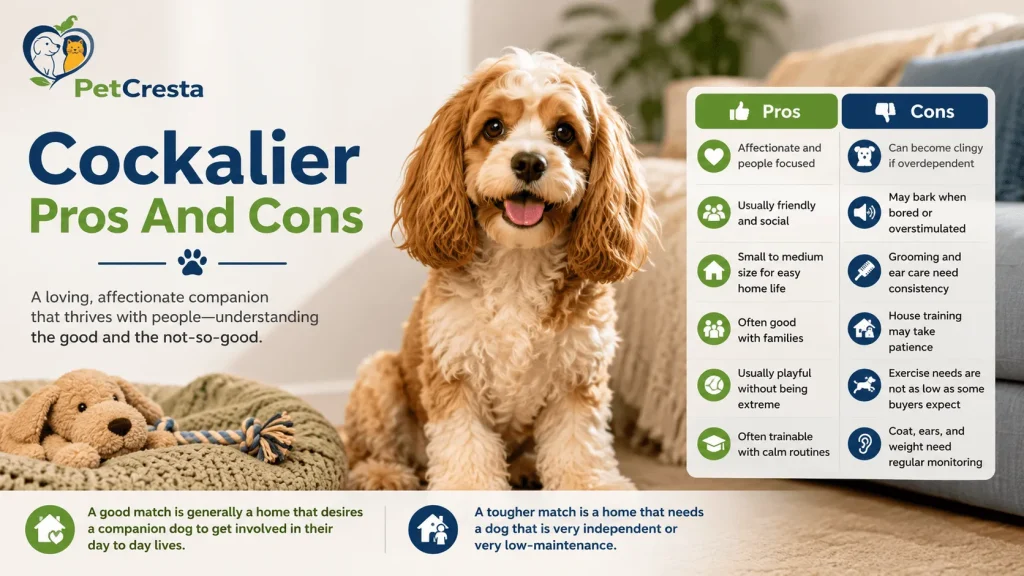
A Cockalier can be an affectionate, manageable companion, but the mix is not automatically easy or low-maintenance. Much depends on the parents, coat type, early development, and how much time the household can give to grooming, training, and companionship.
| Pros | Cons |
|---|---|
| Affectionate and people-focused | Can become overly dependent if independence is never taught |
| Often friendly and socially engaged | Some struggle with long periods alone |
| Small-to-medium size works in many homes | Grooming and ear care need regular attention |
| Often responsive to reward-based training | Coat type and shedding are variable |
| Can work well in family homes | Some inherit stronger sporting drive than buyers expect |
| Usually playful without needing extreme exercise | Parent-breed health screening matters |
| Adaptable when needs are met | Less predictable than a standardized pure breed |
A good match is usually a household that wants the dog involved in daily life. A more difficult match is a home expecting a highly independent, very low-maintenance companion.
Cockalier Origin, Parent Breeds, And Why This Mix Varies

A Cockalier is a cross between a Cavalier King Charles Spaniel and a Cocker Spaniel. That description sounds simple, but it does not tell you everything about the dog.
The Cocker parent matters. Depending on the country and breeder, the parent may be an English Cocker Spaniel or an American Cocker Spaniel. English Cockers can also come from noticeably different show and working backgrounds.
Those differences can affect coat, build, activity level, scent interest, working drive, and the health questions a buyer should ask.
The Cavalier side generally contributes a smaller companion-spaniel background and a strong tendency toward close contact with people. The Cocker side may contribute more sporting behavior, activity, coat maintenance, and environmental interest.
A Cockalier is not a standardized pure breed, so variation should be expected rather than treated as a fault. Two dogs carrying the same Cockalier label can differ substantially in adult size, coat, exercise needs, and everyday behavior.
Which Cocker Spaniel Is Used in a Cockalier?
This is one of the most useful questions a prospective owner can ask.
“Cocker Spaniel” may refer to more than one parent type, and knowing which one was used can make the rest of the puppy information easier to interpret.
English Cocker Spaniel Parent
An English Cocker may come from show-oriented or working lines.
Show-bred dogs often have more coat and a heavier traditional spaniel appearance. Working-bred English Cockers are commonly selected more strongly for activity, scent work, retrieving ability, and stamina.
That does not mean every working-bred parent produces an extreme puppy or every show-bred parent produces a quiet one. The actual parents still matter more than the label.
American Cocker Spaniel Parent
An American Cocker Spaniel has a different breed history, outline, head shape, and coat presentation from the English Cocker.
Its health-screening framework also differs in some areas.
If a breeder simply says “Cocker Spaniel,” ask which breed and line they mean. The answer can affect your expectations for coat care, body type, exercise, and parent-health verification.
What Should a Buyer Ask?
Before choosing a puppy, ask:
- Is the Cocker parent English or American?
- If English, is the parent mainly from working or show lines?
- What are both parents like in the home?
- How much exercise do they normally need?
- What health testing was completed for each parent?
- Why was this particular pairing chosen?
The name of the cross tells you the ingredients.
The parents tell you much more about the actual puppy.
F1, F1b and Later-Generation Cockaliers
Breeders may use terms such as F1, F1b, or multigenerational Cockalier. These labels describe the breeding relationship, not the quality of the dog.
F1 Cockalier
An F1 Cockalier is produced by breeding a Cocker Spaniel directly to a Cavalier King Charles Spaniel.
The puppy receives genetic material from both parent breeds, but that does not mean every visible trait will land exactly halfway between them.
F1b Cockalier
An F1b usually results when a Cockalier is bred back to one of the parent breeds.
That can shift the expected appearance or behavior toward the parent breed used in the backcross, although individual variation remains.
Later-Generation Cockalier
Later generations may involve two Cockaliers or a more complex sequence of crosses.
The generation label can help explain the pedigree, but it cannot tell you whether a puppy has a good temperament, healthy parents, or an appropriate coat for your household.
Ask for the actual pedigree and parent information rather than assuming:
F1 = healthier
or:
F1b = more predictable
Neither label replaces health testing or good breeding decisions.
Cockalier Full Grown Size And Adult Appearance

Most adults will be in the small to medium size, but some will be compact and some more ‘spaniel’ in their body. Final size will vary according to parent size, bone and growth pattern.
The appearance can also change significantly. Some adult dogs maintain a more rounded face with silkier fur. Others, on the other hand, have heavier feathering and a fuller frame, and are more spaniel-like.
| Life stage | What often happens |
|---|---|
| 8 to 12 weeks | Soft coat, round features, fast early growth |
| 4 to 6 months | Longer legs, more movement, the coat begins to change |
| 7 to 12 months | Feathering develops, body fills out, and adult temperament becomes clearer |
| Adult | Final weight, coat pattern, and daily energy become easier to predict |
Common colors include:
- cockalier black
- red cockalier
- tri color spaniel
- cockalier black and white
- golden cockalier full grown
Color can alter appearance but is not a good indicator of temperament, trainability or health.
Cockalier Dog Size Chart
Height may be slightly different, as this can be a blend of the Cocker Spaniel side or the Cavalier side. Most adults remain in a small to medium size but the initial growth may be irregular before the frame settles.
Height Chart
| Age stage | Typical height range | What this often means |
|---|---|---|
| 8 to 10 weeks | 4 to 6 inches | Very young puppy, still delicate |
| 11 to 12 weeks | 5 to 7 inches | Early body shape starts to show |
| 3 to 4 months | 6 to 9 inches | Legs lengthen, and movement becomes stronger |
| 5 to 6 months | 8 to 11 inches | Noticeable growth stage |
| 7 to 9 months | 10 to 13 inches | The frame becomes more balanced |
| 10 to 12 months | 12 to 15 inches | Many are near adult height |
This is a guide only chart. Adult height may be slightly increased or decreased according to parent size, nutrition and overall health.
Cockalier Weight Chart
Weight is as important as height because it impacts body condition, which has an impact on their joints, movement and comfort over time. A healthy frame should be sleek and well covered and not thin or heavy.
| Age stage | Typical weight range | What to monitor |
|---|---|---|
| 8 to 10 weeks | 4 to 6 pounds | Appetite, stool quality, steady gain |
| 11 to 12 weeks | 5 to 8 pounds | Smooth growth without overfeeding |
| 3 to 4 months | 7 to 12 pounds | Body condition and meal routine |
| 5 to 6 months | 10 to 16 pounds | Growth pace and exercise tolerance |
| 7 to 9 months | 12 to 22 pounds | Muscle gain, not extra fat |
| 10 to 12 months | 15 to 28 pounds | Adult weight becomes clearer |
A wide age range of adults is expected in this mixture. Some remain lighter and closer to the Cavalier side and others develop with more Cocker quality and become heavier.
When Do Cockaliers Stop Growing?
Many small-to-medium dogs approach adult height during the first year, but filling out can continue after height growth slows.
The most useful clues are the size of the parents and the puppy’s own growth trend.
A puppy that reaches near-adult height is also not behaviorally mature simply because it looks grown.
How Can You Estimate Adult Size?
Use several pieces of information together:
- Adult size of the mother
- Adult size of the father
- Cocker parent type
- Previous puppies from the same parents, if any
- The puppy’s growth pattern
- Veterinary assessment of body condition and development
Do not overfeed a puppy in an attempt to reach a particular weight chart.
The goal is healthy growth, not winning a race to an arbitrary number.
Cockalier Temperament And Cockalier Personality

This is a social and affectionate comrade in many homes who enjoys being near humans. Many are playful, but not overwhelming and love participating in normal household tasks.
Sensitivity is common. Some dogs in this group may become upset when they are roughed up, their routines are chaotic or they are treated with harsh correction. Usually, a calm tone and clear structure are more effective than pressure.
This blend works well in the home since it is often people oriented responsive. Meanwhile, if independence is not practiced, that intimacy can become an overattached relationship.
How Much Does Parent Temperament Matter?
A Cockalier does not inherit personality from the name of the cross.
Temperament is influenced by many genes, the behavior of both parents, early puppy development, social experiences, health, and learning.
The parents therefore deserve more attention than general statements such as “Cockaliers are always calm” or “Cockaliers are always friendly.”
Cavalier Influence
Cavaliers are companion spaniels and are often strongly people-oriented. That can contribute to a dog that values closeness and social interaction.
It can also mean that independence needs to be taught rather than assumed.
Cocker Influence
Cocker Spaniels have sporting ancestry.
Depending on breed and line, the Cocker side may contribute stronger interest in scent, movement, retrieving, environmental exploration, and physical activity.
Working-Line Influence
A Cockalier with a strongly working-bred Cocker parent may need more structured activity and mental work than someone expecting a quiet lap-sized companion anticipated.
That does not make the dog worse.
It means the household needs to match the dog that was actually bred.
Before choosing a puppy, ask how both parents behave:
- after exercise
- around visitors
- in unfamiliar places
- around other dogs
- when handled
- when left alone
- during quiet time at home
Specific examples are more useful than the phrase “lovely temperament.”
Family Fit And Home Life
This breed is frequently used for a house where a pet is required to play with the family. Many are successful with children, older dogs and multi-dog homes when handled in a respectful manner and introductions are handled well.
While apartment living can be successful, it’s not that simple. It’s more about space and features than square footage. Even though a small dog may be more manageable in an apartment, if it barks at every noise or if it’s distressed when it is on its own, it is harder to manage.
Household Fit Checklist
- Generally good with respectful children
- Does well with other dogs, following early socialization
- Can be used in older adults who desire a close companion.
- Will tolerate exercise and barking done effectively in apartments
- For most one-time owners who are consistent, a reasonable option is to go with
- Typically, a lower level of fit in households where there are long absences throughout the day.
Cockaliers With Cats and Small Pets
Some Cockaliers live comfortably with cats and other household pets, especially when introductions are controlled and the dog has learned calm behavior around them.
The Cocker side can also contribute interest in birds, scents, and fast-moving animals.
That makes individual prey interest more relevant than the Cockalier label itself.
Introduce dogs and cats gradually, use physical separation when unsupervised at first, and avoid assuming a friendly dog will automatically be safe with every small animal.
Cockalier Barking Level, Behavior Concerns, And Time Alone
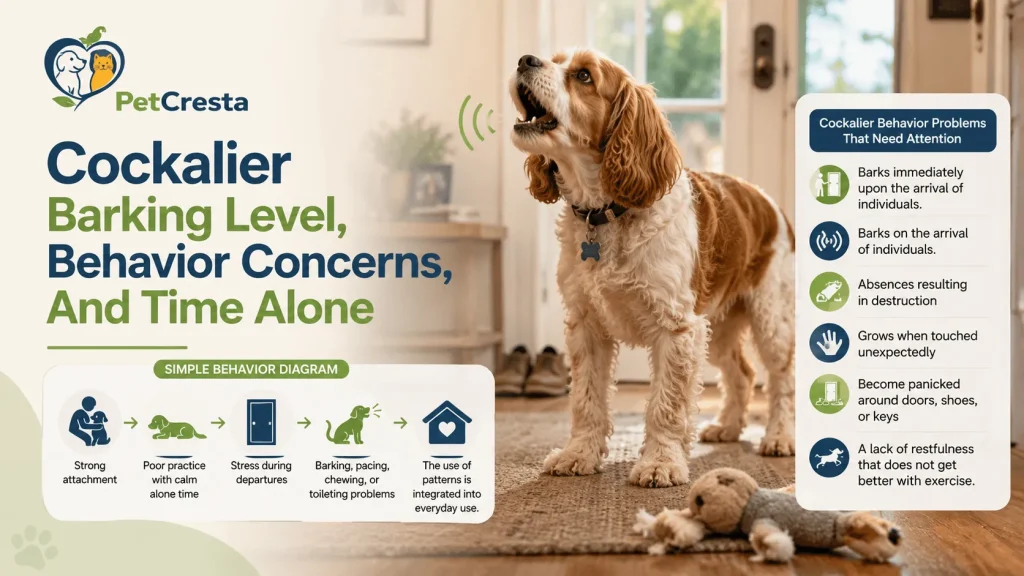
Typically, the barking is not serious, but can escalate rapidly when no routines are established, the environment lacks stimulation or when left alone. Common triggers are: people at the door, outside noise, over-excitement, boredom and frustration at the time of departure.
This blend can get very intertwined with one or more individuals in the household. But that intimacy is desirable, too, and is a danger of separation anxiety if the dog is never left alone indoors at ease.
The aggressive behavior must not be accepted as a normal breed characteristic. If it does occur it is more likely that there is pain, fear, guarding, poor socialization or chronic stress. If a behaviour change suddenly occurs, it is always a cause for concern that there is a medical and/or emotional cause.
Simple Behavior Diagram
Strong attachment
↓
Poor practice with calm alone time
↓
Stress during departures
↓
Barking, pacing, chewing, or toileting problems
↓
The use of patterns is integrated into everyday use.
Cockalier Dogs Behavior Problems That Need Attention
- Barks immediately upon the arrival of individuals.Barks on the arrival of individuals.
- Absences resulting in destruction
- Grows when touched unexpectedly
- Become panicked around doors, shoes, or keys
- A lack of restfulness that does not get better with exercise.
Do Cockaliers Bark a Lot?
Barking varies more by individual dog and situation than by Cockalier coat, size, or generation.
Common triggers include:
- visitors
- hallway or street noise
- excitement
- boredom
- frustration
- separation-related distress
Apartment owners should pay particular attention to environmental sounds and settling skills.
A smaller dog is not automatically a quieter apartment dog.
Is Aggression Normal in a Cockalier?
Aggression should not be treated as an expected Cockalier trait.
Growling, snapping, or biting may be associated with fear, pain, resource guarding, handling sensitivity, social conflict, or other causes.
A sudden behavior change is especially important.
If a dog that normally tolerated handling begins growling when picked up, touched around the neck, groomed, or approached while resting, rule out pain or illness rather than assuming the dog has suddenly become “dominant.”
Cockalier Shedding, Cockalier Grooming, And Ear Care
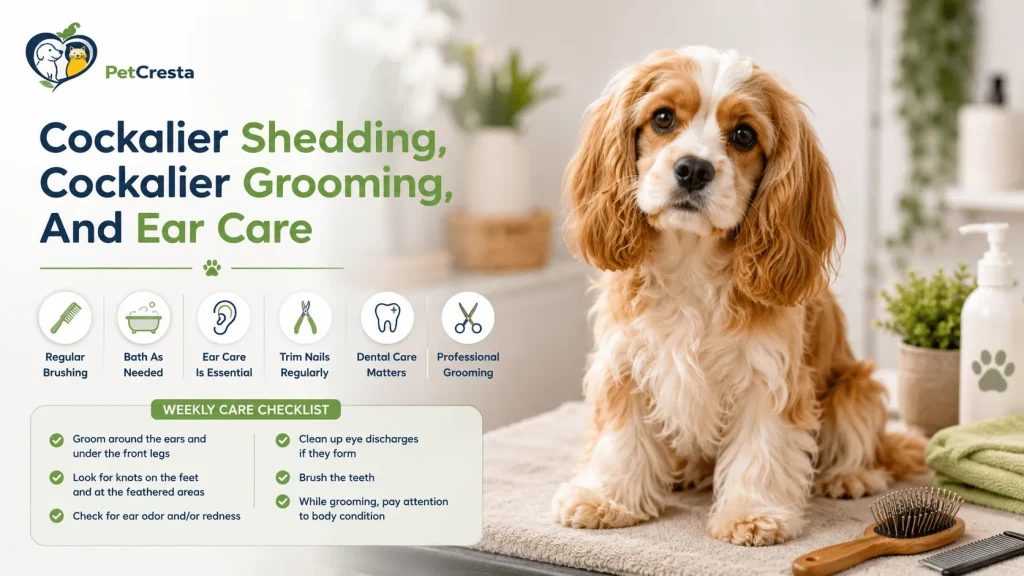
The majority of the dogs in this range shed some hair. This varies based on the type of coat, season, frequency of brushing and which parent was more dominant. Some have lighter silk coats that shed less, whereas some have a denser spaniel coat which can trap loose hair if not brushed enough.
This is not a reliable low allergen option. This mix shouldn’t be used for being hypoallergenic, as no dog is entirely hypoallergenic.
It is important to pay special attention to ear care. Long ears can collect moisture and decrease the flow of air, making it more likely to cause irritation and infection. Dental care is also important, particularly if your dog is a small companion dog that can develop tartar rapidly.
| Care area | What usually helps |
|---|---|
| Brushing | Several times each week |
| Bathing | As needed, based on coat and skin condition |
| Ear checks | Frequent checks for odor, redness, and wax |
| Nail trims | Regular trims before nails become long |
| Dental care | Frequent brushing, ideally daily |
| Professional grooming | Helpful for heavier coats and feathering |
Weekly Care Checklist
- Groom around the ears and under the front legs
- Look for knots on the feet and at the feathered areas
- Check for ear odor and/or redness
- Clean up eye discharges if they form
- Brush the teeth
- While grooming, pay attention to body condition
Are Cockaliers Hypoallergenic?
No dog should be treated as completely hypoallergenic, and Cockaliers are not a dependable low-shedding or low-allergen choice.
Some shed less visibly than others, but allergenic proteins are also present in saliva and dander.
A household with significant dog allergies should not choose a Cockalier based on a breeder promise that the coat will be “hypoallergenic.”
Cockalier Ear Care
The hanging, often feathered ears inherited from both parent breeds deserve regular attention.
Check for:
- redness
- unusual odor
- excess discharge or wax
- repeated head shaking
- scratching
- pain when the ear is touched
Keep the outer ear and surrounding coat dry after bathing or swimming.
Do not put routine cleaners or home remedies into the ear canal simply because the dog has long ears. Recurrent irritation or infection needs veterinary assessment so the underlying cause can be addressed.
Cockaliers Exercise Needs And Daily Activity

Cockaliers are often responsive to training because many are socially engaged, food-motivated, and interested in working with people.
The challenge is not usually whether the dog is capable of learning.
It is whether the household is consistent.
Sensitive dogs may learn quickly but can also become confused when rules change from one person or day to the next. Reward-based teaching, short sessions, and clear routines are usually more useful than harsh correction.
| Time of day | Useful activity |
|---|---|
| Morning | A walk and a short training session |
| Midday | Toilet break and a sniffing game |
| Afternoon | Calm rest with a chew or puzzle toy |
| Evening | Walk, light play, and settle practice |
The use of the backyard does not equate with guided activity. Dogs do not require all that open space; they need interaction and structure. Cockaliers with stronger working-Cocker influence may benefit from training that gives them something to do rather than asking only for passive obedience.
Recall games, scent work, retrieve games, food-search activities, and calm settling practice can all be useful.
Cockalier Training Basics

King Charles cocker spaniel can be very trainable, as many are food-motivated and will respond well to calm praise and socialization. It’s not always the ability to be smart. It is consistency.
A sensitive dog can learn something very fast and it can learn bad habits just as quickly if the rules change from day to day. Those who are calm with repetition do much better than those who are harsh with correction.
Early training priorities
- Name response
- Toilet routine
- Comfort in a calm crate or pen.
- Ears, feet and mouth are handled without injury.
- Loose leash basics
- Settling on a mat
- Short rest periods by themselves
Single training should start early and gradually. Contact with humans can make a dog much more dependent than intended.
Cockalier Puppy Care And Early Routines

A puppy in this category is likely to be playful, inquisitive, and sensitive. There is a lot of sleeping, lots of toilet accidents and chewing is a developmental stage, not a bad temperament.
The first few weeks should be about establishing routine and not excitement. Safe socialization, calm handling, brief grooming experience, consistent feeding, and consistent sleep schedules are much more important than attempting to accomplish everything in one.
First 24 Hours at HomeFirst 24 Hours at Home
Keep the first day relatively quiet.
Show the puppy:
- sleeping area
- water
- toilet location
- limited safe living space
Avoid giving unrestricted access to the whole home immediately.
Too much space can make toilet training, chewing management, and supervision harder.
Keep the breeder’s food initially unless your veterinarian advises otherwise.
The puppy has already experienced separation from its previous environment, so the first day does not need a stream of visitors and activities.
First Night
Some puppies settle quickly.
Others cry because everything familiar has disappeared.
Keep nighttime toilet trips calm and brief. Avoid turning every wake-up into play, but do not expect a newly arrived young puppy to manage an adult overnight routine immediately.
Then continue into your existing First month priorities list.
First Month priorities
- Create a toilet timetable
- Start brushing and ear handling. Introduce brushing and ear handling.
- Learn to separate in a short, calm manner.
- Minimize and maintain a positive social media presence.
- Take naps to avoid overreactiveness
- Be optimistic about progress; don’t forget that the process is gradual.
If the house is very different in everyday life because of extended periods of absence, lack of time to train the puppy, or lack of patience with grooming and housework, it may not be a good match.
Feeding And Weight Control

Feeding should change with age, activity, body condition, health, and the food being used rather than staying fixed for life.
Choose a complete and balanced diet appropriate for the dog’s life stage.
Puppies generally need smaller, more frequent meals while growing. Healthy adults are often managed well on measured meals, while senior calorie needs may change as activity and muscle mass change.
Treats count too.
A training session can add far more calories than owners realize when every successful behavior earns an extra snack.
Watch Body Condition, Not Just Weight
A healthy dog should usually have:
- ribs that can be felt without pressing through a thick layer of fat
- a visible waist when viewed from above
- some abdominal tuck from the side
Mixed-breed weight charts are less useful when parent size varies substantially.
If your Cockalier gradually loses its waist, becomes less willing to exercise, or gains weight despite no obvious food change, review portions and speak with your veterinarian.
Life-Stage Feeding Focus
Do not add vitamins, calcium, joint products, or skin-and-coat supplements automatically because the dog has long hair or is still growing.
Supplements should have a reason.
Persistent vomiting, diarrhea, reduced appetite, weight loss, or recurring digestive trouble deserves veterinary assessment rather than repeated unsupervised diet changes.
Cockalier Health: What Owners Should Know

A Cockalier can inherit health risks from either parent breed.
That makes the exact parentage especially important.
A puppy with an American Cocker parent does not have exactly the same family-health background as one produced from an English Cocker, and neither Cocker parent replaces the health concerns associated with the Cavalier side.
Crossbreeding does not automatically remove inherited disease.
Responsible breeding should begin with appropriate screening of both parent breeds.
Health Risks From the Cavalier Parent
Mitral Valve Disease
Mitral valve disease is an important health concern in Cavalier King Charles Spaniels.
For breeding Cavaliers, the Cavalier King Charles Spaniel Club, USA recommends heart clearance by a board-certified veterinary cardiologist along with continued periodic screening.
A heart murmur is a finding that needs interpretation rather than a diagnosis that owners should make at home.
Possible signs of heart disease can include reduced exercise tolerance, breathing changes, weakness, or collapse, but these signs have many possible causes and require veterinary assessment.
Syringomyelia and Chiari-Related Disease
Syringomyelia is another condition associated with the Cavalier background.
Signs in an affected dog may include pain around the neck or shoulders, sensitivity, unusual scratching, reluctance to jump, or neurologic changes.
Those signs are not specific enough to diagnose syringomyelia at home.
Persistent pain or unusual scratching deserves a veterinary evaluation.
The Cavalier club advises prospective buyers to ask breeders about syringomyelia and whether breeding dogs have undergone MRI screening where available.
Eyes, Hips and Patellas
Cavalier breeding guidance also includes specialist eye screening, patella evaluation, and hip assessment.
These risks do not disappear simply because the other parent belongs to another breed.
Health Risks From the Cocker Parent
The appropriate questions change depending on which Cocker Spaniel was used.
If the Parent Is an American Cocker Spaniel
The American Spaniel Club’s current basic CHIC framework for Cocker Spaniels includes formal hip evaluation and specialist eye examination, with additional health information and testing used depending on the dog and family line.
Ask for the actual results rather than accepting:
“Our vet checked the parents.”
A general wellness examination is not the same as formal pre-breeding orthopedic or ophthalmic screening.
If the Parent Is an English Cocker Spaniel
English Cocker health recommendations include several DNA tests.
The English Cocker Spaniel Club of America currently recommends prcd-PRA, Familial Nephropathy (FN), and Adult Onset Neuropathy (AON) for both show- and field-bred English Cockers. Field-bred lines have additional recommendations including Acral Mutilation Syndrome (AMS) and Exercise Induced Collapse (EIC). The club also discusses specialist eye and hearing screening among additional evaluations.
This is one reason buyers need to know more than:
“The puppy has a Cocker Spaniel parent.”
The type of Cocker changes the health questions.
Other Health Problems Owners May Encounter
Cockaliers may also experience problems that are common across many companion and spaniel-type dogs, including:
- ear inflammation or infection
- dental disease
- weight gain
- eye disease
- orthopedic pain
- skin or allergy problems in some individuals
These should not all be presented as equally likely or automatically inherited.
The individual dog, parents, family history, environment, and preventive care all matter.
Signs That Deserve Veterinary Attention
Contact a veterinarian when you notice persistent or significant changes such as:
| Sign | Why It Matters |
|---|---|
| Collapse or fainting | Can indicate a serious medical problem |
| Breathing difficulty | Requires prompt assessment |
| Persistent exercise intolerance | Can have cardiac, respiratory, orthopedic, or other causes |
| Repeated painful ear problems | May require examination and treatment |
| New neck pain or unusual scratching | Several neurologic, skin, ear, or pain conditions are possible |
| Sudden reluctance to jump or move | Pain should be investigated |
| Vision or eye-comfort changes | Eye problems can worsen quickly |
| Persistent vomiting or diarrhea | Illness and dehydration may develop |
| Abrupt behavior change | Pain or illness can alter behavior |
Do not use the table to diagnose the cause.
It tells owners when not to ignore a change.
How Long Do Cockaliers Live?
A lifespan of around 12–15 years is commonly cited for Cockaliers, but robust Cockalier-specific survival data are limited.
It is better to treat that as a general estimate than as a guaranteed breed statistic.
Individual lifespan is affected by:
- inherited disease
- body condition
- preventive veterinary care
- dental health
- accidents
- environment
- lifestyle
- the health background of both parent lines
A mixed-breed label does not guarantee a longer life.
What Health Tests Should Cockalier Parents Have?
There is no single universal “Cockalier health test panel” that replaces screening each parent according to its own breed and family history.
That is the most important buying principle in this section.
Cavalier Parent Health Checklist
Current CKCSC USA guidance recommends the following before breeding a Cavalier: cardiologist heart clearance, specialist eye screening, patella evaluation, and hip assessment. The club also encourages periodic repeat examinations for several of these areas.
| Area | What to Ask For |
|---|---|
| Heart | Clearance by a board-certified veterinary cardiologist |
| Eyes | Specialist ophthalmology examination |
| Patellas | Formal patella evaluation |
| Hips | OFA or other appropriate formal hip assessment |
| Syringomyelia | Ask what the breeder knows about family history and MRI screening |
American Cocker Parent Health Checklist
For American Cocker Spaniels, the American Spaniel Club’s current basic health-registry/CHIC approach uses:
| Area | What to Ask For |
|---|---|
| Hips | OFA or appropriate formal hip evaluation |
| Eyes | Current specialist eye examination |
| Other tests | Additional family-line or breeder-specific testing where relevant |
The American Spaniel Club specifically uses formal hip and ophthalmic screening as core parts of its current CHIC framework.
English Cocker Parent Health Checklist
Current English Cocker Spaniel Club of America guidance includes:
| Test | Relevant Lines |
|---|---|
| prcd-PRA | Show and field |
| Familial Nephropathy (FN) | Show and field |
| Adult Onset Neuropathy (AON) | Show and field |
| Acral Mutilation Syndrome (AMS) | Field lines |
| Exercise Induced Collapse (EIC) | Field lines |
| Specialist eye testing | Recommended |
| Other physical/electrodiagnostic tests | According to line and program |
Recommendations can change, and breeders outside the United States may work under different schemes.
Check current guidance for the country and parent breeds involved.
What Health Testing Does Not Guarantee
Health screening reduces uncertainty.
It does not guarantee a disease-free puppy.
The Cavalier club itself warns buyers that even screened and clear parents cannot guarantee that a puppy will never develop a health problem.
Testing has limits because:
- A DNA result covers a particular mutation, not every disease
- Some diseases are influenced by several genes
- Some clinical conditions develop later
- Environment and body condition still matter
- No screening program covers every possible illness
The right question is not:
“Are the parents health tested?”
Ask:
“Which tests were done, when were they done, what were the results, and can I verify them?”
How to Verify the Parents’ Health Records
Before paying a deposit:
- Ask for the registered names of both parents.
- Confirm exactly which breed/type the Cocker parent is.
- Ask for the name of each test.
- Ask where the result can be verified.
- Match the record to the correct dog.
- Check the date of the examination.
- Read the actual result.
- Compare the tests with current parent-breed recommendations.
- Ask the breeder to explain any result you do not understand.
- Discuss medical/genetic interpretation with a veterinarian when necessary.
“DNA tested” does not mean the same thing as:
fully screened for every relevant inherited condition.
Many important evaluations involve physical examination, imaging, cardiology, or ophthalmology rather than a DNA swab.
Where to Find a Cockalier
A Cockalier may be available through a breeder, rescue organization, shelter, or private rehoming.
The route changes how much history is available, but it does not change the basic questions:
- What is known about health?
- What is known about temperament?
- What is known about the parents or previous home?
- Does this particular dog fit your household?
Buying From a Breeder
A responsible breeder should be able to identify both parents clearly and explain why they were bred together.
For a Cockalier, this includes identifying the exact type of Cocker parent.
They should also be willing to discuss health limitations rather than describing the cross as automatically healthier because it is mixed.
Adopting Through a Rescue or Shelter
Ask about:
- veterinary history
- handling and grooming tolerance
- behavior around people
- response to dogs or other pets
- house training
- alone-time behavior
- known bite or guarding history
- reason for surrender where known
A less complete history does not make a rescue dog unsuitable.
It simply means the household may need to accept more uncertainty.
How to Evaluate a Cockalier Breeder
The goal is to turn marketing claims into evidence.
Breeder Claim vs Evidence
| Breeder Says | What to Ask For |
|---|---|
| “Parents are fully health tested” | Exact test names and verifiable results |
| “The puppies are vet checked” | Actual puppy veterinary record |
| “Both parents are healthy” | Parent-breed-specific screening |
| “Great temperament” | Specific examples of each parent’s behavior |
| “Well socialized” | Description of how and when puppies are exposed to normal life |
| “Hybrid vigor” | Parent health evidence rather than a slogan |
| “Hypoallergenic” | Treat as unreliable for this cross |
| “Health guarantee” | Complete written agreement and remedy |
| “Rare color” | Color does not replace health or temperament evidence |
Cockalier Breeder Red Flags
Be more cautious when a breeder:
- cannot clearly identify the Cocker parent type
- cannot provide parent health records
- uses a DNA panel as the only form of health screening
- says crossbreeds cannot inherit parent-breed health problems
- guarantees a hypoallergenic coat
- guarantees every puppy will have the same temperament
- always has multiple litters immediately available
- pressures buyers to send a deposit quickly
- provides no meaningful contract
- has no return or rehoming policy
- asks almost nothing about the buyer
- refuses to discuss weaknesses in the parents
No breeder can guarantee perfection.
A breeder who understands the dogs should be able to discuss risk honestly.
Questions to Ask Before Paying a Deposit
- Is the Cocker parent English or American?
- If English, is the dog mainly from working or show lines?
- What are the registered names of both parents?
- How old were they when bred?
- What health screening was completed on the Cavalier?
- What screening was completed on the Cocker?
- Where can I verify those results?
- Why did you choose this pairing?
- What are both parents like in the home?
- How do they respond to unfamiliar people and dogs?
- How are the puppies raised and socialized?
- Do puppies practise short periods of independent rest?
- What veterinary care occurs before collection?
- At what age do puppies leave?
- Can I read the contract before paying?
- What does the health agreement actually cover?
- What happens if I can no longer keep the dog?
- How do you choose which puppy goes to which home?
- Have these parents produced puppies before?
- What health or temperament weaknesses exist in either family line?
The quality of the answers matters more than how polished the breeder’s website looks.
Ownership Cost And Care Load
Only one payment equals ownership. Continuous expenses make much more of an impact on the actual experience than the up-front cost.
Grooming, support with dental treatment, food and emergency planning are all important. A lower priced puppy from poor genetics can end up costing much more if health or behavioral problems arise later in life.
| Cost area | What to plan for |
|---|---|
| Food | Ongoing monthly cost |
| Grooming | Home tools or professional care |
| Preventive veterinary care | Exams, vaccines, parasite control |
| Dental care | Routine cleaning support and possible treatment |
| Training | Classes, one-to-one help, or behavior guidance |
| Emergency planning | Insurance or savings |
Routine veterinary costs vary with age, location, lifestyle, preventive-care recommendations, and the individual dog’s health. Budget for both predictable care and expenses that cannot be planned in advance.
Is The Cocker Spaniel Cavalier Mix The Right Fit?

This is a good option for a lot of houses. The typical characteristics are friendliness, size, and family-friendliness. The down side is that this pooch may desire actual participation. From the beginning, one can expect grooming, ear care, emotional attachment, and health awareness.
Strengths
- Loving and caring about people
- Many can be used in a variety of ways in the home.
- Typically can be trained using gentle approaches
- Generally friendly with families and other dogs
Challenges
- Can become clingy
- May bark if bored or stressed when it needs attention.
- The grooming process can be more time consuming than it seems.
- Not an effective low allergen option.
- Health screening is significant in so many ways
This is a great match for homes looking to have a companion dog that will be there consistently for them. Typically, a less secure option for households that prefer a very independent or low maintenance dog.
Comparisons With Other Dogs

A Cocker Spaniel Cavalier mix is sometimes likened to a dog that has the same dog-like qualities as a companion dog, but with some different predictability, coat color and maintenance. The best comparisons are generally the Cavapoo and Cavalier King Charles Spaniel. Another comparison that is useful to make for homes that are considering a miniature Cocker Spaniel with more Poodle in it are miniature cockapoos.
The true test for many families is how high the expectations are, how well they can tolerate the dog’s appearance, the amount of energy the dog has, and how much difference they can accept between the different breeds of the mixed dog.
Cocker Spaniel Cavalier Mix Vs Cavapoo
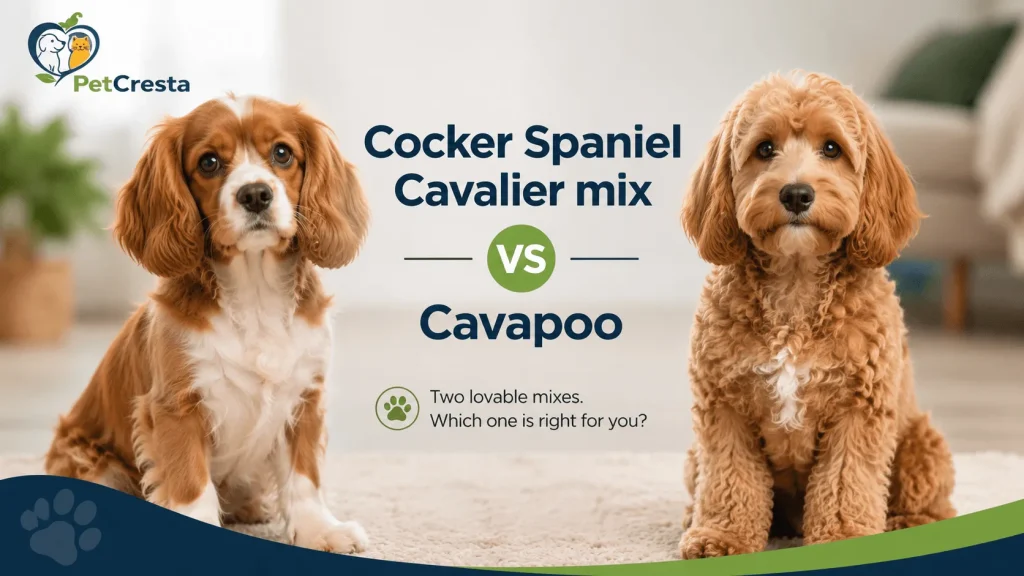
This comparison matters for people deciding between a spaniel mix and a doodle-style companion. Both can be loving family dogs, but they often differ in coat type, grooming pattern, and overall feel.
A Cocker Spaniel Cavalier mix usually has a more traditional spaniel appearance with a soft, feathered, or lightly wavy coat. A Cavapoo often has more visible Poodle influence in coat texture and may appeal more to homes looking for lighter shedding. The practical choice often comes down to whether the home prefers a spaniel-type dog or a Poodle-influenced companion. Families comparing early care needs may also want to read about a cavapoo puppy before deciding between these two companion mixes.
Cockalier Vs Cavalier King Charles Spaniel

This comparison is typically made between variation and predictability. Cavalier King Charles Spaniel is a proven purebred breed with a more consistent appearance and temperament, while a Cocker Spaniel Cavalier mix may possess a mix of traits based on its parents.
A Cocker Spaniel Cavalier mix might be a little sturdier, a little more playful or more active. In many homes, a Cavalier is more classic when he is a companion dog and has a more settled reputation. Many buyers will choose to have either a pure-breed or a mixed breed with a greater percentage of spaniel blood.
Comparison Box
| Feature | Cocker Spaniel Cavalier mix | Cavapoo | Cavalier King Charles Spaniel |
|---|---|---|---|
| Type | Cocker Spaniel and Cavalier mix | Cavalier and Poodle mix | Pure breed |
| Predictability | Moderate | Moderate | Higher |
| Overall look | Traditional spaniel style | Doodle-style companion | Classic toy spaniel look |
| Coat type | Soft, feathered, or lightly wavy | Wavy to curly in many dogs | Silky and feathered |
| Shedding | Moderate in many lines | Often lighter, but not zero | Moderate |
| Grooming need | Moderate to high | High in many coats | Moderate |
| Energy level | Moderate | Low to moderate or moderate | Low to moderate |
| Temperament style | Affectionate and playful | Affectionate and trainable | Gentle and companion-focused |
| Best for | Homes wanting a spaniel-type companion | Homes wanting Poodle influence in coat and trainability | Homes wanting a more established breed profile |
| Main watch point | Parent variation | Coat upkeep | Breed-specific health background |
A Cockalier and Cockapoo can both appeal to homes looking for a small-to-medium companion dog, but the second parent breed changes the comparison considerably.
A Cockalier combines two spaniel backgrounds. A Cockapoo combines a Cocker Spaniel with a Poodle.
That can affect:
- coat type
- grooming pattern
- shedding tendency
- activity
- training style
- body shape
- health-screening requirements
A Cockapoo should not automatically be treated as hypoallergenic either. Coat and shedding remain variable in crossbred dogs.
The more useful question is not which mix is “better.”
It is which parent combination and individual dog suit the household better.
Cockalier Decision Checklist
Before deciding, ask yourself:
| Question | Why It Matters |
|---|---|
| Can I provide regular grooming? | Coat and ear maintenance are ongoing |
| Can I manage daily companionship needs? | Many are strongly people-oriented |
| Can I provide appropriate exercise and enrichment? | Some inherit more Cocker activity than expected |
| Can I teach calm alone time? | Overdependence can become difficult |
| Am I comfortable with mixed-breed variation? | Size, coat, and activity are not standardized |
| Can I budget for veterinary care? | Parent-breed health risks deserve attention |
| Will I verify both parents’ health records? | “Health tested” needs evidence |
| Do I know which Cocker type is involved? | It affects phenotype, activity, and health questions |
A long list of “yes” answers does not guarantee a perfect match.
A clear “no” on one of the major care requirements may tell you where the real mismatch lies.
Conclusion
This blend can be an exceedingly attractive house friend in the event the home is ready for what it actually desires. That usually involves a lot of daily attention, training, care and thoughtful A Cockalier can be an affectionate, enjoyable companion, but the name of the mix cannot tell you exactly what an individual dog will be like.
The parents matter.
So does the type of Cocker Spaniel, the temperament of both dogs, the health screening behind the litter, early puppy development, and the household the dog eventually joins.
Before buying, verify rather than assume.
Before adopting, ask for as much history as is reasonably available.
And before deciding that the soft ears and spaniel expression have already won you over, make sure the grooming, activity, health, and companionship needs work with your real routine.
The best fit comes from choosing the dog behind the label.
FAQ’s
Most adults stay in the small to medium range. Final size depends on parent build, breeding line, and early growth pattern. Many mature somewhere between the Cavalier side and the Cocker side in size.
Many do well in family homes because they are social and people focused. They often enjoy close contact, play, and a daily routine with their people. Gentle handling and supervision still matter, especially with young children.
They often learn well with calm, reward-based training. Consistency usually works better than pressure or harsh correction. Sensitive dogs do best with short sessions and a steady routine.
Yes, most shed at least some hair during the year. The amount depends on coat type, season, and grooming routine. Regular brushing helps control loose hair and coat buildup.
No dog is truly hypoallergenic. This mix can still produce dander, saliva proteins, and loose hair. It should not be chosen as a reliable low-allergen option.
Yes, some become very attached and find absences hard. That can show up as barking, pacing, or unsettled behavior. Early alone time practice and a predictable routine can help.
Heart disease, ear disease, eye disease, and dental disease deserve close attention. Weight gain can also become a problem if food and exercise are not balanced. Inherited risks from both parent lines should be considered before buying.
It can be a good fit for first-time owners in the right home. This mix usually does best with people ready for grooming, training, and companionship. It is less ideal for anyone wanting a highly independent dog.
For the right home, it can be very rewarding. The breed often offers affection, companionship, and a friendly family presence. The value depends on whether the home can handle grooming, training, and daily involvement.
Aggressive behavior can come from fear, pain, poor socialization, or overarousal. Some dogs also react when routines are stressful or boundaries are unclear. A veterinary check and calm behavior assessment are the safest next steps.
Some of them form very strong attachments and struggle with absence. Signs may include barking, pacing, chewing, or distress when left alone. Short practice departures and a stable routine often help reduce the problem.
It is a cross between the Cocker Spaniel and Cavalier King Charles Spaniel. It is usually bred as a companion dog with a soft, social temperament. Adult size, coat type, and energy level can vary with the parent lines.
References
- Purina UK, Cockalier Dog Breed Information
- The Spruce Pets, Cockalier Dog Breed Characteristics and Care
- American Kennel Club, Cavalier King Charles Spaniel Dog Breed Information
- American Kennel Club, Cocker Spaniel Dog Breed Information
- American Kennel Club, English Cocker Spaniel Dog Breed Information
- Cavalier King Charles Spaniel Club USA, Health Testing Guidelines
- Cavalier King Charles Spaniel Club USA, Heart Health Information
- Cavalier King Charles Spaniel Club USA, Syringomyelia
- Cavalier King Charles Spaniel Club USA, Questions To Ask The Breeder
- AVMA, Pet Dental Care
- American Cavalier King Charles Spaniel Club, Defining the Cavalier
- American Kennel Club, Cocker Spaniel Facts You May Not Know
- American Kennel Club, Cavalier King Charles Spaniel Facts You May Not Know