Thinking About a Sheepadoodle Puppy? Size, Temperament, Care, Price And Buyer Guide
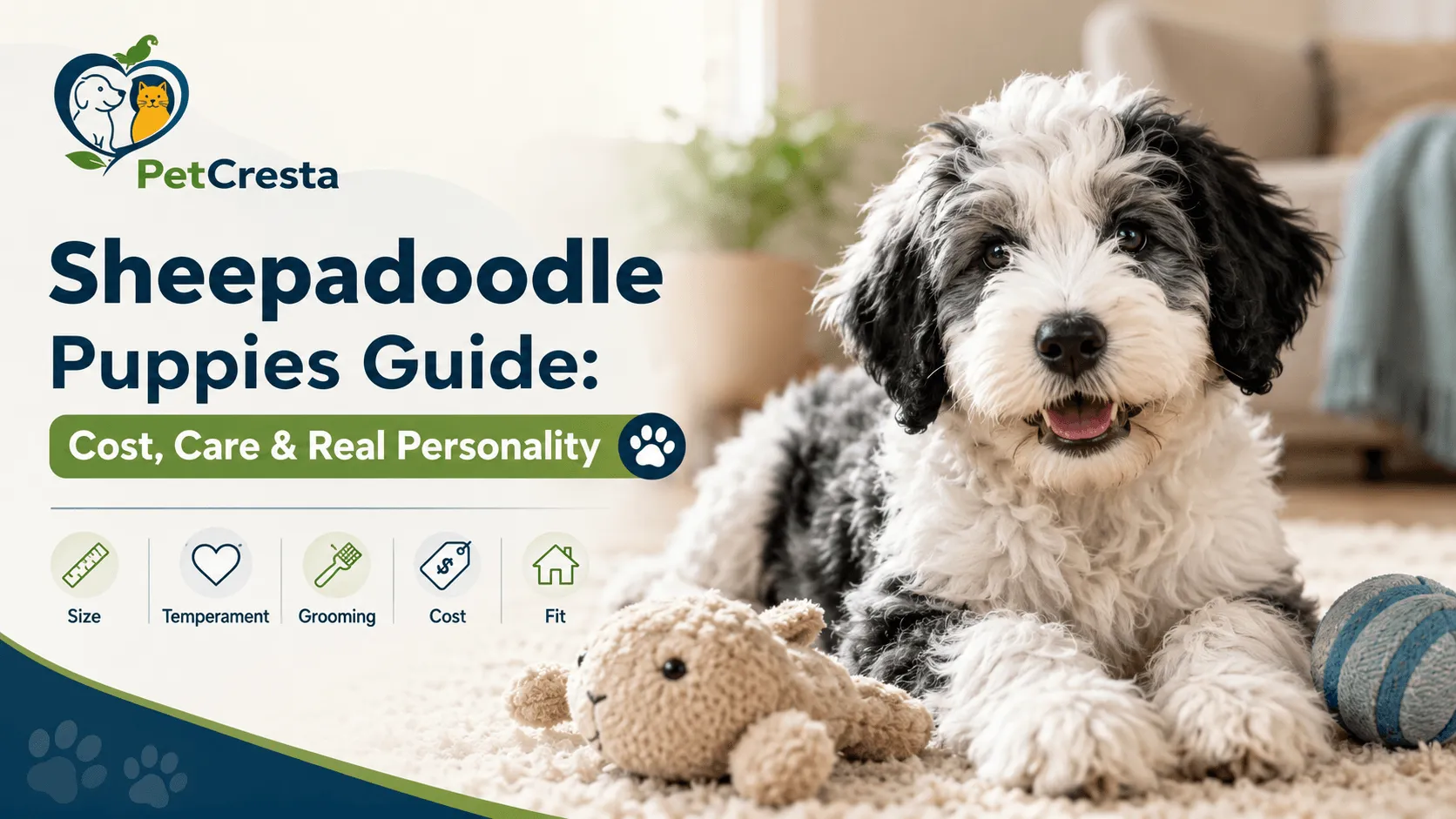
Sheepadoodle puppies are not to be overlooked. That waggy tail, happy expression and a slightly awkward gait can make even the sensible adult begin to talk about puppy names before the practical questions are asked.
Sheepadoodles are a cross between an Old English Sheepdog and a Poodle. The mix can result in a friendly and clever companion, but adult size, coat, shedding, energy and temperament are not guaranteed. Puppies of the same litter can become very different dogs.
This guide doesn’t just focus on the pictures. You’ll find out what daily care might require, how much grooming you may get, what health records to ask for and whether the adult dog (not just the cuddly puppy!) is a good fit for your household.
Mixed-Breed Reality Check: A puppy’s generation, color or even the name of its breeder does not mean that the dog will grow to the adult size, have the texture of its coat, shed, be healthy or be a certain temperament.
Quick Answer: Is A Sheepadoodle Puppy Right For You?
Sheepadoodles might be a good choice for an active family that likes to train, be around, and groom their dog regularly. The blend may not be ideal for a person who desires a dog that is easy to care for and will be left alone for extended periods of time every day.
It’s easier to make the decision when you imagine a brisk, muddy, bristly, rambunctious youngster, rather than an 8-week-old puppy sitting still for a photo.
A Sheepadoodle May Suit You If:
- You want a social dog that joins everyday family activities.
- You can provide regular training and mental activity.
- You are comfortable maintaining a dense, mat-prone coat.
- You accept uncertainty in adult size and visible shedding.
- You can manage a strong adolescent dog.
- You can budget for professional grooming and veterinary care.
Think Twice If:
- You want minimal brushing or professional grooming.
- You require guaranteed low shedding.
- You need an exact adult size.
- The dog will routinely spend long days alone.
- You are unprepared for nipping, jumping, or leash pulling.
- Appearance is your main reason for choosing the mix.
Better a well-thought-out “no” than a puppy brought home whose needs are not met. This decision is for the benefit of all, including the dog.
Sheepadoodle Characteristics At A Glance
The following table provides general planning guidelines. Sheepadoodle does not have a single breed standard followed, and the following information is not a guarantee.
The final results depend on the size of the parents, breeding line, generation, health, and individual development.
| Trait | Practical Expectation |
|---|---|
| Breed type | Mixed-breed dog |
| Parent breeds | Old English Sheepdog and Poodle |
| Common marketed sizes | Mini, medium or moyen, and standard |
| Adult size | Varies widely by parent dogs and breeding line |
| Coat | Curly, wavy, loose or shaggy |
| Shedding | May be lower, but is not guaranteed |
| Grooming | Usually high |
| Temperament | Often social, playful and people-oriented |
| Exercise | Moderate to high, depending on the individual |
| Trainability | Often responsive with consistent training |
| Alone-time tolerance | Variable; gradual training is important |
| Family fit | Possible with supervision and preparation |
| Lifespan | Commonly estimated at roughly 10–15 years |
| Best fit | Homes prepared for training, grooming and interaction |
Standard dogs are typically around 65-85 lbs and 18-27 inches, although some breeder programs have wider ranges. Miniature lines are sold at approximately 25-45 pounds and 15-20 inches. These are market figures, not official classes.
What Is A Sheepadoodle Dog?

They are a cross between an Old English Sheepdog and a Poodle. It is not a pure sheepadoodle breed and therefore there is no central authority controlling the size labels, coat categories, or breeding generations.
It is important to know the parent breeds so that expectations are set properly. It doesn’t give a recipe for the completed dog.
The parent breeds both have working backgrounds. Old English Sheepdogs were used to herd sheep and Poodles were bred as water retrievers. Today’s Sheepadoodles are typically bred as companion dogs, but this working heritage can still be a factor in activity, trainability, behaviour related to movement and mental stimulation.
What Is A Sheepadoodle Mixed With?
The classic combination is an Old English Sheepdog and a Poodle. Depending on the size the breeders want to produce, they can use a Standard, Miniature or less frequently a Toy-sized Poodle.
Standard, Miniature and Toy Poodles are recognized by the American Kennel Club as size varieties. Standards are taller than 15 inches, Miniatures are 10 inches or taller, but not more than 15 inches, and Toys are 10 inches or shorter. Under the official standard, Old English Sheepdogs start at 22 inches at maturity for males and 21 inches for females.
Those parent-size differences are why the word “Sheepadoodle” doesn’t really say much about eventual scale. Request registered names, adult weight and measured height of both parents.
How The Parent Breeds May Influence The Mix
Old English Sheepdogs are big, muscular dogs with a long coat and a history of livestock guarding. According to their official standard, they are adaptable, intelligent and even-tempered.
Possible Old English Sheepdog influences include:
- A larger frame
- Dense or shaggy coat
- Sociability
- Herding movement
- Body blocking or crowding
- Close involvement with family routines
Poodles are athletic, active, and intelligent. They were developed as water retrievers, despite the polished show-dog image many people picture today.
Possible Poodle influences include:
- Fast learning
- Athletic movement
- Responsiveness
- Curlier coat
- Lower visible shedding in some dogs
- A strong need for mental activity
A puppy may show several tendencies from one parent and different tendencies from the other. Genetics does not distribute personality and appearance in neat, equal portions.
Each puppy receives a different combination of genes. Even littermates may develop different adult sizes, coat textures, shedding levels, and behavioral tendencies.
How Big Do Sheepadoodle Puppies Get?

They can grow into a medium or large sized dog. The size of the adult will vary according to the specific parent dogs, the type of Poodle breed, previous generations, sex, health and normal genetic variation.
Breeder labels are useful for planning purposes but are not official Sheepadoodle size classes. A “mini” from one breeder might be a “medium” from another, so the actual measured size of the parents and past adult offspring are more indicative.
Sheepadoodle Size Chart
| Marketed size | Common planning range | What to verify |
|---|---|---|
| Mini | About 25–45 pounds and 15–20 inches | Parent measurements and adults from similar litters |
| Medium or moyen | No universal range | How that breeder defines the term |
| Standard | About 50–90 pounds and 24–27 inches | Both parent sizes and previous adult offspring |
| Micro or toy | Highly variable breeder terminology | Full parentage, health testing, and adult-size evidence |
| Teacup | Marketing term rather than an official class | Breeding practices, parent size, and health evidence |
These ranges are indicative of market trends, not assurances. There is no way to predict how tall or heavy a puppy will be when it becomes an adult, but a breeder can make a good estimate based on the parents and other litters they have produced.
Mini Sheepadoodle vs Standard Sheepadoodle
A smaller Sheepadoodle will be easier to pick up, carry and walk on a leash. It can also eat less and be more comfortable in a smaller house. Less is not easy. Mini Sheepadoodles can be as active, vocal, powerful, and costly as any other breed.
Standard dogs have another physical reality. A puppy jumping at a visitor at 12 lbs. is not the same as a 75 lb. adolescent jumping at a visitor, is it? Body size is associated with increased food portions, medication expenses, crate size, vehicle space, boarding and grooming expenses.
| Feature | Mini Sheepadoodle | Standard Sheepadoodle |
|---|---|---|
| Space needs | More flexible | Needs more physical room |
| Strength | Easier for some households | More physically demanding |
| Food cost | Usually lower | Usually higher |
| Grooming intensity | Still high | High, with more coat area |
| Exercise needs | Individual; often moderate to high | Individual; often moderate to high |
| Best fit | Homes prepared for an active small-to-medium dog | Homes comfortable managing a large dog |
While smaller Sheepadoodles might be easier to lift, carry and physically manage, they can be just as energetic, vocal, strong for their size and costly to groom. Standard Sheepadoodles need more space, more equipment and more control when they are adolescent. Pick the adult dog that you are able to handle, not the smallest label that is being marketed.
Sheepadoodle Dogs Growth By Age
A growth chart is best used to show the changing needs of a puppy, not to imply that all puppies should reach the same weight on the same birthday.
| Age | Typical Developmental Focus |
|---|---|
| 8–12 weeks | Rapid growth, coordination, settling into the home |
| 4–6 months | Teething, increasing strength, coat change |
| 6–9 months | Adolescent behavior, leash and greeting challenges |
| 9–12 months | Many smaller lines approach adult height |
| 12–18 months | Larger lines may continue growing and filling out |
Growth is not just about getting taller. The dog may still be changing in muscle, chest width, coordination and coat density until it is almost full-grown.
When Do Sheepadoodles Stop Growing?
Sheepadoodle of any size can reach their full adult size before they are a year old. Standards may continue to grow or fill out until 12-18 months, and beyond.
Physical maturity is not synonymous with behavioral maturity. A dog can be fully grown and still be as excited as a cannonball when it’s greeting visitors.
Growth patterns may be influenced by nutrition, illness, neuter timing, and genetics. Your veterinarian can check if development is normal and if body condition is normal.
F1 vs F1B Sheepadoodle: What Is the Difference?

The generation labels on Sheepadoodles indicate the relationship between the parent dogs. They can give an overall direction of the coat, but not adult size, shedding, allergy tolerance, temperament or health. The actual parents, their health records, their behavior and past adult offspring are more informative than the label. The same backcross terminology is used in other Poodle mixes, and our guide explaining what an F1B Bernedoodle is shows what the label describes and what it cannot predict.
F1 Sheepadoodle
The F1 Sheepadoodle is typically the first generation cross between an Old English Sheepdog and a Poodle.
Possible outcomes include:
- Coats that are curly, wavy or loose
- Wide shedding variation
- Different body types within the same litter
- Mixed parent-breed behavior
- A broad adult-size range
Calling the mix “50/50” describes ancestry, not the visible percentage of each trait.
F1B Sheepadoodle
Typically, an F1 Sheepadoodle is bred back to a Poodle to create an F1B Sheepadoodle. Some breeders may have a different backcross, so it is still necessary to confirm the parentage.
The higher the Poodle influence, the more likely the dog will have a curly coat or less visible shedding. Curl can also cause more loose hair to be trapped inside the coat which makes it more necessary to comb and prevent mat.
An F1B puppy is not guaranteed to be hypoallergenic for someone who suffers from dog allergies.
F2 And Multigenerational Sheepadoodles
F2 Sheepadoodles are often the result of crossing two F1 Sheepadoodles. Subsequent labels can be F1BB, F2B or the general term “multigenerational.”
Definitions may not be uniform across programs. Request the complete family tree from the breeder rather than the abbreviated form.
A breeder may be able to choose for specific traits over time with later generations. The number of generations is not the only factor that determines results. Results are dependent on the quality of the selections, recordkeeping, size of the population, and health practices.
Generation labels describe the structure of the pedigree, but do not guarantee a specific coat, size, temperament, allergy, or health result.
| May Suggest | Cannot Guarantee |
|---|---|
| Broad coat direction | Exact coat texture |
| Relative shedding tendency | No shedding |
| Pedigree structure | Allergy safety |
| Possible grooming workload | Exact adult size |
| Greater parent-breed influence | Temperament |
| Breeder’s pairing strategy | Health |
Request the full family tree from the breeder and not just an abbreviation. The buyer should know more than just an F-label; it’s typically supplemented by health screening, parent temperament and adult dogs of related litters.
Sheepadoodle Temperament And Personality

They are affectionate, playful, responsive and interested in people. They tend to want to be involved in family activities and not watch from a different room.
There is still variation among individuals. The development of a puppy is influenced by genetics, parent behavior, early handling, social exposure, learning history, stress, health, and home environment.
| Traits families may appreciate | Behaviors that may need training |
|---|---|
| Affectionate and social | Jumping |
| Playful and curious | Mouthing and nipping |
| Interested in training | Leash pulling |
| Closely involved in family routines | Demand or alert barking |
| Often responsive | Difficulty settling |
| Comical and expressive | Following people constantly |
| Interested in movement and games | Chasing, circling, or body blocking |
A Sheepadoodle can easily learn the sound of a food container, the shoes used for walking and where the treats are kept in the cabinet. Others appear to think that opening a package, folding laundry, and going to the kitchen are group activities.
That involvement can be fun but it must be structured. Puppies should be taught to be calm, to rest independently and to be away from the family for brief periods during the day.
Barking, pulling, jumping, puppy biting and overexcitement are not necessarily a reflection of temperament. The four factors of frequency, intensity, context and recovery are important. Any sudden changes in behaviour should be discussed with a vet, especially if they occur in conjunction with pain, appetite loss, sensitivity to touch, sleep disturbances, or withdrawal.
Are Sheepadoodles Smart?
Both parent breeds are active and intelligent, and Poodles are described in their official standard. Old English Sheepdogs are also known as being clever and versatile.
While it is helpful, it is not self-training. Quick learners see the unintentional rewards as well.
If a dog is given attention every time it barks, it might determine that this is a great way to communicate. Household rules are clear so those little experiments do not become household routines.
Are Sheepadoodles Good Family Dogs?

They can be a great addition to a family home. It is dependent on the dog, the adult size, supervision, training and whether everyone is on the same rules.
The term “family dog” should never be interpreted as “safe without management.”
Sheepadoodles And Children
A friendly puppy can still bite sleeves, run at your feet, snatch toys and jump at faces. Circling, blocking or fast movement may be signs of herding ancestry.
Young children should never be left alone with dogs without adult supervision. The dog should also have a restful spot where children don’t climb on, hug or wake the dog up.
Children can participate in basic training, treat tossing and supervised grooming practice. The adult is always responsible for safety.
Large Sheepadoodle can knock down a small child without any aggressive intent. The 4 paws on the floor lesson is a good one to teach early to avoid lots of confusion later.
Are Sheepadoodles Good for First-Time Owners?
A first-time owner who has prepared himself or herself could do quite well with a Sheepadoodle. An easy teddy-bear dog may overwhelm someone who expects it to be.
Typically, the learning curve is steepest with:
- Coat maintenance
- Puppy biting
- Adolescent strength
- Leash manners
- Alone-time training
- Calm behavior
- Consistent routines
A reward-based puppy class can provide structure before problems grow. Groomer appointments should also be planned before the coat becomes tangled.
Can Sheepadoodles Live With Cats And Other Dogs?
Sheepadoodles may live with other dogs and cats. Compatibility is dependent on the animals, their history and the way in which introductions are managed.
Early exposure can be beneficial. It will not ensure that a dog will not take advantage of the opportunities or that an existing dog will accept the new addition.
Start with individual safe spaces. Arrange short, calm, supervised meetings after allowing the animals to see each other through a gate or barrier.
Separate pets and keep valuable toys under control until pets are calm. High escape routes and dog free resting places should be provided for cats.
Chasing/Herding movement can be triggered by running. If the behavior is ongoing, hard staring, lunging, fear or resource guarding, seek professional advice.
Never assume that a puppy is safe to handle because it is gentle, as it can harm rabbits, birds, rodents or other small animals. Physical separation is the best plan.
Can A Sheepadoodle Live In An Apartment?
There are some Sheepadoodles that can live in an apartment. Adult size, barking, toilet access, activity, settling skills and time alone are all important factors in success.
A calm standard dog may be better suited to deal with it than a restless mini. The other part of the equation is floor space.
Pets must be leashed appropriately in the shared hallway and elevator. If the house is a few floors up, it can get tiring to take the puppy out to go to the bathroom often.
Noise also matters. Distress vocalization or alert barking can easily become a neighbor problem.
Coat care requires space as well. A wet Sheepadoodle is like a bath mat that moves, but the bath mat can shake water around the room.
A yard is a helpful place but it is not a substitute for walks, sniffing, training, companionship and calmness practice.
How Long Can A Sheepadoodle Be Left Alone?
There is no one-size-fits-all time limit for Sheepadoodles. Young puppies require lots of toilet trips, feeding, sleeping and supervision, and adults have a wide tolerance.
The teaching of independence should be a gradual process. Start with short periods of separation when the puppy is calm and gradually increase the length of time over the course of a few minutes to a working day.
If introduced positively, a safe pen or crate may be useful for management. It is not intended for extended periods of panic containment.
Aiding in settling can be easier if exercise and toilet opportunities are provided before an appropriate departure. Some dogs may find food puzzles helpful, as long as they are safe for them to chew on without supervision.
Boredom and separation-related distress are different. A bored dog will tear up a cushion just for fun, a stressed dog will howl, drool, try to escape, or break doors and windows.
Warning signs include:
- Persistent barking or howling
- Heavy drooling
- Escape attempts
- Destruction near exits
- Refusal to settle
- Self-injury
- Elimination linked to panic
If you don’t know what happens, record the dog when you leave. If the distress is ongoing, it should be discussed with a veterinarian or qualified behavior professional.
The First Year With A Puppy Sheepadoodle

The first year is a fast one. A little puppy gets bigger, more coordinated, more independent and much better at finding loopholes in the rules of the house.
Training should progress with the dog. Early taught skills require continued practice during adolescence.
8–12 Weeks: Settling In and the First Week at Home
The first week should be calm, routine and safety oriented. The puppy is learning to sleep in one place, the toilet in another, who gives him food and comfort, and what happens during the day.
The main priorities are:
- Frequent toilet opportunities
- Consistent meals
- Gentle crate or pen introduction
- Name response
- Short handling sessions
- Quiet rest
- Brief training
- Gradual social exposure
A simple routine usually works better than a packed calendar of visitors and outings.
| Time of day | Main focus |
|---|---|
| Morning | Toilet, meal, brief play, and rest |
| Mid-morning | Toilet, short training, and gentle handling |
| Midday | Meal when age appropriate, toilet, and sleep |
| Afternoon | Supervised play, exploration, and rest |
| Evening | Meal, calm family time, and a toilet break |
| Bedtime | Final toilet trip and a quiet sleep routine |
Do not switch the puppy’s food unless directed otherwise by a veterinarian. Slowly make any food change.
Training sessions can be just a minute or two long. At first, the dog needs to be named, hand-targeted and accepted on the collar and step calmly into the crate.
Watch for appetite, stool, hydration and energy. If vomiting or diarrhea occurs repeatedly, weakness, changes in breathing, refusal to eat or severe lethargy are signs to seek veterinary help. Owners should understand how long a dog can go without water and contact a veterinarian when reduced drinking occurs with vomiting, diarrhea, weakness or unusual lethargy.
3–5 Months: Teething And Habit Building
As teething progresses, chewing and mouthing may become more noticeable. Provide appropriate chew toys and gently guide teeth away from skin and clothes.
Leash practice can be started in small amounts. Grooming should be short and sweet, focusing on paws, ears, face and combing.
Rest remains necessary. A sleepy puppy can appear to be energetic, noisy and even a little possessed.
6–9 Months: Strength And Adolescence
Increased pulling, barking, jumping, and selective responses to familiar cues may occur during adolescence.
The dog doesn’t have to be “forgetting everything.” The world can be more rewarding than the person with the leash because competing sights, smells, confidence, and hormones can make the world more rewarding.
Keep rules consistent. Reward calm greetings, loose-leash movement, recall, grooming, and rest. Continue to reward these behaviors.
9–18 Months: Maturing Without Being Fully Mature
During this time, many small dogs reach adulthood. Standards can still be developed and behavior is clearly adolescent.
As adults get older, coat care can get more difficult. There is still a need for independence work, calm greetings, recall and handling practice.
Never cease training because the dog appears to be grown. A very puppy-like brain can reside in an adult-sized body.
How To Train A Sheepadoodle Puppy

Sheepadoodles are quick learners when training is clear, rewarding and consistent. The same ingenuity that can be used to create intentional rewards can be used to create unintentional rewards, which can also be effective in influencing behaviour.
Avoid extended sessions and end when the puppy is interested.
Sheepadoodle Training Tips Or Priorities
| Skill | Why It Matters |
|---|---|
| Name response | Builds attention |
| Recall | Supports safety |
| Sit and down | Creates basic communication |
| Settle on a mat | Builds calm behavior |
| Leave it | Improves safety and impulse control |
| Loose-leash walking | Reduces pulling as the puppy grows |
| Grooming tolerance | Supports coat maintenance |
| Crate comfort | Supports rest and management |
| Alone-time practice | Builds independence |
| Calm greetings | Reduces jumping |
Praise the good thing before the puppy does the bad thing. A treat when 4 paws are on the floor is more beneficial than multiple yelling after the jump.
Typical problems are nipping, jumping, pulling on the leash, barking for attention, overexcitability, chasing movement and inability to settle. Preventing the puppy from repeatedly practicing these behaviors is part of training. The household environment is managed with gates, pens, leashes, closed doors, covered bins and appropriate chew items, while new habits are being taught.
If the fear persists, panics when left alone, is aggressive, resource guards, has extreme handling distress, injurious biting, or sudden behavioral changes, seek veterinary or qualified behavior support.
Sheepadoodle Socialization
Socialization is teaching a puppy to be comfortable with normal life. It is not about forcing greetings with all the dogs and people.
Exposure can be useful, such as:
- People of different appearances
- Calm, suitable dogs
- Varied surfaces
- Household sounds
- Vehicles
- Grooming tools
- Veterinary handling
- Home appliances
- New environments
- Quiet observation
Allow the puppy to decide on distance where possible. New experiences can be manageable with food, play, and quiet space.
Stay away from high-risk dog areas until your veterinarian has determined that your area is protected enough for your dog to be vaccinated.
How Much Exercise Does A Sheepadoodle Need?

Exercise requirements vary by age, size, health, weather and energy. Puppies should not be made to endure but should be allowed short periods of activity, exploration and rest.
A good routine involves a combination of movement and learning and recovery.
Exercise For Puppies
Suitable activities may include:
- Free movement in a safe area
- Short walks when appropriate
- Supervised play
- Sniffing
- Brief training
- Gentle exploration
- Rest
Avoid repetitive jumping, long-distance running, and forced exercise beside a bicycle. Growing joints need sensible loading, not a fitness challenge.
Exercise For Adolescent And Adult Sheepadoodles
Older dogs may enjoy:
- Daily walks
- Controlled retrieving
- Scent work
- Training games
- Hiking suited to fitness
- Play with compatible dogs
- Swimming when safe
- Household activities
Build fitness gradually. A dog that spends the week on the sofa should not suddenly tackle an exhausting weekend hike. Active households comparing trainable Poodle crosses may also consider whether a Springer Doodle is a good fit, although its sporting ancestry can produce a different exercise and behavior profile.
Mental Activity, Rest, And Learning To Settle
Mental stimulation can be a Sheepadoodle’s way to feeling content without the added pressure of over-exciting growing joints or causing constant physical excitement.
Useful options include:
- Food puzzles
- Scent searches
- Short training sessions
- Pattern games
- New walking routes
- Mat settling
- Simple household tasks
- Calm sniffing opportunities
Activity should be alternated with sleep and quiet time. A tired puppy can become noisier, more mouthy, more active and less responsive to familiar commands.
If an energetic dog is constantly being tried to be used up, it can result in a fitter energetic dog. Restfulness is also a learned behavior. A Sheepadoodle does not require hours of constant activity to settle; planned naps, predictable routines, impulse-control work and quiet enrichment are enough.
Restlessness is not necessarily a sign that the dog needs more exercise. Similar behavior can be caused by pain, anxiety, digestive discomfort, lack of sleep or inability to cope with the environment.
Do Sheepadoodles Shed?

While some Sheepadoodles shed less than many double-coated dogs, no dog can be promised not to shed.
Coat shedding is influenced by coat genetics, curl, density, season, health and grooming. A wavy coat may not shed as rapidly onto clothing and furniture as a straight one. This can make it seem like there’s no shedding when there is.
This can also result in more work in the grooming table, as there’s less hair on the sofa. Brushing, combing, bathing, drying and clipping will help to keep the hair contained within the coat and prevent painful mats.
Loose or shaggy coats can shed more visible hair. Puppy texture does not always indicate adult coat texture, either, as it can become curlier, denser, looser, or more mat-prone as the puppy matures.
Are Sheepadoodles Hypoallergenic?
There is no such thing as a dog that is completely allergen free. Allergens in the dog are not just loose hair, but also in saliva, skin dander, urine and oil secretions. A low shedding dog can cause a lot of symptoms.
Although some practical information may be gained from spending time with the individual dog, it is not a guarantee of long-term tolerance. After the dog is in the home, allergen exposure also changes.
If you have significant dog allergies, consult with an allergist before getting a puppy.
Common Sheepadoodle Coat Types
| Coat Type | Common Appearance | Visible Shedding | Matting Risk | Grooming Work |
|---|---|---|---|---|
| Curly | Poodle-like curls | Often lower | High | High |
| Wavy | Soft waves | Variable | Moderate to high | Moderate to high |
| Loose or shaggy | Sheepdog-like | Variable | Variable | Moderate to high |
No coat category removes the need for care. Length, density, activity, moisture, and friction change how quickly tangles form.
Sheepadoodle Grooming Needs

Most Sheepadoodles require frequent brushing and combing, along with regular professional grooming. Coat length, curl, density, activity, moisture, and the individual dog’s tolerance all affect the schedule.
Many owners plan professional appointments approximately every six to eight weeks. A longer coat or limited home maintenance may require shorter intervals.
Home Grooming Routine
A practical routine may include:
- Brushing in small sections
- Checking the coat with a metal comb
- Inspecting paws and nails
- Monitoring the ears
- Cleaning around the eyes when needed
- Maintaining the sanitary area
- Bathing and drying correctly
- Toothbrushing
To check the coat properly:
- Divide the coat into small sections.
- Brush gently from the ends toward the deeper coat.
- Follow each section with a metal comb.
- Confirm that the comb passes close to the skin without catching.
- Stop if the dog shows pain or marked distress.
- Contact a groomer when mats cannot be removed safely and comfortably.
The surface may look smooth while tight tangles remain underneath. Fingers and a metal comb provide more information than a quick visual check.
Do not cut tight mats with ordinary scissors. Skin can be pulled into the tangle and cut accidentally.
Areas Most Likely To Mat
Tangles commonly form where movement, pressure, or moisture affects the coat:
- Behind the ears
- Under the collar
- Under the harness
- Armpits
- Chest
- Belly
- Tail base
- Back of the legs
- Paws
- Sanitary area
The surface may look smooth while tight knots sit underneath. Fingers and a comb tell you more than a quick glance.
When to Choose a Groomer or Veterinarian
Routine coat care belongs with a groomer. Pain, inflammation, discharge, new masses, or sudden hair loss need veterinary assessment.
| Groomer May Help With | Veterinarian Should Assess |
|---|---|
| Routine clipping | Pain |
| Ordinary tangles | Skin sores |
| Nail maintenance | Ear discharge |
| Bath and dry | Persistent odor |
| Coat shortening | Sudden hair loss |
| Cosmetic trimming | New lumps or inflamed skin |
A groomer may be the first person to notice a change, but a diagnosis should come from a veterinarian.
Health Issues And Sheepadoodle Lifespan

Interbreeding is not a guarantee of good health. They can inherit disease risks from either parent or acquire diseases that are not related to their parents.
The typical planning time frame is approximately 10-15 years, although there is limited data on the lifespan of Sheepadoodles at the population level. Longevity depends on individual size, genetics, body condition, disease history and preventive care.
What Is The Lifespan Of A Sheepadoodle?
Smaller dogs are not necessarily going to age differently than larger dogs, but there are differences.
A healthy lifestyle is promoted by:
- Responsible breeding
- Appropriate nutrition
- Lean body condition
- Regular veterinary care
- Dental care
- Safe activity
- Parasite prevention
- Prompt assessment of illness
Don’t assume that a breeder’s high estimate is a guarantee. Longevity claims should be taken as a guide to planning, rather than a contract with biology.
Orthopedic Concerns
One of the problems that comes to mind with breeding selection and long-term joint comfort is hip dysplasia. According to the national breed-club guidance the Old English Sheepdog should have hip evaluation as one of the recommended screening tests.
A formal screening result is more helpful than the parent being told that he/she “runs normally.” Dogs may be active and yet have structural changes.
Joints are also impacted by body weight. Hands-on body-condition checks are important because a thick coat can cover up weight gain.
Any lameness, stiffness, decreased jumping ability, difficulty getting up or decreased activity should be evaluated by a veterinarian.
Eye Concerns
Inherited eye diseases occur in both parent-breed health discussions. Breeding dogs may need examinations by a veterinary ophthalmologist as part of a formal screening program.
A general puppy wellness examination does not replace parent eye screening.
Seek prompt care for:
- Redness
- Cloudiness
- Squinting
- Discharge
- Sudden vision difficulty
- A painful or enlarged eye
Eye problems can worsen quickly, so waiting several days to “see what happens” is not always safe.
Skin, Coat and Ear Problems
Dense coats can trap moisture and hide redness, sores, parasites, or debris.
Ear trouble may show as:
- Head shaking
- Scratching
- Odor
- Redness
- Discharge
- Pain when touched
Do not repeatedly clean a painful ear without knowing the cause. Infection, allergy, foreign material, and other conditions may look similar at home.
Mats can pull the skin and restrict airflow. Severe tangling may hide wounds until the coat is clipped.
Thyroid And Metabolic Concerns
The Old English Sheepdog’s recommended screening guidance includes thyroid evaluation. That does not mean every Sheepadoodle will develop thyroid disease.
Possible signs of an endocrine or metabolic problem can overlap with many other conditions. Weight change, skin problems, low energy, or coat thinning require proper examination rather than a diagnosis based on appearance.
Breeding-health recommendations should be checked for the exact parent breeds and sizes used, since Poodle screening guidance differs by variety.
What Hybrid Vigor Does And Does Not Mean
Genetic diversity can affect disease risk, but “hybrid vigor” is often used as though it guarantees a healthier puppy. It does not.
A mixed-breed dog can inherit disease-associated variants from either side. Orthopedic structure, eye disease, endocrine conditions, allergies, and other problems do not disappear because the parents belong to different breeds.
Good breeding uses family history, screening, temperament, structure, and honest recordkeeping. A catchy phrase cannot replace any of those things.
What Health Tests Should Sheepadoodle Parents Have?
The tests should be representative of the health recommendations for both parents. The parents were not formally breeding-health screened; the statement is a routine statement.
The OFA’s CHIC program collaborates with parent clubs to establish breed specific protocols. A CHIC number does not imply that all tests were normal or that the dog will not develop disease in the future, it simply indicates that the dog has completed the necessary tests at that time and the results have been published.
Health Records To Request
| Record | What It Helps Assess | How to Verify | Warning Sign |
|---|---|---|---|
| Parent identity | Confirms which dogs produced the litter | Match registered names and records | Parents not identified |
| Orthopedic screening | Assesses selected joint risks | Check recognized database | “Vet checked” only |
| Eye examination | Reviews inherited eye concerns | Confirm date and examiner | Missing or outdated result |
| Genetic testing | Screens specific variants | Match report to dog identity | Unidentified screenshot |
| Puppy veterinary record | Documents early care | Review dated records | No written record |
| Previous-litter information | Shows actual line outcomes | Ask about adult offspring | Seller avoids the question |
OFA results may include orthopedic, eye, cardiac, thyroid, patellar and DNA-based results. Results of normal tests are available for public search, and there may be varying disclosure requirements for abnormal results.
Ask the breeder for each parent’s registered name or identification number. Do not use a cropped screenshot to search the database.
Explain The Limits Of Testing
Health screening decreases uncertainty. It is not a cure for all diseases.
There are some conditions that do not have a reliable prescreening test. Others are multigenic, environmental or age-related changes.
Results must be from the right dog and at the right age. Some tests must be renewed from time to time as well.
There may be some financial protection in the form of a puppy contract or health guarantee. Both are not a substitute for careful parent selection.
What Should A Sheepadoodle Puppy Eat?

This puppy should be fed a balanced puppy food that is appropriate for their full size. Your veterinarian will adjust the plan based on growth rate, body condition, health and activity.
Labeling is more important than marketing terms like “natural,” “ancestral,” or “premium.”
Choosing Puppy Food
Search for a food for growth. Bigger Sheepadoodle puppies might require a formula that’s designed for the controlled growth of large sized dogs.
Feed the same food as the breeder for the first few days, unless advised otherwise by a veterinarian. Slowly introducing a new food can help minimize digestive upset.
Take the package feeding guide as a guide. Monitor::
- Stool quality
- Appetite
- Weight trend
- Rib coverage
- Waist
- Energy
- Growth
The WSAVA nutrition resources suggest that, instead of just the ingredient list or package claims, regular nutritional assessment and body-condition monitoring is recommended.
How Often Should A Sheepadoodle Puppy Eat?
A puppy’s diet is typically divided into a few small meals daily. As the dog grows, the frequency of meals is usually reduced.
The schedule is affected by age, size, health, medication, activity and household routine. Your veterinarian can help establish a program for the individual puppy.
Do not leave food out in the open unless directed. Easier to monitor appetite and intake with measured meals.
Unless advised otherwise by a veterinarian for medical reasons, fresh water should be provided.
Body Condition Beneath A Thick Coat
Fluff can make a dog look bigger than they are and camouflage excess weight and unwanted weight loss.
Smoothly run hands over the ribs. Ideal body condition is when the ribs are easily felt without a thick layer of fat and a waist is visible from above. WSAVA’s body-condition chart is based on the feel of the rib, waist, abdominal tuck and fat distribution, not just weight.
Check the dog in a dry, uncompressed coat. With a long, rounded cut, photos can be deceiving.
Treat calorie count. Small rewards for training can mount up rapidly if lessons occur throughout the day.
Bloat-Aware Feeding Habits
Some concern of GDV may exist with larger Sheepadoodles due to their large body size and Standard Poodle lineage.
Reasonable habits include:
- Eating more than one meal at a time
- Discouraging frantic eating
- Steering clear of abrupt, strenuous exercise after a big meal
- Check for abdominal pain
- Talk to a vet about your personal risk
These habits do not ensure prevention. A more thorough veterinary conversation may be warranted in dogs that have a close relative with GDV or other risk factors.
Sheepadoodle Colors And Coat Changes

Color is a matter of taste. It is not a predictor of whether the dog will be healthy, trainable, calm or fit into your home.
The puppy markings can change with the growth of the adult coat.
Commonly Marketed Colors And Patterns
Descriptions may include:
- Black and white sheepadoodle puppy
- Black sheepadoodle puppy
- White sheepadoodle puppy
- Gray
- Fading black
- Brown sheepadoodle puppy
- Parti patterns
- Merle sheepadoodle puppy
Terms vary between breeders. Ask for clear photographs of adult relatives under ordinary lighting.
How Sheepadoodle Coats May Change
Dark puppy coats can fade to gray or silver. Contrast may fade and brownish patches can become lighter.
There can also be a change in texture. During maturation, the soft coat of a puppy may get denser, curlier, looser, or mat-prone. Early photographs are not a final design.
Merle And Fashionable Color Marketing
Merle is not a quality. The importance of pedigree knowledge is that the pattern has to be taken into consideration in the breeding process, as well as the pairing of the dogs, when breeding responsibly.
Color is just one aspect of health. Hip, eye, thyroid, temperament, structure and family-history information is still relevant.
A high surcharge for a popular pattern does not mean that the breeder has invested more resources in valuable health testing.
Clarify “Golden Sheepadoodle”
The term “Golden Sheepadoodle” is not always used. It can be a Sheepadoodle with a warm-colored coat, or a dog that has some Golden Retriever blood.
Request specific parent breeds. A marketing name should not be used to replace a pedigree explanation.
How Much Do Sheepadoodle Puppies Cost?

Many of these puppies sold by breeders in the United States fall in the $1,500 to $3,500 range for planning purposes in July. Some mini, micro, fashion color or trained puppies are being sold above that price. One of the current pages of breeders lists Standard Sheepadoodles at $3,250 and a live Crockett Doodles puppy listing had $2,200 after a discount.
Subject to regional and seasonal variation in price. High fees are not necessarily good and low fees are not necessarily bad.
What Affects The Purchase Price?
Pricing may reflect:
- Breeder location
- Parent health screening
- Veterinary care before pickup
- Size label
- Coat or pattern demand
- Puppy training
- Microchipping
- Transport
- Contract support
- Market demand
Some costs reflect real work. Others reflect marketing. Ask what is included so you can compare offers fairly.
First-Year Sheepadoodle Price
The purchase fee is only the opening expense.
First-year costs may include:
- Veterinary examinations
- Vaccines
- Parasite prevention
- Spay or neuter surgery when appropriate
- Crate and pen
- Harnesses and leashes
- Food
- Grooming tools
- Professional grooming
- Puppy classes
- Identification and microchip registration
- Insurance or emergency savings
- Replacement items during teething
Large puppies outgrow equipment quickly. Plan for more than one harness, collar, and bed.
Ongoing Ownership Costs
Recurring costs may include:
- Food
- Grooming
- Preventive veterinary care
- Dental care
- Training support
- Boarding
- Pet sitting or dog walking
- Medication
- Insurance
- Emergency treatment
Professional grooming can become one of the largest predictable expenses after food and routine veterinary care.
An emergency reserve matters. Puppies are remarkably creative about swallowing objects that were never intended to become lunch.
Mini vs Standard Cost Differences
A mini may eat less and require smaller equipment. Professional grooming can still be expensive because coat complexity matters as well as body size.
Standards often cost more for:
- Food
- Grooming
- Medication by weight
- Large crates
- Vehicle equipment
- Boarding
- Transport
- Physical handling support
Smaller does not always mean cheaper. A difficult coat, frequent appointments, or health needs can outweigh the difference in food cost.
Price And Payment Red Flags
Pause when a seller:
- Pressures you to pay immediately
- Requests an untraceable payment
- Refuses to provide a written agreement
- Will not identify the parent dogs
- Bases the price mainly on a “rare” color
- Has unclear deposit terms
- Avoids explaining refunds
- Cannot provide health records
- Offers shipping without screening the home
A deposit may be normal. Its conditions should be understood before money changes hands.
How To Choose The Right Sheepadoodle Puppy

Begin with the adult lifestyle you can support. Coat pattern and puppy size come later.
The right puppy is not automatically the one that reaches you first, sits quietly in a photograph, or has the most dramatic markings.
Start With Household Fit
Ask yourself:
- What adult size can I manage?
- How much grooming can I maintain?
- How long will the dog be alone?
- Are children or other animals present?
- Can I handle adolescent behavior?
- Is training support available?
- Can I afford recurring care?
Honest answers help narrow the right breeding line, size, age, and temperament.
Evaluate The Parent Dogs
Ask about:
- Measured height and weight
- Temperament
- Health records
- Coat type
- Behavior around people
- Previous offspring
- Family health history
Meet the parents when practical, though the sire may live elsewhere. Video and documented behavior can still provide information.
A nervous, aggressive, or physically unsound parent deserves careful discussion. One polished photograph tells you very little.
Evaluate The Puppy
Look for a puppy that appears alert, comfortable, and appropriately interactive.
Useful observations include:
- Interest in the environment
- Recovery after a mild surprise
- Comfort with gentle handling
- Movement
- Interaction with littermates
- Appetite and general condition
- Breeder observations across time
Do not attempt to diagnose health from a brief visit. Review the veterinary record and arrange your own examination after pickup.
One short temperament test cannot predict adult behavior. A breeder who has watched the litter for weeks may offer more useful observations than a stranger visiting for twenty minutes.
Ask How The Puppies Are Raised
Ask whether puppies experience:
- Household sounds
- Different surfaces
- Calm handling
- Grooming tools
- Crates or pens
- A separate toilet area
- Car travel
- Suitable visitors
- Rest periods
- Veterinary handling
- Safe interaction with appropriate dogs
More exposure is not always better. Experiences should be gradual, age-appropriate, and positive.
Puppies also need sleep. A breeder program that constantly stimulates puppies may overlook recovery and emotional comfort.
How To Find A Responsible Sheepadoodle Breeder

A beautiful website, long guarantee, or high price does not prove responsible breeding. Evidence does.
Good breeders can explain both the appealing and difficult parts of their dogs.
Evidence To Look For
Look for:
- Clearly identified parent dogs
- Verifiable health screening
- Honest discussion of disease risk
- Parent temperament information
- Previous-litter follow-up
- Clean, managed housing
- Veterinary records
- A socialization plan
- Grooming introduction
- Written contract
- Return-to-breeder clause
- Clear deposit terms
- Support after pickup
Responsible breeders usually ask buyers questions too. Placement should be about fit, not only payment.
AKC guidance describes formal health testing as breed-specific evaluation of breeding dogs aimed at reducing inherited disease. It also notes that responsible breeders commonly require dogs they produced to be returned if the owner can no longer keep them.
Reasons To Pause
Be cautious when a seller:
- Guarantees a hypoallergenic puppy
- Guarantees no shedding
- Promises an exact adult size
- Shows unverifiable health screenshots
- Hides the parents’ identities
- Always has many mixes available
- Pushes for immediate payment
- Ships without learning about the home
- Has no return policy
- Uses rare-color pressure
- Cannot explain how puppies are raised
One concern may have an innocent explanation. A pattern of avoidance is different.
Questions To Ask A Breeder
A productive conversation covers health, size, temperament, raising practices, and the contract. Write down the answers so you can compare programs later.
A confident breeder should not become defensive when asked for documentation.
Health Questions
Ask:
- Which tests were completed on each parent?
- Where can I verify the results?
- What health problems have appeared in related dogs?
- Which veterinary records come with the puppy?
- Has the puppy been examined?
- What does the guarantee actually cover?
Request records before paying the full balance.
Size And Coat Questions
Ask:
- What are the parents’ measured sizes?
- How large were adult dogs from similar litters?
- Which coat types have appeared?
- How much visible shedding has been reported?
- At what age did related dogs finish growing?
- How does the breeder define mini, moyen, or standard?
A range is more honest than an exact promise.
Temperament Questions
Ask:
- How do parents behave with unfamiliar people?
- How do they recover after stress?
- Have they shown fear, guarding, or aggression?
- How are puppies assessed?
- How are grooming and handling introduced?
- How does the breeder match puppies with homes?
Words such as “sweet” and “loving” are pleasant but vague. Ask for real behavior descriptions.
Contract Questions
Ask:
- What happens if I cannot keep the dog?
- What does the health guarantee cover?
- Which conditions are excluded?
- Are there deadlines for a veterinary examination?
- What are the deposit and refund terms?
- Is breeding restricted?
- What support is offered after pickup?
Read the entire agreement before signing.
Marketing Claim vs Evidence Table
| Marketing Claim | Evidence the Buyer Should Request |
|---|---|
| “Health tested” | Named tests and verifiable results |
| “Hypoallergenic” | No guarantee is possible |
| “Will stay mini” | Parent measurements and previous adults |
| “Family raised” | Description or evidence of daily environment |
| “Temperament tested” | Method, timing and limitations |
| “Health guarantee” | Complete written contract |
The goal is not to catch a breeder using the wrong phrase. It is to understand what stands behind the claim.
What Should Be In A Contract?

Check the contract before making a deposit. When a puppy has been selected, emotions run high, making early review easier.
A clear agreement can contain:
- Seller and buyer identification
- Puppy identification
- Parent information
- Veterinary records
- Vaccination details
- Parasite-control record
- Microchip information
- Health-guarantee terms
- Guarantee exclusions
- Buyer responsibilities
- Return or rehoming clause
- Spay or neuter terms
- Breeding restrictions
- Deposit and refund policy
- Pickup age
- Transportation terms
- Support contact
Vaccination records should show which doses were administered and when future doses are due, including how often dogs need rabies shots under the veterinary schedule and applicable local rules.
Retain copies of the advertisement, receipts, test results, correspondence and signed contract. A health guarantee is not a substitute for parent screening. It provides an explanation of what happens after the problem; screening is designed to minimize unnecessary risk prior to the production of the litter.
The meaning of contracts may differ from region to region. If a term is unclear or there is a dispute, consult local legal counsel.
Sheepadoodle Adoption And Rescue

Poodle mixes such as Sheepadoodles sometimes come into shelters or rescue groups. Availability is subject to change and the dog may not have a full pedigree or health records.
Some possible sites to search for are:
- Local shelters
- General dog rescues
- Poodle rescues
- Old English Sheepdog rescues
- Foster-based groups
- Carefully managed owner-rehoming programs
Ask about:
- Known health history
- Adult weight
- Grooming tolerance
- Behavior around children
- Behavior around dogs and cats
- Alone-time behavior
- House-training
- Training history
- Current medication
- Reason for surrender
- Foster observations
An adult dog will provide you with more details about size, coat and current behavior. There may be gaps in the background.
Rescue does not necessarily imply that the dog has a serious behavior issue. Surrender may be due to moves, illness, housing, cost or grooming needs.
Make a smooth transition. A social dog can still take time to rest and get to know the new home.
Sheepadoodle Vs Other Doodle Mixes

Families may look at multiple Poodle crosses before deciding. There are some general trends that can be used to narrow down the choices, but there is no definitive combination that will produce a certain personality or coat. Households considering another potentially large and heavily coated companion mix can compare whether a Newfiedoodle is right for them, especially when adult size, grooming and time alone influence the decision.
Parent dogs and breeding practices are more helpful than stereotypes.
| Mix | Common Buyer Consideration | Shared Caution |
|---|---|---|
| Goldendoodle | Retriever influence and broad size variation | Grooming and temperament vary |
| Bernedoodle | Often marketed as heavier or calmer | Size and coat can still be demanding |
| Labradoodle | Labrador influence and many breeding lines | Low shedding is not guaranteed |
| Aussiedoodle | Often stronger herding and motion sensitivity | Mental work and structure matter |
| Sheepadoodle | Sheepdog appearance and possible herding traits | Adult size and coat vary |
Readers interested in a Poodle mix with stronger Australian Shepherd influence can also review the Australian Mountain Doodle, particularly when herding behavior, motion sensitivity and activity level are major considerations.
Key Takeaways
- Sheepadoodles are a cross between an Old English Sheepdog and a Poodle.
- Adult size, coat, shedding and temperament may vary.
- There are no standard sizes for mini and other sizes.
- Even if the shedding is not obvious, grooming can be challenging.
- Calmness, handling and independence should be introduced in early training.
- Marketing claims are not as important as parent health records.
- They are well suited to homes that are ready to engage and commit to coat maintenance
FAQ’s
A Sheepadoodle is a mixed-breed companion dog produced from an Old English Sheepdog and a Poodle. Sheepadoodles are often social, intelligent, playful, and people-oriented, but their adult size, coat, shedding, energy, and temperament can vary between individual dogs.
An F1 Sheepadoodle is usually the offspring of an Old English Sheepdog and a Poodle. An F1B Sheepadoodle is commonly produced by breeding an F1 Sheepadoodle back to a Poodle. F1B dogs may be more likely to have curlier coats, but low shedding and allergy tolerance are never guaranteed.
It needs a complete growth diet, frequent toilet breaks, adequate sleep, safe socialization, short training sessions, and early grooming practice. Teach calm greetings, leash manners, crate or pen comfort, recall, handling tolerance, and gradual independence. Regular veterinary care and parent health records also matter.
Most Sheepadoodles need brushing and combing several times each week. Many require professional grooming about every six to eight weeks. Dogs with longer, denser, or curlier coats may need more frequent appointments and more home maintenance to prevent mats.
Sheepadoodle weight varies because there is no universal size standard. Mini Sheepadoodles are often marketed at about 25–45 pounds, while standards commonly fall around 50–90 pounds. The measured weights of both parents and adult dogs from earlier litters provide better guidance than the breeder’s size label alone.
Many Sheepadoodles are responsive and learn quickly when training is consistent and reward-based. They can also learn jumping, barking, pulling, or stealing when those behaviors receive attention. Early training should focus on recall, loose-leash walking, calm greetings, grooming tolerance, settling, and alone-time practice.
Reference Box
The following source types support the breed, health, nutrition, allergy, and breeder guidance used in this article.
- American Kennel Club — Official Standard of the Old English Sheepdog: Parent-breed height, coat, temperament, and structure.
- American Kennel Club — Official Standard of the Poodle: Poodle size varieties, coat, activity, and temperament.
- American Kennel Club — Poodle History: Poodle working and water-retrieving background.
- American Kennel Club — Old English Sheepdog Information: Breed-club health-screening recommendations.
- Orthopedic Foundation for Animals — CHIC Program: Public breed-specific health-screening protocols and interpretation of CHIC certification.
- Orthopedic Foundation for Animals — Disease and Records Guidance: Searching public health records and understanding screening categories.
- American Academy of Allergy, Asthma & Immunology: Dog-allergen sources and limitations of hypoallergenic claims.
- World Small Animal Veterinary Association: Nutritional assessment and canine body-condition scoring.
- Merck Veterinary Manual: Gastric dilatation-volvulus risks, signs, and emergency status.
- Current Sheepadoodle market pages: July 2026 size and purchase-price examples, used only as market observations rather than medical evidence.