
Choosing Wall Sconces For A Home With Pets

The bedside table already holds glasses, a phone, a book, and a water glass. Beside the sofa, the dog’s bed occupies the spot where a floor lamp might otherwise go. In a home shared with pets, finding room for useful lighting can become a small furniture puzzle.
Wall-mounted lighting offers another option. Moving the light onto the wall can free a bedside surface, open up floor space, and reduce the number of lamp bases sitting near pet beds, scratching posts, or busy walking routes.
The best fixture, though, is not simply the one that looks good in a product photo. Its purpose, position, power source, controls, projection from the wall, and accessibility all matter.
For pet owners, there is another question to ask: how will the light fit into the room once the pet’s normal habits and furniture are taken into account?
Quick Answer: What Should Pet Owners Look for in Wall Sconces?
When choosing wall sconces for a home with pets, look for fixtures that provide the type of light you actually need while staying clear of normal pet activity.
Pay particular attention to:
- where your dog or cat sleeps, climbs, jumps, or plays
- whether cords will be accessible
- how far the fixture projects from the wall
- whether the switch is easy for you to reach
- how the shade directs the light
- whether the fixture is easy to wipe clean
- how bulbs or LED components are serviced
- whether installation requires electrical work
A good wall light should make the room easier to use without creating another obstacle for people or pets.
Give Each Wall Light a Clear Job
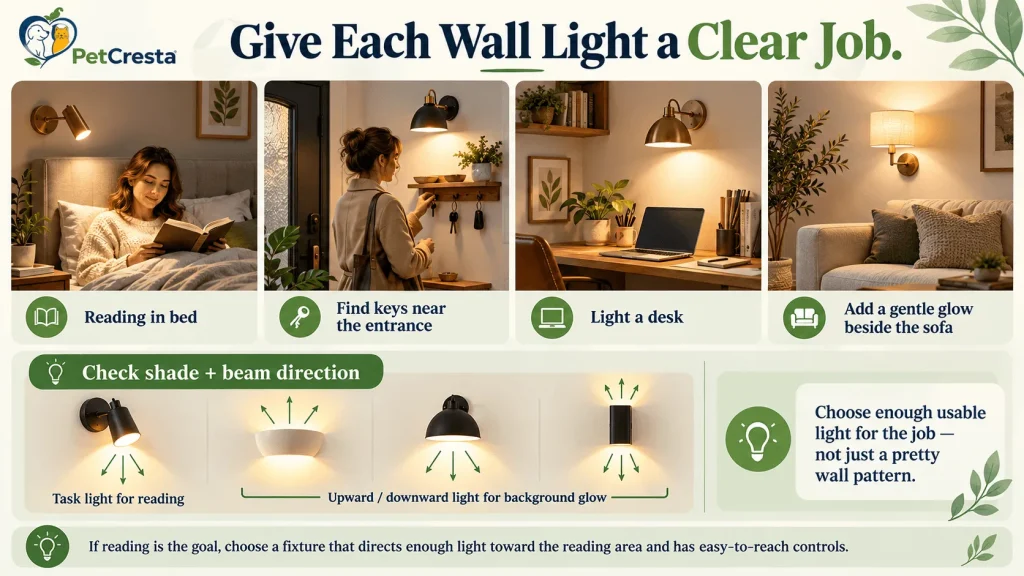
Before choosing a finish or shape, decide what you want the light to accomplish.
Reading in bed, finding your keys near the entrance, illuminating a desk, and adding a gentle evening glow beside the sofa are different lighting jobs.
When comparing wall sconces, examine the shade and beam direction as closely as the fixture’s appearance.
A directed light can work well for reading or illuminating a particular surface. A fixture that casts light upward, downward, or in both directions may be more useful for general background lighting.
This distinction matters beside a bed or reading chair. A decorative pattern on the wall may look attractive without placing enough usable light on the book in your lap.
If reading is the main purpose, choose a fixture that directs sufficient light toward the reading area and has controls you can reach comfortably from your normal position.
Use Wall Lighting to Free Up Floor and Surface Space

One of the biggest advantages of wall-mounted lighting is simple: the lamp no longer needs its own piece of floor or table space.
That can be particularly useful in rooms shared with pets.
A wall-mounted lamp can make a small reading corner easier to arrange when there is little room between a chair and a window. The side table can remain available for a drink or book, while the floor stays open for a pet bed or a clearer walking route.
The same idea works beside a bed. Moving the lamp onto the wall can leave more useful space on a narrow nightstand.
Look at the room as it actually exists rather than imagining an empty floor plan. Pet beds, scratching posts, feeding areas, crates, climbing furniture, and toy baskets are part of the layout.
Planning around those objects usually produces a more practical result.
Projection matters as well.
A long adjustable arm may work perfectly over a wide chair but feel awkward in a narrow passage. If the fixture moves, measure its fully extended position rather than only the dimensions of the wall plate.
Check nearby curtains, cabinet doors, room doors, shelving, and tall furniture before choosing the final location. Good room planning should account for both furniture and pets, especially in homes where beds, scratching posts, crates, and feeding areas are part of the everyday layout. Pet owners can also explore PetCresta’s pet care guides for more practical household considerations.
Plan The Power Connection Before You Buy

Wall lights are commonly sold in hardwired, plug-in, and rechargeable configurations. Confirm exactly how a fixture receives power before ordering it.
Product photography does not always make the power arrangement immediately obvious.
Hardwired Wall Sconces
A hardwired fixture connects to the home’s electrical system and can provide a clean appearance without a visible cord running to an outlet.
Installation requirements depend on the property, fixture, existing wiring, mounting surface, and local electrical requirements.
Do not assume that a location is suitable simply because there appears to be space on the wall.
Where new wiring, modification of an electrical connection, or other electrical work is required, use a qualified professional and follow applicable requirements and the fixture manufacturer’s instructions.
Renters should also check their lease or obtain the required permission before arranging permanent alterations.
Plug-In And Rechargeable Wall Sconces
Plug-in models can be useful when adding a permanent electrical connection is impractical.
Plan the complete cord route before deciding where the fixture belongs.
An outlet located directly beneath or near the lamp can create a much cleaner setup than an outlet positioned across the room.
In a pet household, avoid leaving loose electrical cords where a dog, cat, rabbit, or other animal can chew, pull, paw at, or become tangled in them.
Cable management should be considered part of the installation rather than something to solve afterward.
Rechargeable designs remove the need for a permanent power cord, but they still require practical access for charging. Check how the unit is removed or connected for charging before mounting it somewhere difficult to reach.
Think About What Your Pet Can Actually Reach

Mounting a fixture above floor level does not automatically place it beyond a pet’s reach.
Cats are the obvious example. A sofa back, dresser, shelf, window ledge, or headboard can completely change what a cat can reach.
Dogs can also bump nearby furniture, investigate hanging cords, or knock objects into the area around a fixture.
Look at the proposed location from your pet’s normal routes through the room.
Ask:
- Can my cat reach it from nearby furniture?
- Does a cord hang close to a pet bed?
- Could a dog bump the furniture beneath it?
- Does an adjustable arm swing into a commonly used path?
- Are there dangling decorative elements that invite investigation?
You do not need to redesign the entire room around the pet. You simply need to consider the environment that actually exists. Cats can use furniture and elevated surfaces in ways that are easy to overlook during room planning, so PetCresta’s cat guides may also be useful for owners adapting indoor spaces around feline habits.
Find the Right Mounting Position From the Furniture
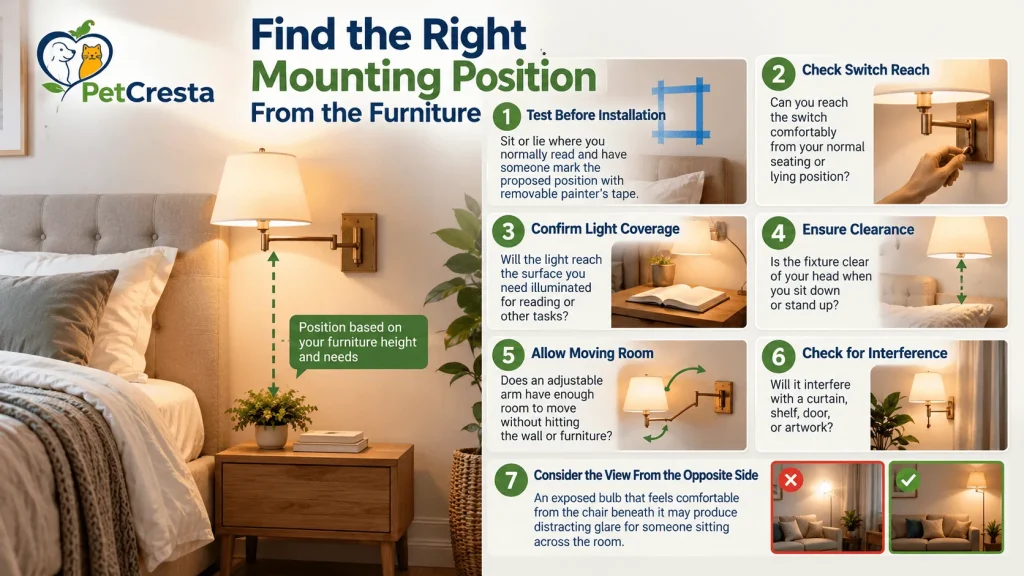
There is no universal mounting height that works beside every bed, sofa, or reading chair.
Mattress height, headboard size, seating height, fixture dimensions, switch location, arm length, and light direction all influence the correct position.
Test the location before installation.
Sit or lie where you normally read and ask someone to mark the proposed fixture position with removable painter’s tape.
Then check several things.
Can you reach the switch comfortably?
Will the light reach the surface you need illuminated?
Is the fixture clear of your head when you sit down or stand up?
Does an adjustable arm have enough room to move?
Is it likely to interfere with a curtain, shelf, door, or artwork?
Look at the fixture from the opposite side of the room as well.
An exposed bulb that feels comfortable from the chair beneath it may produce distracting glare for someone sitting across the room.
If possible, review photographs of the fixture while illuminated rather than relying only on unlit product images.
Choose the Right Brightness and Light Direction

A wall sconce should solve a lighting problem, not simply occupy an empty wall.
For reading, you generally need useful light directed toward the page or working surface.
For evening background lighting, a softer or more indirect fixture may be preferable.
Bedrooms and living rooms often benefit from having more than one source of light rather than relying on a single bright fixture. A wall lamp can work alongside ceiling lights, table lamps, or other ambient lighting so the room can be adjusted for different activities.
Dimming can make a fixture more flexible, but compatibility matters.
If you want dimming, confirm that the fixture, bulb or integrated LED system, and control are designed to work together. Follow the manufacturer’s specifications rather than assuming every LED fixture can be connected to any dimmer.
Choose Fixtures That Are Easy to Clean

Pets do not necessarily make wall lights dirty, but homes with animals often require regular dust and hair management.
Fixture design affects how easy that routine becomes.
Smooth surfaces are generally simpler to wipe than ornate designs with numerous grooves or small decorative pieces. Open upward-facing shades may collect more dust than some enclosed or downward-facing designs.
Consider maintenance before installation.
Check how the shade is removed, how the bulb is accessed, and whether you can comfortably clean the fixture once nearby furniture is back in position.
Always follow the manufacturer’s cleaning instructions and disconnect or switch off power as directed before maintenance.
Integrated LED fixtures deserve another check before purchase.
Find out whether the light source or driver can be serviced or replaced and what happens if a component eventually fails. That question can matter more than the initial appearance of the fixture.
Test One Room Before Changing the Whole House

You do not need to replace every floor lamp and table lamp at once.
Start with the part of the house where lighting currently causes the most inconvenience.
That might be:
- a crowded bedside table
- a chair without useful reading light
- a narrow entryway
- a sofa beside a pet bed
- a corner where a floor lamp obstructs the walking route
Use the new arrangement for several evenings before repeating it elsewhere.
Pay attention to whether the switch feels conveniently placed, whether the light reaches the intended area, whether glare is noticeable, and whether people and pets can move around the fixture comfortably.
Real-world use often reveals things that measurements alone do not.
Wall Sconce Checklist For Pet-Friendly Homes
Before buying or installing a fixture, run through this simple checklist.
| Check | What to Look For |
|---|---|
| Purpose | Reading, ambient lighting, task lighting, or entry lighting |
| Light direction | Does the beam reach the intended area? |
| Projection | Will the fixture stick into a walkway or furniture zone? |
| Pet access | Can a pet reach it from furniture or climbing surfaces? |
| Cord route | Are plug-in cords secured away from pets? |
| Controls | Can you comfortably reach the switch or dimmer? |
| Mounting position | Does it work with the bed, chair, or sofa height? |
| Cleaning | Can the shade and fixture be cleaned easily? |
| Servicing | Can bulbs or LED components be accessed? |
| Installation | Does electrical work require a qualified professional? |
The goal is not to make a room pet-proof in every possible circumstance. It is to choose lighting that fits the way the household already functions.
A successful wall light should become almost unnoticeable in daily life. Your book has enough light, the bedside table has more room, the walkway stays open, and your pet can settle in its usual spot without competing with another lamp base.
Those small improvements are a good reason to make room on the wall. f your home is shared with a dog, PetCresta’s dog guides offer more advice on everyday routines, behavior, and creating a comfortable home environment.
FAQs
They can be. Wall-mounted lights can free up floor and table space that may otherwise compete with pet beds, crates, scratching posts, or walking routes. The fixture still needs to be positioned so pets cannot easily interfere with it or its wiring.
Not automatically. Wall mounting removes the floor-standing base, which can be useful in some homes, but safety still depends on installation, wiring, fixture placement, and the individual pet’s behavior.
Yes, depending on the room. Cats may reach fixtures from sofa backs, shelving, headboards, window ledges, or other furniture. Assess accessibility from nearby elevated surfaces rather than judging height only from the floor.
They can be, provided the cord is routed and secured so the pet cannot readily chew, pull, or become tangled in it. The location of the nearest outlet should be considered before choosing the mounting point.